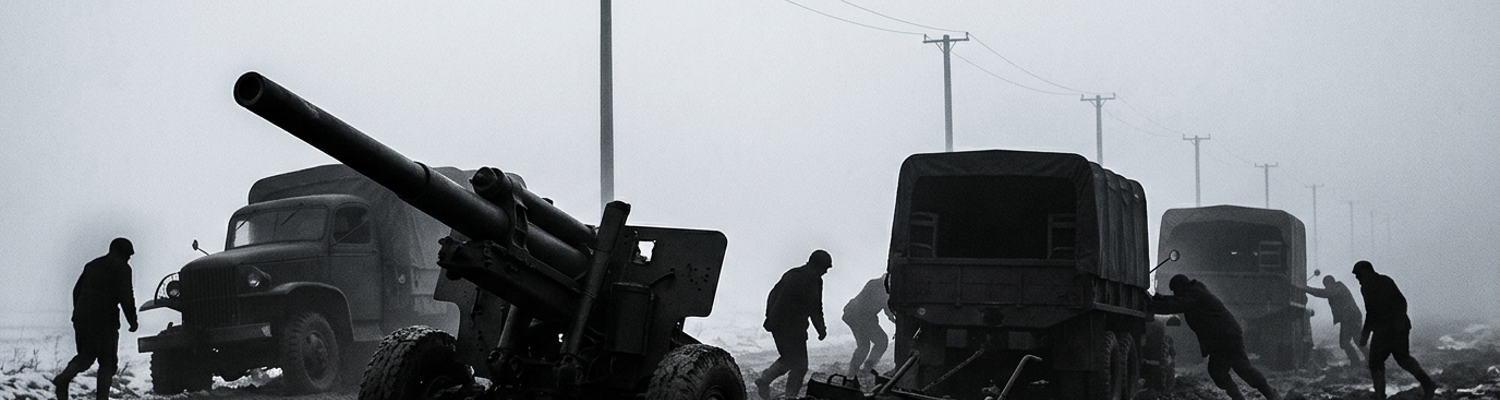

Artillery Bombardment and Saarland Road Network Destruction
Archival evidence shows that elements of the 94th Infantry Division marched for forty-eight hours through freezing mud in early February 1945. Daily caloric intake dropped below twelve hundred calories. Soldiers carried eighty pounds of gear across the frozen terrain near the Moselle River. Quartermaster reports indicate that winter clothing requisitions failed to reach the frontline battalions. Men wrapped their boots in burlap sandbags. Rations froze solid.
They slept in waterlogged slit trenches.
A close review of operational logs indicates that Allied artillery regiments expended over 120,000 high-explosive rounds across the Saar-Palatinate front. Major General Walton Walker ordered the XX Corps artillery to conduct continuous saturation fire against German defensive positions along the Siegfried Line. Gun crews operated 155mm M1 howitzers day and night. Barrels overheated. Ordnance maintenance companies recorded heavy wear on the gun tubes (Ordnance Department File 414.3). This friction required complete barrel replacements for dozens of artillery pieces within a twenty-day window.
Artillerymen loaded ninety-five-pound M107 projectiles.
They propelled them using Number 4 powder charges toward coordinates mapped between Saarlautern and Merzig. The recoil mechanisms on the M1 howitzers leaked hydraulic fluid due to the sustained firing schedules. Supply clerks struggled to requisition replacement seals from depots in rear areas. The transportation of the 120,000 rounds required an unbroken chain of heavy trucks hauling pallets of explosives from railheads in eastern France. Battery commanders adjusted firing tables daily to account for the smoothbore effect caused by eroded rifling.
The heavy bombardment reduced local road networks to rubble.
Ordnance maps from the Third U.S. Army show that primary transit arteries through the Saarland were obliterated by friendly shellfire. The macadam surfaces of Highway 51 and secondary farm roads dissolved into overlapping craters up to fifteen feet wide. Water filled these depressions during the late February rains. The red clay mud swallowed two-and-a-half-ton CCKW cargo trucks up to their axles. Convoys halted completely. Quartermaster truck companies attempted to bypass the main thoroughfares. This decision pushed heavy vehicular traffic onto unpaved logging trails. The trails immediately collapsed under the weight of the loaded convoys.
Deep ruts trapped the trailing vehicles.
Traffic bottlenecks stretched for seven miles along the approaches to Dillingen. Military police units assigned to route control failed to clear the congestion. Army provost marshals ordered drivers to abandon disabled vehicles in the ditches. The mechanical strain on the transport fleet was absolute. Axles snapped. Maintenance logs from the forward supply trains detail hundreds of broken leaf springs and shattered differential gears. Combat engineers from the 135th Engineer Combat Battalion worked continuously to fill the craters with debris scavenged from ruined German villages.
They dumped broken bricks and shattered roof tiles directly into the mud.
Tires blew out. The jagged masonry destroyed the bias-ply rubber of the transport trucks. Convoy speeds dropped to an average of three miles per hour. Supply officers at the rear echelon depots continued to dispatch ammunition and ration trucks into the sector without coordinating with forward traffic control points. Incoming vehicles collided with returning ambulance convoys on single-lane roads bordered by uncleared minefields. Drivers sat idling in freezing truck cabs for up to fourteen hours waiting for the engineers to clear pathways through the rubble.
Engines seized.
The constant idling drained fuel reserves designated for the mechanized spearheads. Quartermaster units eventually resorted to carrying ammunition boxes on their backs across the final two miles of pulverized terrain. Men physically hauled the 105mm and 155mm shells through the freezing slush. The mechanized supply chain had entirely collapsed.
Provost Marshal Control Posts and Casualty Overload
A close review of XX Corps operational logs reveals that forward Military Police control posts processed an unmanageable volume of casualties during the third week of February. Elements of the 503rd Military Police Battalion established their primary traffic regulation points at the shattered crossroads outside Saarlautern. These junctions were initially designed to route fresh infantry and ammunition forward. The directional flow violently reversed when front-line medical companies began evacuating the victims of the sustained German artillery barrages. Over three thousand wounded and deceased personnel arrived in the 503rd sector within a seventy-two-hour window.
Army provost marshals had allocated only twelve men to man the intersection at Route 51.
The sheer volume of incoming casualties instantly overwhelmed this small detachment. Field hospitals operating under the 319th Medical Battalion filled to capacity. Ambulance drivers unloaded their patients directly onto the mud at the MP checkpoints. The Graves Registration personnel ran out of standard cardboard identification tags by the second morning. Forward Military Police control posts were swamped with thousands of wounded and deceased personnel. Medical officers from the 319th Medical Battalion drafted the MPs into service as emergency stretcher-bearers.
MPs abandoned their standard routing protocols.
They physically carried shattered infantrymen out of the freezing slush. The military police stripped the Web gear off the dead to distribute salvaged ammunition to returning riflemen. Deceased soldiers from the 94th Infantry Division were stacked in temporary collection points along the roadside. Rear-echelon mortuary units could not advance through the artillery craters. Archival evidence shows that military police sergeants resorted to using scavenged German parachute silk to cover the bodies. The physical presence of hundreds of corpses and bleeding men transformed the traffic control points into makeshift triage centers.
Soldiers suffering from shrapnel wounds lay on the frozen asphalt.
MPs desperately tried to wave heavy armor columns through the same narrow corridors. The resulting friction between combat operations and casualty evacuation halted the movement of the 10th Armored Division for six hours. Blood froze directly to the canvas stretchers before medics could unload the vehicles. Traffic management collapsed as Military Police units struggled to process casualty streams through damaged thoroughfares. Engineers had laid temporary corduroy roads using felled pine trees.
The constant grinding of tank treads snapped the timber into splinters.
The resulting debris punctured the tires of the Dodge WC-54 ambulances moving rearward. Two-and-a-half-ton ammunition trucks driving forward on single-lane farm tracks met them head-on. The heavy bombardment had already obliterated the shoulders of the roads. Zero room existed for vehicles to pass each other. An ambulance convoy from the 10th Armored Division encountered a supply train near Dillingen. Both columns locked together bumper-to-bumper.
MPs attempting to resolve the gridlock found their communication equipment useless.
The SCR-300 backpack radios failed because the freezing temperatures rapidly depleted their dry-cell batteries (Signal Corps Technical Manual TM 11-242). Hand signals became the only method of directing the massive mechanized formations. Visibility dropped to less than fifty feet in the winter fog. Drivers could not see the MPs waving them off the main routes. A single disabled M32 tank recovery vehicle blocked the primary evacuation intersection for nine straight hours.
Provost marshals ordered their men to physically push stalled ambulances into the adjacent minefields.
This directive resulted in multiple detonations. The explosions destroyed the medical vehicles and killed the occupants. The military police lacked heavy wrecker trucks to tow the disabled chassis out of the mud. Route control degraded into localized shouting matches between supply officers demanding right-of-way and medical personnel trying to save their patients. The structural failure of the traffic network forced infantry battalions to wait an additional two days for resupply. Forward medical clearing stations reported a forty percent mortality rate among soldiers waiting for transport.
Personal Effects Triplicate Receipts and Hospital Bottlenecks
Archival evidence shows that the Office of the Provost Marshal General enforced a rigid accounting protocol for the dead across the European Theater. Division commanders received direct orders from Washington requiring that every personal item recovered from a deceased soldier be cataloged on standard-issue forms before burial. Clerks assigned to Graves Registration units had to generate physical triplicate receipts for all recovered property. This mandate applied to heavily soiled items including blood-soaked letters, crushed wristwatches, and bent Zippo lighters.
Soldiers detailed to this duty stripped the pockets of the dead.
They recorded the serial numbers of individual dollar bills. The administrative process required three sheets of thick paper separated by two sheets of blue carbon transfer paper. Men worked in open-air collection points near Saarlautern while temperatures hovered around ten degrees Fahrenheit. Winter conditions severely degraded the physical materials required for this accounting. The standard-issue fountain pens supplied by the Quartermaster Corps relied on liquid ink reserves.
Freezing temperatures cracked the plastic ink reservoirs.
The black dye flooded the clerks numb hands. The mechanical failure of the writing implements forced the personnel to use soft-lead pencils. The pencil tips easily tore through the damp requisition forms. A close review of operational logs reveals that completing a single W.D. P.M.G. Form 54 took up to forty-five minutes per casualty under these weather conditions. The regulations demanded exact descriptions of every piece of jewelry. Clerks noted specific engravings on wedding bands and the metal composition of religious medallions.
Provost marshals operating behind the XX Corps lines rejected any paperwork containing smudges.
Trucks transporting the dead back to the temporary cemeteries at St. Avold were denied entry if the paperwork did not perfectly match the physical inventory tied to the corpse. Graves Registration officers established secondary checkpoints just to audit the triplicate receipts. The carbon paper froze solid. It snapped into unusable fragments when clerks attempted to separate the layers. Administrative paperwork created a severe bottleneck at field hospitals where triage tents were inundated with catastrophic traumatic injuries.
Field hospitals operating under the 319th Medical Battalion erected canvas Pyramidal tents.
These structures served as primary receiving centers for incoming casualties. The canvas tents were immediately overwhelmed by the high volume of shattered infantrymen arriving from the Dillingen bridgehead. Medical personnel received hundreds of soldiers suffering from severed limbs, exposed abdominal cavities, and severe facial lacerations caused by German 88mm airburst shells. Surgeons required rapid turnover of the canvas folding cots to operate on the hemorrhaging men.
The Provost Marshal General mandate explicitly forbade moving a deceased patient out of the triage tent.
The triplicate receipt had to be completely filled out, signed, and attached to the corpse first. Medical clerks physically blocked the narrow aisles between the operating tables. They inventoried the pockets of men who died during transport. Stretcher-bearers stood idle in the freezing mud outside while waiting for the clerks to finish counting coins. The paperwork directly halted the evacuation chain.
It caused secondary fatalities among the wounded.
Triage officers at the 4th Field Hospital documented instances where living patients bled to death on the dirt floor. Deceased soldiers occupied the only available surgical beds pending personal effects inventory. Orderlies attempted to bypass the regulation by dragging the dead into the adjacent snowbanks to clear space for incoming ambulances. Military police officers stationed at the hospital entrances threatened to arrest the medical staff for violating the property mandates.
The resulting arguments between combat surgeons and provost marshals suspended medical operations for hours at a time.
Clerks fumbled with their broken writing implements trying to print legibly on the forms while heavy artillery concussions shook the ground. Blood from the adjacent operating tables frequently spilled onto the clipboards. The ruined forms had to be thrown away and restarted from the beginning.
Wire Communication Disruption and Third Army Headquarters
Archival evidence shows that the Third U.S. Army relied on a fragile network of W-110-B field wire to maintain command and control across the Saar-Palatinate region. Signal battalions unspooled hundreds of miles of this cable from the back of moving jeeps using RL-39 reeling machines. The standard wire consisted of four steel strands for tensile strength and three copper strands for conductivity. A rubber jacket and weatherproof cotton braid wrapped the metal core.
These lines ran directly from Lieutenant General George S. Patton headquarters in Luxembourg City down to the XX Corps command posts near Thionville.
From there, the wire extended into the forward tactical zones occupied by the 94th Infantry Division between Saarburg and Orscholz. The terrain offered zero protection for the exposed cables. German heavy artillery targeted the primary transit corridors where these communication trunks were laid. High-explosive fragmentation shredded the cotton braid and rubber insulation. Jagged steel shrapnel severed the copper conductive strands inside the wire jackets.
Entire spools of wire were vaporized by direct hits from 88mm shells.
Signalmen rarely had time to connect them to the switchboards. A single 155mm airburst could cut a division primary communication trunk in forty different places. Signal Corps linemen attempted to repair the damage during active bombardments. Repair crews from the 94th Signal Company waded into freezing drainage ditches along Highway 51 to locate the broken ends of the cables. Men stripped the rubber casing with bare hands. Heavy gloves made handling the small TL-13 pliers impossible.
Allied mechanized units caused as much damage as the incoming enemy fire.
Tank destroyers from the 774th Tank Destroyer Battalion frequently drove off the main roads to bypass the massive traffic bottlenecks near Dillingen. Their steel treads ground the W-110-B wire deep into the frozen mud and snapped the lines entirely. Real-time contact between the Third Army rear echelon and the front-line battalions completely collapsed by the morning of February 19. Commanders sitting at the headquarters map tables stared at silent telephones.
A close review of operational logs indicates that division commanders immediately established ad hoc courier networks.
Major General Walton Walker ordered the 10th Armored Division to strip Willys MB jeeps from their reconnaissance troops and repurpose them for mail delivery. These unarmored vehicles navigated the exact same destroyed road networks that were currently trapping the heavy supply convoys. Drivers carried physical copies of the daily W.D. A.G.O. Form 1 Morning Reports and logistics requisitions in waterproof canvas map cases (Quartermaster Corps File 319.1). The transit time for a standard G-4 ammunition request increased from four minutes over a field telephone to fourteen hours via jeep courier.
Messengers driving between the forward command post at Orscholz and the rear supply dumps at Metz repeatedly encountered uncleared minefields.
Deep ruts in the logging trails forced the couriers to drive at walking speeds through active shelling zones. Military police periodically halted the couriers to check for German infiltrators. This further delayed the transmission of supply documents. Shrapnel from near misses frequently punctured the exposed engine blocks of the courier vehicles. The structural failure of the communication grid directly degraded ground combat operations. Battalion commanders could not report their daily personnel losses to the Graves Registration units in real time.
Platoon leaders in the 302nd Infantry Regiment wrote casualty figures on discarded C-ration cardboard boxes.
They handed them to foot runners when the jeeps inevitably broke down. These runners physically walked through the artillery craters to reach the regimental command posts. Many couriers were killed in transit by German mortar fire. The supply requests they carried disappeared into the mud with them. Quartermaster officers at the rear echelons refused to dispatch replacement ammunition without proper written authorization from the front lines. Frontline infantrymen fought with bayonets while thousands of artillery rounds sat idle on pallets twenty miles away.
Civilian Transport Requisitioning and Rhine Pontoon Crossings
Archival records from the Third U.S. Army Quartermaster detail a severe shortage of organic transport vehicles for rear-echelon mortuary units by early March 1945. Forward collection points near Trier overflowed with casualties from the Saar-Palatinate offensive. The 604th Graves Registration Company lacked the standard two-and-a-half-ton CCKW trucks required to transport the dead back to established cemeteries in France. Army chaplains attached to the XX Corps initiated unauthorized requisition protocols to seize civilian transport from nearby German farms and municipal garages.
These officers commandeered dozens of heavily worn Opel Blitz and French-built Renault AGC flatbed trucks.
Military police officers from the 503rd Military Police Battalion immediately contested these seizures at the local motor pools. Provost marshals had issued standing orders that all captured or requisitioned civilian vehicles must be strictly allocated for hauling German prisoners of war and clearing debris from the main supply routes. The MPs physically confiscated the ignition keys directly from the chaplains hands. A close review of motor pool dispatch logs shows that this jurisdictional conflict halted the evacuation of field morgues for days.
Chaplains argued that the decomposing bodies in the temporary collection points posed a severe biological hazard.
The adjacent 319th Medical Battalion field hospitals were directly at risk. Military police sergeants ignored these appeals and ordered their men to uncouple the trailers from the civilian trucks. The commandeered Opel Blitz vehicles suffered from degraded carburetor floats and cracked distributor caps. Army mechanics lacked the metric tools and specific replacement parts to properly service the German engines (Ordnance Maintenance Manual TM 9-1801). Chaplains ordered Graves Registration clerks to load the truck beds with corpses despite the mechanical deficiencies and the MP blockades.
Fights broke out between the clerks and the military police on the frozen gravel of the motor pools.
Provost marshals threatened to officially arrest the chaplains for insubordination and misappropriation of military assets. A single Renault flatbed sat idling for six hours while two captains argued over the dispatch clipboard. Once the chaplains finally secured a fraction of the contested civilian trucks, the resulting morgue convoys faced severe delays attempting to navigate congestion across shattered Rhine pontoon bridges. Elements of the 1140th Engineer Combat Group had constructed an M2 Treadway bridge across the Rhine River near Oppenheim.
This crossing consisted of heavy steel tracks laid over inflatable pneumatic rubber floats.
The directional flow of traffic heavily prioritized eastbound armored columns and ammunition trains belonging to the 4th Armored Division. Morgue convoys attempting to cross westward back into France encountered massive gridlock at the eastern staging areas. The civilian Opel Blitz trucks lacked four-wheel drive. They frequently became mired in the deep mud along the riverbank approaches. Military police traffic control units strictly enforced one-way traffic across the span to prevent the heavy tanks from colliding with the returning trucks.
The rubber pontoons slowly deflated under the extreme weight of the crossing Sherman tanks.
Engineers constantly halted all vehicular movement to replace the damaged pneumatic floats. Combat engineers used 55-horsepower Evinrude outboard motors to push replacement pontoon sections into the heavy river current. German heavy mortar fire periodically shattered the wooden decking and warped the structural steel treadways. Traffic came to a complete standstill. Traffic control points held the westbound morgue convoys on the eastern bank for up to thirty-six hours during these repair operations.
The requisitioned civilian trucks held up to forty bodies each.
They were stacked horizontally on wooden pallets in the open air. The steel treadways of the M2 bridge became completely slick with a mixture of freezing rain, leaked hydraulic fluid, and river water. Morgue truck drivers ground their manual transmissions trying to maintain traction on the wet steel grates when they were finally allowed to cross. Bridge commanders repeatedly ordered the morgue convoys to back up and yield the right-of-way to late-arriving ammunition trucks. The civilian truck engines completely ran out of scavenged gasoline while waiting in the staging areas.