
Aleutian Atmospheric Conditions and Early Radar Limitations
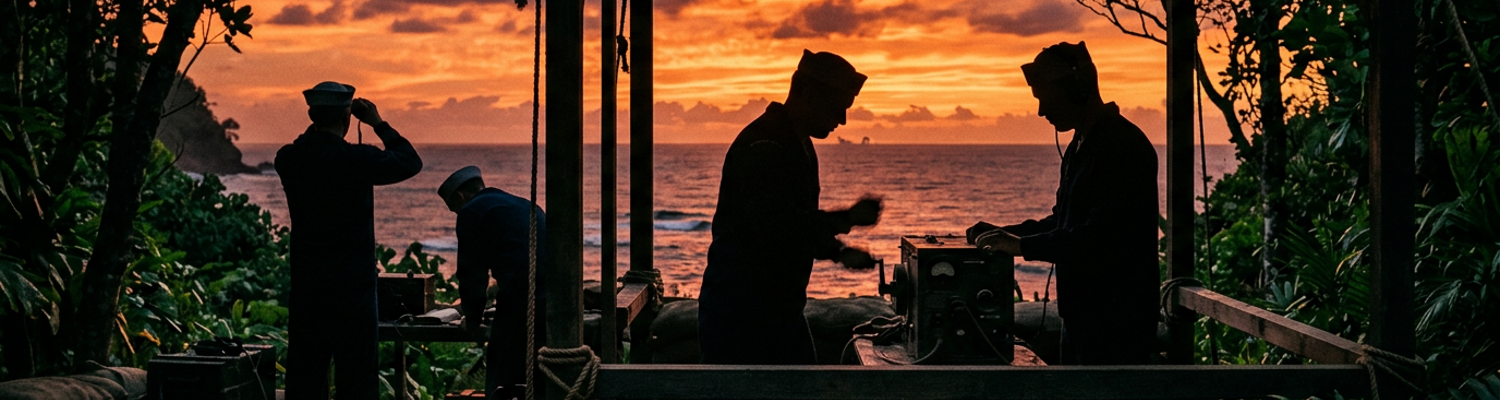
Radio transmitters aboard the warships of Task Group 16.6 hissed into useless static when severe atmospheric interference broke all communications with naval headquarters on Adak Island. Deprived of guidance from the rear echelon, frontline commanders had to rely on their own initiative to patrol the stormy waters around the Aleutian chain. Heavy sea fog completely obscured the horizon and wiped out visibility, preventing lookouts from sighting navigation landmarks or surface threats with optical binoculars. Shipboard CXAM and SG radar sets, along with airborne PBY Catalina radar pickets, were susceptible to phantom returns from atmospheric ducting and dense bird flocks. Radar operators crouched in darkened plotting rooms over green cathode-ray scopes, watching glowing pulses that looked identical to approaching enemy warships.
Warships operating in the North Pacific theater frequently encountered these deceptive surface echoes due to sub-Arctic temperature inversions and gale-force weather. Dense sea fog combined with sudden temperature shifts whenever warm air masses moved over frigid sub-Arctic currents, trapping cold air directly against the water surface. This atmospheric inversion created a duct that bent early microwave pulses downward, channeling radar signals along the curvature of the earth instead of allowing them to dissipate into the upper atmosphere. Transmitted beams traveled hundreds of miles beyond their normal line-of-sight range, bouncing off distant Aleutian mountain peaks and returning to ship antennas as nearby surface targets. Gale winds simultaneously whipped the ocean into massive waves, generating heavy sea return on indicator scopes that prevented technicians from distinguishing between rolling water crests and genuine enemy hulls.
Hulls of actual enemy cruisers proved even harder to distinguish when millions of shearwaters and petrels gathered in tight formations across the water during their annual northern migrations. These dense bird concentrations rested together on the ocean swells in massive flocks that reflected the high-frequency radar beams emitted by shipboard SG sets and airborne patrol planes. Indicator dials registered these biological reflections as solid metallic formations moving in convoy. Patrol pilots aboard PBY Catalina flying boats flew through heavy rain down to fifty feet above the waves to investigate the contacts, only to find startled birds scattering across empty water. Radio blackouts and transmission dead zones prevented these aircrews from warning the surface ships in time, leaving task group commanders to interpret the ambiguous radar plots strictly on their own.
Commanders acting on these ambiguous radar plots altered fleet formations and steered directly toward the coordinates of the phantom targets. Watch officers ordered engine rooms to increase boiler output, accelerating the heavy cruisers and screening destroyers through the chop while battle alarms sounded through ship corridors. Gunners loaded hundreds of high-explosive and armor-piercing shells into the handling rooms of the main turrets, preparing to engage what senior leaders believed was a Japanese evacuation fleet. Fire-control officers locked their directors onto the phantom radar bearings, tracking the false targets as the indicated range closed to twenty thousand yards. Battleship and cruiser gun crews across the task group swung their heavy turrets toward the coordinates, waiting for the final command to open fire into the empty sea fog.
Task Group 16.6 and the Aleutian Naval Cordon
Sea fog blanketed the patrol sectors assigned to Rear Admiral Robert M. Griffin and Task Group 16.6 as those locked gun mounts awaited his final word to fire. Griffin commanded this task group to maintain a surface blockade southwest of Japanese-occupied Kiska Island. Battleships USS Mississippi and USS Idaho anchored the formation, screened by heavy cruisers, light cruisers, and destroyers patrolling in a wide defensive perimeter. Griffin positioned these warships across the southern approaches to intercept Japanese transport convoys attempting to slip past the American ring and reinforce the island garrison. Lookouts on the flagship bridge peered into the overcast weather with optical binoculars, finding only churning gray swells and zero visibility across the patrol sector.
Sectors assigned to the outer screen offered no visual reference points as freezing spray coated the fire directors, optical rangefinders, and steel superstructures with a slick layer of brine. This thick ice left the entire cordon dependent on radar antennae rotating against the gale. Navigators plotted each heading change by dead reckoning on paper charts, struggling to maintain formation intervals without running into adjacent ships in the gloom. Technicians adjusted receiver gain dials on the radar sets of USS Mississippi and USS Idaho to separate surface targets from the heavy ocean clutter and confirm the fleet formation. This mechanical adjustment boosted circuit sensitivity, causing the receivers to capture distant mountain peaks and dense flocks of migrating shearwaters as solid surface targets.
Targets appearing as glowing green blips tracked steadily across the indicator scopes, prompting plotting officers to calculate an enemy speed of sixteen knots on a course closing with the American battle line. Griffin studied these precise electronic tracks in the windowless flag plot, concluding that a Japanese evacuation squadron was attempting to break through his blockade. Watch officers transmitted urgent rudder and engine commands down to the steering compartments, turning the battleships and heavy cruisers into an aggressive line of battle. Gun captains inside the main battery turrets received new range inputs every few seconds, cranking their elevation wheels until the fourteen-inch rifles pointed directly toward the phantom coordinates. Firing circuits energized across the main batteries as the range dropped below twenty thousand yards.
Yards of open ocean separated the American warships as they prepared to unleash their broadsides into the mist. Destroyer captains kept their ships in close screening stations around the capital ships rather than racing forward to investigate, fearing enemy torpedoes in the fog. Shell splashes from the eventual American salvos would soon bounce false echoes back to the shipboard radar receivers, convincing watch standers that the phantom enemy warships were maneuvering through the impact zones. Steel shell casings would pile up inside the handling rooms while fuel gauges dropped toward critical reserves across the entire task group. Griffin would soon face a critical logistical shortage that would force him to abandon this carefully constructed blockade.
Phantom Surface Contacts on July 26 1943
Blockade operations reached a breaking point just after midnight on July 26, 1943, when radar operators aboard TG 16.6 reported multiple unknown surface contacts roughly eighty miles southwest of Kiska. Radar operators on the flagship Mississippi watched distinct green blips moving steadily across the phosphor screens of their SG radar displays. Plotting teams marked these echoes at ranges between sixteen and twenty-two thousand yards, interpreting the formation as seven Japanese warships steaming in a tight defensive column. Griffin examined the grease-pencil markings on the flag plot board and ordered watch standers to verify the targets through the fleet communications net before ordering a turn toward the enemy. Signalmen rushed onto the exposed bridge wings with hooded shutter lamps to blink coded queries to the surrounding cruisers, but the thick sea fog blocked the light beams before adjacent watch standers could see them.
Watch standers in the shipboard radio rooms took over the work of the blinded signal lamps as technicians attempted to broadcast contact coordinates across the formation. Severe atmospheric static and massive backlogs of encrypted signals overwhelmed shipboard radio rooms trying to corroborate contact reports. Radiomen sat beneath heavy headphones, struggling to pull faint dots and dashes out of sharp background noise caused by electrical disturbances in the sub-Arctic skies. Cryptographers fed paper message strips through mechanical cipher wheels to decode each transmission, but the volume of contact queries created processing delays that stretched past thirty minutes. Cruisers Wichita and Portland drafted urgent reports stating that their own radar scopes showed erratic blips that faded and reappeared at random intervals, but these clarifying updates remained trapped in the outgoing radio queues.
Queues of undecoded dispatches stacked up in wooden sorting trays while the bridge command team made tactical assumptions on incomplete data. Griffin interpreted the lack of conflicting dispatches as silent agreement from his task group captains that the enemy had been found. Radar technicians on Mississippi adjusted their receiver gain controls to track the targets more closely, which increased receiver sensitivity and locked the fire-control directors onto atmospheric echoes. Destroyers patrolling on the outer perimeter failed to spot any wakes or hulls with their short-range radars, yet their negative reports remained buried under the backlog of unread signals. Plotting officers calculated that the closing speed between the two opposing forces had reached twenty-eight knots, reducing the tactical margin for decision to mere minutes.
Minutes ticked by as Griffin decided against detaching screening destroyers to scout ahead through the fog, fearing that Japanese torpedo spreads would sink the smaller escorts in zero-visibility water. Bridge messengers carried direct orders down to the gunnery plots to prepare the main batteries for an immediate surface engagement based entirely on the flagship radar plot. Turret crews received these orders and dialed the radar coordinates directly into the mechanical fire-control computers of Mississippi and Idaho. Hydraulic hoists lifted heavy fourteen-inch shells from armored handling rooms up to the gun breeches, followed by silk powder bags stamped with yellow ignition pads. Fire-control directors rotated atop the steel superstructure to match the electronic bearings, aligning fourteen heavy gun barrels toward the coordinates roughly eighty miles southwest of Kiska.
Heavy Naval Bombardment of Empty Ocean Swells
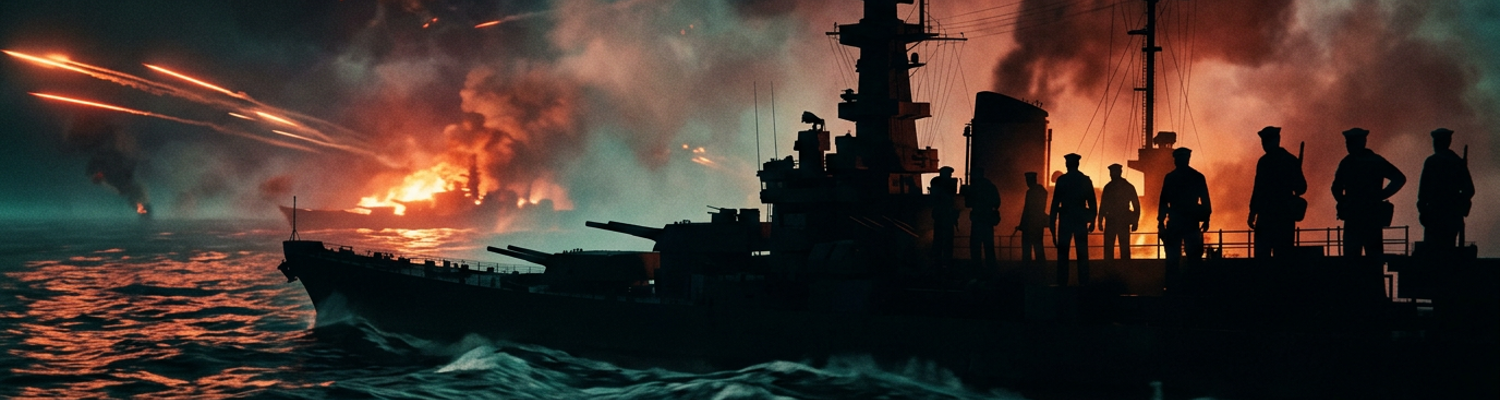
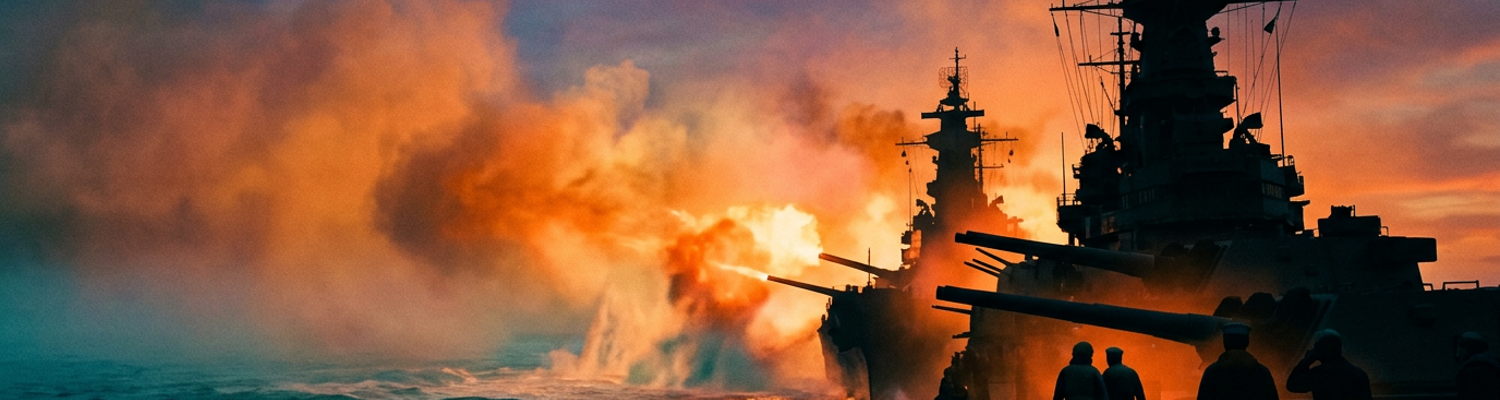
Kiska remained shrouded in mist as USS Mississippi blasted the night with simultaneous broadsides, igniting thousands of pounds of cordite across her forward turrets. Giant muzzle flashes lit up the dense mist, temporarily blinding topside observers while concussive shockwaves sheared steel rivets and tore paint from the bulkheads. USS Idaho joined the bombardment from her parallel column, matching the flagship bearing to throw continuous salvos of armor-piercing projectiles into the empty sea. Both warships poured steel into the coordinates provided by the SG radar screens, operating on the belief that they had cornered an enemy battle fleet. USS Mississippi and USS Idaho expended over one thousand rounds of heavy ammunition, including 518 fourteen-inch shells, firing at radar blips that drifted across the indicator tubes.
Tubes aboard the screening cruisers added hundreds of eight-inch and six-inch rounds to the barrage, churning the ocean swells with geysers of salt spray and falling shrapnel. Foam from the crashing shell splashes created bright white streaks across the black water, sparking instant panic among the topside crews. Lookouts reported phantom torpedo wakes and visual contacts despite daylight recon confirming no Japanese surface combatants were within two hundred miles. Strained eyes mistook churning whitecaps and diving seabirds for Japanese periscopes, destroyer silhouettes, and approaching torpedo spreads. Watch standers shouted frantic alarms into bridge speaking tubes, prompting helmsmen to wrench steering wheels over into violent evasive turns that scattered the tight American formation.
Formation discipline broke down as engine rooms answered emergency flank-speed bells, burning precious bunker fuel while captains maneuvered wildly to dodge weapons that existed only in the fog. Destroyers accelerated out of the screening perimeter to drop depth charges onto the supposed submarine contacts, shaking the hulls of nearby American ships with deep underwater concussions. Echoes from these underwater detonations and high-explosive surface bursts bounced directly back into the shipboard radar receivers, sustaining the false targets on the cathode-ray screens. Turret crews loaded and fired continuously for more than thirty minutes, filling handling rooms with blistering heat, acrid powder fumes, and piles of hot steel casings. Mechanical hoists jammed under the relentless pace of fire, forcing gunners to manhandle heavy powder bags to keep the fourteen-inch barrels cycling.
Cycling gun directors stayed locked onto the fading blips until the electronic returns suddenly vanished from the screens when the sub-Arctic atmospheric inversion shifted over the open sea. Griffin ordered an immediate cease-fire as the glowing targets dissolved into empty baseline noise across every radar screen in the task group. Weary gun crews collapsed against the armor plate of their silent mounts, surrounded by empty shell racks and depleted propellant magazines. Daylight soon filtered through the persistent mist, illuminating an undisturbed, empty ocean without floating wreckage, oil slicks, or enemy survivors. Search planes launched from American bases and cruisers swept the area in widening patterns, finding nothing except cold water and barren waves.
Replenishment Withdrawal and Naval Cordon Breach
Waves battered the hulls of the screening destroyers as fuel gauges registered dangerously low reserves after hours of violent high-speed turns and depth-charge attacks against false sonar echoes. Captains sent urgent visual and radio dispatches to the flagship, warning that several escorts carried less than twenty-four hours of steaming endurance in their bunker tanks. Griffin assumed the engagement had repelled an enemy reinforcement run and ordered TG 16.6 south to conduct underway replenishment with fleet oilers. Senior officers on the flagship staff believed that their midnight cannonade had shattered an incoming convoy and driven any surviving Japanese vessels back toward the Kuril Islands. Navigators marked new steering coordinates on their plotting boards, setting a steady course southward into the open ocean where the supply ships waited in safer waters.
Waters surrounding the vacated patrol box filled with fog as cold Arctic air swept over the ocean, hiding the sector where Task Group 16.6 had just maintained its defensive line. Standard naval doctrine called for rotational refueling so that half of a blockade force remained on station while the other half took on fuel, but Griffin chose to pull his entire task group south at once to protect his capital ships from isolated submarine ambushes. Naval planners had not stationed a relief squadron in the immediate area, leaving the southern and western approaches to the island completely devoid of radar coverage and surface guns. The routine refueling withdrawal vacated the outer blockade sector, opening an unguarded sixty-mile corridor while aerial visibility dropped to zero. PBY Catalina flying boats and Army Air Forces bombers based on nearby islands could not cover the gap because the deteriorating weather grounded flight operations across the region.
Cancellations of region-wide flights ensured that no American eyes watched the outer approaches while Griffin warships steamed toward their rendezvous with the fleet oilers. Oilers rolled heavily in the gray swells hundreds of miles south of Kiska as lookouts spotted the silhouettes of the approaching American warships. Sailors on the plunging decks hurried to prepare heavy fuel lines, readying winches, booms, and canvas-wrapped hoses to begin transferring thousands of barrels of fuel. Heavy swells battered the hulls of the warships as they pulled alongside the oilers, forcing helmsmen to fight their rudder wheels to prevent catastrophic collisions in the open ocean. Riggers secured messenger lines between the pitching vessels, hauling thick rubber hoses through the freezing spray to lock them onto the fuel intake valves of Mississippi and Idaho.
Idaho and Mississippi accepted black bunker oil surging through the suspended lines under high pressure, slowly replenishing storage compartments that had been emptied during the high-speed pursuit of phantom radar blips. Engineers monitored the pumping gauges closely, knowing that refueling twenty warships in rough seas would require days of continuous work far from the combat zone. Radio receivers aboard the refueling warships picked up only crackling static during those long days of pumping operations, isolated by distance and northern electrical storms. Radar operators on the flagship watched their green scopes sweep across empty ocean swells, detecting nothing beyond the supply tankers riding parallel in the mist. Officers on the bridge assumed that their rearward position was secure and that Kiska remained trapped behind the surrounding minefields and terrible weather.
Admiral Kimura and the Operation Ke Evacuation
Weather conditions proved ideal for Imperial Japanese Navy Rear Admiral Masatomi Kimura as he navigated cruisers and destroyers through the dense fog straight into the vacated patrol lane. Kimura stood on the exposed bridge of his flagship, the light cruiser Abukuma, having previously turned back an earlier sortie when clearing skies threatened to expose his ships to American bombers. Dense banks of cold sea mist now enveloped the light cruisers Abukuma and Kiso along with eleven screening destroyers, cutting surface visibility down to less than three hundred yards. Lookouts stationed on the bows of each vessel leaned over the spray shields with handheld sounding leads and stopwatches, monitoring the churning gray swells for signs of submerged volcanic reefs. Helmsmen maintained formation by watching the foaming wake of the ship directly ahead, following gyrocompass headings that took the squadron directly across the sector Task Group 16.6 had abandoned to refuel.
Refueling operations kept the Americans far to the south while Kimura navigated his evacuation force into Kiska Harbor and embarked all 5,183 garrison troops in fifty-five minutes without alerting Allied forces. Lookouts aboard Abukuma picked out signal lamps flashing from the rocky shoreline as the warships glided past North Head and dropped anchor into the sheltered bay. Japanese soldiers emerged from subterranean tunnels and sod-covered dugouts along the beaches, forming disciplined columns beside wooden piers and gravel tide flats. Motorized landing barges and wooden cutters ferried hundreds of infantrymen across the calm harbor water, pulling alongside the cruisers and destroyers as soon as mooring lines were made fast. Sailors leaned over the ship railings to secure the bobbing boats, dropping heavy cargo nets down the steel hulls so the troops could climb upward without delay.
Delay was unacceptable as soldiers scrambled up the hemp netting into the waiting hands of deck crews, carrying only the clothes on their backs to maximize space aboard the crowded warships. Garrison officers enforced strict orders to abandon rifles, personal packs, and steel helmets on the shoreline, leaving piles of discarded infantry equipment scattered across the gravel beaches. Crewmen guided the streaming lines of soldiers below decks into mess compartments, officer staterooms, boiler passages, and ammunition handling flats until every interior space was packed shoulder to shoulder. Demolition teams onshore ignited delayed-action fuses inside heavy coastal artillery bunkers, blew apart radio transmitters with sledgehammers, and booby-trapped administrative shacks with hand grenades. Landing craft coxswains opened sea cocks or detonated explosive charges through the bilges of their wooden boats, scuttling every support craft in the harbor waters to ensure no equipment fell into enemy hands.
Hands aboard the flagship hauled in mooring chains the moment the last scuttling crews were pulled aboard from the frigid water. Engineers spun steam throttle valves wide open, turning twin propeller shafts to back the heavily overloaded warships away from the smoking anchorage. Kimura guided the column of warships through the harbor narrows and steered back into the protective fog bank, setting a southwest heading at flank speed. Cruisers and destroyers burned refined bunker fuel to suppress black smoke plumes as they slipped south of the Aleutian chain, avoiding the patrol zones where American bombers had resumed search flights. Deck crews aboard Griffin battleships secured their refueling hoses and turned north to resume their surface blockade, completely unaware that they were returning to guard an entirely deserted island.
Operation Cottage and Landings on Abandoned Kiska
Island defenses remained a top concern for officers at North Pacific Force headquarters, who treated the silent volcanic rock as an armed fortress waiting to slaughter landing parties. Allied military intelligence misinterpreted Japanese radio silence and shoreline stillness as defensive entrenchment rather than full evacuation. Aerial reconnaissance pilots flying through rare clearings in the overcast reported that coastal guns sat unmanned and bomb craters remained unfilled, but analysts believed these signs proved the defenders had moved underground to prepare an ambush. Planners remembered the suicidal Japanese charges during the fighting on Attu and concluded that the garrison commander was holding his fire until Allied troops crowded the narrow beaches. Quartermasters at the staging bases on Adak and Amchitka loaded troopships with thousands of tons of artillery ammunition, stretchers, and cold-weather combat gear for an operation codenamed Cottage.
Cottage commenced as troopships steamed out of the staging anchorages under heavy naval escort, carrying thousands of soldiers toward the fog-bound beaches of Kiska. Over 34,000 Allied assault troops landed on Kiska on August 15, 1943, expecting entrenched Japanese resistance. Riflemen scrambled over the gunwales into landing craft through freezing chop, hitting the black volcanic sand on the western shores before pushing inland through knee-deep muck and wet tundra. Soldiers climbed steep ravines with fixed bayonets under the cover of thick fog, scanning rocky outcroppings and sod-covered ridges for hidden machine-gun pillboxes. Fog banks reduced visibility to a few yards as frontline companies lost sight of their flanking units, leaving isolated squads to advance blindly into the mountainous interior.
Interior ridges echoed with sudden bursts of rifle fire as shifting mist and dark rocks triggered confused skirmishes between advancing patrol columns. Disoriented American and Canadian platoons mistook each other for Japanese counterattackers in the driving drizzle, fighting friendly-fire battles across the wet ridges that killed twenty-eight men and wounded dozens more. Scouts scouring the abandoned encampments stumbled across discarded helmets, destroyed artillery pieces, and explosive booby traps wired to cabin doors and supply caches. Detonations ripped through several squads when searching soldiers pried open sealed Japanese dugouts, adding to the growing casualty lists on an island without a single living enemy defender. Search teams steadily uncovered proof that the entire enemy garrison had slipped away weeks prior, discovering written messages chalked on mess hall walls and abandoned gun emplacements stripped of vital firing pins.
Pins and detonators hidden in the harbor waters proved just as deadly as the booby traps on land. USS Abner Read struck a submerged Japanese naval mine in Kiska waters on August 18 while patrolling the harbor approaches where search teams were inspecting the deserted shoreline. The underwater detonation blew off the stern section of the warship, killing seventy-one sailors and wounding forty-seven more in the icy bay. Combat commanders tallied over three hundred total Allied casualties from friendly fire, land mines, booby traps, and naval mines during an operation aimed at an enemy force that was already safe in Japan. General Corlett ordered all assault units to halt combat operations and begin clearing beach minefields, concluding the Aleutian campaign with the physical occupation of the abandoned island.
Friendly Fire Incidents and Aleutian Repercussions
Island occupation duties shifted to combat engineers who probed the volcanic ridges and muddy beaches to secure the landing zones while hospital ship corpsmen treated hundreds of battered soldiers. Confused by dense fog and complex topography, Allied forces had engaged in friendly fire skirmishes that killed 28 soldiers and wounded dozens more across the jagged scree slopes of Kiska. American and Canadian patrols had traded rifle salvos and mortar rounds for forty-eight hours through blinding mist, each group believing they had trapped remnants of the Japanese rear guard. Battalion commanders collected spent American .30-06 and Canadian .303 brass casings from the same ravines, matching bullet calibers to the fatal wounds suffered by their own men. Stretcher bearers carried these casualties down the steep hillsides to coastal aid stations, where medical officers logged the blunt trauma, shrapnel tears, and gunshot wounds that had occurred without a single shot fired by an enemy soldier.
Soldiers receiving treatment aboard offshore auxiliary ships suffered from severe burns and hypothermia as the offshore waters proved just as treacherous as the mist-covered tundra. The destroyer USS Abner Read had struck a dormant Japanese naval mine during sweeps around the empty island, resulting in 71 fatalities and dozens of wounded sailors when an underwater detonation severed her entire stern section. Damage control teams battled spreading fires and rushed heavy timbers into flooded lower compartments to keep the crippled warship from slipping beneath the waves. Rescuers pulled survivors from the freezing water and hauled them onto adjacent escort vessels before fleet tugs towed the floating hull back to the repair base at Adak Island. Naval architects and maintenance crews examined the sheared steel plates, realizing that lingering Japanese sea barriers still inflicted heavy losses long after Kimura had escaped.
Japanese forces prompted Admiral Thomas C. Kinkaid to convene formal naval boards of inquiry at Adak to examine the chain of blunders that had paralyzed his command. Intelligence officers cross-referenced the abandoned Japanese shore positions with the gunnery logs of Task Group 16.6, uncovering the bitter truth about the midnight cannonade of July 26. Radar plots from the battleships Mississippi and Idaho had tracked nothing more than atmospheric mirages and seabird flocks, yet the resulting withdrawal to refuel had left the back door wide open for Kimura. Staff officers acknowledged that the high-tech radar systems had generated an illusion of certainty, blinding the task group leadership to the physical realities of the Aleutian climate. Senior planners circulated classified reports across the theater, warning that unverified radar contacts could easily bait entire fleets out of position.
Positioning errors and communication failures drew the attention of Admiral Chester Nimitz, who reviewed these findings at Pearl Harbor and implemented comprehensive changes to naval radar doctrine across the Pacific Fleet. Gunnery officers established strict operational mandates forbidding capital ships from expending heavy ammunition against uncorroborated radar contacts without aerial scouting or optical verification. Communications specialists overhauled fleet cryptographic equipment and signal procedures to ensure that high-priority radio traffic would never again be delayed behind routine administrative messages during combat operations. Army and Marine Corps planners integrated lessons from the Aleutian friendly-fire tragedies into training curricula for upcoming amphibious landings, emphasizing strict squad boundaries and light signals to prevent fratricide in heavy smoke. Transport crews loaded heavy equipment and troops onto assault ships to depart the barren sub-Arctic islands, redeploying the veteran divisions toward the Marshall and Gilbert campaigns.