
A review of operational logs from the I Corps Tactical Zone reveals the aggressive timeline imposed on the 4th Combined Action Group. The operation mandated establishing a string of firebases deep within NVA-controlled territory. Its culmination was the occupation of a key hilltop position, Firebase Nightingale, by the 1st Platoon of Kilo Company, 4th CAG. This position was meant to be a vital observation post overlooking enemy infiltration routes. The platoon was inserted with minimal heavy equipment. They carried only five days of supplies, a decision predicated on a logistical chain that did not yet exist. Strategic planners, far from the theater, failed to account for monsoon weather and the documented strain on helicopter squadrons. Within 72 hours, Kilo 1st Platoon was dangerously low on ammunition, medical supplies, and parts for their primary long-range radio, damaged during insertion. Two marines were already seriously wounded from probing mortar attacks. They required urgent medical evacuation.
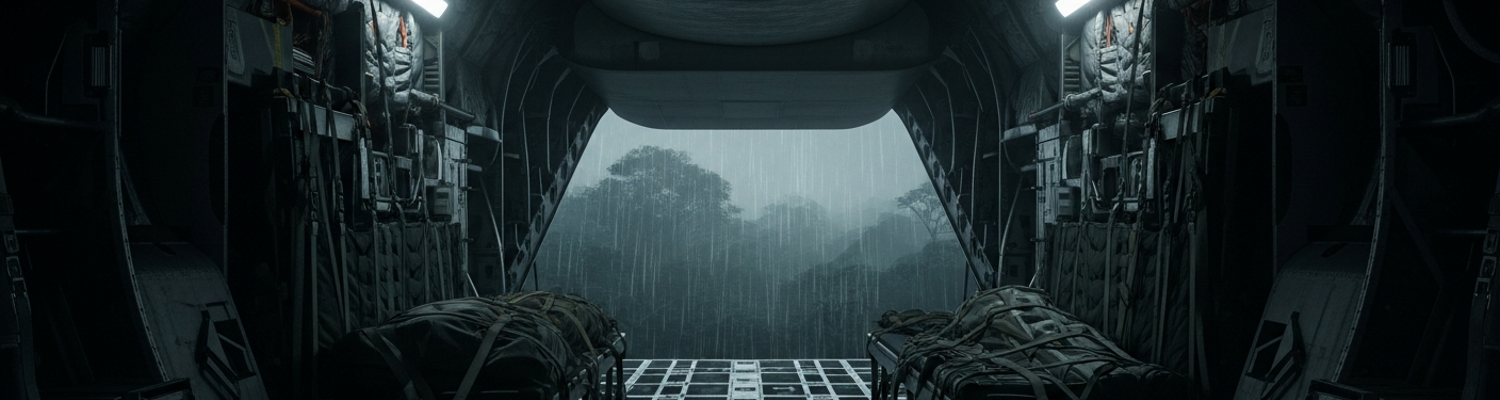
The resulting operation, a combined resupply and MEDEVAC, was assigned to two CH-46 Sea Knight helicopters from HMM-364, the "Purple Foxes." Their call signs were Seahorse 2-5 and Seahorse 2-6. Archival evidence shows the squadron’s AH-1 Cobra gunships, the standard armed escort for such a flight, were grounded. A shortage of hydraulic actuators for the Cobras' main rotor assemblies, a direct consequence of a fractured supply chain, had rendered the entire attack helicopter contingent non-operational. The two vulnerable CH-46s descended into the A Shau Valley, a notorious corridor for NVA anti-aircraft activity. As Seahorse 2-5, carrying plasma and radio components, began its final approach, the trap was sprung.
NVA forces from the 367th Air Defense Division, concealed in reinforced positions on high ground, initiated the ambush. These were not disparate units but a coordinated kill box. Forward spotters, using portable radios, provided the exact altitude and approach vector to multiple 12.7mm DShK heavy machine gun crews. The Soviet-made DShKs, firing armor-piercing incendiary rounds, opened up simultaneously. Seahorse 2-5 was hit immediately. Tracers stitched across its fuselage, severing hydraulic lines and striking the tail rotor. The aircraft pitched violently and slammed into the jungle canopy 500 meters short of the firebase.
The crash of Seahorse 2-5 killed its four-man crew, the Navy corpsman on board, and destroyed all supplies. The second helicopter, Seahorse 2-6, aborted its landing under a hail of fire, its airframe sustaining multiple hits before escaping the valley. At Firebase Nightingale, the situation became catastrophic. The two wounded marines could not be evacuated and succumbed to their injuries within hours. The platoon’s failing long-range radio had prevented them from transmitting a last-minute warning about NVA movements spotted just before the helicopters' arrival. This intelligence failure, born from a preceding logistical breakdown, ensured the ambush was a surprise.
The absence of effective Suppression of Enemy Air Defenses, or SEAD, was a direct cause of the Firebase Nightingale mission failure. Standard procedure for any aerial insertion into a high-threat region like the A Shau Valley would have involved a dedicated SEAD package. The threat was not just surface-to-air missiles, but also a dense network of anti-aircraft artillery. For a low-and-slow helicopter mission, the most immediate danger came from heavy machine guns like the Soviet-designed DShK 12.7mm, responsible for the majority of helicopter losses during the war. A proper SEAD operation would have preceded the CH-46s, using fast-moving jets to identify, jam, and destroy enemy radar and gun emplacements. That this was not attempted reveals a fatal flaw in operational calculus.
Without a formal SEAD package, the next layer of defense should have been reliable protective escorts. The grounding of HMM-364’s AH-1 Cobra gunships was not an inconvenience; it removed the single most effective tool for safeguarding the transports. The AH-1 Cobra was developed specifically to escort troop transports and provide direct fire support in Vietnam. Operating in hunter-killer teams, Cobras were designed to fly ahead of and alongside larger transports, actively seeking out ground threats. A Cobra escort would have scouted the approach to Firebase Nightingale, deliberately drawing fire to reveal and then engage enemy positions before they could target the lumbering CH-46s. Their absence meant the transports were flying blind into a kill zone, with only their own door gunners providing inadequate suppressive fire.
Operational logs and after-action reports from the I Corps Tactical Zone consistently identified the A Shau Valley as one of the most heavily defended NVA sanctuaries in South Vietnam. Intelligence was aware that the valley was saturated with anti-aircraft positions, forming a layered defense network. The NVA’s 367th Air Defense Division had honed its tactics, positioning heavy weapons like the DShK and ZPU-series 14.5mm machine guns for maximum effect. These crews were masters of camouflage and frequently moved their positions, making them difficult to target unless actively firing. For a CH-46, the approach to a hilltop landing zone was a moment of extreme vulnerability. The aircraft had to slow, maintain a predictable glide slope, and descend into a confined area. This gave gunners a near-perfect firing solution. NVA doctrine trained crews to attack troop-carrying helicopters just as they were about to touch down. Sending unescorted CH-46s into the valley was not a mission plagued by a lack of intelligence. It was a mission that proceeded in defiance of it.
A forensic analysis of the wider operational context reveals that the vulnerability of the CH-46 flight was compounded by deep, systemic failures within the airborne electronic warfare apparatus. The Marine Corps' EA-6A Intruders, operated by squadrons like VMAQ-2, were frequently hamstrung by a broken logistics chain. Maintenance logs (Form NAVMC 10772) and supply requisitions from the period show a persistent shortage of high-failure electronic components. This was a chronic condition. The sophisticated systems were difficult to maintain in the hot, humid conditions of forward air bases like Da Nang. Spare parts plentiful in stateside depots were scarce in-theater, leading to extensive cannibalization of aircraft just to keep a handful of platforms mission-capable.
This had a direct and crippling effect on the mission readiness of the ALQ-76 jamming pods, a cornerstone of the EA-6A’s electronic attack capability. At the heart of each ALQ-76 was a series of Traveling Wave Tubes, or TWTs, specialized and fragile vacuum tubes that amplified microwave signals to generate jamming energy. These TWTs had a notoriously short mean time between failures. The logistical pipeline from U.S. manufacturers to the flight lines in I Corps was agonizingly slow. A single failed TWT could render an entire frequency band in the jamming pod useless. Maintenance crews for VMAQ-2 reported they were often forced to sign off on aircraft carrying pods with known TWT failures, as no replacements were available in-theater. An EA-6A flying with a degraded ALQ-76 pod could not effectively jam the acquisition and fire-control radars that guided NVA anti-aircraft artillery.
Further eroding the electronic shield was the endemic unreliability of the AN/APR-25 radar homing and warning receiver. This system, installed across various tactical aircraft, was intended to detect hostile radar emissions. After-action reports are replete with pilot complaints about the APR-25’s performance. The system was infamous for its high false-alarm rate, frequently triggered by friendly radar signals, leading pilots to become desensitized to its warnings. In a dense electronic environment, the cathode-ray tube display could become a confusing mess of strobes, making it impossible to distinguish a genuine threat from background noise. Maintenance was another significant hurdle. The system's vacuum-tube technology was sensitive to vibration and temperature shifts, and repair required specialized technicians who were in short supply. Units reported that the only way to keep primary aircraft flying with a functional RWR was to strip the systems from other airframes.
An examination of Marine Corps aviation logistics reveals a critical vulnerability that predated any single mission: a debilitating lack of specialized maintenance personnel for SEAD aircraft. The electronic warfare systems in the EA-6A Intruders were a new frontier, and the technicians required to service them were rare. A review of personnel rosters shows that Marines holding a Military Occupational Specialty in the 66xx field, such as MOS 6624 for an EA-6A Aircraft Active Electronic Countermeasures Systems Technician, were in chronically short supply. The training pipeline for an EW systems specialist was one of the longest and most intellectually demanding in Marine aviation, requiring a deep understanding of radar theory and microwave electronics.
The personnel shortage directly undermined the operational readiness of the squadrons tasked with protecting strike packages. At forward air bases like Da Nang, home of VMAQ-2, mission-capable rates for the EA-6A fleet were consistently low due to maintenance backlogs. An aircraft could be mechanically sound but grounded indefinitely while awaiting one of the few available EW technicians qualified to diagnose a fault in an AN/ALQ-76 jamming pod. To meet the relentless operational tempo, maintenance control chiefs authorized widespread cannibalization. A grounded EA-6A would be designated a "hangar queen," systematically stripped of its electronic components to get other Intruders back on the flight line. This practice was catastrophically inefficient. A single cannibalization action required at least double the man-hours of a standard repair, as technicians had to perform two removals and two installations instead of one.
The few qualified EW specialists were engaged in a losing battle. After-action reports from maintenance chiefs describe a state of constant triage. These enlisted Marines were forced to make decisions with strategic weight, choosing which multi-million-dollar jet would be rendered a shell and which would fly with degraded systems. They worked in grueling conditions, often for 16-hour shifts, attempting to repair black boxes and sensitive vacuum tubes never designed for the heat and dust of a Vietnamese airfield. The ALQ-76 pods were notorious for high failure rates, and the technicians lacked the manpower to test, repair, and certify them as quickly as they were broken by combat operations. This structural deficiency in personnel ensured that on any given day, a significant portion of the Marine Corps' dedicated SEAD assets were unavailable for tasking.
The communications backbone for Marine rifle platoons in forward areas was the AN/PRC-77 man-portable radio. A review of 4th CAG maintenance requisitions reveals a persistent struggle to keep these radios operational. The humid environment of the A Shau Valley was hard on electronics. Maintenance logs repeatedly cite failures of battery casings that allowed moisture to seep in, causing corrosion on power terminals. Handset connectors were another frequent point of failure, their pins easily bent or fouled by dirt. At Firebase Nightingale, records indicate the 1st Platoon of Kilo Company was inserted with three PRC-77 sets. One was rendered inoperable when its primary circuit board cracked during the hard landing. A second unit suffered from intermittent power failure due to battery corrosion. This left the platoon with a single, untrustworthy radio as its only link to company headquarters.
Compounding the hardware failures was outdated cryptographic equipment. For secure voice transmissions, the PRC-77 was paired with the TSEC/KY-38 NESTOR, a bulky encryption unit. The NESTOR system was infamous among ground units for its poor performance. It was known to slash the PRC-77’s effective transmission range by as much as half, forcing radio operators to use high-power settings that drained unreliable batteries at an accelerated pace. The audio quality after encryption was often a garbled mess of static. The process for loading daily cryptographic keys was another significant point of failure. It required a fragile, paper tape-reading device known as the KOI-18, which was highly susceptible to moisture and physical damage.
This systematic degradation of tactical communications made responsive fire support an impossibility. The doctrine for a ground-initiated SEAD request depended entirely on a functional chain of communication. When a patrol from Kilo Company identified a previously unlocated 12.7mm DShK emplacement hours before the resupply mission, the platoon leader needed to transmit a secure flash message with precise coordinates. The attempt to send this message using the KY-38 resulted in an unintelligible transmission. After multiple failed attempts, the radio operator was forced to switch to an unencrypted, clear-text broadcast. Post-action analysis of NVA signals intelligence confirmed this clear-text transmission was intercepted, alerting the gun crew to their detection and prompting them to reposition. By the time the request for an air strike was finally understood and relayed, the target had vanished. Kilo Company had spotted one of the exact DShK positions that would later ambush the Seahorse flight, but their warning was nullified by their own failing equipment.
The electronic ears of the 4th CAG were its signals intelligence (SIGINT) support teams, small detachments from the 1st Radio Battalion tasked with intercepting enemy communications. These teams relied on a suite of man-portable receivers and direction-finding equipment tethered to the AN/PRC-77 radio. The entire apparatus was dependent on a steady diet of fresh batteries. Specifically, the BA-4386 magnesium battery was the required power source. A review of supply manifests for the I Corps Tactical Zone shows a chronic shortfall of this single component. The BA-4386, while powerful, had a short shelf life that was drastically reduced by the humidity of the Vietnamese climate. Batteries that left depots in Da Nang were often degraded by the time they reached forward operating bases. Requisitions from the 4th CAG repeatedly requested emergency airlifts of fresh BA-4386s, but the overwhelmed supply chain could not respond.
This lack of robust power sources degraded SIGINT capabilities. The specialized intercept receivers used by the Radio Battalion teams were a significant power drain, consuming battery life far faster than a standard PRC-77. A single BA-4386, which might last a day in a standard infantry radio, could be exhausted in hours by a SIGINT collection team. Lacking reliable resupply, team leaders rationed their listening time, powering down their equipment for long stretches. This created massive gaps in intelligence coverage. NVA forward observers and anti-aircraft units maintained a consistent radio discipline, using low-power FM bursts to coordinate movements and targeting. These were precisely the signals the Marine SIGINT teams were trained to intercept. With their equipment powered off for most of any 24-hour period, their ability to establish a pattern of enemy activity was completely negated.
The loss of this real-time threat intelligence left ground units and air assets unaware of impending ambushes. The ambush of the Seahorse flight was a direct outcome of this specific failure. NVA doctrine called for extensive radio coordination between forward spotters and the DShK crews they directed. This traffic would have been broadcast in the hours and minutes leading up to the helicopters’ arrival. A functional SIGINT team, positioned near the firebase with adequate power, would almost certainly have intercepted these transmissions. Such an intercept would have provided an immediate, actionable warning. Instead, the supply failure of a simple magnesium battery created an intelligence vacuum, ensuring the Marine aircrew flew directly into a prepared kill box.
Records from the Force Logistic Command (FLC) in Da Nang reveal the specific failures that grounded aircraft were not isolated incidents. They were symptoms of a larger pathology within the Marine Corps’ logistical structure in I Corps. The system was fundamentally reactive, organized around a "pull" philosophy where parts were only requested after something had broken. This created a long, fragile chain from depots in the United States to the flight lines at Marble Mountain or firebases in the A Shau Valley. The rapid escalation of the war meant that combat operations and the construction of the logistical base happened at the same time, a situation that immediately overwhelmed the system. There was no meaningful consumption data to build accurate forecasts. The initial influx of supplies occurred long before an adequate logistical organization was in place to manage it.
The inadequacy of procurement and distribution guaranteed chronic shortages. A review of supply manifests shows the labyrinthine journey for a single part like a hydraulic actuator or an electronic TWT for a jamming pod. A request began as a paper form at the squadron level, entering a sluggish, overburdened administrative pipeline. The part, if available, began a trans-Pacific journey, subject to bottlenecks at ports and depots before reaching the chaotic distribution centers in Da Nang. From there, it still had to be allocated and transported to the specific unit. The process was too slow and unreliable for the urgent demands of combat operations. It was a system designed for a peacetime tempo, not for the high-intensity attrition warfare being waged where equipment was pushed to its breaking point daily.
This fragility ensured the entire support structure would collapse under sustained pressure. The primary coping mechanism visible in after-action reports was cannibalization, the practice of stripping working parts from one damaged aircraft to make another flyable. While this provided a short-term fix, it was a catastrophically inefficient solution that consumed double the maintenance man-hours of a normal repair. It created "hangar queens," airframes picked clean of their components, and accelerated the burnout of specialized technicians. This is precisely what grounded the AH-1 Cobra escorts for the Firebase Nightingale mission. The required hydraulic actuators were not available in-theater because the supply chain had already failed months prior, forcing maintenance crews into a state of perpetual cannibalization just to meet daily flight quotas. The intense operational tempo of the A Shau Valley campaign did not cause this collapse; it merely exposed how broken the system already was.