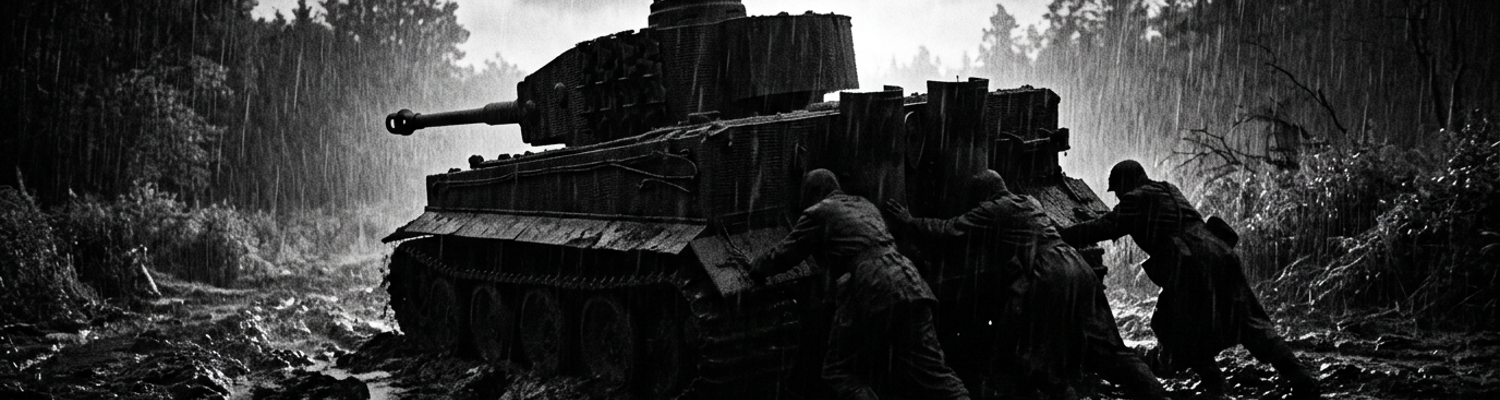

Anglo-American Command and Soil Saturation
Archival evidence shows Lieutenant General Brian Horrocks of British XXX Corps took operational command over Major General Alexander R. Bolling and the US 84th Infantry Division for an assault launched on November 18 1944. Bolling deployed men without prior combat experience. Horrocks directed them to eliminate the Geilenkirchen salient. This eight-square-mile bulge west of the Roer River anchored a heavily reinforced sector of the German Westwall. Veteran elements of the German 176th Infantry Division and the 15th Panzergrenadier Division defended the salient. They occupied reinforced concrete bunkers with overlapping fields of fire. British plans assigned the US 334th Infantry Regiment to clear the high ground around Prummern. The British 43rd Wessex Division struck north toward Bauchem and Tripsrath. Specialized Sherman Crab flail tanks from the British 79th Armoured Division provided armor support. Standard Shermans from the British 8th Armoured Brigade followed the initial breach elements.
Green American infantry had never trained alongside British armored units.
A close review of operational logs indicates continuous freezing rain turned the topsoil of the Wurm River basin into liquid loess clay. Tracked vehicles sank to their belly plates within yards of departing hard-surfaced roads. Flail tanks weighing over thirty tons suffered track derailments. Dense mud compacted into drive sprockets. The pressure snapped guide pins and seized return rollers. Crewmen in the 8th Armoured Brigade burned out steering clutches. They tried to winch their vehicles out of saturated road shoulders between Geilenkirchen and Immendorf. Soldiers of the 309th Engineer Combat Battalion worked with trenching spades under direct mortar fire. They dug mud out from beneath trapped chassis. American M4 medium tanks fitted with standard track shoes could not find traction in the clay. They slid sideways into water-filled shell craters along the axis of advance. Armored recovery vehicles threw their own tracks. British Churchill ARVs attempted to extract bogged Shermans from roadside culverts. Operational records note mechanical breakdowns incapacitated half of the supporting armor before the assault waves reached the outer German anti-tank ditch.
Every primary unpaved supply track collapsed under wheel traffic by midday.
Severe weather crippled contact between American and British forward elements. Signal detachments laid rubber-coated field telephone wire along road edges. Continuous traffic from Churchill and Sherman tanks sheared the cables beneath churned mud. Sleet penetrated the canvas covers of American SCR-300 radio transceivers. The water caused circuit shorts in damp vacuum tubes. BA-70 battery packs exhausted in under two hours. British radio operators using Wireless Set No. 18 transceivers discovered low-elevation terrain blocked high-frequency ground waves entirely. Thick brick masonry in farm complexes like Bauchem worsened the signal degradation. Radio teams attempted to drive grounding spikes into the soil. The waterlogged silt generated excessive electrical noise. This scrambled transmissions. Battery resupply teams attempted to hand-carry dry cells forward through communication trenches. They found the ditches filled with waist-deep muddy water. Runners sent on foot to deliver coordinate corrections had their combat boots pulled off by the suction of the clay. Forward observers from the 326th Field Artillery Battalion lost contact with firing batteries for forty-five minutes. German battery fire from 88-millimeter guns struck exposed infantry platoons during this blackout.
British and American wire crews expended eight miles of assault cable without securing a direct link to headquarters.
Signal Photographic Units and Equipment Failure
Cameramen from the US Army 165th Signal Photographic Company received tactical assignments directly alongside the leading rifle companies. Field directives from the Psychological Warfare Division mandated frontline visual documentation. Allied Supreme Headquarters required this footage to feed technical intelligence analysis. Two-man camera teams from the 165th attached to the 84th Infantry Division. They advanced behind the lead scouts of the 334th Infantry Regiment. The unit pushed eastward out of Immendorf toward Prummern. British Army Film and Photographic Unit personnel assigned to the 43rd Wessex Division accompanied the initial infantry dashes into the outskirts of Bauchem. Each photographer carried an M1 carbine or service revolver. They packed standard entrenching tools and heavy field photographic gear. Their kits included 35-millimeter Eyemo model 71 cameras and Speed Graphics. British personnel carried Newman and Sinclair clockwork cinema cameras. Moving across open loess ground exposed these teams to continuous German 81-millimeter mortar spreads. 7.92-millimeter machine gun fire from Westwall pillboxes swept the approach routes. Cameramen crawled on their bellies through drainage ditches filled with runoff water. They filmed British flail tanks detonating anti-personnel mines along the railway embankment north of Geilenkirchen.
German snipers targeted hand-cranked camera lenses as optical equipment belonging to artillery observers.
Sub-freezing sleet and knee-deep loess mud caused immediate mechanical failures across all camera platforms. Factory lubricants inside spring-driven Eyemo and DeVry movie cameras congealed into heavy grease. Temperatures dropped near zero degrees Celsius. The cold slowed down clockwork motors and caused shutter speeds to drag or seize completely. Combat cameramen stripped their camera housings in forward slit trenches. They washed the escapements and gear trains with leaded vehicle gasoline. This allowed them to operate the mechanisms completely dry. Cellulose acetate film stocks turned dangerously brittle in the damp freeze. The cold film passed rapidly through internal guide gates. The dry tension snapped sprockets and shredded the emulsion. Detached chemical flakes jammed inside aperture plates. Photographers carried unexposed 100-foot film spools and sheet-film holders directly against their bare skin. They placed the metal canisters beneath wool undershirts and combat jackets. They relied on personal body heat to keep the base pliable before threading it under fire. Condensation formed rapidly on cold glass whenever equipment moved between body heat and freezing air. Soldiers cleared objective elements using dry wool socks. Treated tissue dissolved into pulp in the sleet.
Friction inside the frozen transport gates generated static electrical discharges.
Technicians faced relentless mud coating lens housings and fouling dark slides during the advance on Prummern on November 19. Camera crews wrapped vulcanized rubber ponchos around their camera bodies. They cut up gas mask waterproof bags and secured the material with friction tape. This sealed out the liquid loess clay churned up by artillery rounds. Sleet coated exposed glass with ice within seconds of aiming toward German defensive positions on the high ground of Hill 101. Photographers used cut-down cardboard ration cartons as improvised lens hoods. This kept water from seeping into shutter mechanisms. Mud caked into the gear teeth of Newman and Sinclair winding handles. British AFPU operators cleared the mechanisms with trench knives while lying prone under 88-millimeter counter-battery barrages. Cameramen lost multiple Eyemo units to grit infiltration. The sand stripped internal drive gears during rapid fire sequences before American assault elements entered Prummern.
Forward Aid Stations and Immersion Casualties
Combat cameramen from the 165th Signal Photographic Company stationed near the 333rd Infantry Regiment aid stations documented trench foot rates exceeding conventional shrapnel trauma. The regiment pressed into the low-lying terrain outside Suggerath and Geilenkirchen. Riflemen occupied waterlogged defensive ditches. Water levels hovered continuously between ankle and calf height. The human foot underwent rapid peripheral vasoconstriction followed by severe tissue maceration. Soldiers wore standard-issue service shoes and canvas leggings without opportunity for drying. Local capillary circulation ceased and nerve endings died within seventy-two hours of immersion in standing water at three degrees Celsius. Combat cameramen recorded rolls of 35-millimeter footage showing American infantrymen carried into aid stations. Their feet swelled to double normal volume. The skin appeared pale and waxy before turning purple and sloughing off upon touch. Company sick-call logs reveal six out of every ten casualties processed through forward clearing points during the fourth day of fighting suffered from severe immersion foot.
Litter bearers carried more men disabled by their own footwear than by German 88-millimeter airbursts.
Continuous moisture and immobilized supply chains forced battalion surgeons to convert damp cellars into triage points. Saturated loess soil paralyzed vehicle movements across the regimental rear. Dodge three-quarter-ton ambulances grounded out as axles dragged through liquid clay along unpaved cart tracks north of Immendorf. Regimental medical personnel requisitioned the subterranean cellars of bombed-out stone structures in the ruins of Suggerath. Water continuously seeped through shattered masonry and cracked cellar ceilings. Medical aides laid discarded telephone wire spools and wooden ration crates across the floor. This kept stretchers out of the pooled runoff. Battalion surgeons worked by the illumination of single carbide lamps. They cut away stiffened leather boots using curved trauma shears. The feet had swollen past the lace eyelets. Medical staff lacked the supplies to establish warming regimens. Quartermaster trucks carrying dry wool socks and extra blankets sat trapped in road ruts three miles to the south. Gasoline for heating stoves remained stuck in the same convoy.
Dry socks ceased reaching frontline foxholes on the second morning of the offensive.
Medical officers of the 309th Medical Battalion repurposed entire cellar spaces exclusively to manage exposure cases. These non-combat injuries overwhelmed normal surgical protocols. Cellar triage stations became holding wards. Dozens of incapacitated infantrymen sat propped against damp brick walls. They elevated their bare blackened feet on empty 105-millimeter ammunition crates. Surgeons suspended routine wound debridement. They spent hours applying mineral oil or drying powders by hand to combat tissue necrosis. High ambient humidity inside the unventilated rooms prevented limbs from shedding trapped moisture. Evacuation priority classifications collapsed under the volume of non-ambulatory exposure cases. Men displaying advanced peripheral neuropathy could neither stand on sentry duty nor pull the trigger of an M1 Garand with cold-numbed hands. Regimental records for November 21 show forty-eight litter patients with third-stage trench foot waited thirty-six hours on damp stone floors. Three six-by-six trucks fitted with tire chains eventually bypassed mud chokepoints to transfer them to field hospitals in Lindern.
Flail Tank Immobilization at Prummern
The assault along the unpaved cart road linking Immendorf to the western entrance of Prummern collapsed into total mechanical failure precisely between 0914 and 0919 on the morning of November 18. British Sherman Crab Mark V flail tanks from B Squadron led Company A of the US 334th Infantry Regiment through an uncleared German minefield. The 1st Lothians and Border Horse of the 79th Armoured Division operated these thirty-two-ton vehicles. Each tank featured a front-mounted rotating cylinder spinning forty-three heavy steel chains at 180 revolutions per minute. The chains beat the topsoil to detonate buried Tellermines. The lead Crab struck a concealed roadside drainage culvert at 0914. The culvert had collapsed into a pit of liquid loess clay. Saturated silt instantly fouled the front drive sprockets. The mud packed tight against the idler wheels and threw both tracks off their suspension bogies. The driver attempted to force the vehicle forward through the sinkhole. The high-torque resistance sheared the transfer case internal gears. This cut power to the flail drum mid-rotation. The second flail tank swung hard left to bypass the obstruction. The water-soaked clay shoulder gave way under the left side of the hull. The tank slid into a four-foot drainage ditch. Its lower escape hatch sank below the waterline. The third Crab tried to back down the narrow corridor to clear a firing lane at 0917. It snapped a track pin on a submerged piece of masonry. The right track assembly unspooled across the roadbed.
Three armored hulls plugged the narrow breach lane completely.
This five-minute blockage halted trailing casualty evacuation and stripped the assault infantry of their only mine-clearing screen. Advancing American riflemen moved in the beaten tracks directly behind the spinning flails. They found themselves stranded thirty yards short of the outer German trench line. They had no safe route through the minefield. German defensive teams from the 176th Infantry Division instantly opened fire from camouflaged positions around Hill 101. They swept the muddy roadway with synchronized MG 42 machine-gun bursts from the western houses of Prummern. Rifle squads could not drop prone or scatter into the adjacent ditches. Wooden Schu-mine 42 anti-personnel devices remained hidden beneath the sod. Four modified Willys MB litter jeeps belonging to the 1st Battalion medical detachment sat trapped bumper-to-bumper in the sunken road cuts directly behind the stalled armor. Water-filled earthen banks and concertina wire bound the soft-skinned jeeps. They had zero turning radius to maneuver back toward Immendorf. Splinters from German 81-millimeter mortar shells punctured two front tires. The shrapnel tore through canvas stretcher covers carrying wounded American scouts.
Litter bearers dragged bleeding men off jeep hoods directly into rain-filled shell craters to escape crossfire.
Cameramen of the 165th Signal Photographic Company moved fifty yards behind the lead jeeps. They documented the complete breakdown of forward momentum as command cohesion disintegrated. Radio communication died across saturated SCR-300 circuits. Infantry captains sent runners crawling through muddy track ruts to order men forward with fixed bayonets. Riflemen probed the heavy clay inch by inch with six-inch blade tips under continuous artillery airbursts. They tried to clear paths to haul wounded soldiers back to safety on shelter-half tarpaulins. British tank commanders unlatched their turret hatches to hook winch cables between the disabled lead Crab and a trailing recovery vehicle. 88-millimeter high-explosive rounds slammed into the embankment and drove the crews back inside their steel hulls. Winch lines repeatedly snapped under the weight of thirty tons of deadweight suctioned into clay. Operational recovery logs recorded thirty-eight wounded soldiers trapped along four hundred yards of zero-clearance roadway without cover by 0919.
Tactical Isolation of Forward Rifle Companies
Lead elements of Company F of the 334th Infantry Regiment found themselves pinned in open beet fields eight hundred yards northeast of Prummern by 1130 on November 19. British Sherman tanks belonging to the 8th Armoured Brigade held assignments to provide direct-fire support. They halted completely after two vehicles bellied out on earthen berms bordering the Prummern-Beeck road. Three American rifle platoons pressed into an exposed depression designated as Objective Cherry. They lacked armored protection and physical contact with flanking units. German panzergrenadiers of the 15th Panzergrenadier Division executed a rapid pincer movement across the high ground. Two Sturmgeschutz III assault guns supported them from reverse-slope hull defilade. High-explosive 75-millimeter rounds severed field telephone wires linking the company command post to battalion mortars. Hand-held SCR-536 walkie-talkies failed to broadcast signals through the dense rain. German rifle squads closed within fifty yards without armor to suppress incoming machine-gun fire. They cut the withdrawal route toward Prummern. Eighty-four American soldiers remained trapped inside an active kill pocket.
Every retreating runner fell within thirty yards of the company perimeter.
Casualty clearing routes disintegrated completely as the encirclement tightened. Specially modified Willys MB quarter-ton litter jeeps attempted to reach Company F along an unpaved agricultural track flanking Hill 101. Mechanics had outfitted these vehicles with steel crossbars to carry two tiers of folding stretchers. Both vehicles bottomed out. Their low-clearance front differential housings struck solid ridges of compacted loess mud concealed beneath deep standing water. Drivers shifted aggressively into four-wheel drive. This sheared universal joints on the rear prop shafts. The jeeps immobilized up to their wheel hubs in freezing slush. Splinter fragments from German 120-millimeter mortars perforated the unarmored engine blocks. The shrapnel cracked distributor caps and left battery terminals flooded with muddy water. Medics attempted to haul wounded soldiers on foot across the saturated open terrain. Two litter bearers required forty minutes to advance one hundred yards through knee-deep clay.
Mud stripped the boots off litter bearers attempting to carry stretchers on foot.
Squad leaders of the 2nd Battalion faced an immediate tactical dilemma. German counterattacking forces began clearing the forward rifle pits with stick grenades and automatic fire. Isolated squads could neither transport non-ambulatory casualties through the open mud nor maintain defensive positions. They held depleted Garand clips and empty bazooka tubes. Battalion command logs show platoon sergeants ordered able-bodied riflemen to conduct a fighting withdrawal through a drainage ditch toward the outskirts of Prummern. They left nineteen severely wounded men behind in a roofless brick barn. Two unarmed company aid men elected to stay with the casualties. They placed red cross brassards over their wet wool overcoats and set out white cloth markers outside the stable door. German assault troops from the 104th Panzergrenadier Regiment overran the position eight minutes later. They captured all nineteen wounded soldiers alongside their attending medical personnel.
Twelve of the captured Americans suffered from compound fractures that went untreated for forty-eight hours in German holding points.
War Department Casualty Records and Photographic Evidence
Paperwork in Berlin began registering men before field commanders in Prummern confirmed they were missing.
Wounded infantrymen of the 334th Infantry Regiment captured near Prummern on November 19 entered a complex German evacuation channel moving east toward Erkelenz and Cologne. German medical personnel cataloged each American casualty into prisoner logs. They assigned identification numbers that fed into the Wehrmacht information bureau known as the Wehrmachtsauskunftsstelle. Severely wounded soldiers suffering from untreated shrapnel wounds and frozen extremities routed across transit stations directly to Stalag IV-B in Muhlberg. Others went to Stalag VI-G in Bonn-Duisdorf or the hospital facilities of Stalag IX-B at Bad Orb. Medical clerks stamped individual index cards with serial numbers and regimental tags. The US War Department still carried these men on morning reports as Missing in Action. War Department casualty audit boards later compared International Red Cross notifications and captured Stalag registers against regimental roster cards. They reconciled conflicting dates of death and capture. Discrepancies emerged where men died of hypothermia during transit boxcar journeys. German administrative personnel had not yet entered their names into official hospital death logs.
Official casualty tallies took months to catch up with actual losses.
Surviving 35-millimeter negative rolls and 4x5 Graflex cut-sheet negatives from the 165th Signal Photographic Company became primary physical evidence. The film verified how the advance completely broke down around Geilenkirchen. Combat cameramen exposed thousands of feet of DuPont Superior II black-and-white stock. They captured the exact spatial distribution of submerged vehicles and blocked culverts along the Immendorf-Geilenkirchen axis. Reel canisters marked with division grease-pencil codes cataloged tracked Sherman tanks bogged past their differential casings. The footage showed winch cables broken under tension and British flail assemblies caked in mud. Allied technical intelligence officers retrieved and reviewed these footage rolls to assess why standard recovery protocols failed in the loess soil of the Wurm River valley. Chemical traces in the film stock preserved cold-weather static discharges and water-spotting caused by melted sleet inside Eyemo camera shutters. This provided visual proof of the atmospheric conditions that incapacitated motorized transport. Analysts used frame-by-frame magnification of the negative strips to map the coordinates where supply columns jammed along single-lane tracks. Mud halted the forward delivery of fuel and small-arms ammunition.
The footage preserved what radio logs could not describe.
War Department analysts cross-referenced 165th Signal Photographic Company exposure records with 309th Medical Battalion intake sheets. They verified how rapidly exposure casualties mounted. Cameramen filmed rows of blanket-wrapped litter cases lining church basements in Suggerath. They documented the exact clinical stages of trench foot before gangrene forced field amputations. Photographic roll logs recorded exact times and company coordinates. Investigators tracked how medical evacuation corridors collapsed hour by hour between November 18 and November 22. Identifiable roster numbers stenciled on helmet liners matched names entered in Stalag registers days later in several film sequences. This proved wounded men lay stranded in roadside ditches for over thirty hours before German capture parties reached them. War Department auditors closed files on forty-one missing soldiers using these photographic frame sequences as conclusive physical verification of capture locations.