
Prewar Field Service Regulations and Doctrine Assumptions
M4 Sherman tanks and M7 Priest self-propelled howitzers rolled into French assembly fields with their radial aircraft engines roaring under heavy throttle. Mechanics adjusted track tensions and topped off fuel cells while tank gunners traversed their 75-millimeter main guns across unobstructed horizons to check firing linkages and optical sights. Infantry squads from the 90th Infantry Division marched behind the warm exhaust grates of those armored vehicles carrying standard gear configured for fast foot marches behind advancing armor. FM 100-5 Field Service Regulations emphasized rapid mechanized exploitation, visual fire coordination, and fluid offensive maneuvers across open terrain. Manual writers designed those motorized columns to break through ruptured enemy lines and fan out into open countryside where vehicle commanders could maintain momentum without getting bogged down in static skirmishes. Tank commanders stood upright in open turret hatches to scan the distant landscape and prepare to spot enemy positions for supporting field pieces and rifle companies.
Artillerymen adjusted optical rangefinders and battery plotting boards because pre-invasion Army doctrine assumed direct visual contact between forward artillery observers, infantry units, and supporting armor elements. Training manuals instructed observers to climb water towers, haylofts, or hilltops where they could see the entire front line and steer high-explosive shells onto enemy targets by eyesight alone. Radio operators carried bulky SCR-284 transmitters and unreeled heavy copper telephone wire across farm tracks expecting uninterrupted radio transmissions and clear line-of-sight communication with nearby tank crews. Doctrine treated direct visual alignment as the essential requirement for combined arms cooperation, promising that infantry platoons pinned down by machine guns could point out targets with tracer rounds or smoke grenades for immediate tank gun responses. Battery officers calculated firing angles with simple slide rules assuming that spotters could adjust artillery bursts onto visible targets within ninety seconds of the initial round hitting dirt. Field commanders placed complete trust in these visual fire networks, confident that clear sightlines would allow gunners to demolish enemy strongpoints before foot soldiers crossed the open grass.
Commanders grounded that confidence in large scale interwar maneuvers that had tested fast moving mechanized forces across broad expanses of the American South. Interwar training exercises like the 1941 Louisiana Maneuvers validated large scale armored sweeps without accounting for compartmentalized coastal estuaries. Armored divisions and truck borne infantry rolled across hundreds of square miles of dry pine woods, open pastures, and rolling cotton fields during those southern war games, driving around mock defenses to capture road junctions with minimal resistance. Army evaluators praised bold corps commanders who launched sweeping flank attacks along dry highways, rewarding tactical speed and wide envelopments while treating difficult terrain as secondary obstacles that motorized columns could simply bypass. Planners ignored the muddy realities of restricted river mouths, choked tidal canals, and compartmentalized earth banks, assuming that engineers could bridge or bypass any natural water barriers within hours. Exercise reports praised aggressive forward motion as the primary requirement for combat success, convincing general staff officers that rapid mobility would prevent German forces from establishing organized defensive belts.
Maps distributed to division commanders in early summer repeated those open country assumptions, depicting Normandy as rolling farmland where tanks could support infantry along paved roads and dry pastures. Soldiers of the 90th Infantry Division strapped on gas mask bags, cartridge belts, and ammunition bandoliers under orders that demanded continuous forward attacks along designated phase lines. Heavy prime movers and cargo trucks crowded the coastal assembly areas behind Utah Beach, their cargo beds packed with ammunition crates and wire spools built for rapid pursuit operations across wide country plains. Staff officers handed company captains their battle orders and aerial reconnaissance photographs, pointing out dirt tracks that led directly toward the low, swampy ground of the Seves River valley. Tank crews started their diesel and gasoline engines, engaging heavy clutches to move forward in file down narrow sunken paths that blocked their radio antennas and obscured their turret sights.
Cotentin Peninsula Topography and Bocage Obstacles
Steel track grousers ground against the packed dirt of these cart paths, wedging thirty ton tanks between vertical walls of flint and tangled roots. Centuries old earthen hedgerow embankments and sunken lanes along the Cotentin Peninsula systematically restricted vehicle traversal and compartmentalized battlefields into isolated pockets. French farmers had spent generations piling fieldstones and heavy topsoil up to eight feet high along property lines, planting hawthorn and oak hedges on top to keep livestock inside and turn every pasture into a walled fortress. Sherman drivers who attempted to climb these massive mounds pushed their front armor straight into the air, exposing their thin belly plates to concealed anti-tank guns while pointing their 75-millimeter cannons uselessly at the clouds. Tank commanders closed their hatches and backed down the rutted tracks, leaving the accompanying infantry squads cut off from direct fire support on the far side of impenetrable dirt walls.
Riflemen from the 90th Infantry Division bunched together inside these tiny four acre cow pastures, unable to see beyond the dense brush at the end of their rifles. Squad leaders shouted across hedgerow gaps to locate neighboring platoons, but the thick soil embankments absorbed voice calls and deadened the sound of nearby rifle fire. Radio operators adjusted their antenna coils and raised whip aerials above the brush lines, only for German snipers to shoot the exposed rods and shatter the delicate vacuum tubes inside the transmitters. Patrols that pushed forward through hand hacked gaps in the vegetation encountered hidden machine gun bunkers placed diagonally across the open grass, suffering casualties before they could locate the muzzle flashes. Foot soldiers crawled along muddy drainage ditches at the embankment bases, inching southward until the suffocating maze of hedgerows broke open at the edge of the river valley.
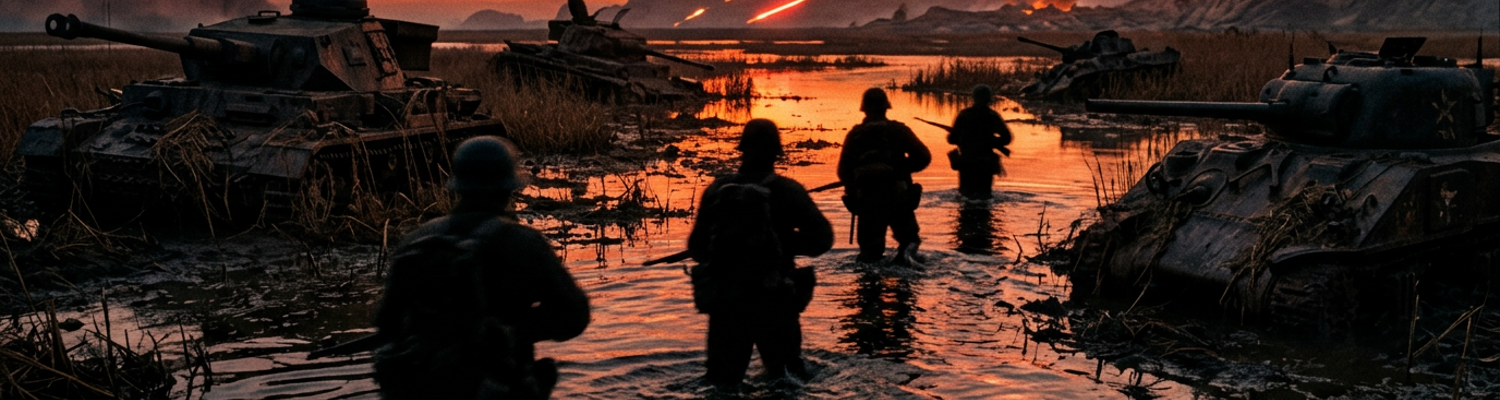
Water seeped through the soldiers leather combat boots as the terrain sloped downward into a broad gray expanse of wet reeds. The Seves River and its surrounding tidal estuary created a wide exposed basin devoid of natural cover against hostile observation. Ocean tides pushed inland from the western coast twice every day, swelling the sluggish stream into a flooded sheet of shallow water that drowned the lower meadows and turned farm dirt into black sucking mud. Drainage ditches and irrigation canals cut through this soggy plain, creating waist deep water barriers that forced advancing riflemen to slow to a heavy crawl without a single tree, ditch, or stone wall to hide behind. American company commanders raised their field glasses across this wet expanse and realized that any push toward the opposite shoreline required crossing several hundred yards of open marsh in plain view of enemy gunners.
Gunners from German artillery batteries watched every ripple in the marsh grass through optical rangefinders and battery telescopes mounted on the commanding high ground south of the river. German forces integrated the flooded marshlands into their defensive belt, anchoring defensive sectors in the Periers region behind pre-registered obstacles. Pioneer battalions had opened local water gates and dammed tidal outlets weeks earlier, deliberately widening the flood zones to funnel all American movement toward narrow elevated causeways. Machine gun crews and mortar batteries sighted their barrels onto these exact causeways and mudflats, staking rolls of concertina wire across the water and anchoring explosive tripwire mines beneath the muddy surface. Paratroopers from the German 6th Parachute Regiment settled into camouflaged log bunkers along the southern bank, holding their fire until the first American companies waded out into the center of the waterlogged basin.
The Seves Island Crossing and Communication Collapse
Infantrymen of the 358th Infantry Regiment launched the assault across the Seves River mudflats on July 22, 1944, stepping off the firm northern bank directly into the open tidal flats. Rifle companies waded forward through waist deep brackish water and thick silt, holding their rifles overhead as their heavy canvas equipment absorbed moisture and dragged them downward. Fallschirmjaeger Regiment 6 trapped the crossing battalions with pre-registered mortar concentration grids and interlocking automatic weapons fire as soon as the lead elements reached the middle of the exposed flats. High explosive mortar shells plunged in calculated patterns across the muddy ground, detonating on contact with the wet surface and throwing lethal metal fragments into soldiers who had no foxholes or embankments for cover. German MG 42 machine guns fired fixed traverse lanes from fortified log bunkers along the river dykes, catching entire platoons in crossfires that tore through the reeds and pinned the survivors flat in the mud.
Signalmen crawled through the wet silt behind the assault waves, dragging heavy reels of wire through the mud to connect company leaders with rear artillery batteries. Hostile artillery fire rapidly severed field telephone wires, cutting the landlines into ragged pieces and ending wire communication across the river within the first hour of combat. Radio operators unslung their portable transmitters to call for protective smoke screens and counter-battery fire, but the harsh coastal marsh destroyed their electronic gear. SCR-536 and SCR-300 radios failed due to tidal mud contamination and terrain shielding, leaving forward observers cut off from the division artillery battalions. Saltwater and wet silt gummed up channel selectors, switches, and battery connections, while sunken river channels and high hedgerow dikes blocked radio signals from reaching receivers positioned on the northern mainland. Forward observers shouted into dead handsets and tried to wipe the connectors clean with wet uniform sleeves, but moisture inside the chassis shorted the delicate circuits and killed all outgoing transmissions.
Runners dashed back into the open mudflats to deliver handwritten target coordinates to the waiting tank companies on the northern shore. German snipers and mortar crews spotted these couriers immediately, killing or wounding them in the exposed shallows before they could reach the riverbank. Sherman tank crews on the far shore attempted to provide direct fire support, but the dense hedgerows and low ground obscured their optical sights and hid the German paratroop positions. Tank gunners fired seventy five millimeter high explosive rounds blindly over the heads of the infantry, yet without forward observers to correct their aim, the shells landed harmlessly in empty marshland or dangerously close to American rifle pits. Armor commanders refused to drive their thirty ton vehicles into the soft riverbed, knowing the heavy hulls would sink to their sponsons in the tidal mud and turn into stationary targets for German anti-tank guns.
Paratroopers from Fallschirmjaeger Regiment 6 took advantage of this American isolation, launching aggressive counterattacks through the hedgerows along both flanks of the crossing site. German assault squads advanced with submachine guns and stick grenades, systematically encircling the scattered rifle companies that were trapped on the island without ammunition resupply. American company commanders ordered their remaining riflemen to fix bayonets and form tight perimeter defenses inside water filled ditches, but the lack of artillery support made their positions indefensible against plunging mortar fire. Surviving officers organized a fighting withdrawal under intense fire, pulling wounded soldiers back through the mudflats toward the northern shore as darkness settled over the estuary. Riflemen abandoned heavy water soaked machine guns, smashed useless radio sets in the silt, and waded through the rising evening tide to escape total destruction on the southern bank.
Armored Support Failures on the Tidal Mudflats
M4 Sherman tanks of the 712th Tank Battalion revved their radial engines along the northern dikes to lay down covering fire for the exhausted riflemen scrambling out of the rising water. Tank commanders ordered their drivers to advance into the marsh to screen the retreating foot soldiers behind thirty ton armored hulls. M4 Sherman tanks assigned to support the crossing became mired in the soft silt of the tidal flats, unable to traverse outside narrow targeted causeways. Steel track shoes clawed into the saturated marsh bed, sinking into deep gray muck until the belly plates rested on the mud and immobilized the suspension systems. German artillery batteries quickly targeted these stalled vehicles along the road, dropping heavy mortar rounds and high explosive shells that shattered the stone shoulder and set two lead tanks on fire. Tankers pulled emergency release levers and dropped through floor hatches into the ditch water, leaving the single passage completely blocked by burning wreckage.
Crewmen serving as armored forward observers raised their binocular optics against the smoke of the burning tanks, but they were unable to visually identify camouflaged German anti-tank guns and mortar pits concealed within adjacent hedgerow banks. German gunners had dug their 7.5 centimeter Pak 40 anti-tank guns deep into the root systems of the dikes, covering the steel shields with cut branches, sod, and woven burlap that matched the natural brush. German mortar squads operated from deep trenches behind the hedgerow banks, firing high angle barrages that left no visible muzzle flashes across the flat landscape. American tank gunners swung their 75-millimeter cannon barrels toward vague dust clouds, firing high explosive shells into empty fields without destroying the hidden German positions. High explosive anti-tank rounds soon punched through the side armor of the stalled American vehicles, detonating internal ammunition racks and igniting fuel tanks. Shrapnel from these explosions shattered optical periscopes and severed exterior whip antennas, blinding the surviving tank crews inside their steel compartments.
Tanks remaining on the northern riverbank ceased their fire and backed away into orchard lanes after anti-tank fire destroyed the lead vehicles. The complete loss of direct fire armored assets left isolated infantry rifle companies with only light organic weapons to suppress enemy strongpoints. Riflemen crouching in flooded drainage ditches had brought only their personal M1 Garand rifles, a few Browning Automatic Rifles, and portable 60-millimeter mortars across the estuary. Small arms ammunition flattened against the thick oak logs and earthen revetments protecting the German machine gun positions. Mortar squads dropped small high explosive rounds near the enemy bunkers, but the lightweight shells lacked the concussive power needed to crack the reinforced soil. Company officers shouted for rocket teams to crawl forward with bazookas, but wet battery connections and damp rocket igniters caused the shoulder fired weapons to misfire in the mud.
Fallschirmjaeger gunners swept their MG 42 machine guns across the American rifle pits with deadly freedom, knowing no armored cannon remained to knock out their fortified pillboxes. American squad leaders watched their canvas ammunition pouches run dry, leaving them unable to keep enemy counterattack teams from working around their flanks. German paratroopers crept along the drainage canals with stick grenades and submachine guns, systematically cutting off the isolated platoons from the riverbank. Platoon sergeants ordered their men to pull their wounded comrades out of the mud and crawl backward toward the water under the failing evening light. Foot soldiers slid through the marsh slime, abandoning their jammed weapons and empty cartridge belts as German mortar fire threw heavy sprays of mud and water across the estuary shallows.
Causeway Evacuation Routes and Frontline Officer Casualties
Stretcher bearers plunged into these churned shallows to pull bleeding riflemen out of the freezing silt before the incoming tide submerged them. Litter bearer relays suffered high casualty rates while manually dragging wounded soldiers through chest deep mud under direct observation. Aid men tied canvas equipment straps around their chests and hauled wooden handled stretchers across hundreds of yards of exposed marsh, sinking past their waists into gray muck with every step. Theoretical medical evacuation plans had assumed motorized ambulances could reach forward aid posts over dry secondary roads, but the tidal estuary forced teams of four to six men to haul a single casualty by hand. German machine gunners on the southern dikes tracked these slow moving evacuation teams across the open flats, firing bursts of armor piercing bullets directly through the canvas litters. Stretcher carriers collapsed into the tidal water alongside the casualties they carried, forcing uninjured riflemen to drop their ammunition boxes and take over the ropes.
Riflemen dragged these waterlogged litters toward the narrow strip of raised roadbed that offered the only physical path off the island. German artillery and Nebelwerfer batteries maintained constant registration on the single inundated causeway connecting Seves Island to the mainland. German spotters on the southern ridgelines corrected artillery fire onto predetermined reference points along the causeway, targeting the culverts and bends where crossing infantry had to slow their pace. Multi barrel rocket launchers fired six tube salvos from concealed pits south of Periers, sending high explosive rockets into the shallow brown water covering the roadway. Shrapnel from these exploding rockets tore through the packed gravel surface and detonated submerged mud banks, throwing casualties and carriers into the deep ditches flanking both shoulders. Evacuation files bunched together along the flooded stone crown whenever incoming shells detonated along the embankment, because any soldier who stepped off the narrow roadway slipped into chest deep drainage canals.
Officers stood waist deep in these embankment ditches to manage the bottleneck while directing their remaining rifle squads to cover the rear. Disproportionate casualties decimated junior leadership on the island, including the severe wounding of Company C commander Captain J. Herbert Burke. Captain Burke moved between his exposed platoon sectors to organize perimeter defenses in the waterlogged hedgerows when shrapnel ripped through his position and knocked him down into the marsh. Company commanders and platoon lieutenants had exposed themselves constantly because destroyed radio sets and severed field telephone wires left hand signals and shouted orders as their only methods of tactical control. Prewar doctrine expected officers to orchestrate combined arms maneuvers from forward observation posts with functioning communications, but the chaotic hedgerow perimeter forced them to lead individual squads under direct fire. German snipers concealed in distant church steeples and elevated oak trees picked off these upright leaders, targeting anyone carrying map cases, wearing binocular straps, or gesturing along the firing line.
Sergeants took command of shattered rifle companies as the loss of commissioned officers left entire platoons without senior direction. Squad leaders gathered scattered survivors into ditch corners, distributing remaining ammunition clips by hand and sending walking wounded down the shattered causeway. Enlisted men who had trained as basic riflemen suddenly found themselves directing defensive fires, selecting withdrawal routes, and organizing rearguard teams with no instructions from battalion headquarters. Fallschirmjaeger assault teams closed within grenade range of the last American holding positions, throwing stick grenades across the waterlogged dikes to collapse the perimeter. Noncommissioned officers gathered the final rearguard elements and ordered a fighting crawl through the mud, pulling their surviving comrades backward while firing single rifle shots into the approaching smoke.
Tactical Reassessment and First Army Doctrine Revisions
Infantrymen crawled through the cold silt after the battered assault elements of the 90th Infantry Division were ordered to withdraw from Seves Island under cover of darkness on July 24, 1944. Medics met the shivering survivors on the northern bank, bandaging shattered limbs and loading litter cases onto transport trucks while division staff officers counted more than nine hundred casualties from the three day battle. Battalion commanders reported that theoretical training manuals emphasizing open country maneuver had proven completely useless against German defenders dug into ancient earthen dikes. Staff officers forwarded these casualty reports and terrain maps to higher headquarters, demonstrating that uncoordinated infantry frontal charges across flooded estuaries led only to mass casualties. Lieutenant General Omar Bradley reviewed these catastrophic losses at First Army headquarters and halted further direct assaults across the Seves marshland.
Headquarters staff reevaluated offensive tactics in the bocage, substituting rigid maneuver doctrine with improvised combined arms hedgerow breaching teams. Combat engineers assembled in rear maintenance depots alongside armored mechanics to weld heavy steel beams cut from German beach obstacles directly onto the front hulls of M4 Sherman tanks. Tanks equipped with these steel cutters could plow straight through eight foot dirt embankments without ramping their unprotected undersides into the air, opening sudden passageways into enclosed fields. Infantry squads trained with individual tank crews in nearby pastures, learning to advance in close coordination where riflemen suppressed German anti-tank gunners while tank crews destroyed enemy machine gun nests with direct high explosive fire. Demolition specialists integrated into these teams by carrying fifty pound satchel charges to blast gaps through stone revetments whenever heavy root clusters stopped the armored plows. Tank commanders stayed close to the foot soldiers and practiced keeping their guns trained low along the hedgerow bases to sweep enemy rifle pits before riflemen vaulted into the pastures.
Mechanics bolted waterproof telephone boxes to the rear armor of medium tanks because the disaster at the Seves mudflats accelerated the integration of external tank infantry communication boxes and closer tactical air ground coordination ahead of Operation Cobra. Riflemen crouching behind advancing tanks could now grab the exterior telephone handset and speak directly through the vehicle intercom, guiding gunners onto camouflaged anti-tank guns without needing to pound on the hull or shout above engine noise. Air support parties assigned to frontline battalions received high frequency radios mounted inside armored personnel carriers, linking infantry forward observers directly with Ninth Air Force fighter bomber squadrons. Pilots flying P-47 Thunderbolts overhead maintained constant contact with these ground controllers, receiving exact map coordinates and colored smoke designations to drop 500-pound bombs on German positions within minutes of an infantry request. Ground officers synchronized these artillery barrages, air strikes, and armored advances into unified fire plans that systematically dismantled German defensive strongpoints before infantrymen entered a pasture.
Soldiers of the 90th Infantry Division drilled with these newly established methods in reserve billets north of the Seves River while receiving thousands of replacement troops to fill their empty rifle companies. Commanders soon replaced fatigued officers across the division, appointing Brigadier General Raymond McLain on July 30 to take charge of the unit and instill practical hedgerow tactics throughout its regiments. Officers reorganized depleted platoons into balanced assault groups equipped with automatic rifles, bazookas, and backpack radios calibrated to work alongside the reinforced tanks. Supply depots delivered crates of white phosphorus shells, satchel charges, and miles of fresh field telephone wire to frontline staging areas along the Periers highway. Regimental commanders aligned their rebuilt battalions along the designated departure lines on July 25, prepared to test their transformed combined arms doctrine in the massive offensive southward.