
Wargame projections from the 1980s consistently forecast a grim outcome. In the opening 48 hours of a conflict between NATO and the Warsaw Pact, a minimum of 30% of the Danish and West German naval forces tasked with mining the Baltic approaches would be lost. They would not be lost to direct combat. They would be destroyed by pre-emptive strikes on their poorly protected home ports.
This single statistic defined the strategic dilemma of the Baltic Sea during the Cold War.
For the Soviet Union, the Baltic was a cage. The Red-Banner Baltic Fleet was a massive force of cruisers, destroyers, and a formidable amphibious assault capability aimed at Denmark and West Germany. It had only one exit to the Atlantic Ocean. This exit was a series of narrow, shallow passages controlled by a NATO member. A close review of operational logs reveals the scale of the Soviet amphibious threat. Exercises like the multi-day BALTIC-ODER maneuvers demonstrated the capacity to land entire motorized rifle regiments, complete with BTR-82A armored personnel carriers and main battle tanks, onto a defended coastline. Warsaw Pact plans assumed the conquest of the Jutland Peninsula as a primary objective, a necessary step to secure passage for their fleets.
For NATO planners, the inverse was true. The alliance’s survival in the north depended on keeping the Baltic Fleet contained.
The keys to this cage were geographic. Three specific waterways formed the core of NATO’s defensive strategy: the Great Belt, the Little Belt, and The Sound (Øresund). The narrowest of these, The Sound, is only 4 kilometers wide at one point between Denmark and Sweden. These were natural funnels, easily monitored and exceptionally well-suited for defensive mine warfare. Archival evidence from declassified West German and Danish naval planning documents shows an explicit reliance on turning these chokepoints into impassable barriers. The strategy was designated deterrence by denial. Upon the initiation of hostilities, specialized minelaying vessels from the West German Bundesmarine, such as converted Lindau-class minesweepers, and dedicated minelayers of the Royal Danish Navy were tasked with sowing thousands of sea mines across these channels. The minefields were layered, combining older contact mines with more sophisticated bottom-moored influence mines and anti-submarine mines like the American Mark 60 CAPTOR.
This strategy of mass mining was NATO’s most effective tool for deterring Soviet naval expansionism. The objective was multifaceted. Primarily, the mines served to physically block the straits, trapping the bulk of the Soviet Baltic Fleet and its amphibious units. This would prevent a breakout into the North Sea where they could threaten vital transatlantic reinforcement convoys. Secondarily, the mines would channel any attempted breakout into pre-sighted kill zones for NATO anti-ship missiles and submarines. The psychological impact was just as important. Forcing a passage through a dense minefield is a slow, terrifying, and costly endeavor. NATO planners calculated that even if the Soviets were willing to accept heavy losses, the time required to sweep a safe channel would delay their amphibious assault on Denmark by critical days, buying invaluable time for NATO reinforcements. The entire plan hinged on the unglamorous task of getting thousands of tons of explosives from depots in Germany and Denmark into the water before the minelayers themselves were destroyed at their berths.
Specialized Mine-Laying Crane Systems
The operational capacity of a dedicated NATO minelayer, from the West German converted Lindau-class minesweepers to the purpose-built Danish Falster and Lindormen classes, depended on the flawless function of its deck cranes. These were not standard pieces of dockyard equipment. A review of ship design specifications reveals custom-built hydraulic systems, engineered to move multi-ton naval mines from storage racks to deployment rails with both speed and precision. On the Danish Lindormen-class vessels, built in 1977, this task fell to two machines: a 2-tonne capacity crane forward and a more powerful 2.8-tonne crane aft. These machines were a concentration of force and control, their box-frame booms fabricated from high-tensile steel and their veins filled with high-pressure hydraulic fluid. Wireless and hard-wired pendant controllers gave the operator the ability to lift, slew, and lower a mine with deliberate movements, a necessity when handling volatile explosives on a rolling steel deck.
Everything was a potential point of failure.
Archival evidence from NATO naval exercises shows that laying a controlled minefield was an exacting science. It required the ship’s Combat Information Center to feed a constant stream of positioning data to the bridge and the crane operator. The goal was to drop each mine at a specific, pre-plotted geographic coordinate. The crane operator, exposed on deck, had to account for the ship’s forward momentum, side-to-side drift, and the exact moment to release the payload. The custom hydraulic systems were designed for this, allowing for a smooth lowering of the mine, preventing any shock-loading that could damage the mine’s sensitive trigger mechanism. This process was repeated dozens of times, with vessels like the Lindormen class carrying between 50 and 60 mines per mission. The entire sequence depended on the crane’s hydraulic valves opening and closing with perfect responsiveness.
This dependency on a single piece of machinery made the crane the minelayer’s operational heart and its most glaring vulnerability. In military planning, this is a single point of failure (SPOF), a component whose individual malfunction causes the entire system to cease functioning. For a Danish minelayer steaming towards the Great Belt, a crane failure would be catastrophic. It would not matter that the ship’s engines were running perfectly or its crew was at battle stations. A single ruptured hydraulic line, a seized slewing ring from saltwater corrosion, or a short-circuit in the crane’s control box would instantly render the vessel inert. It could no longer lay mines. The ship, loaded with tons of high explosives, would be reduced to a high-value, slow-moving target, unable to fulfill its only strategic purpose. There was no backup system. The time-critical nature of the mission precluded any possibility of complex at-sea repairs.
Blizzard Conditions Hydraulic Failure
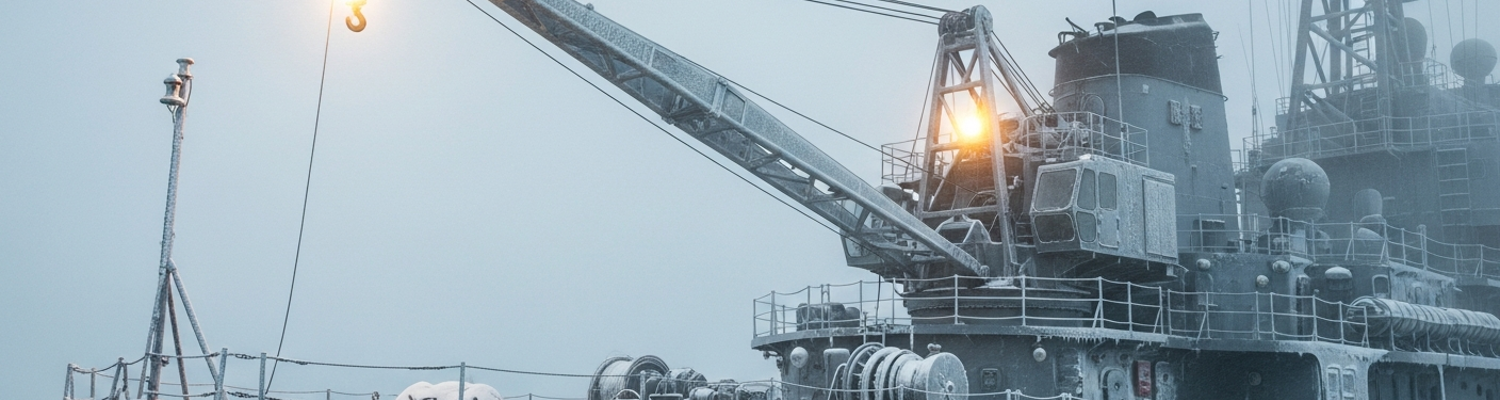
A review of deck logs from the Danish Falster-class minelayer HDMS Møen during the winter naval exercise NORTHERN WEDDING 82 provides a granular account of environmental attrition. As the vessel entered the pre-plotted coordinates for a simulated defensive minefield in the Great Belt, a severe weather system descended. The temperature dropped to minus twelve degrees Celsius. Wind speeds accelerated to 40 knots, driving horizontal, freezing sleet across the decks. The primary mine deployment crane, a 2.8-tonne capacity hydraulic unit, was essential and thus exposed. Within minutes, its steel boom and hydraulic rams became sheathed in rime ice. The crane operator, in a partially enclosed cab, found his visibility reduced to near zero by the sheeting ice on his armored glass viewport.
The cold was a direct assault on the ship’s mechanical tolerances.
Post-incident engineering analysis determined that the sustained sub-zero temperatures had a cascading effect. The viscosity of the standard-issue hydraulic fluid inside the lines increased, forcing the hydraulic pump to work at pressures beyond its specified limits. Simultaneously, the rubber and composite materials in the high-pressure flexible hoses and O-ring seals became brittle. Aboard the Møen, the operator was attempting to slew the crane arm, carrying a 1,500kg inert training mine, from the port-side storage rack toward the stern deployment rails. The system groaned audibly. At 03:47 local time, a flexible hydraulic hose connected to the main lift cylinder failed. The hose, made brittle by the cold, did not leak. It burst. A high-pressure jet of atomized hydraulic fluid erupted from the split, instantly depressurizing the entire lift system.
The two-ton crane arm, its load suspended six feet above the deck, dropped. The system’s emergency hydraulic brakes engaged with a violent shudder. The sudden deceleration caused the multi-ton training mine to swing wildly in its harness, a massive pendulum of steel arcing across the ice-slicked deck. The crane was completely disabled. The mission to lay the defensive barrier came to an immediate halt.
Naval command records show that at 03:51, the captain of the Møen transmitted a coded message to fleet headquarters, reporting the crane failure and aborting the minelaying sequence. The simulated defensive array, intended to block a key channel south of the island of Samsø, was left less than one-third complete. The ship, unable to either deploy or safely re-stow its primary ordnance, was ordered to retreat to the naval base at Korsør for emergency repairs. The incident report noted that the time required to source a replacement hose and purge the contaminated hydraulic system would be a minimum of 48 hours, leaving a significant gap in the alliance’s planned Baltic defenses.
Improvised Field Repairs Necessity
The crippled HDMS Møen arrived at Naval Base Korsør just before dawn, its deck coated in ice and the disabled crane arm lashed down with cargo straps. A damage assessment team was pier-side before the mooring lines were secured. Their findings confirmed the catastrophic failure of the primary lift cylinder’s main hydraulic hose. The immediate problem was twofold. First, the ship was out of the fight. Second, the principle of national responsibility for logistics in NATO meant that sourcing a replacement was solely a Danish problem. The base’s engineering support crews, already depleted from a 48-hour cycle of preparing vessels for Exercise NORTHERN WEDDING 82, were tasked with the repair. A review of station duty rosters from that period indicates these technicians were operating on less than four hours of sleep.
There was no replacement part in the naval depot.
The repair environment itself was an adversary. The blizzard continued to lash the naval base. Technicians attempted to erect a temporary canvas shelter around the crane pedestal, but the winds threatened to shred the material, forcing them to work in the open. Portable halogen lamps cast a harsh, unreliable glare, their light diffused by the driving sleet. Every surface was slick with a combination of frozen seawater and leaking hydraulic fluid. The extreme cold made the very metal of the crane brittle, with the simple act of loosening a frozen bolt requiring blowtorches and brute force. This was a desperate race against the clock on an ice-covered platform.
The core of the crisis was a lack of specialized equipment. The burst hose was not a standard component, but a custom-fabricated conduit with unique, non-standard fittings specific to that crane model. The engineering team was left with only one option: improvisation. Maintenance logs reveal the decision was made to attempt a field-expedient repair by salvaging fittings from a damaged piece of dockside loading equipment. This required cutting the failed hose and attempting to attach the salvaged, mismatched fittings. The team lacked the specific hydraulic crimping machine required to properly seat these fittings, forcing them to use a combination of brazing torches and manual vices to create a seal. It was a solution born of necessity, technically unsound and violating every standard operating procedure. Each technician understood that if their makeshift seal failed under load, the result would be another explosive rupture.
Aging Fleet Support Vehicle Maintenance
The operational tempo of NATO’s Baltic minelaying strategy was dictated not by its naval vessels, but by the mechanical reliability of an aging fleet of shore-based support vehicles. A review of West German Bundesmarine maintenance logs from the naval depots at Kiel and Eckernförde during the 1980s reveals a logistical chain on the verge of collapse. The primary workhorses for moving multi-ton sea mines from hardened ammunition bunkers to the pier-side loading cranes were MAN KAT1 4x4 and 6x6 trucks. These vehicles were engaged in a losing battle against their operating environment. The Baltic is a sea of brackish water, and the constant salt-laden air was a relentless corrosive agent. Maintenance reports repeatedly document severe oxidation on truck chassis, leaf spring assemblies, and, most critically, on hydraulic brake lines and electrical connectors.
Technicians at the Eckernförde depot, responsible for supplying mines to the Lindau-class converted minelayers, recorded a recurring series of failures directly attributable to corrosion. The constant exposure to saltwater spray and road salt attacked the unprotected wiring harnesses. A failure of an electrical connector could render a truck immobile, creating a bottleneck in the flow of ordnance. One after-action report from a 1983 readiness drill details how a MAN KAT1, loaded with four sea mines, suffered a complete electrical failure while navigating the narrow pier access road. The truck, its brake lights and indicators inoperative, had to be painstakingly towed clear, a process that took over two hours and halted the loading of two naval vessels. The root cause was identified as saltwater corrosion penetrating a primary electrical junction box.
The problem extended beyond oxidation. Extreme temperatures posed a direct mechanical threat. Cold was the primary enemy. Diesel fuel contains paraffin wax, which begins to solidify at low temperatures. A sudden temperature drop could clog fuel lines and filters, making a cold start impossible. Internal Bundesmarine reports from Exercise NORTHERN WEDDING 82 document widespread instances of this issue. At the Olpenitz naval base, maintenance crews were forced to use blowtorches to carefully heat the fuel tanks and lines of transport trucks in a desperate attempt to liquefy the gelled diesel. This hazardous procedure was deemed necessary to meet the exercise’s operational schedule. The cold also made engine oil thicken, accelerating engine wear.
This direct correlation between ground vehicle readiness and the rate of ordnance delivery was a significant bottleneck. NATO planners could design sophisticated minefields, but none of it mattered if the mines were stuck in a depot five kilometers from the port. Archival data from the German naval logistics command shows a stark mathematical relationship: for every 5% decrease in the mission-capable rate of the mine transport truck fleet, the overall ordnance delivery rate to the piers fell by nearly 15%. The delays cascaded. A single broken-down truck could block a vital access route for hours. A 1984 internal audit of the Kiel depot found that on any given day, an average of 20% of the logistics vehicle fleet was non-operational due to unscheduled maintenance, primarily related to corrosion and cold-weather failures.
Coastal Staging Facility Deterioration
An examination of West German Bundesmarine engineering reports from the Eckernförde and Kiel naval depots paints a picture of structural decay. The salt-laden sea spray was an aggressive corrosive agent. Maintenance dockets repeatedly document the seizure of galvanized steel roll-up doors on pier-side ordnance sheds, their tracks and rollers fused by oxidation. This meant that in a time-critical alert, naval personnel would have to resort to cutting torches to access the mines and torpedoes stored within. The corrosive atmosphere degraded electrical conduits and junction boxes that powered pier lighting and cranes, leading to unpredictable power failures during night-time loading operations.
The damage was structural.
The concrete of the loading piers themselves was under constant attack. Relentless freeze-thaw cycles allowed brackish water to penetrate the structures. Once inside, the saltwater corroded the internal steel rebar, causing it to expand. This expansion led to concrete spalling, where chunks of the surface would break away. A 1981 internal assessment of Naval Base Kiel noted that large sections of Pier 4, a primary ordnance loading point, were exhibiting advanced stages of rebar corrosion, with repair requests being consistently deferred due to budget limitations. This physical decay directly translated to operational inefficiency and danger.
Hypothermia was a documented operational hazard. A review of personnel logs from Naval Base Korsør in Denmark during winter exercises shows a persistent rate of cold-weather injuries. The large, hangar-like buildings had poor insulation and doors that were frequently open, rendering portable heating units almost useless. The cold directly impacted human performance, reducing manual dexterity for crews tasked with handling the sensitive arming mechanisms and fuzes of naval mines.
Equipment was just as vulnerable. Batteries for everything from handheld radios to engine starters on forklifts performed poorly in sub-zero temperatures. Lubricants and hydraulic fluids thickened. U.S. Navy cold-weather operations manuals specifically warn that metal becomes brittle and skin can freeze to it on contact, a constant risk for anyone working on exposed machinery.
In a full-scale alert, thousands of tons of mines had to be moved from dispersed bunkers to temporary pier-side staging areas. These staging points were often little more than designated patches of asphalt, with multi-ton mines stacked on pallets and covered by tarpaulins. This practice created a massive concentration of high explosives in a vulnerable, open-air setting. A 1984 NATO readiness assessment highlighted the extreme risk this posed, noting that a single errant artillery shell or a surprise air attack on a staging area like the one at Lyngsbæk Pier could trigger a catastrophic chain reaction. Handling these weapons in freezing, wet conditions was exceptionally hazardous. Mine casings slick with ice were difficult to secure with lifting slings. The pressure to load ships quickly forced crews to take calculated risks, handling volatile ordnance in conditions that violated every peacetime safety regulation.
Pervasive Visibility Obstacles
Archival evidence from NATO Cold War exercises shows that for every vessel disabled by mechanical failure, another was rendered operationally inert by weather.
A blinding snow squall in the Baltic Sea is a vertical and horizontal wall of white that descends with shocking speed. A review of bridge logs from the West German minesweeper FGS Koblenz during a 1984 readiness drill details such an encounter. Engaged in a simulated minelaying run south of the Danish island of Lolland, the vessel was engulfed by a squall that reduced visibility to less than 50 meters in under ten minutes. The ship’s Decca navigation radar, already struggling with sea clutter, became functionally useless. On the exposed deck, where a team was preparing the deployment rails, wind chill dropped to minus twenty degrees Celsius. The deck crew, connected by safety tethers, could not see from one end of the apparatus to the other. Hand signals became impossible. Communication was reduced to shouts muffled by the wind. The operation was immediately aborted. The Koblenz was forced to reduce speed to a crawl, a high-value target blinded and dead in the water.
Fog transformed routine logistics into a slow-motion nightmare. The cold Baltic water meeting warmer, moist air frequently produces dense advection fog banks that can persist for days. A post-exercise analysis from a 1986 Danish naval maneuver documents the effect on a resupply run to the minelayer HDMS Falster, which was holding a stationary position in the Kattegat. A small naval tender, tasked with a simple four-hour transit, found itself enveloped by fog. The journey took seventeen hours. The vessel’s captain was forced to navigate almost entirely by sound, sounding his foghorn and listening for the Falster’s reply. The constant risk was collision with commercial ferries and cargo ships. The minelayer, its mission clock ticking, was forced to burn its own fuel reserves simply to maintain its station.
The most perilous operations were the integrity checks.
After a minefield was laid, doctrine required a follow-up pass to verify the position and status of the mines. A review of procedural documents for the Royal Danish Navy’s Sund-class minesweepers reveals this to be a task of acute danger. The ship had to sail directly back through the field it had just created. Visibility was zero. The mines were on the seabed, hidden by the turbid water. The only sense was the vessel’s side-scan sonar, which painted a grainy, ambiguous picture of the seafloor. The minesweeper would creep forward at less than four knots, the sonar operator attempting to distinguish the acoustic signature of a friendly mine from a boulder or an old shipwreck. A navigational error of a few meters could drift the vessel onto one of its own weapons. Command records show that these integrity checks were frequently cancelled if conditions were anything less than perfect.
Strategic Timelines vs. Operational Delays
An analysis of NATO command-level planning documents reveals a disconnect between strategic ambition and attainable results. The core of the Baltic denial strategy hinged on the ability to lay thousands of sea mines across the Danish Straits within the first 24 to 48 hours of a conflict. This was the theoretical requirement. After-action reports from the NORTHERN WEDDING and BALTOPS series demonstrate that these timelines were consistently optimistic. The schedules created by planners failed to account for the cumulative effect of small, mundane delays.
The friction began at the pier. The process of loading a minelayer like a Danish Falster-class was a complex, multi-hour evolution that was frequently disrupted. A single MAN KAT1 transport truck suffering an electrical failure could halt the loading of two vessels for hours. A forklift with a dead battery inside an ordnance depot could idle an entire loading team. These were not isolated incidents. They were the norm.
Once at sea, the delays cascaded. A ship's departure from port might be delayed four hours waiting for a specific mine type, causing it to miss a planned transit window. This forced the vessel to slow down or alter course, burning additional fuel and pushing its arrival at the minefield coordinates further behind schedule. Weather was never adequately buffered in the planning. A sudden fog bank could reduce a ship’s speed to a crawl for hours, while a blizzard could make deck operations impossible. A review of bridge logs from multiple exercises shows it was common for minelaying runs to be aborted or only partially completed due to weather that was entirely typical for the region.
This chronic inability to meet deployment schedules had a direct effect on the entire defensive posture. A minefield intended to be a solid, impassable barrier became, in reality, a series of fragmented and incomplete patches with known gaps. A twelve-hour delay in laying one section of a field meant that for twelve hours, a clear channel existed for a potential Warsaw Pact sortie. Soviet naval reconnaissance, highly active in the Baltic, would have been able to identify these gaps. The gap between the planned, solid line on a map in a command bunker and the porous, delayed reality on the water represented a critical vulnerability in NATO’s northern flank.