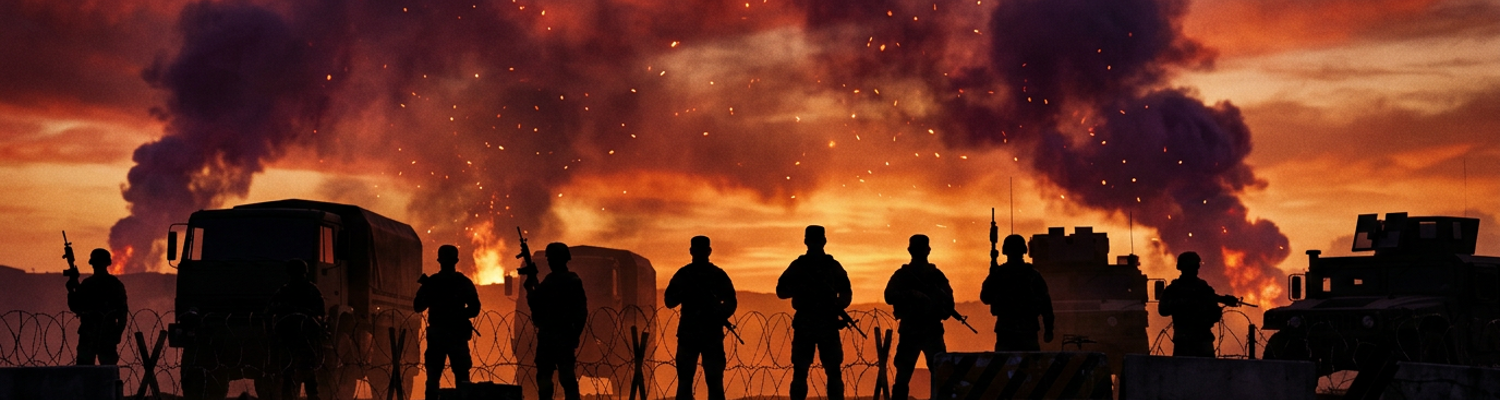

Convoy Deployment along University Avenue
Transmission gears stripped inside the lead quarter-ton utility truck when the driver rammed a burning timber roadblock at thirty miles per hour. Metal teeth sheared from the countershaft with a loud mechanical crack, sending boiling gear oil spraying across the floorboards and filling the open cab with thick grease smoke. Enlisted military policemen slammed their combat boots against the firewall to brace against the sudden deceleration, coughing through rubber M17 protective masks that were already saturated with tear gas seeping past their cheek seals. The driver wrestled the transfer case lever into low range, grinding the remaining drive gears together to force the crippled truck over the smoking logs. Squad leaders leaned over the canvas half-doors with empty rifles to push burning branches clear of the front axles.
Branches and smoldering debris blocked the asphalt lanes of University Avenue just past the city railroad depot, trapping the vehicle column between residential brick walls and hostile crowds. The 503rd Military Police Battalion deployed their two-and-a-half-ton cargo trucks along this corridor on September 30, 1962, advancing abreast with Company A of the 716th Military Police Battalion to reach besieged federal marshals at the campus center. Insurgents hiding in darkened yards pelted the canvas-topped trucks with gasoline bombs, concrete chunks, and iron pipes, denting olive-drab steel hoods and shattering safety glass windshields. Rioters dragged telephone poles and scrap farm machinery across intersections to create fortified road blocks, forcing convoy drivers to hit the obstacles at full throttle without slowing their momentum. Squad leaders leaned over the wooden troop racks to watch for ambushes, their standard wooden riot batons splintering as they struck rioters attempting to scramble over the tailgates.
Tailgate boarders fell away as lead bullets from hunting rifles tore into the truck canopies and the convoy entered the final approach toward the campus perimeter. Sniper fire flashed from second-story residential windows and dense magnolia trees along University Avenue, drilling holes through metal door panels and showering drivers with fragmented glass. Strict rules of engagement ordered the military policemen to advance with unloaded weapons, leaving the soldiers to absorb direct hits behind fiberglass riot shields while chemical gas clouds from federal tear gas canisters drifted back into their open cabs. Drivers ducked below dashboard level to steer blindly through chemical smoke that burned their exposed necks, keeping their tires rolling over iron railroad spikes and broken soda bottles scattered across the pavement. Flat tires flapped violently against metal wheel wells as inner tubes tore apart, but the convoy kept moving forward to push battered bumpers against the campus entrance gates.
Gates of heavy iron collapsed under the weight of the lead truck, opening a narrow corridor into the tear-gas haze of the campus grounds. Utility vehicles and troop haulers ground their remaining gears across the torn grass of the Grove, swerving past burning passenger cars and overturned sedans that illuminated the dark driveways with orange flames. Snipers reloaded behind nearby brick academic buildings, sending shotgun pellets bouncing off the steel helmet shells of the soldiers while drivers steered overheating engines toward the circular drive in front of the Lyceum. Convoy commanders signaled with red lens flashlights from truck cabs, directing the 503rd and Company A to dismount and establish a protective perimeter of vehicles around the exhausted federal marshals holding the administration building steps.
Tactical Isolation at the Campus Lyceum
Soldiers leaped from the cargo beds to form a ring of interlocking riot shields across the Lyceum portico, pushing between the screaming crowd and the battered federal marshals collapsed on the stone stairs. More than one hundred marshals and civilian deputies had absorbed hours of bricks, iron pipe blows, and shotgun blasts, leaving dozens bleeding from head wounds with their tear gas canisters almost completely spent. Civil officials dragged the wounded men across the threshold onto makeshift triage pallets arranged in the central corridor. Squad leaders from the 503rd positioned their soldiers shoulder to shoulder along the outer perimeter, locking their bayoneted M14 rifles across their chests to absorb flying rocks while enforcing orders to keep their ammunition magazines packed in their web pouches. Army commanders pushed through the front double doors into the gas-choked administration offices to link up with civilian leadership and establish an operational headquarters.
Headquarters radios crackled with static, revealing an absolute failure of operational coordination between incoming military officers and Mississippi law enforcement agencies. Local police and state highway patrol units had cut off direct radio communication, abandoned their traffic posts around the university, and pulled their patrol cars completely back into the town square without sharing road intelligence. Military dispatchers tried to reach state patrol channels on their tactical frequency bands, but civil authorities refused to provide the assigned frequencies or relay reports about armed groups gathering in the nearby streets. Commercial telephone lines into the Lyceum went dead when rioters cut the outside utility wires, leaving army leaders unable to coordinate movements with nearby reinforcement convoys still stuck on University Avenue. Brigadier General Charles Billingslea and his staff had to rely on fragmented radio relays passed through federal marshals to map out hostile firing nests in the surrounding darkness.
Darkness concealed snipers in the oak groves who opened fire on the Lyceum portico, striking the white building pillars and shattering second-floor window panes right above the defensive perimeter. Soldiers holding the line could not return fire under their strict instructions, forcing them to crouch behind their dented fiberglass shields while shotgun pellets hammered against their steel helmets. Heavy tear gas drifted backward into the ranks, clogging the intake valves of their rubber M17 masks and blinding the enlisted men with caustic powder that burned their sweat-soaked skin. Drivers parked the two-and-a-half-ton trucks bumper to bumper along the circular curb to construct a barricade, using the heavy steel cargo beds to shield the front steps from hunting rifle bullets. Squad leaders checked the firing chambers of their rifles to ensure they remained empty, keeping their men disciplined with shouted commands through their mask diaphragms while rioters hurled glass bottles filled with gasoline against the truck tires.
Tires on the outer trucks began to burn when rioters threw bottles of gasoline against the wheels, forcing soldiers to beat out the flames with riot batons and wet wool blankets. Exhausted federal marshals inside the entrance doorway passed out their remaining cartons of chemical tear gas grenades to the front-line squads, providing the soldiers with their only standoff weapon against the surging mob. Officers formed small dismounted teams to sweep the grass outside the portico, throwing tear gas canisters into the darkness to drive rioters back from the stalled utility trucks. Army mechanics crawled underneath damaged trucks with wrenches and wire to bind cracked steering rods, keeping the vehicles operable to transport wounded marshals from the steps into the building. Soldiers held the ring of vehicles through the night, maintaining the Lyceum perimeter by physical force until additional infantry battalions fought their way into the campus from the Oxford town square.
Strict Rules of Engagement and Ballistic Exposure
Infantrymen from the newly arrived battalions deployed directly alongside the battered military policemen, but every soldier operated under absolute restrictions that stripped them of standard defensive firepower. Federal orders barred enlisted soldiers from chambering M1 Garand ammunition without explicit signoff from a general officer, leaving whole companies standing in combat formation with empty rifle receivers. Eight-round ammunition clips remained locked inside heavy canvas web pouches because Brigadier General Charles Billingslea held sole operational authority to release live rounds. Company officers enforced this directive by ordering soldiers to keep rifle operating rods resting on empty chambers, ensuring that no projectile could enter the barrel even by accident. Military police squad leaders paced directly behind the line to inspect the open receivers of each weapon, verifying that no panicked soldier inserted an en bloc clip when hunting rifle rounds cracked overhead from nearby trees. Command doctrine treated the deployment strictly as a civilian crowd control mission rather than a combat operation, forcing the men to rely solely on fixed bayonets and interlocking riot shields while armed domestic insurgents targeted their positions from darkened campus buildings.
Buildings surrounding the Lyceum provided cover for rioters who realized that the military units would not fire back and closed the distance, subjecting the front ranks to continuous ballistic and chemical assaults at point-blank range. Hunting shotguns fired birdshot into the defensive perimeter from only paces away, spraying lead pellets that struck the exposed faces, necks, and hands of the soldiers while heavier loads dented their steel helmet shells. Insurgents hurled chunks of heavy concrete and jagged red bricks gathered from university walkways directly into the formation, fracturing jawbones and cracking fiberglass riot shields as soldiers braced together to keep their cordon intact. Glass soda bottles filled with concentrated sulphuric acid stolen from the university science laboratories burst across the front line, splashing corrosive liquid that dissolved protective rubber gas masks and ate through heavy cotton uniform fabric. Corrosive acid burned deep into the bare skin of frontline military policemen, searing eyes and blistering hands as chemical fumes combined with saturated tear gas clouds inside the ranks. Enlisted men absorbed the severe burns and blunt trauma without breaking ranks, holding their passive cordon line across the asphalt while obeying orders never to chamber a round or raise their rifles to aim.
Medics crawled directly behind the rank of riot shields to pull fallen soldiers out of the chemical puddles and flush acid-burned faces with cold water from five-gallon vehicle cans. Field commanders transmitted repeated radio requests to headquarters for permission to chamber live ammunition as the casualty count among the military police and marshals climbed steadily past one hundred wounded men. General Billingslea continuously denied each request, determined to prevent mass civilian casualties that would immediately follow an open volley of thirty-caliber rifle fire into the crowd. Deprived of permission to shoot, frontline soldiers absorbed hours of physical punishment, using short thrusts with wooden batons and horizontal pushes with blunt rifle stocks to drive back aggressive attackers who tried to drag men out of formation. Troop leaders steadily plugged gaps in the perimeter as stretcher teams hauled unconscious military policemen into the Lyceum triage stations, preserving the passive cordon through physical endurance. Soldiers held that continuous ring around the administration building until the first light of dawn exposed armed snipers, breaking the momentum of the crowd and forcing the domestic insurgents to abandon their assault positions across the campus grounds.
Protective Equipment Degradation and Chemical Saturation
Policemen loosened their web belts as the immediate gunfire slackened, but the soldiers remained trapped inside suffocating M9A1 protective masks that had failed across the defensive line. Filter canisters screwed into the left cheeks of the gray rubber facepieces had absorbed hours of dense tear gas clouds mixed with heavy soot from burning car tires and smoldering wood barricades. Microscopic carbon particles and caustic chemical crystals completely packed the porous filter elements, restricting airflow through the intake channels until breathing became an agonizing struggle. Chemical agents saturated the rubber material itself, allowing burning droplets to pool inside the chin cups and seep past sweat-slicked cheek seals directly onto raw skin. Soldiers experienced intense burning across their eyes, noses, and throats as caustic vapor bypassed the saturated filters. Squad leaders ordered their men to clear the facepieces by exhaling with force, but oily soot glued the delicate rubber flutter valves shut, trapping stagnant gas inside the masks and triggering violent bouts of vomiting.
Batons of fractured hardwood lay across the grass and sidewalk where sickened soldiers had swung against blunt weapons to defend the cordon through the night. Standard thirty-six-inch wooden sticks had splintered along their grain lines after repeatedly striking iron pipes, heavy timber clubs, and hurled concrete chunks. Soldiers whose batons had snapped in half were forced to raise their unloaded rifles to block incoming projectiles, which exposed the weapons to direct damage and heavy contamination. Airborne soot from overturned burning trucks and pulverized masonry dust drifted straight into the open bolt tracks and receiver wells of the unchambered rifles. Operating rods jammed halfway along their guide channels as oily soot caked the moving steel surfaces, while carbon grit settled into the bolt raceways and locked the rotating bolt assemblies tight. Squad leaders attempted to clear the soot-fouled rifle mechanisms by working the bolt handles with their boot heels, but the gritty buildup seized the actions and rendered the weapons completely inoperable for defensive handling.
Jeeps parked behind the cordon suffered equally catastrophic mechanical failures as drivers attempted to shift positions and haul contaminated weapons away from the front ranks. Drivers had repeatedly slammed their transfer cases into low range to ram through roadblocks and push abandoned civilian sedans away from the Lyceum drive. Severe shock loads on the drivelines sheared the teeth off the transmission countershaft gears and stripped the ring and pinion sets inside the front axles. Metal gear fragments ground against internal bearings, locking transfer case levers in place and filling the vehicle undercarriages with the stench of scorched lubricant. Stripped jeep drivetrain gears left multiple utility trucks dead in the circular roadway, blocking the primary evacuation paths needed for wounded marshals. Drivers jumped out of the stalled vehicles to uncouple seized driveshafts with hand wrenches, allowing other soldiers to manually push the dead trucks into defensive positions along the perimeter curb.
Mechanics set up an emergency repair point behind the Lyceum portico to salvage whatever operational equipment remained functional for the day ahead. Support personnel drained smoking gear cases, stripped jammed rifle components down to the bare receivers, and washed the soot-covered operating rods in five-gallon cans of solvent. Supply sergeants cracked open reserve wooden crates to distribute replacement batons and fresh filter elements to military policemen standing along the outer line. Exhausted soldiers pried off their clogged M9A1 canisters and screwed in the clean replacement filters, clearing their airways as fresh air finally entered the rubber facepieces. Squad leaders inspected every cleaned weapon receiver, reassembled the bolts, and checked each position along the vehicle barricade. Company commanders ordered the fortified perimeter to hold steady around the administration building while fresh federal infantry units moved outward to secure the surrounding campus streets.
Tactical Improvisation and Compound Defense
Riflemen stepping beyond the Lyceum circle caught immediate ballistic fire from domestic rioters crouching behind oak trees and parked vehicles along the outer avenues. Insurgents armed with commercial sporting rifles and heavy hunting shotguns targeted the advancing soldiers, sending lead bullets cracking through the tree limbs and gouging into the asphalt. Army field manuals had instructed the troops to clear civilian crowds by advancing in triangular riot wedges, but these textbook formations proved fatal against direct rifle fire. Squad leaders immediately ordered their men to abandon the open riot wedges when high-velocity rounds began striking equipment belts and ricocheting off steel helmets. Soldiers pulled back toward the administration drive to avoid being cut down in the open, leaving textbook dispersal doctrine behind to construct a static perimeter.
Perimeter barricades required heavy physical mass, forcing soldiers to drag scorched M37 cargo trucks into an interlocking crescent across the circular drive. Drivers and riflemen shoved the smoldering trucks bumper to bumper across the pavement, using the blackened steel bodies and ruined cargo beds as defensive shields against incoming rifle fire. Soldiers locked long bayonets onto the muzzles of their unloaded rifles and stepped into the narrow gaps between the truck bumpers, thrusting the steel points forward to hold the line. Sharp bayonet blades created an unbroken barrier that kept rioters from climbing over the hoods or slipping past the flattened tires into the administration compound. Squad leaders stood directly behind the vehicle axles, bracing the line and using wooden axe handles to knock aside club-wielding attackers who attempted to reach over the truck fenders. This improvised vehicular barricade absorbed continuous volleys of rocks and sporting rifle bullets, keeping the isolated defense intact without firing a single defensive shot.
Rioters escalated their assault against the vehicle barricade by starting up a heavy diesel bulldozer commandeered from a nearby campus construction site. Insurgent drivers slammed the machine into gear and steered the steel blade directly toward the Lyceum portico, intending to smash through the parked trucks and crush the soldiers holding the line. Riflemen behind the barricade held their ground with fixed bayonets as the steel tracks tore across the campus turf and diesel fumes washed over the defensive perimeter. Federal marshals and military police squad leaders leaned across the truck hoods to fire a concentrated volley of tear gas projectiles directly into the open operator cab. Caustic tear gas blinded the civilian driver, causing him to choke and leap from the moving vehicle before the blade could ram the defensive line. Policemen swarmed the idling machine, jamming the throttle linkage and disabling the heavy controls to halt the bulldozer just yards away from the M37 barricade.
Mechanics severed the fuel lines and drained the hydraulic fluid from the captured bulldozer to ensure that the heavy machine could not be restarted. Squad leaders then redistributed their remaining tear gas munitions along the front bumpers, directing every man to keep his bayonet leveled at waist height toward the darkened campus. Insurgents continued to loose intermittent hunting rifle fire and hurled bricks at the trucks, but the reinforced barrier denied the rioters any physical breach into the administration offices. Company commanders repositioned perimeter squads into tight defensive teams around the Lyceum entrances, anchoring the flanks of the compound while awaiting brigade reinforcements. Sentries maintained their bayonet positions against the truck fenders through the remaining hours of darkness, repelling every rush until sunrise exposed the surrounding campus clearings.