
The Post-Evacuation Mortality Spike
The final casualty reports from the Hungnam evacuation in December 1950 told a story the initial combat reports did not. A close review of operational logs from the 72-hour period following the main withdrawal reveals a sharp, statistically undeniable spike in mortality rates among wounded US Navy and Marine Corps personnel. The Died of Wounds classifications, a grim accounting of men who survived the initial battlefield injury only to die later, escalated by a factor of three against projections.
These were not deaths from overwhelming, unsurvivable combat trauma. Post-mortem analyses documented a repeating pattern. Deaths from extremity exsanguination despite the application of tourniquets. Fatalities from sepsis that began in non-lethal abdominal wounds. Systemic shock induced by otherwise manageable tissue damage. The data pointed away from the effectiveness of enemy weapons and directly toward a failure in the post-injury chain of survival. Men stabilized at battalion aid stations on the frozen perimeter were dying hours later, within sight of the fleet.
The cause of death was not the enemy's weapon, but the clock. The critical 'golden hour' for trauma care became a six, eight, or even ten-hour ordeal. This was a direct result of logistical collapse. Designated beachmaster units, tasked with coordinating traffic from the shore, were overwhelmed, creating a chaotic backlog of vessels. Landing Craft Utility boats, never designed for medical transport, were commandeered as makeshift ambulances. Their slow speed and open decks exposed the wounded to hypothermia and the elements for hours.
Communications nets, saturated with tactical traffic for naval gunfire and air support, lost the urgent CASEVAC requests from corpsmen on the ground. The pleas for transport vanished into digital noise, leaving stabilized casualties waiting for a boat that was never dispatched.
This surge in post-combat deaths occurred while the most advanced medical facilities on the planet floated just over the horizon. The naval hospital ships USNS Comfort and USNS Mercy, each a 1,000-bed floating hospital with state-of-the-art surgical suites, were on station. A command decision, however, held them in a designated safe corridor approximately 90 nautical miles from the Hungnam beachhead. Intelligence indicated a credible threat from shore-based anti-ship weapons. From the fleet admiral’s perspective, the risk of losing a hospital ship, a non-combatant vessel and a massive symbol of national commitment, was tactically and politically unacceptable.
The consequence of this risk mitigation was that a landing craft carrying a critically wounded marine faced a five-to-six-hour transit just to reach life-saving care. That transit time alone exceeded the survivable window for a casualty with a non-compressible torso hemorrhage.
The LST-870 Mine Encounter
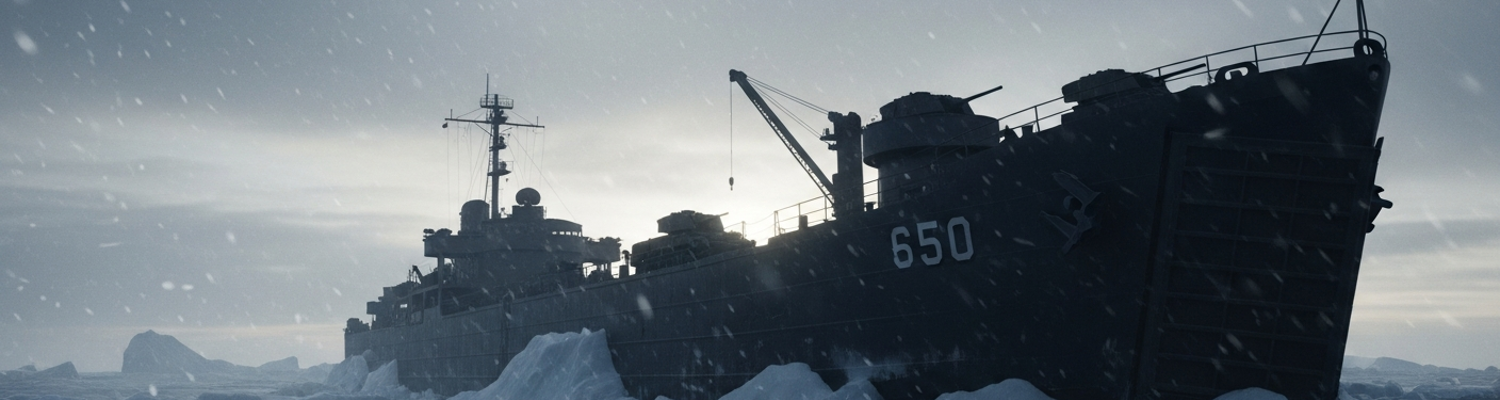
By mid-December 1950, the port of Hungnam was a choked chaos of vessels. Into this maritime environment sailed Landing Ship, Tank-870. Its crews called the LST class the 'Large Slow Target.' LST-870 was a World War II design, a flat-bottomed ship with large bow doors made to ground itself on a beach and disgorge tanks. Its presence was part of the massive sealift to pull X Corps, including the 1st Marine Division, off the continent. The ship was built for amphibious assault, not for the grim task of mass evacuation under fire.
Its mission was a product of desperation. With dedicated hospital ships held far offshore, operational command repurposed any available hull. A review of ship logs (NARA Record Group 313) shows LSTs were frequently tasked with bringing casualties off the beaches after delivering their cargo. LST-870 was designated an emergency casualty transport. Its cavernous, unheated tank deck, a steel expanse designed for M4 Sherman tanks, became a makeshift hospital ward. Stretchers were lashed to the deck plates in rows. There were no surgical suites, no sterile environments, and not enough medical personnel for the dozens of wounded men brought aboard from overwhelmed aid stations.
They lay exposed in the vast, cold interior, at the mercy of a vessel designed to haul machines.
Transit from the Hungnam perimeter was through a known minefield. Naval intelligence was aware that North Korean forces, with Soviet assistance, had seeded the coastal waters. The primary threat came from shallow-water contact and magnetic influence mines, deployed from low-tech wooden barges and fishing boats. U.S. minesweeping technology was challenged by these devices. The danger was not theoretical. A Japanese freighter supporting the evacuation had already struck a mine in the harbor on December 10th.
LST-870 cleared the relative safety of the naval gunfire support line and entered the designated channel. It was navigating waters where the enemy was actively trying to re-seed mines.
In this contested water, the ship was struck. A concussive blast, likely from a moored contact mine the ship's flat-bottomed hull ran over, ripped through the forward third of the vessel. The explosion buckled the hull plates. Seawater immediately began flooding the forward compartments, and the ship took on a sudden, dangerous list. The impact threw men and equipment across the tank deck, inflicting new injuries on the crew and the helpless casualties below. A vessel already failing as a hospital was now a sinking trap. Damage control parties fought to control the flooding, knowing that hundreds of wounded men lay just feet away, unable to escape the rising water.
Fragmented Intelligence and Communications
The intelligence failure off the Korean coast was rooted in a fundamental underestimation of the enemy. Naval intelligence assessments preceding the Wonsan landing and Hungnam evacuation systematically discounted the threat from North Korean mine warfare. High command refused to believe a primitive navy could challenge U.S. sea control. The reality, supported by extensive Soviet technical advisors, was a massive and sophisticated mining campaign. Over 3,000 mines were laid in the Wonsan area alone, a mix of older contact types and advanced Soviet-made magnetic and pressure-activated models. They were deployed by civilian laborers on wooden barges and fishing junks at night, making them nearly impossible to track.
This simple tactic effectively weaponized a 400-square-mile area of the harbor.
The U.S. was ill-equipped to handle it. Post-World War II demobilization had gutted the Pacific minesweeping fleet. The few active ships were outdated wooden-hulled sweepers, effective against standard moored mines but dangerously vulnerable to magnetic variants designed to detonate by sensing a steel hull's magnetic signature. The discovery of these advanced mines often happened when a vessel was destroyed, forcing clearance operations to a crawl.
Intelligence that did exist was often trapped by fragmented radio protocols. A post-war transition within the U.S. Navy from Very High Frequency (VHF) to Ultra High Frequency (UHF) radios was incomplete. Newer American ships could not always communicate with older minesweepers, allied vessels from the British Royal Navy, or shore-based Marine units still on VHF systems. A Japanese minesweeper under U.S. contract might identify a new line of suspected mines, but its report, transmitted over a local VHF channel, would never be received by the UHF-equipped task force command ship orchestrating the movements of transports like LSTs. The solution was to relay messages through intermediary ships, a cumbersome process that introduced delays.
Layered on top of these radios, cryptographic systems added another barrier. To maintain security, the American naval command provided allied ships with certain multinational ciphers but reserved others for U.S.-only communications. It was a common occurrence for crucial operational messages to be accidentally sent in a U.S.-only cipher to a British or Canadian destroyer, which lacked the keys to decrypt it. The message, containing updated coordinates for a new minefield, would have to be re-transmitted by a U.S. ship in the correct format, wasting more time.
Within the Far East Command, a rigid hierarchy of signal prioritization consistently relegated naval intelligence to a lower tier than immediate tactical requests from ground forces. General MacArthur’s headquarters staff in Tokyo was responsible for coordinating the Army, Navy, and Air Force, but a severe reduction in intelligence personnel after World War II had left the command structure with gaps. A Marine unit’s urgent call for close air support would receive priority on the strained communications networks. A Navy minesweeper group’s report on suspicious surface contacts in a supposedly cleared channel simply could not compete. The entire system was structured to prioritize the ground fight, leaving ships moving through contested waters dangerously uninformed.
The 36-Hour Delay
Declassified communications records (ASA-PAC File K-77B-1) show the first hint of the impending disaster was captured not by a naval vessel, but by a small, isolated Army Security Agency listening post in Japan. The intercept was a high-frequency radio transmission, heavily encrypted, originating from a known Soviet advisory signal unit and directed to a North Korean naval command element on the coast. The transmission’s origin and destination alone were enough to trigger a high-priority alert. The ASA, a fledgling organization born from the post-WWII restructuring of military intelligence, was tasked with monitoring Soviet and Chinese communications. Korea was often a secondary concern.
This was an exception.
The message was flagged under a special handling protocol, a remnant of WWII procedures for exceptionally sensitive signals intelligence. This protocol physically removed the intelligence from normal dissemination channels. Instead of being immediately analyzed and forwarded to Naval Forces Far East (NAVFE), the raw intercept data was hand-carried by a designated officer on a C-47 Skytrain transport flight from Japan to the Armed Forces Security Agency headquarters in Washington D.C. for decryption. This process was a direct result of inter-service rivalry. The Army, Navy, and Air Force cryptologic agencies had only recently and reluctantly joined under the AFSA umbrella, and each service jealously guarded its collection capabilities. The Navy had few of its own dedicated SIGINT assets in theater, making it reliant on Army and Air Force collection.
This dependency created a procedural bottleneck. A full 36 hours elapsed between the initial intercept in Japan and the delivery of the decrypted intelligence to the watch officer at the Office of Naval Intelligence in the Pentagon. From there, it had to be relayed back across the Pacific to General MacArthur's Far East Command in Tokyo and then, finally, to the Commander of Seventh Fleet, the operational command responsible for the evacuation. The message content was devastatingly specific. It contained a list of grid coordinates for a newly laid field of Soviet-made magnetic influence mines. The coordinates detailed a dense barrier laid directly across the primary deep-water channel leading away from the beachhead. The very channel designated as the 'safe' transit corridor for heavy transport ships.
By the time the warning arrived, it was a historical document, not actionable intelligence. The information was over a day and a half old. During that 36-hour window, dozens of ships, including LST-870 laden with casualties, had already received their sailing orders. They were navigating directly into the kill box identified in the intercept. The system designed to protect intelligence from the enemy had, in practice, protected the intelligence from its own forces until it was too late.
The Cryptographic Personnel Shortage
A post-mortem of naval intelligence operations during the Korean War reveals a system on the verge of collapse before the first shots were fired. The rapid demobilization following World War II had stripped the armed forces of their most experienced personnel. A review of the U.S. Navy's Naval Security Group rosters from 1945 to 1950 shows a catastrophic loss of institutional knowledge. The group responsible for signals intelligence and cryptology saw its ranks of trained specialists evaporate. Veteran Morse intercept operators, seasoned traffic analysts, and the small cadre of trained cryptanalysts and linguists were gone, returned to civilian life.
Expertise had been sent home.
The few intelligence collection platforms available to the Seventh Fleet, often just destroyers with a hastily-installed radio van welded to their decks, frequently operated with skeleton crews. A unit designed for a 24-hour, three-shift watch cycle might only have enough qualified personnel for a single shift, leaving the radio spectrum unmonitored for sixteen hours a day.
This shortage created an insurmountable backlog in the decryption and analysis of intercepted communications. On a fully-manned intelligence vessel, the process was a production line: an intercept operator captured a coded transmission and passed the raw data to a team of cryptanalysts for immediate processing. During the Korean War, that production line was broken. Archival records from the Armed Forces Security Agency show that even when a signal was intercepted, it often went into a physical queue of paper transcripts and magnetic tapes. There were not enough trained analysts to process the volume of incoming data.
An overworked analyst might be faced with dozens of low-priority intercepts that had to be manually sorted through. The complex Soviet-made encryption systems used by North Korean and Chinese forces required painstaking, manual work with codebooks and worksheets, a process that could take hours or days for a single message.
The queue of unread messages became a physical stack of paper.
This intelligence gap was directly responsible for losses at sea. The system was forced to triage, prioritizing high-level command network traffic while lower-priority signals were ignored. This created a blind spot. Declassified intercept logs show that intelligence regarding North Korean mining operations was often contained in these supposedly low-priority transmissions. A signal from a Soviet naval advisor to a local North Korean port authority, for example, discussing the unloading schedule for 'specialized naval stores' would be flagged as low-priority and placed at the bottom of the analysis queue. By the time an analyst decrypted it 48 or 72 hours later, the message would reveal the delivery of thousands of Soviet magnetic and contact mines. The operational orders routing transport ships like the LSTs through supposedly safe channels had already been issued. The ships were sailing directly toward minefields that U.S. intelligence had technically already discovered, but had failed to process in time.
The Collapse of Medical Doctrine
Amphibious warfare doctrine from the period shows a clear, multi-echeloned system for casualty evacuation. The chain of care began with a corpsman on the front line, moving a wounded Marine to a battalion aid station for stabilization. From there, the plan dictated a transfer to a larger collection station and then evacuation by landing craft to a designated transport or, ideally, a fully equipped hospital ship positioned offshore. In a winter campaign, speed was paramount. Medical planners understood that every moment a casualty spent exposed to the elements drastically reduced their chances of survival, turning survivable wounds into fatal encounters with hypothermia and shock.
The entire system was built to move a casualty from the battlefield to a surgical suite within the 'golden hour.'
This doctrinal plan collapsed.
The primary reason was the command decision to hold the hospital ships in a safe corridor nearly 90 nautical miles from the beachhead. This single choice broke the chain of evacuation at its most important link. The multi-hour transit time required to reach these ships made a mockery of the golden hour. On the ground, the communications architecture disintegrated. Post-action analysis of radio logs indicates medical evacuation requests, transmitted on low-priority VHF frequencies, were consistently lost in the chaotic static of high-priority UHF combat traffic.
With the doctrinal system shattered, commanders turned to improvisation. Any vessel with a deck was pressed into service as a makeshift ambulance. A close examination of ship manifests and operational orders reveals the widespread repurposing of Landing Ship, Tanks as casualty transports. This decision, a tactical necessity born of desperation, was catastrophic for the wounded. The unheated steel cavern of an LST's tank deck became a de facto hospital ward. There were no sterile surgical bays, no proper lighting, no climate control. Wounded men were laid on stretchers directly onto cold, vibrating steel plates, often in pools of oil and seawater.
An insufficient number of corpsmen, equipped only with basic battle dressings, were left to manage hundreds of critically injured men in these conditions. They lacked plasma, which often froze and broke its glass bottles in the extreme cold. They lacked the surgical tools and sterile environment needed to provide meaningful care. The LST, a logistical workhorse built to deliver the tools of war, had been turned into a floating gallery of suffering, amplifying the very injuries it was supposed to help heal.