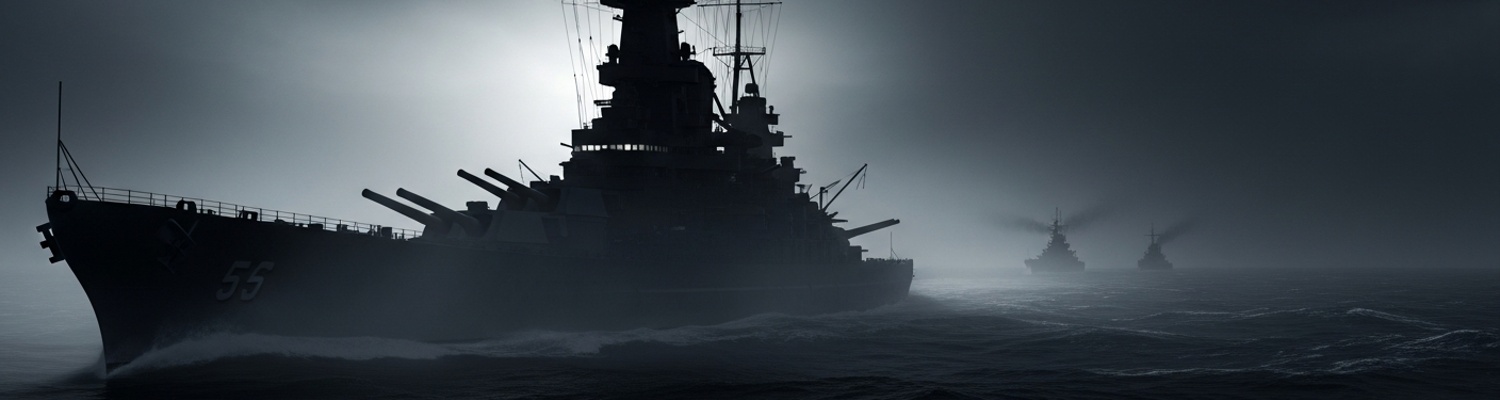

The Great Pacific War Game
0400 local time. May 3, 1935. Position 45°N, 175°W. The United States Fleet, designated Black Force and commanded by Admiral Joseph M. Reeves, initiated the main phase of Fleet Problem XVI. This was not a minor drill. It was the largest naval exercise in American history, a full-scale rehearsal for War Plan Orange, the nation’s long-standing blueprint for a conflict with Japan. The exercise spanned five million square miles of the North Pacific.
The premise was direct. An aggressive Orange force had already notionally seized strategic positions across the Eastern Pacific, occupying the Aleutian Islands and Midway. Black Force’s mission was to execute a trans-pacific offensive, retake the islands, and engage and destroy the Orange fleet. The entire problem was divided into five distinct phases. Each phase was designed to test a specific component of this massive undertaking, from securing advanced bases to the final, decisive fleet engagement. A review of the exercise parameters (NARA Record Group 80) reveals a logistical and strategic problem designed to push the fleet to its absolute limits. It was a test of projecting power over thousands of miles of open ocean.
Primacy of the Gun Club
The battleship was the foundation of the exercise’s tactical planning. An examination of archival records for Fleet Problem XVI shows that all operational maneuvers were subordinate to a single objective. That objective was positioning the main battle line for a decisive gunnery duel. The fleet was built around divisions of capital ships like the USS Pennsylvania and USS California. Its movement was bound by the speed of its slowest units, the older oil-fired battleships.
Everything was about concentration of fire.
Tactical instructions from the period show a deep focus on drills designed to allow six or more battleships to bring their main batteries to bear on a single enemy vessel. In one such drill, the USS Idaho was theoretically destroyed in six minutes by concentrated fire. The command structure itself reflected this doctrine. Battleship admirals and their staffs dictated the tempo and direction of the fleet’s movement. Every other element, from destroyers to cruisers, was tasked with screening, scouting for, and supporting this central column of dreadnoughts as it steamed ponderously toward its intended battle space.
Aviation was a supporting element. Four aircraft carriers participated. The Lexington, Saratoga, Langley, and the newly commissioned Ranger were present, but their role was institutionally minimized. Operational logs show their primary tasking was scouting for the battle fleet. They also spotted the fall of shot for the battleships' main guns. While Admiral Reeves was known as an advocate for naval aviation, he operated within a system that viewed air power as an auxiliary function. The carriers were kept on a short leash, tethered to the slow-moving battle line. They were unable to use their superior speed for independent flanking attacks or deep strikes. The exercises did include mock air raids against Orange-held land bases and some anti-ship missions. These were designed to harass and slow the enemy in preparation for the main engagement, not to deliver the decisive blow. The design of the problem itself, which saw submarines like the USS Bonita able to penetrate the carrier screens and simulate successful torpedo attacks on the Ranger, showed the vulnerability that came from tying the carriers so closely to the main fleet.
Rivalries, Budgets, and Battleships
The intellectual architecture of Fleet Problem XVI was built on a foundation of profound institutional insecurity. The primary target was a rival service: the United States Army. The influence of Brigadier General Billy Mitchell was still a powerful force in Washington. Mitchell, a vocal advocate for air power, had spent years arguing that bombers made surface fleets obsolete. His 1921 and 1923 bombing tests, which sank the captured German battleship Ostfriesland and the old American battleships Virginia and New Jersey, were public spectacles. They were designed to humiliate the Navy and prove his point. Though he was court-martialed for insubordination in 1925, his ideas had taken deep root in the Army Air Corps. The Air Corps saw a future where long-range bombers, not naval vessels, were America’s primary defenders.
This created a deep-seated antagonism. An agreement announced on January 9, 1931, between Admiral William V. Pratt and General Douglas MacArthur attempted to define responsibilities for coastal defense, but the rivalry continued. The Army’s 1938 publicity event, where three B-17s intercepted the Italian liner Rex over 600 miles from shore, was seen by the Navy as a direct challenge to its control of the maritime domain.
Fleet Problem XVI was, in many ways, a rebuttal to the Army Air Corps. The Navy’s “gun club” admirals, the powerful clique of battleship commanders who dominated the service’s hierarchy, had to demonstrate that their capital ships were not vulnerable to air attack. They needed to prove that naval aviation, organic to the fleet, was sufficient for all sea-based operations. This would negate any role for land-based Army bombers. The exercise’s focus on projecting power across the vast distances of the North Pacific was a deliberate demonstration of capabilities the Army could not match. Every successful sortie by carrier aircraft and every instance of underway replenishment that extended the fleet’s range was a data point intended to counter the Army’s arguments and secure the Navy’s primacy in upcoming budget battles on Capitol Hill.
The battleship admirals found their most powerful allies in the United States Congress. Congressional pressure overwhelmingly favored traditional capital ship doctrine for political and economic reasons. The Vinson-Trammell Act of 1934, championed by Representative Carl Vinson of Georgia, authorized a large naval construction program to bring the Navy up to treaty limits. This legislation, born from the economic crisis of the Great Depression, classified naval shipbuilding as a form of public works. Building a single battleship was a monumental industrial project that sent federal dollars into a diverse array of industries. It meant huge contracts for private shipyards like Newport News and for the Navy’s own shipyards. It also meant work for steel mills in Pennsylvania, armor plate forges, and manufacturers of turbines and electrical systems in districts across the country. A vote for a battleship was a vote for jobs back home. This made it far more politically palatable than allocating similar funds for aircraft carrier programs.
This created a powerful feedback loop. The Navy’s senior leadership could point to congressional authorizations as justification for their battleship-centric fleet structure. The funds allocated by politicians like Carl Vinson and Senator Park Trammell were heavily skewed toward battleships and cruisers. While the 1934 Act did authorize carriers, the bulk of the tonnage and funding was directed at traditional surface combatants. Innovators within the Navy who argued for a greater emphasis on naval aviation were fighting not just against institutional inertia, but against a deeply entrenched political and industrial complex.
The Information Breakdown
The simulated enemy Orange Force, built around the fast carriers Saratoga and Lexington, did not conform to the battle line-centric expectations of Admiral Reeves’s Black Force. Instead of a slow, predictable advance, Orange Force commanders used the high-speed flanking capabilities of their carriers, which could sustain speeds well over 30 knots, to dictate the terms of the engagement. This pace consistently outstripped the Black Force’s decision-making cycle. The core of Black Force, its divisions of battleships, was limited to the speed of its slowest members, often steaming at less than half the speed of the opposing carriers. Staff officers on the flagship USS Pennsylvania found their plotted positions for the Orange fleet were consistently wrong. The enemy was never where intelligence projections placed them. The command structure, designed to maneuver a single, ponderous battle line, was being systematically dismantled by an opponent who refused to engage on its terms.
The system was fracturing.
The mechanical backbone of command, the High-Frequency radio, was failing. An analysis of radio traffic logs from the exercise shows significant delays in the transmission and reception of vital messages. In the 1930s, naval radio communication was an entirely manual process. It depended on operators transmitting Morse code, which was then decoded by hand and physically delivered to the command plot. A single contact report from a scouting plane could take hours to reach Admiral Reeves’s staff. A PBY Catalina patrol plane spotting Orange Force carriers at 0700 would encode the message, transmit it via a temperamental HF set prone to atmospheric distortion, have it be received, and then have it painstakingly decoded aboard the flagship. By the time the information was plotted on the main chart, often as late as 0930, the enemy carriers had moved nearly 80 nautical miles. The intelligence was obsolete upon arrival. The problem was compounded by sheer volume. With over 160 ships and 450 aircraft participating, the limited radio channels were overwhelmed. Urgent enemy contact reports were lost in a sea of routine administrative traffic.
This cascade of delayed and disjointed data created a state of near-paralysis on the flag bridge of the USS Pennsylvania. Radio operators were inundated with a flood of conflicting contact reports from scattered units. A destroyer on the outer screen might report enemy cruisers at a specific bearing. That report could be contradicted minutes later by a scout plane from the Ranger placing the enemy miles away. Submarines like the Bonita were able to penetrate the defensive screens and radio in their own sightings, adding another layer of often contradictory information to the plot. The flag plot, intended to be a center of clarity, became a map of contradictions. Young officers struggled to reconcile dozens of competing reports. They tried to determine which sightings were accurate, which were misidentifications of friendly ships, and which were simply ghosts born of poor visibility and exhausted lookouts. The command team lacked a reliable method to filter and verify the incoming torrent of information. Admiral Reeves and his staff were left to make critical decisions based on a fragmented and dangerously inaccurate picture of the battlespace.
A Prescient Failure at Pearl Harbor
A review of the post-exercise umpire reports reveals a system shocked by its own findings. The theoretical success of Admiral Ernest J. King’s carrier-led Orange Force was not just a tactical victory. It was a direct indictment of the Navy’s entire warfighting philosophy. A key event that crystallized this failure was King’s simulated surprise air raid on Pearl Harbor, a scenario with an uncanny resemblance to events six years later. Launching his strike from the Saratoga from a position 100 miles out, King’s aircraft were ruled to have achieved total surprise. They inflicted devastating simulated damage on the naval air stations and the ships moored inside. The official analysis bluntly stated that the Black Force’s battleship screens and Combat Air Patrols were completely ineffective against a fast, well-coordinated air attack.
The critiques also highlighted the extreme fuel consumption of the carriers. They burned through their bunkers at an alarming rate to maintain high speeds for flight operations and to catch up with the main fleet. This finding raised serious questions about their ability to sustain long-range independent operations. The Saratoga alone consumed as much as ten percent of its fuel in a single day of high-speed maneuvers. The exercise also demonstrated the acute vulnerability of submarines to aerial observation and the fleet’s overall lack of effective anti-submarine methods.
The results landed with force inside the Navy Department. A quiet but intense political battle began. The powerful “gun club” of battleship admirals, who dominated the General Board and other key committees, immediately went on the defensive. Archival correspondence shows a concerted effort to downplay the significance of King’s carrier successes. They argued that the exercise parameters were unrealistic. They claimed King had violated the spirit of the war game by refusing a decisive fleet engagement. They pointed to the successful mock torpedoing of the carrier Ranger by the submarine Bonita as clear evidence that carriers operating without the dense anti-aircraft protection of a battleship screen were too vulnerable. This faction leveraged its institutional power. It ensured that the official takeaways emphasized the need for better anti-aircraft gunnery and improved screening tactics for the battle line. The problem was framed as one of tactical refinement, not fundamental doctrinal error.
Opposing them was the growing camp of naval aviation advocates. They were emboldened by the exercise’s outcome. Figures like Admiral King and others who had witnessed the speed and striking power of the independent carrier force used the critiques as ammunition in their fight for institutional change. They argued that Fleet Problem XVI proved that the carrier, not the battleship, was the new capital ship. Their arguments, circulated in memos and staff college presentations, called for a radical doctrinal shift. They advocated for the formation of autonomous carrier task forces built around two or more carriers for mutual defense and offensive concentration. They pushed for the development of faster support ships and a logistics train capable of refueling carriers at sea to extend their operational reach. This was a direct challenge to the established order, a struggle for the Navy’s budget and its very identity.
Unlearned Lessons and Geopolitical Consequences
The sheer scale of Fleet Problem XVI was not lost on observers in Tokyo. Japanese naval intelligence closely monitored these annual exercises. They viewed them as direct rehearsals for War Plan Orange. The 1935 problem, with its focus on a trans-pacific offensive and operations in the Aleutians, was seen as a clear signal of American strategic intent. This reinforced the Imperial Japanese Navy’s long-held “decisive battle” doctrine, or Kantai Kessen. This doctrine assumed the U.S. Pacific Fleet would have to cross the ocean to engage. The exercise confirmed to Japanese planners that they would need to counter a numerically superior American force. This calculation drove their own focus on developing capabilities designed to attrite the U.S. fleet as it advanced, including long-range naval aviation and superior torpedo technology. Fleet Problem XVI was a training exercise for the U.S. Navy. For the Japanese, it was a crucial piece of intelligence that hardened their own strategic assumptions.
Despite the stark performance of carrier aviation in the exercise, Congressional appropriations and naval construction policy continued to favor the big-gun ship. The Vinson-Trammell Act of 1934 had already established a construction program heavily weighted toward battleships, a reality driven by the powerful political and industrial coalition. The results of a single naval exercise were not enough to derail this momentum. A review of naval registers shows that while the Yorktown-class carriers were under construction, the Navy simultaneously began design work on the next generation of battleships, the North Carolina class. The policy shift toward carrier-centric naval power was happening, but at a glacial pace, contested at every step by institutional inertia and political reality. The lessons of Fleet Problem XVI were echoing in the halls of the Naval War College, where younger officers began wargaming independent carrier task force operations. But the fleet's core combatants were still being forged in the image of Jutland.
Years later, the exercise’s most vital findings were finally and violently validated. This forced a policy shift born from crisis. The operational concepts of independent, long-range carrier strikes and the need for a robust logistics train capable of underway replenishment, both highlighted in 1935, became the cornerstones of the U.S. Navy’s war in the Pacific. The high fuel consumption of carriers like the Saratoga had been noted as a critical vulnerability. This finding directly informed the massive expansion of the fleet’s auxiliary and oiler force under the Two-Ocean Navy Act of 1940. This act, passed as global war erupted, represented the ultimate policy shift. It authorized a 70% expansion of the fleet and funded 18 new aircraft carriers. It was the industrial and legislative fulfillment of the lessons that Fleet Problem XVI had offered years earlier: that future naval wars would be fought and won by carrier air power, projected across vast oceanic distances.