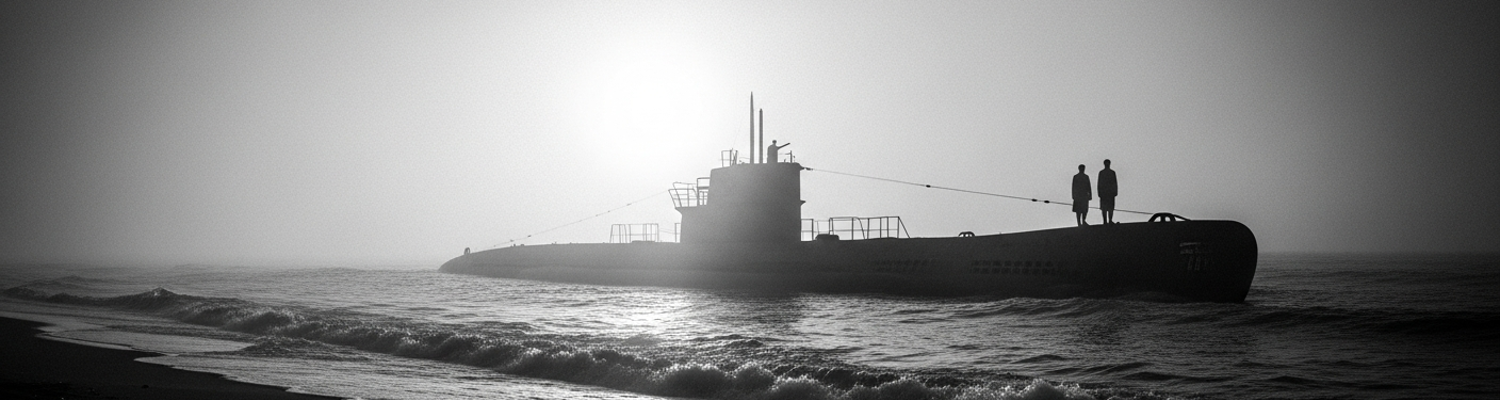

The fog off the coast of Amagansett, Long Island, was a wall of white on June 13, 1942. Coast Guardsman John Cullen, age 21, patrolled the beach with a flashlight and a flare gun, performing a new and monotonous duty: watching for enemy infiltration. Just after midnight, figures materialized from the mist. They were the leading edge of Operation Pastorius, a German intelligence plan to cripple the American war effort. The men had just been deposited on the beach by U-202, a Type VIIC submarine under Kapitänleutnant Hans-Heinz Lindner, weeks out of Lorient, France. The U-boat itself had run aground on a sandbar only 200 yards from shore. Its position was so compromised the crew considered scuttling the vessel and fighting their way onto American soil.
The landing team was led by George John Dasch. His four-man unit, including Ernst Peter Burger, Heinrich Harm Heinck, and Richard Quirin, fought their way ashore in an inflatable raft that almost capsized in the surf. They wore German Navy uniforms, a measure to ensure they would be classified as prisoners of war if captured during the landing. The plan disintegrated upon encountering Cullen. Dasch tried to bribe the young guardsman with $260, claiming they were stranded fishermen. Another saboteur muttered angrily in German. Cullen, unarmed and sensing immediate danger, feigned cooperation before retreating to his station to sound the alarm. By the time an armed patrol returned, the Germans were gone. They had hastily buried their mission equipment and caught a train to Manhattan. The patrol, however, found four waterproof crates in the dunes.
A review of the operational logs shows the threat contained within those boxes. They held not just German naval uniforms, but a complete arsenal for a sustained sabotage campaign. Inside were high explosives, various detonators, sophisticated pen-and-pencil-style timing devices, and incendiaries. The equipment was intended for a two-year mission to destroy American infrastructure. Targets included hydroelectric plants, aluminum factories, bridges, and railroad hubs like the Hell Gate Bridge and the Horseshoe Curve in Pennsylvania. The discovery of these materials on American soil proved the war was no longer an ocean away. An enemy with the means and training for widespread destruction was now operating inside the nation’s borders. The FBI, alerted by the Coast Guard, initiated a manhunt.
This was not an isolated event.
Four days later, on June 17, a second team executed a flawless landing far to the south. The German submarine U-584, another Type VIIC commanded by Kapitänleutnant Joachim Deecke, surfaced off Ponte Vedra Beach, Florida. This group of four, led by Edward Kerling, came ashore without incident. Learning from the Amagansett team’s near-disaster, they wore bathing suits and German Navy hats, which they quickly discarded. They buried their own four crates of explosives and incendiaries and, blending in with the local population, boarded a bus to Jacksonville. From there they continued by train toward targets in Chicago and Cincinnati. Their landing went completely undetected. The successful infiltration at Ponte Vedra Beach demonstrated that the Amagansett incident was not a fluke but part of a coordinated, strategic assault.
The technical capacity for the United States to electronically detect the U-boat landings in June 1942 was nonexistent. The US Army possessed early-warning radar sets like the SCR-270, but these systems were designed for a different threat. A review of their technical specifications (operating in the lower VHF band, around 106 MHz) shows they were ideal for detecting large, high-altitude aircraft at ranges up to 150 miles. They could not discern a small, low-profile target like a submarine conning tower from background sea clutter. Shipboard radars, such as the early CXAM series, faced the same limitations. There was no American equivalent to the British Chain Home system, an integrated coastal defense network. The handful of SCR-270s were positioned as standalone air defense assets. Sonar, or ASDIC, was exclusively a ship-mounted technology for hunting submerged U-boats at sea; no system for static, coastal hydrophone monitoring existed.
The coast was electronically blind.
Without a technological solution, the entire burden of detection fell upon human eyes. The primary defense consisted of rudimentary beach patrols conducted by the U.S. Coast Guard. Archival evidence shows these patrols, nicknamed Sand Pounders, were often manned by a single guardsman covering miles of coastline on foot or horseback. John Cullen was on a solo six-mile patrol. This thin screen of official observers was supplemented by a reliance on civilian reports. The Eastern Sea Frontier, the naval command responsible for the Atlantic coast, depended on alerts from commercial fishermen, local pilots of the Civil Air Patrol, and seaside residents. In May 1942, this ad-hoc system was formalized into the Coastal Picket Force, a civilian auxiliary of yachtsmen and fishermen who took their private vessels out on anti-submarine patrols. Often called the Corsair Fleet, these volunteers were given minimal training and antiquated machine guns to act as a picket line.
This fragile detection network was further undermined by a fractured and limited law enforcement presence in the vast coastal regions. The Federal Bureau of Investigation held primary jurisdiction for counter-espionage, but in 1942, its resources were concentrated in urban centers, not remote stretches of beach. A formal agreement from 1940 gave the FBI responsibility for intelligence in the Western Hemisphere, but this did not translate to a significant physical presence along thousands of miles of shoreline. When a landing occurred, the initial response fell to whichever local authority was closest, often a town constable with no training for a national security incident. The Coast Guard itself, having been transferred to the Department of the Navy, was stretched thin between new combat roles and its traditional duties. The flawless, completely undetected landing at Ponte Vedra Beach, Florida, exposed the weakness of this system. The Florida team simply walked ashore, buried their equipment, and boarded a public bus without encountering a single patrolman or federal agent.
The selection and training process for Operation Pastorius was an exercise in applied destruction. A close review of the operational plan reveals the Abwehr established a specialized sabotage school on a secluded estate at Quentz Lake, near Brandenburg. Here, eight chosen candidates underwent an accelerated, three-week course. The curriculum was intensely hands-on. Instructors drilled the men in the precise manufacture and use of explosives, incendiaries, and an array of timing devices. Days were spent studying the vulnerabilities of American industrial and transportation infrastructure, using detailed maps and factory blueprints. The training focused on creating maximum disruption with minimal resources, teaching recruits how to identify critical failure points on railroad bridges, within hydroelectric turbine halls, and at complex chemical plants. They learned to assemble pen-and-pencil-style detonators, calculate explosive yields, and deploy chemical incendiaries designed to cripple electrical substations. Morning calisthenics were followed by hours of practical demolition work. All notes were systematically destroyed.
This was a factory for producing human weapons.
The singular qualification for recruitment was prior, long-term residence in the United States. The Abwehr understood that technical skill was useless without the ability to move invisibly within American society. A review of the saboteurs’ backgrounds shows men who were not just fluent in English but were deeply familiar with American culture. George John Dasch, the 39-year-old leader of the Long Island team, had worked as a waiter in New York and served for over a year in the U.S. Army before receiving an honorable discharge. Edward Kerling, leader of the Florida team, had studied engineering and worked various jobs in the U.S. after arriving in the late 1920s. Others, like Herbert Haupt, had come to America as children and gained citizenship through their parents, making them virtually indistinguishable from native-born Americans. This intimate knowledge was the core of the operational concept. These men knew how to ride the Long Island Rail Road, order food in a diner, and catch a Greyhound bus without attracting attention.
The tactical doctrine for Operation Pastorius emphasized long-term, independent operation. The two four-man teams were not intended to be a commando squad; they were meant to be a slow-burning fuse. Archival evidence from their captured equipment confirms they were supplied for a mission lasting up to two years. Each team landed with tens of thousands of dollars in American currency, part of a total fund of nearly $175,000, to support themselves while they established new lives. The plan called for them to find legitimate jobs, secure housing, and completely integrate themselves before beginning their sabotage campaign. They were equipped with expertly forged documents, including Social Security cards and driver’s licenses. Communication with Germany was to be minimal. The teams were expected to act with a high degree of autonomy. Kerling and Dasch were even given handkerchiefs with the names of potential sympathizers written in invisible ink, a resource for building a wider support network. This model of infiltration bypassed traditional military defenses entirely.
A review of U.S. Army doctrine from 1942 reveals a near-fatal capability gap: the absence of specialized units trained for tracking in complex wilderness terrain. Had any of the German saboteurs evaded capture and proceeded toward inland targets like the Horseshoe Curve railroad pass near Altoona, Pennsylvania, they would have entered a geographic environment for which the American military had no prepared response. The force structure of the U.S. Army was oriented entirely toward conventional warfare. It lacked any element analogous to the German Gebirgsjäger. The famed 10th Mountain Division, the only U.S. unit of its size to receive specialized training for mountain conditions, was not activated until July 1943 at Camp Hale, Colorado, a full year after the landings. Its purpose was combat in the mountains of Europe, not counter-sabotage in the Alleghenies. The task of hunting a trained operative would have fallen to standard infantry or National Guard soldiers, men whose training consisted of marching and large-unit tactics, not the subtle arts of tracking.
This institutional unpreparedness was compounded by the difficulty of distinguishing a saboteur from the local civilian population. The Abwehr's primary qualification for selecting the Pastorius operatives was their prior residence in the United States. Once away from the coast, in the forests and small towns of the interior, these men would not have appeared as foreign agents. They would have looked and sounded like local hunters, fishermen, or hikers. They understood American customs and could navigate public transit. The operational plan was to melt into the civilian backdrop for months or years before striking. For a military patrol or a local constable, the challenge was profound. Lacking any distinct accent or behavior, the saboteurs possessed deep cover. There was no reliable method for a sentry to differentiate a German agent from a local resident.
Faced with a military unequipped for the manhunt, the burden of tracking would have defaulted to local and state law enforcement. This meant relying on methods that were often decades out of date. A review of rural law enforcement practices of the era indicates a heavy dependence on traditional man-tracking, often utilizing posses of armed civilians and, where available, bloodhounds. The effectiveness of bloodhounds was highly situational, best suited for fresh trails in rural environments. An operative trained at the Quentz Lake school would have understood basic counter-tracking techniques, such as using waterways to break a scent trail. Jurisdictional divisions between federal, state, and local police created a fractured response. The FBI had primary authority, but its agents were concentrated in cities and lacked the specific skills for a wilderness pursuit. A county sheriff in rural Pennsylvania, possessing a handful of deputies and a few tracking dogs, would have been the primary instrument against a man trained in explosives and military evasion.
A close review of the FBI and Coast Guard’s response to the Amagansett landing reveals a logistical system defined by improvisation. The manhunt, which FBI Director J. Edgar Hoover intended to be the largest in the Bureau’s history, was crippled from its first moments by a lack of mobility. With the saboteurs having vanished onto a public train, federal agents descending on eastern Long Island found themselves without pre-positioned vehicles. Archival evidence of the era’s federal law enforcement posture shows that assets were concentrated in urban field offices. This forced agents into a state of ad-hoc requisitioning. They commandeered vehicles from the local police, took over delivery trucks, and pressed any available civilian automobile into service to establish roadblocks. This scramble for transport was mirrored on the water, where the Coast Guard’s Corsair Fleet was being hastily assembled from the private yachts and fishing boats of civilian volunteers.
This material deficit extended to the most fundamental tools of a manhunt. Examination of the equipment available to the Eastern Sea Frontier’s beach patrols in mid-1942 shows a near-total absence of appropriate tracking and communications gear. The Sand Pounders relied on a static communication system of portable handset telephones that had to be physically plugged into jack boxes installed at intervals along the shore, a network useless for a mobile pursuit. Man-portable radios were not standard issue for FBI agents or guardsmen, forcing a reliance on runners and overburdened telephone landlines. Specialized tracking equipment was nonexistent. The Coast Guard’s Dogs for Defense program, which would eventually supply trained tracking dogs, was only initiated after the Pastorius landings, a direct reaction to this capability gap. Records show that when the military established a mounted patrol on St. Catherine’s Island, Georgia, shortly thereafter, the soldiers were issued wild horses and had to break the animals themselves.
Local authorities bore the brunt of this federal failure. The initial alert at Amagansett fell to the small Coast Guard station and the Suffolk County Police Department. This was a constabulary force equipped to handle local crime, not a national security emergency. When dozens of federal agents arrived, their demands for vehicles, manpower, and local knowledge instantly overwhelmed the small department’s capacity. Every car deputized by the FBI was one less available for a local emergency. Every officer assigned to guide federal agents through the back roads was one less manning his actual jurisdiction.
When FBI agents arrived at the Amagansett Coast Guard station on the morning of June 13, 1942, they did not come to assist. They came to take over.
A review of inter-agency correspondence from the time shows that FBI Director J. Edgar Hoover operated under the assumption of absolute authority in all matters of domestic espionage, a position granted by a 1939 presidential directive. This created immediate friction. The Coast Guardsmen who discovered the landing and the Suffolk County police officers who were first to respond found themselves abruptly sidelined. Evidence, including the cache of explosives, was seized exclusively by the Bureau. Eyewitness accounts, most importantly the description of the saboteurs from Coast Guardsman John Cullen, were treated as proprietary FBI intelligence rather than actionable information to be shared. This assertion of jurisdictional primacy was a hostile bureaucratic takeover that bred resentment and choked the flow of information.
The subsequent manhunt was not one operation, but at least three separate and uncoordinated efforts. The command structure for continental defense was dangerously fractured. General Hugh A. Drum, head of the Army’s Eastern Defense Command, was responsible for land-based military responses. His authority did not extend to the water. Admiral Adolphus Andrews, commanding the Navy’s Eastern Sea Frontier, was responsible for combating the U-boat menace. His command stopped at the high-tide line. A close examination of their operational directives shows two distinct military empires with almost no formal mechanism for joint planning. J. Edgar Hoover’s FBI formed a third, independent power center, reporting only to the Attorney General. There was no American equivalent of a joint headquarters where Drum, Andrews, and Hoover could direct a unified response. The result was chaos. While Army patrols began to mobilize, they did so with no intelligence from the FBI about who they were looking for. As the Navy tried to hunt the U-boat, it received no data from the FBI’s interrogation of potential contacts.
This structural failure guaranteed a delay in disseminating tactical intelligence. Archival records of the FBI’s investigation confirm that a detailed description of George Dasch was known to the Bureau within hours of the landing. Yet this information was not immediately broadcast to state and local police departments for fear of causing a public panic and compromising Hoover’s control of the case. While FBI agents guarded the information in Long Island, the saboteurs themselves were riding the Long Island Rail Road into Jamaica, Queens, where they disposed of their satchels and then took the subway into Manhattan. Analysis of the captured German equipment was conducted in an FBI laboratory vacuum. This data was not shared with Army or Navy ordnance experts who could have helped predict the saboteurs’ likely targets based on their technical capabilities. The four men from the Amagansett landing had a multi-day head start, moving freely through the nation’s largest city, because the agencies tasked with stopping them refused to talk to one another.
The defensive screen against Operation Pastorius was not electronic or military, but overwhelmingly human and civilian. A close examination of the operational record in the hours after the Amagansett landing shows a near-total reliance on chance encounters and suspicious activity reports from untrained observers. While Coast Guardsman John Cullen’s report was the official trigger, the entire coastal defense system was built upon the hope that fishermen or local pilots would spot something out of place. The system’s fragility was laid bare by the second landing. The saboteur team in Florida came ashore at Ponte Vedra Beach and melted into the local population without a single report being filed. They boarded a public bus to Jacksonville and were gone before any official presence could have possibly been alerted.
This reliance on civilians extended directly into the manhunt itself. As the FBI descended on eastern Long Island, its efforts were defined by a dependence on local citizens. A review of the FBI’s initial response shows a scramble for resources that federal and military authorities did not have in place. Local police departments were overwhelmed. Agents began commandeering private vehicles and relying on area residents for their intimate knowledge of the terrain. Citizens formed impromptu search parties and manned unofficial roadblocks, driven by public announcements and a sense of patriotic duty. This created a chaotic, uncoordinated effort where the line between official law enforcement and civilian vigilantism became blurred.
The entire operation unraveled not because of coastal patrols or civilian posses, but because of a single act of betrayal.
George John Dasch, leader of the Long Island team, had grown disillusioned with the Nazi regime and decided to defect. He secured the cooperation of Ernst Peter Burger, another member of his team who harbored anti-Nazi sentiments. On June 15, just two days after landing, Dasch made a phone call from a payphone on Manhattan’s Upper West Side to the FBI’s New York office. He identified himself using the code name Pastorius and attempted to explain the plot. The agent who took the call was skeptical and dismissed it. Dasch hung up in frustration. Determined, he took a train to Washington, D.C., checked into the Mayflower Hotel on June 19, and walked into FBI headquarters. He again met with disbelief until he emptied a briefcase containing nearly $84,000 in cash onto an assistant director’s desk.
This act transformed the investigation. Over eight days of intense interrogation, Dasch provided a complete intelligence breakdown of Operation Pastorius. FBI case files (65-51364) document his detailed confession. It included the names of all eight saboteurs, their pre-selected industrial targets, the location of the second team, and even contacts listed in invisible ink on a handkerchief. Armed with this trove of information, the FBI moved with speed. Within two weeks, the entire network was dismantled. Agents arrested Burger in his New York hotel, who then led them to the other two members of the Long Island team. Following Dasch’s leads, the four members of the Florida team were tracked down and arrested in Chicago and New York. The largest manhunt in the Bureau’s history was ultimately solved because the lead saboteur delivered the entire conspiracy directly to J. Edgar Hoover’s doorstep.