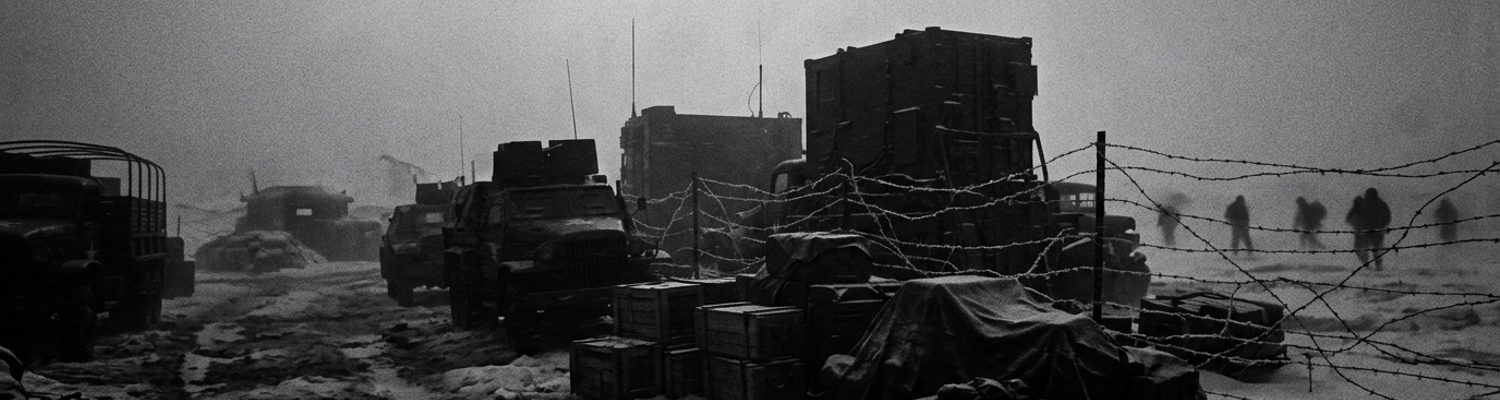

Operation Landcrab and the Holtz Bay Landings
Archival evidence shows that four hundred ten soldiers of the 7th Infantry Division Provisional Scout Battalion entered the operational theater directly against an entrenched force. This defending force numbered over two thousand six hundred Imperial Japanese Army troops. Colonel Yasuyo Yamasaki held the interior high ground. His organized force outnumbered the initial landing scouts by more than six to one. The tactical imbalance was immediate. On the morning of May 11, 1943, fleet submarines USS Narwhal (SS-167) and USS Nautilus (SS-168) surfaced in heavy swells. They sat two miles outside Holtz Bay at Austin Cove. Captain William H. Willoughby directed his scouts through cramped pressure hatches. The men stepped directly into freezing northern gale winds. Crewmen hauled heavy canvas bundles, field rations, and water-cooled machine guns onto the slick outer steel casing of both submarines. The scouts loaded into dozens of four-man LCR-L rubber craft in total darkness. They fought cross-currents that battered the rubber hulls against the submarine ballasts. Willoughby and his vanguard paddled through near-freezing sea spray toward an unmapped section of the island designated as Beach Scarlet. They operated completely out of direct contact with the main American landing force at Massacre Bay.
Four hundred men were stranded on the open water.
A close review of operational logs indicates that mechanical sensor systems broke down hours before the rubber boats reached the breakers. Dense Aleutian fog and sea spray compromised submarine periscope optics and early surface radar arrays. Sub-zero ambient temperatures caused severe internal condensation within the optical tubes of the Type 3 search periscopes. Airborne salt crust rapidly blinded the external prism windows whenever the masts cleared the surface. Newly installed Western Electric SJ surface search radars mounted on the conning tower shears failed under heavy moisture saturation. Screens generated massive distortion and false echoes from low-hanging fog banks. Radar operators could not determine the range to the sheer rock promontories enclosing the bay. Navigators on Narwhal and Nautilus relied on manual dead reckoning, soundings taken with lead lines, and diesel tachometer readings. They steered through submerged volcanic pinnacles using these rudimentary methods.
The electronics failed completely.
When examining the historical record of the Holtz Bay approach, American naval reconnaissance failed to locate the enemy fixed positions. Concealed Japanese strongpoints along rugged ridgelines escaped initial reconnaissance detection. Northern Sector defense forces under Major Eishi Kakuda had excavated deep subterranean shelters, trenches, and light artillery revetments into the rocky saddles of Moore Ridge overlooking the beach. Defenders used native sod and tundra grasses to construct camouflaged apertures for Type 92 heavy machine guns and Type 89 knee mortars. This construction method eliminated visible spoil dirt that could be identified by naval spotting aircraft. Japanese gun crews followed strict fire discipline. They withheld rifle and machine gun fire while the American scouts hauled sodden radio packs and ammunition cases across the volcanic gravel of Beach Scarlet at 0500 hours. Japanese soldiers watched in absolute silence from their high-altitude foxholes. They tracked the landing party through the mist.
Massacre Bay Logistics and Forward Pen Establishment
Archival evidence shows that on the afternoon of May 11, the 7th Infantry Division Provost Marshal detachment stepped off landing craft at Massacre Bay. They walked directly into deep, waterlogged volcanic silt. Captain William Robinson directed military police personnel to establish an improvised shoreline detainee enclosure. The site was a narrow spit of gravel between the surf line and the impassable tundra bogs of Beach Yellow. Engineer squads hammered wooden pickets into the frozen beach shingle. They strung double-apron barbed wire along a rectangular pen measuring less than forty yards across. The selected site sat barely four feet above the high-tide line. It lay directly in the path of freezing sleet squalls blowing off the North Pacific. Standard perimeter security fencing and heavy timber posts had been left in the holds of transport ships. Planners prioritized shipments of 105mm artillery shells and mortar rounds over detention supplies. Military police scavenged rolls of uncoiled concertina wire from engineer supply dumps directly at the waterline to close off the pen. High tides drove saltwater across the floor of the enclosure twice each day. The volcanic sand turned into a freezing slurry where prisoners were ordered to sit.
No dry ground existed.
A close review of operational logs indicates that only twenty-eight Japanese soldiers were captured alive during the initial phases of the landing. This low number created an unexpected data deficit that compromised division-level planning. Imperial Japanese Army doctrine and the Senjinkun military code compelled defenders to fight to the last man. Soldiers used Type 97 hand grenades against their own bodies or charged American rifle positions with fixed bayonets rather than submitting to capture. Wounded, concussed, or unconscious service troops belonging to airfield construction units, medical platoons, and coastal antiaircraft batteries made up the twenty-eight men who survived to reach the shoreline. Frontline patrols from the 17th Infantry Regiment dragged these dazed survivors through wet tundra snow directly to the Massacre Bay wire for processing. Divisional interrogators lacked qualified Japanese linguists at the beachhead to extract tactical data before shock and hypothermia set in. Military Intelligence Service personnel arrived without specialized language references. They were unable to conduct tactical interrogations of shivering prisoners whose body temperatures were plummeting below ninety degrees. Operational staff received almost no actionable data regarding Colonel Yamasaki and his interior defense positions or counterattack routes.
The captives gave nothing away.
When examining the historical record of medical clearing stations, sub-zero dampness, exposure, and gangrenous frostbite severely debilitated both detainees and guards within hours of arrival. Aleutian ambient temperatures hovered near thirty degrees Fahrenheit. Constant sea spray and sleet saturated standard-issue leather combat boots and soaked through wool socks. American military police standing guard over the shoreline pen suffered crippling immersion foot. Restricted capillary circulation caused foot tissue to blacken, swell, and die. Detainees endured identical exposure while wearing soaked cotton field uniforms and split-toe rubber shoes. These garments offered zero thermal protection against the slush pooling inside the wire. Guard details hauled limp prisoners across the muck by their jackets to keep their faces out of freezing puddles on the ground. Over five hundred American soldiers across Massacre Bay were evacuated to offshore ships with advanced gangrenous tissue decay by May 14. Remaining guards at the beach pen could barely stand on their blackened feet. Beach aid stations exhausted their entire supply of dry socks, sulfonamide powder, and wool blankets before relief echelons landed.
Triage tents filled with gangrene cases.
Signal Corps Failures and Frozen Battery Arrays
Archival evidence shows that the 7th Signal Company struggled to maintain operational wireless communication across the Massacre Bay beachhead from the opening hours of the assault. Signal personnel winched heavy SCR-299 mobile radio units off landing lighters into freezing Pacific swells. Mechanics mounted these units inside modified K-51 panel trucks. Salt-laden spray penetrated the ventilation louvers of the vehicle chassis. Saltwater drenched the accompanying PE-95 gasoline generators and auxiliary battery arrays. Ambient air temperatures hovered near twenty-eight degrees Fahrenheit. This caused constant moisture to freeze directly across the exposed terminals of the twelve-volt lead-acid storage cells. Freezing electrolyte fluid cracked the hard-rubber battery casings. Such damage permanently disabled the direct-current power reserves needed to ignite the filaments of the four-hundred-watt BC-610 transmitters. Motor pool mechanics stripped fouled spark plugs and drained ice crystals from fuel lines using bare fingers. Water condensation continuously shorted the high-voltage dynamotors. Enlisted operators watched output meters drop to zero across the beachhead grid. This happened before units established contact with naval gunfire liaison officers offshore.
The primary radio networks died within hours of hitting the beach.
A close review of operational logs indicates that this immediate electrical collapse severed direct tactical relays between the shoreline detainee enclosure and division intelligence staff. Wire-laying teams from the 17th Infantry Regiment attempted to bridge the gap. They strung lightweight W-110 field wire across the beach shingle toward Major General Albert E. Brown and his command post two miles inland. Brackish ocean water washed over the low-lying terrain. The water soaked the canvas-wrapped wire and shorted the connections through the conductive volcanic soil. Military police guarding the twenty-eight captive Imperial Japanese Army soldiers had no operating EE-8 field telephones. They lacked functioning radio links to transfer preliminary interrogation findings to the 7th Infantry Division G-2 section. Captain Robinson and his guards extracted tactical admissions concerning defensive positions along the high ridges. These written notes remained confined to wet field notebooks at the surf line. Division planners directing inland assaults received zero data updates regarding Japanese troop concentrations, defensive trench networks, or planned withdrawal vectors.
Interrogation reports remained trapped at the high-tide mark.
When examining the historical record of frontline communications, environmental barriers eliminated all physical runner networks between the beachhead and forward units. Signal officers dispatched foot messengers across the swampy lowlands of Massacre Valley. They sent men toward the rocky defiles of Jarmin Pass to carry written tactical orders by hand. Attu muskeg consists of dense mats of waterlogged sphagnum moss sitting atop thawed volcanic muck and permafrost. This terrain sucked couriers down past their knees at every step. Soldiers carrying waterproof canvas pouches discarded entrenching tools, rations, and field equipment. They did this to crawl out of deep mud bogs. The terrain slowed courier movements to less than three hundred yards an hour. Freezing exhaustion, trench foot, and exposure disabled dozens of runners. Japanese snipers dug into the rocky spurs of Cold Mountain shot messengers crossing open tundra basins. Forward battalions of the 32nd Infantry Regiment engaged entrenched machine-gun bunkers in total tactical isolation. They received no warnings from division intelligence and transmitted no situation reports back to the command beachhead.
Three messenger platoons lost seventy percent of their effectives to cold-weather casualties and enemy fire.
Zero message packets reached their destination.
G-2 Intelligence Bottlenecks and Untranslated Documents
Archival evidence shows that inside the perimeter of the Massacre Bay detainee pen, personal effects stripped from the twenty-eight captured Japanese troops accumulated in damp canvas bags. These bags remained uninventoried. Military police under Captain Robinson followed standard intake procedures by confiscating all items found in uniform pockets. They tossed field message books, pocket diaries, family letters, and folded administrative maps into unlined wooden ammunition boxes stacked beside the guard tent. Saltwater seepage and driven snow saturated the porous rice paper of these field diaries. The Japanese referred to these books as gunjin techo. Water blurred pencil notes written by soldiers of the 303rd Independent Infantry Battalion. In several recovered notebooks, Japanese infantrymen had recorded daily rations dwindling to dried kelp. They documented the progressive destruction of their ammunition dumps along Cold Mountain. The diaries also detailed the growing resolution among Yamasaki and his officers to mount a final foot assault across the mountain passes toward the American beaches. Exposure to freezing rain degraded the paper into an unreadable pulp along the shoreline gravel. Provost marshal staff never transferred the wooden boxes inland.
The wooden containers sat stacked beneath soaked tarpaulins sixty yards from the surf.
A close review of operational logs indicates that the 7th Infantry Division faced an acute shortage of Japanese-language specialists. The division possessed only four Military Intelligence Service officers and enlisted linguists qualified to decipher military Japanese across the entire landing force. Task force headquarters kept two of these personnel aboard the assault transport USS Zeilin (APA-3). The two linguists sent ashore at Massacre Bay were assigned to Major General Albert Brown and his mobile command shelter to handle high-level radio traffic. Neither man visited the forward prisoner pen. Linguists confronted handwritten field orders drafted in sosho. This abbreviated cursive script defeated standard translation manuals. It required hours of optical examination under battery-powered lanterns. Mud and ocean spray obscured the kanji characters denoting unit designations, supply levels, and map coordinates for mountain assembly points. Over four hundred pages of handwritten intelligence captured from forward rifle pits accumulated inside dispatch folders on desk tables. These documents remained completely untouched while translators spent entire shifts attempting to verify single identification tags.
Captured field orders lay unread inside wet dispatch pouches.
When examining the historical record of division intelligence regulations, procedural security protocols prioritized the physical containment of enemy property over the fast tactical distribution of captured intelligence to forward units. Counter Intelligence Corps directives dictated that every document seized on the battlefield had to pass through a rigid custodial chain before any operational dissemination could occur. Field clerks had to record serial numbers, catalog capture coordinates, and seal items in waterproof evidence pouches. These pouches were destined for rear-echelon analysis at the Alaska Defense Command headquarters in Fort Richardson. Guard detachments at the Massacre Bay pen refused to surrender seized notebooks to regimental scout officers without signed counter-authorization from the assistant chief of staff for intelligence. Rigid enforcement of these isolation procedures locked time-sensitive warnings regarding Imperial Japanese Army infiltration routes, night attack assembly sectors, and coordinated assault timetables inside rear-echelon supply tents. Third Battalion of the 17th Infantry Regiment occupied positions below Fish Hook Ridge without receiving the captured Japanese operational orders found forty-eight hours earlier.
The paperwork chain superseded tactical survival.
Colonel Yamasaki and Japanese Force Consolidation
Archival evidence shows that during the night hours of May 27 and May 28, Colonel Yasuyo Yamasaki pulled approximately one thousand surviving troops out of defensive pockets across Fish Hook Ridge, Buffalo Ridge, and the high cliffs above Chichagof Valley. Survivors of the 303rd Independent Infantry Battalion, the 85th Naval Garrison Unit, and disabled engineer platoons withdrew across rocky talus slopes. They moved through heavy ground fog that blanketed elevations between five hundred and twelve hundred feet. Yamasaki established his provisional headquarters inside the wooden buildings of an abandoned fish reduction plant and Japanese living quarters hugging the shoreline of Chichagof Harbor (coordinates 52.933 N, 173.250 E). Radio operators smashed transmitting tubes with rifle butts to maintain strict electromagnetic silence. This action cut off transmissions to the Northern Army staff on Paramushir Island. Japanese ordnance details pooled their remaining small arms. They handed Type 38 rifles and twenty-round ammunition bandoliers from walking wounded to front-line riflemen. Unobserved by Eleventh Air Force B-24 bombers or Navy OS2U Kingfisher spotter planes grounded by zero-visibility mist, Yamasaki concentrated eight hundred combat-effective soldiers into three assault echelons within two miles of the American line.
The entire imperial garrison assembled without triggering an aerial sighting.
When examining the historical record of frontline command posts, the 17th and 32nd Infantry Regiments operated on the premise that retreating Japanese detachments were broken into scattered bands unable to mount unified resistance. Forward observers beneath Clevesy Pass watched small groups of Japanese soldiers abandon weapon pits. Retreating forces left behind unburied dead, shattered Type 92 70mm battalion guns, and discarded gas masks. Major General Eugene M. Landrum had relieved Major General Brown on May 16. Landrum interpreted these tactical withdrawals as proof of operational disintegration across the northern sector. Regimental intelligence summaries distributed on the morning of May 28 categorized the enemy as defeated remnants hiding in isolated mountain caves. Planners anticipated mass individual suicides rather than coordinated offensive maneuvers. American infantrymen on the forward pickets rested in saturated foxholes without stringing defensive concertina wire or digging secondary fallback trenches across the Chichagof corridor. Rear-echelon positions atop Engineer Hill encompassed field aid stations, mobile bakery units, and six 105mm howitzers of the 48th Field Artillery Battalion. These positions sat protected only by unarmed quartermaster troops, mechanics, and light machine-gun outposts.
US division intelligence tracked a routed enemy.
They did not track an army preparing to charge.
A close review of operational logs indicates that specific detainee disclosures recorded on the Massacre Bay beachhead had already detailed this planned concentration forty-eight hours prior to its execution. On May 26, two captured enlisted men from the 303rd Independent Infantry Battalion admitted to military police interrogators that Yamasaki had ordered all surviving units to abandon isolated mountain positions. Prisoners stated that the units would rally at Chichagof Harbor for a single massed bayonet attack. Prisoners confirmed that every able-bodied soldier would charge directly up Clevesy Pass, overrun the artillery batteries atop Engineer Hill, and seize American supply dumps at Massacre Bay. The objective was to replenish spent ammunition and rations. These written summaries sat inside pencil-drafted intake logs at the water edge. They were entirely isolated from Landrum and his tactical command post due to cracked battery arrays and cut landlines. No field telephone message or motorcycle courier reached the forward command bunker of the 32nd Infantry Regiment before sundown on May 28. Japanese assault companies fixed Type 30 bayonets to empty rifles in total silence at the base of the mountain pass.
Third Battalion went to sleep that evening without posting supplemental sentries across the floor of the valley.
The Dawn Banzai Breakthrough Toward Engineer Hill
Archival evidence shows that at approximately 0330 hours on May 29, 1943, Colonel Yasuyo Yamasaki spearheaded a counteroffensive of nearly one thousand Japanese soldiers surging down the floor of Chichagof Valley. The force moved under a thick pre-dawn ground fog that suppressed sound and obscured visibility to less than fifteen paces. Three assault waves charged directly into the junction between Company B of the 32nd Infantry Regiment and Company L of the 17th Infantry Regiment. Japanese riflemen bypassed primary machine-gun emplacements. They utilized the natural blind spots carved by snow-choked creek beds to knife forward sentries before tripwires could be triggered. Surging unchecked up the mountain defile toward Clevesy Pass, the assault force slammed into the forward clearing tents of the 7th Division Medical Battalion. Sleeping medical personnel, unarmed litter bearers, and immobilized post-operative casualties lying on canvas cots were overwhelmed in their sleeping bags within seconds. Japanese troops cleared the tents with Type 30 bayonets and Type 97 fragmentation grenades. They systematically executed over forty wounded soldiers while seizing US field rations, M1 Garand rifles, and morphine ampoules to supply their forward rush.
The forward outpost line vanished in minutes.
A close review of operational logs indicates that the sudden collapse of the forward valley floor left only unorganized support echelons between Yamasaki and his vanguard and the Massacre Bay supply base. Surviving medics fled up the northern slopes. Lieutenant Colonel James Bush of the 50th Combat Engineer Regiment began assembling an improvised defense along the crest of Engineer Hill. This elevation rises roughly eight hundred feet above sea level. Bush rallied approximately four hundred men consisting of combat engineers, vehicle mechanics from the 7th Quartermaster Company, pack-mule handlers, and cooks. He distributed crated M1903 Springfield rifles and bandoliers of .30-06 ammunition directly from supply sledges. Artillerymen from Battery B of the 48th Field Artillery Battalion lowered the muzzles of their 105mm howitzers to near-zero elevation. They prepared to fire direct-canister charges into the climbing fog. Engineers scraped shallow firing slits into the frozen tundra moss using trenching shovels, pickaxes, and bayonets. Two water-cooled M1917 Browning machine guns were manhandled onto the western rim of the plateau. Yamasaki and his leading elements reached the crest at 0600 hours. Hand-to-hand combat erupted along the scrub brush. Engineers swung pick handles, entrenching tools, and empty carbines against Japanese officers wielding samurai swords.
Truck mechanics and hospital orderlies formed the final defensive trench.
When examining the historical record of division operations, this tactical surprise demonstrated how equipment failures at the forward shoreline enclosures traveled upward into command paralysis. The assault route, the hour of attack, and the designated objective matched the admissions provided by Japanese prisoners at Massacre Bay seventy-two hours earlier. The objective was the seizure of the 105mm artillery positions atop Engineer Hill to shell the beachhead. Lead-acid batteries lay frozen and cracked along the beachhead shingle. Military police detachments lacked the electrical wattage to transmit the interrogation transcripts to regimental command posts. Handwritten notes containing the exact details of Yamasaki and his last operational order sat locked inside soaked canvas sacks beside the high-water mark. Division linguists aboard ships miles offshore remained completely unaware that the documents existed. Forward infantry companies had not fortified Clevesy Pass with barbed wire or antipersonnel minefields. G-2 intelligence bulletins continued to report that the enemy forces were trapped, starving, and incapable of organized collective action.
Major General Landrum learned of the offensive only after Japanese hand grenades began detonating inside his forward artillery pits.