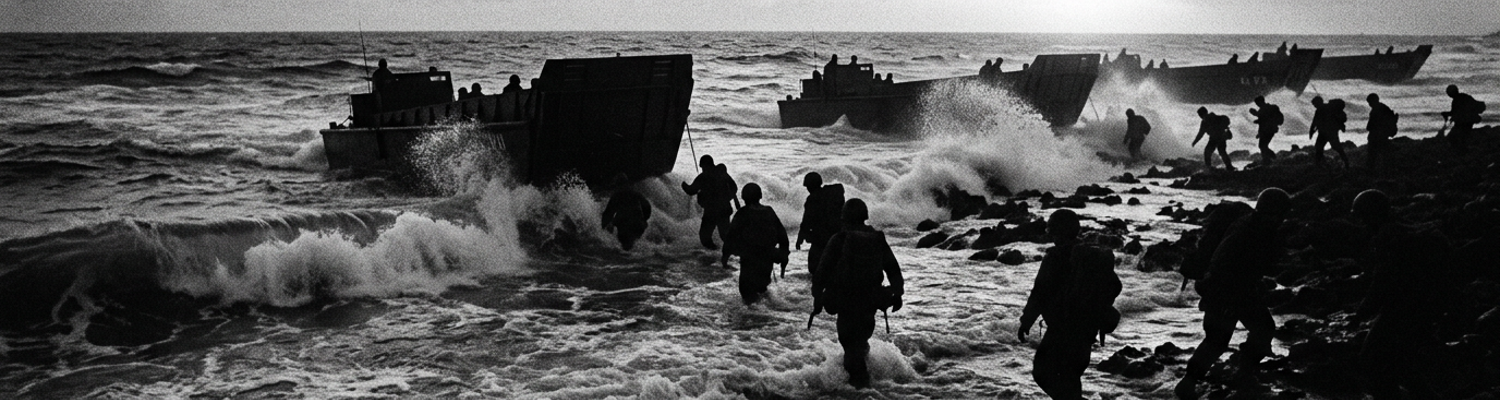

Pre-Assault Planning and the Peleliu Timetable
Diesel exhaust filled the air above the staging area. LCPR engines stalled in the open water. Defenseless swimmers drifted directly toward the abrasive coral of Peleliu. Japanese 47mm anti-tank guns fired into the surf zone.
Archival evidence shows that military staff officers drafted operational timetables for Operation Stalemate II. They based these schedules on the assumption that naval artillery could suppress shore defenses prior to troop debarkation. Vice Admiral Theodore S. Wilkinson established a forty-eight-hour deadline before the primary amphibious landings (CINCPAC File 44-A). This gave reconnaissance units a narrow window from September 12 to September 14.
They had to map and clear thousands of yards of ocean defense networks.
Theoretical training manuals issued at the Naval Amphibious Training Base in Fort Pierce dictated specific procedures. Underwater personnel were instructed to conduct systematic hydrographic surveys during daylight hours. They were supposed to use color-coded buoys and towlines. That doctrine failed immediately against the physical geography of Peleliu. A continuous fringing reef ringed the southwestern coastline. It extended anywhere from fifty to several hundred yards out from the sand. This created an impassable marine barrier.
Water depth dropped to less than three feet over the coral plateau.
Heavy craft grounded on the reef edge. Men were forced directly into knee-deep saltwater channels. High ground machine gun positions maintained clear fields of fire. High-ranking planners underestimated the geological composition of the island. Living limestone absorbs naval high-explosive shells. The material does not fracture uniformly. Japanese reinforced concrete blockhouses remained intact along the treeline.
Theoretical assault manuals made no provision for men swimming into zero-visibility surf under heavy artillery fire.
Underwater Demolition Teams 6 and 7 were assigned to clear Peleliu beaches in September 1944. They were tasked with neutralizing obstacles across White 1, White 2, Orange 1, Orange 2, and Orange 3. Converted World War I destroyer transports transported these units to the Palau Islands. The roster included USS Gilmer and USS Waters. These specialized units comprised ninety-six officers and enlisted men per team. On the morning of September 12, the teams deployed from small LCPR landing craft. They launched roughly two thousand yards off the reef line.
Mechanical breakdowns plagued the initial launch sequence.
Saltwater clogged outboard carburetors (serial number 44-12998). Several craft drifted into target lanes reserved for naval gunfire support ships. The timeline permitted zero margins for error.
Doctrinal Assault Manuals Versus Reef Hydrodynamics
A close review of operational logs indicates that Navy demolition doctrine in 1944 rested on static environmental models. Planners developed these models at the Naval Amphibious Training Base in Florida. Standardized manuals instructed demolition units to operate under specific assumptions. They expected calm coastal waters. They expected predictable low tides. They expected soft sandy sea floors.
Training scenarios forced men to clear pre-fabricated steel tetrahedrons.
Planners assumed that swimmers could stand in shallow surf. They expected men to secure uniform sixty-pound satchel charges against rigid structures. They planned to use standard wooden placement jigs. Manuals prescribed precise timed procedures. Frogmen were supposed to unspool color-coded distance lines along flat bottom geography.
Theoretical protocols failed to account for living marine ecosystems.
They ignored varying coral formations. They ignored heavy open-ocean swells hitting natural barriers. Archival evidence shows that Underwater Demolition Teams 6 and 7 encountered unstable hydrodynamic forces. The barrier reef fringed Peleliu for six hundred yards along the western shore. Pacific ocean swells traveled thousands of miles across open water. These swells slammed directly into the vertical limestone wall of the reef edge.
Water crashed over the lip of the plateau.
This created unpredictable rip currents and powerful undertows. Swimmers attempted to maintain horizontal survey lines. The water repeatedly slammed them into abrasive staghorn coral heads. The coral shredded canvas trunks. The impacts destroyed hydrographic slate boards. Strong ocean currents flowed along the length of White Beach 1 and White Beach 2.
This created severe current shear.
Men were dragged away from designated target sectors at speeds exceeding three knots. Heavy ocean swells swept equipment straight off the reef plateau. Declassified after-action reports reveal that the physical dynamics of the surf zone negated standard navy explosive placement techniques. Ocean surges continuously rolled twenty-pound canvas bags of tetrytol explosives out of position. This happened before fuse wires could be tied off. Swimmers lost their balance in waist-deep water. Backwash pulled sand and loose coral out from under their boots.
Stable placement of demolition charges became impossible.
Tactical commanders on scene made the immediate operational decision to abandon manual guidelines entirely. UDT personnel were forced to crawl on their bellies across the exposed reef flat. They moved under direct mortar fire. Men manually jammed flexible knapsack charges into natural coral crevices. They wedged explosive packs into living reef fissures. Tidal surges violently tossed support craft onto exposed coral pinnacles.
The unpredictability of the ocean currents disrupted the launch and retrieval schedules of LCPR landing craft.
They operated two thousand yards offshore near coordinates 07 00 00 N 134 13 15 E. Strong littoral drift pushed defenseless support vessels into active firing lanes. These lanes were reserved for the five-inch guns of USS Pennsylvania and USS Idaho. Saltwater forced over the gunwales drowned out the four-cylinder engines of light landing craft. Crewmen were stranded in open water. Demolition teams carrying canvas sacks of explosives fought two-knot crosscurrents. They pulled heavy reel lines toward the beach head.
Standard manual calculations offered no solution for water moving in three directions simultaneously.
Command logs from USS Gilmer record severe equipment losses. Swimmer teams lost forty percent of their measuring lines within thirty minutes of entering the water. Hydrographic soundings fluctuated by four feet every few seconds. Swells rolled across the reef shelf. Accurate depth readings became impossible under manual criteria. Swimmers tried to plant marker buoys. Rip tides dragged the lead sinkers away.
The buoys disappeared into sixty-foot oceanic drop-offs just outside the reef rim.
Officers on the water realized that standard wave prediction tables provided zero actionable guidance. High-pressure breakers tore the rubber dive masks straight off the faces of the operators.
Hydrographic Reconnaissance Along Orange and White Beaches
On September 13, elements of Underwater Demolition Teams 6 and 7 moved toward the western shoreline of Peleliu. They executed manual depth soundings across 2,200 yards of designated landing beaches. Thirty-six frogmen entered the water. They deployed directly from LCPR landing craft two thousand yards off the reef edge.
They carried lead-weighted sounding lines.
They carried wooden measuring poles. They strapped slate writing boards to their forearms. Japanese defenders embedded along the limestone ridges of The Point immediately targeted the swimmers. They fired concentrated 47mm anti-tank artillery. They fired heavy Nambu machine gun rounds. Splattering mortar shrapnel repeatedly forced operators under the surface.
The men held lead sinkers against the sea floor.
They measured water depths at five-yard intervals. A close review of operational logs indicates that swimmers spent over ninety minutes in waist-deep water. They logged ocean depth variations down to single-inch increments. They did this under continuous direct fire. Operators marked depth figures on waterproof slate tiles using grease pencils. They noted where water dropped below three feet over the drying reef flat.
Japanese gunners along the high ground systematically tracked swimmer movements across the entire length of White Beach 1.
Archival evidence shows that UDT operators mapped intricate jagged coral formations. These formations extended six hundred yards off White 1, White 2, Orange 1, Orange 2, and Orange 3. The natural barrier reef consisted of dense networks of staghorn coral. It contained raised micro-atolls and hidden underwater fault lines. Depth measurements taken across the plateau revealed vertical coral growth.
This growth reached within eighteen inches of the sea surface at mid-tide.
Naval amphibious craft could not cross these submerged limestone walls. The coral would tear open their hull plates. To map these obstructions, demolition personnel unspooled hundreds of yards of buoyed reel lines. They constructed a precise hydrographic grid across Orange Beach 1 and Orange Beach 2. Detailed field entries logged the exact physical dimensions of individual coral heads.
They pinpointed natural fissures suitable for placing explosive charges.
Ocean swells dragged survey lines into abrasive coral branches. The measuring ropes snapped. Men were forced to manually feel out underwater rock ledges with their hands. Abrasive coral heads sliced through heavy canvas swimming trunks. Leather marine boots failed within minutes of immersion.
Naval intelligence files confirm that hydrographic charts compiled by UDT 7 revealed a specific anomaly.
White Beach 2 contained a forty-yard wide coral depression. This offered the only potential passage for tracked landing vehicles. Operational command post logs from the fleet transport group document the mapping process. Swimmer teams plotted this route under continuous indirect fire. Batteries of 81mm mortars fired from inland cave networks. Direct shell hits destroyed two rubber support craft. This sank hydrographic slates collected along the northern sector of Orange Beach 3.
Swimmers in that sector swam back into open ocean.
They retrieved blank slate boards from waiting LCPRs. They re-entered the target area to execute a second hydrographic survey. Intelligence officers received the hand-drawn physical maps late on September 13. These hand-rendered charts accurately plotted three major coral ridges on White Beach 1. They plotted five isolated limestone pinnacles off Orange Beach 2. They mapped a continuous drying reef flat spanning the entire southern assault zone.
Frogmen completed physical surveys of 2,200 yards of defended reef by nightfall.
They accomplished this without air support. They accomplished this without smoke cover.
Experimental Tetryl Satchel Charges in High Surges
Demolition crews from Underwater Demolition Team 6 and Team 7 faced an immediate engineering crisis. This occurred along the reef flat of White Beach 1 and Orange Beach 2. Standard nitrostarch charges lacked localized detonation velocity. They could not shatter submerged limestone micro-atolls. They could not destroy dense staghorn coral heads.
Operational logs indicate that demolition officers issued experimental rubberized canvas satchel charges.
These packs contained twenty pounds of high-density tetrytol. Tetrytol is a highly reactive blend of 70 percent tetryl and 30 percent TNT. Each waterproof pack contained internal copper crimp detonators. They contained soft binding wire. They featured Schantz aprons fitted with flotation bladders. These bladders were designed to keep the explosives neutrally buoyant during transit.
Swimmers carried these eighty-pound charge arrays across two hundred yards of exposed reef.
They operated under targeted fire from Japanese 47mm anti-tank positions near coordinate 07 00 45 N 134 13 40 E. The crews confronted dense networks of natural coral pinnacles. They found submerged hardwood stakes. They found heavy anti-boat mines anchored directly into living coral beds. Planners calculated that four-ton explosive blasts would breach clean twenty-foot passages through the barrier reef.
These passages were required for incoming tracked landing vehicles.
Copper wires snapped under the weight of saturated canvas. Archival evidence shows that violent ocean surges completely disrupted explosive placement sequences. This occurred between 1000 and 1400 hours on September 13. Pacific ocean breakers hit the six-hundred-yard reef lip. This created five-foot vertical water surges. The water swept across the drying flat at speeds exceeding twelve knots.
Unanchored tetryl satchel charges laid along target lanes were torn from coral heads.
This happened before detonating fuses could be wired together. Heavy undertows dragged loose twenty-pound explosive packs off the shallow shelf. Tons of tetrytol dumped down sixty-foot oceanic drop-offs just outside the reef rim. Swimmers in UDT 7 attempted to secure the rubberized satchels using soft galvanized wire. Water pressure tore the canvas aprons straight off the jagged limestone anchors.
Operational logs from USS Gilmer record massive equipment loss.
Over three thousand pounds of experimental explosives washed away into deep water during a single two-hour operational window. Saltwater seeped into exposed crimp joints. This rendered lead-sheathed tetryl caps inert. Demolition teams failed to establish continuous trunk lines back to firing craft. Swimmers swam barefoot across abrasive limestone under direct mortar fire. They had to recover drifting demolition packs.
A close review of operational logs indicates that field commanders made immediate tactical adjustments on scene.
They operated at coordinates 07 00 15 N 134 13 25 E. Lieutenant Junior Grade A.B. Onderdonk of UDT 7 ordered demolition teams to abandon floating Schantz aprons entirely. Operators were forced to manually wedge individual tetryl blocks into deep structural fissures. They placed them at the base of coral pinnacles. Men used hand-driven steel pitons and scrap wire salvaged from damaged landing craft.
They pinned satchels directly against underwater coral roots.
Pairs of swimmers laid over eight thousand pounds of tetrytol across four designated channel approaches along Orange Beach 1. Navy LCI gunboats moved within eight hundred yards of the reef line. They fired 40mm cannons directly into cliffside embrasures. This shielded the demolition teams. The teams connected Primacord branch lines to main trunk cables.
At 1515 hours, UDT 6 detonated the primary explosive line on White Beach 2.
This displaced hundreds of tons of living reef. It blasted a thirty-foot wide channel through the outer barrier. Shockwaves threw frogmen upward through three feet of boiling surf. Demolition logs from September 14 confirm specific expenditure totals. UDT 6 and UDT 7 expended a total of fourteen thousand pounds of tetrytol explosives.
They neutralized 1,800 yards of coastal barriers prior to the Marine Corps assault.
Blast surveys executed ninety minutes before H-Hour revealed failures. Six secondary demolition charges failed to detonate. High surges severed the main fuse line off Orange Beach 3. Swimmers returned to the blasted channel under intense small-arms fire from Point Cruz. They manually re-primed three unexploded tetryl satchels using friction igniters. They did this seconds before the first wave of LVTs crossed the reef line at 0830 hours.
Tropical Squalls and Demolition Rigging Failures
Torrential squalls rolled over the western coast of Peleliu on the afternoon of September 13. Heavy rain dumped across the two-thousand-yard reef line. Swimmers from Underwater Demolition Teams 6 and 7 operated near coordinates 07 00 30 N 134 13 35 E. They faced sudden wind gusts exceeding forty knots. Heavy ocean spray combined with dense rainfall.
This reduced horizontal visibility from fifteen hundred yards down to less than twelve feet within minutes.
Tactical communication protocol relied on visual semaphore. It relied on colored signal paddles. It relied on arm gestures between frogmen in the surf and LCPR support craft. Torrential rain completely blinded boat coxswains. Primary marker buoys along Orange Beach 2 and White Beach 1 disappeared from view. Sound signaling failed.
Hand-cranked Klaxon horns and brass whistle calls were drowned out by crashing five-foot breakers.
Saltwater intrusion ruined portable SCR-536 radio transmitters aboard light support vessels. This severed direct communication links to converted high-speed transports USS Gilmer and USS Waters. Training manuals assumed clear weather line-of-sight conditions for tactical control. Isolated pairs of frogmen drifted into four-knot crosscurrents. They had no visual contact with support craft.
They had no contact with adjacent demolition teams.
They were forced to locate target coral structures by tactile feel underwater. Visual contact vanished entirely as rain squalls hammered the exposed drying reef flat. Declassified after-action reports reveal that physical mechanical rigging systems collapsed under localized hydrodynamic stress. Standard pre-assault plans mandated the use of galvanized steel aircraft cable. They mandated copper crimp sleeves.
They mandated hemp guy lines and wooden mounting jigs.
These were designed to hold satchel charges against submerged obstacles. Men tied them down around heavy tetrytol explosive packs. Continuous wave drag and ocean surge pulled wooden support legs off living coral heads. Steel aircraft cables sheared at their aluminum crimped splices. This occurred under localized tension loads exceeding eight hundred pounds.
Soft copper tie wires snapped.
This released canvas-harnessed twenty-pound satchels into sixty-foot deep ocean crevasses outside the reef lip. Navy doctrine prescribed connecting charges via uniform rigid frame assemblies. These assemblies proved useless against jagged coral pinnacles. Heavy swell action repeatedly lifted three-hundred-pound multi-charge assemblies. The water slammed them against limestone ledges.
This severed Primacord branch lines.
Operators could not attach main lead cables back to firing craft. Rigging lines snapped instantly against the abrasive teeth of staghorn coral. Archival evidence shows that field commanders made the immediate decision to abandon pre-fabricated rigging kits entirely. Operators from UDT 7 discarded wooden frames and copper ties. They crawled across three hundred yards of shallow limestone.
They were exposed to 47mm anti-tank fire from Japanese bunkers at coordinates 07 00 45 N 134 13 40 E.
Swimmers manually shoved individual twenty-pound tetrytol blocks into deep natural crevices. They wedged explosive packs into living coral roots by hand. Men used hand-driven steel pitons. They used scrap galvanized wire salvaged from damaged landing craft. They pinned charges directly against target coral heads.
Frogmen worked in waist-deep water swept by squall winds.
They bound Primacord detonating lines to jammed satchels using waterproof electrical tape and friction knots. UDT 6 and UDT 7 manually secured six thousand pounds of high explosives by 1600 hours on September 13. They placed these charges directly into seventy target coral formations across White Beach 2 and Orange Beach 1. Demolition teams completed these blast preparations fifteen minutes before dark. They operated without operational air cover.
Physiological Toll of Continuous Water Immersion
Water temperatures averaging eighty-four degrees Fahrenheit accelerated skin tissue breakdown. This affected ninety-six operators from Underwater Demolition Teams 6 and 7 during recon operations off Peleliu.
Archival evidence shows that Naval Amphibious Training Base manuals calculated operational exposure limits based on short two-hour recon sweeps. Operational necessity destroyed those projections. Tactical commanders ordered continuous hydrographic mapping and reef blasting along White Beach 1, White Beach 2, Orange Beach 1, Orange Beach 2, and Orange Beach 3. Operators endured up to sixteen hours of continuous salt-water immersion per shift.
Prolonged submersion stripped natural oils from human epidermis.
This caused severe skin maceration. Tissue breakdown occurred across the feet, legs, and lower torsos of frogmen. Swimmers working off converted high-speed destroyer transports USS Gilmer and USS Waters were forced to remain submerged through multiple tidal cycles. They had to keep pace with the rigid landing schedule of Vice Admiral Wilkinson. Men fought two-knot crosscurrents near coordinates 07 00 30 N 134 13 35 E.
They lugged eighty-pound tetrytol explosive satchels.
They experienced severe muscle cramps and hypothermia despite high ocean water temperatures. Sustained exertion forced body cores to lose heat continuously. Sea salt absorbed through softened skin caused rapid systemic dehydration. Shipboard medical officers possessed no industrial skin barrier creams (Medical Log Book 44-B). They possessed no systemic treatments capable of halting dermis sloughing under sixteen-hour shifts.
Dehydration struck swimmers while standing waist-deep in ocean water.
A close review of operational logs indicates that physical hazards on the exposed drying reef flat compounded the debilitating effects of prolonged exposure. UDT personnel operated in canvas swim trunks, leather marine boots, and dive masks. They repeatedly crashed into abrasive limestone micro-atolls. Five-foot Pacific breakers swept over the six-hundred-yard reef lip. Contact with abrasive coral caused severe lacerations.
It caused crippling salt-burns across open wounds.
Staghorn coral structures sliced cleanly through heavy canvas garments. This tore deep structural gashes into arms, knees, and thighs. High salt concentrations in the ocean water immediately saturated these raw lacerations. This triggered intense burning sensations and muscle spasms. The spasms incapacitated swimmers carrying demolition equipment.
Embedded coral particles left living marine organisms and calcium carbonate dust deep within exposed muscle tissue.
Japanese 47mm anti-tank artillery fired from coordinates 07 00 45 N 134 13 40 E on The Point. This produced flying shell splinters. The splinters compounded lacerations from the natural rock. Swimmers bleeding into shallow reef channels attracted reef sharks to the blast areas. This complicated the manual placement of copper Primacord lines.
Medical officers recorded that eighty percent of returned swimmers required surgical debridement for embedded coral fragments.
They required this before returning to the surf. Naval intelligence files confirm that medical staff aboard USS Gilmer improvised treatment protocols. They managed physical trauma among UDT 6 and UDT 7 personnel. Corpsmen washed open wounds with distilled water. They applied sulfanilamide powder. They bandaged raw lacerations with heavy gauze strips.
Sending operators back into the ocean for subsequent shifts dissolved standard medical adhesive tape within five minutes of re-entry.
Open wounds exposed to raw seawater for a second consecutive shift developed severe secondary bacterial infections within twelve hours. Over thirty percent of active demolition personnel suffered from acute fever by the morning of September 14. They suffered localized tissue inflammation and open ulcers across their limbs. Command logs confirm that UDT 7 deployed men back onto Orange Beach 2. They returned with raw, unhealed wounds bound in friction tape salvaged from demolition kits.
Erosion of Operator Cohesion Before the Landing
Extreme physical exhaustion degraded unit combat effectiveness across Underwater Demolition Teams 6 and 7 in the final twenty-four hours preceding the assault. Ninety-six operators had spent over thirty-six out of forty-eight hours exposed in the surf by the late hours of September 14. They hauled equipment across exposed reef flats. They operated without relief shifts.
Demolition crews hauled eighty-pound tetrytol charge arrays and heavy galvanized reel lines.
They fought continuous two-knot littoral currents along White Beach 2 and Orange Beach 1. Sleep deprivation compounded the physical toll. Transports USS Gilmer and USS Waters offered no functional rest quarters. Engine vibrations and constant ammunition loading kept men awake. They experienced brief three-hour recovery windows between tides.
Muscle tremors and violent shaking prevented swimmers from maintaining basic tactical formations.
Operational logs from UDT 6 record that squad leaders could no longer maintain visual control over their four-man swim pairs beyond ten yards. This occurred in the twilight surf near coordinates 07 00 30 N 134 13 35 E. Men dropped equipment into deep crevice beds. Degraded grip strength made holding canvas straps impossible.
Exhausted swimmers drifted away from designated blast sectors without noticing the shift in current.
A close review of operational logs indicates that this physical exhaustion directly compromised the speed and precision of pre-landing reef clearing operations. Standard doctrine allocated fifteen minutes to complete specific tasks. These included crimping copper caps onto Primacord trunk lines or anchoring steel pitons into limestone. Exhausted personnel required upwards of forty-five minutes. Hands raw from handling wet hemp rope lost tactile sensitivity.
Operators could not feel mechanical igniter pins under murky water.
Field officers noted that individual demolition teams began acting in isolation rather than as coordinated squads. They ignored semaphore flags raised by LCPR support craft eight hundred yards offshore. Physical depletion altered human cognitive function on scene. Demolition operators repeatedly miscalculated length requirements for detonating cord. This resulted in fragmented explosive layouts.
These layouts failed to clear uniform passages through the staghorn coral barriers.
Operational readiness hit its lowest point four hours before the main assault waves launched. Declassified after-action reports reveal that hypothermia and severe fatigue compromised the overall operational readiness of UDT personnel. Continuous immersion in eighty-four-degree ocean water caused relentless conductive heat loss. Seawater conducts heat away from human skin twenty-five times faster than air.
Prolonged exposure steadily pulled thermal energy from body cores.
Swimmers suffered from progressive mild to moderate hypothermia. Core temperatures dropped below ninety-five degrees Fahrenheit. Medical records from USS Gilmer show that returned operators exhibited classic signs of cold-water trauma. They exhibited severe shivering, slurred vocal response, reduced peripheral blood flow, and profound apathy.
Physical exhaustion paired with low core body temperatures severely impaired motor control.
Men were unable to operate simple brass wire-cutters. They could not tie basic knot configurations. Medical officers declared thirty-eight operators medically unfit for further water deployment six hours before H-Hour. Command logs from transport division ships record that replacement swim crews could not be assembled from reserve units.
No backup UDT personnel existed within the task force.
Remaining operators from UDT 7 were forced back into the ocean with sub-normal body temperatures. They experienced severe muscular twitching while making final reconnaissance passes off Orange Beach 3. Swimmers struggled to climb the rope ladders of returning LCPRs. Deck crews had to haul them aboard using cargo nets. Unit cohesion had thoroughly dissolved into scattered groups of physically incapacitated men by 0600 hours on September 15. They held onto wooden gunwales along coordinates 07 00 15 N 134 13 25 E.
Tactical Lessons from the Peleliu Surf Operations
The events along the Peleliu reef shelf exposed fundamental flaws in Navy doctrine regarding reef demolition. Pre-assault manuals published by the Naval Amphibious Training Base at Fort Pierce operated on a specific assumption. They assumed that high-explosive satchels could be laid along uniform, static sea floors. They expected conditions similar to Atlantic beaches or artificial training tanks.
Planners calculated explosive charge weights based on destroying rigid steel tetrahedrons and timber piling networks.
They did not calculate for living coral structures. Standard doctrine prescribed laying sixty-pound nitrostarch satchels directly on submerged obstacles using wooden placement jigs. Planners assumed that static water pressure would direct the force downward to fracture target materials. Operational logs from Underwater Demolition Teams 6 and 7 confirm a different physical reality.
When these charges detonated over saturated staghorn coral heads along White Beach 1 and Orange Beach 2, the fluid mechanics of the open reef altered shockwave propagation.
The explosive energy dissipated sideways into surrounding water channels. It failed to fracture the living limestone base. The sixty-pound charges produced shallow craters less than nine inches deep. They failed to open navigable boat lanes for incoming landing craft. Standard Navy manual tables offered zero calculations for fluid energy dissipation over porous limestone shelves.
Archival evidence shows that standard doctrine contained a major tactical blind spot regarding hydrodynamic wave action over barrier reefs.
Fort Pierce training doctrine assumed that UDT personnel could complete explosive placement operations during calm water windows. They expected to use manual color-coded buoy lines and wooden survey pegs. At Peleliu, ocean swells hitting the western fringing reef created five-foot water surges. These surges swept across the shallow plateau at speeds exceeding twelve knots.
Demolition crews attempting to secure standard rubberized tetrytol packs discovered a severe problem.
Unanchored explosives were instantly lifted by backwash currents. They were swept down sixty-foot drop-offs outside the reef perimeter. Tactical doctrine possessed no contingency for securing charges against vertical limestone walls. It offered no solutions for irregular coral crevasses under five-knot crosscurrents. Swimmers were forced to improvise.
They jammed flexible knapsack charges into natural rock fissures by hand while holding their breath under mortar fire.
Navy high-speed transports USS Gilmer and USS Waters logged the loss of over three thousand pounds of standardized explosive satchels. This occurred due to line breakage and surge wash on September 13 alone. The doctrine completely ignored the physical mechanics of how living marine ecosystems absorb blast energy. The main coral barrier remained intact until operators resorted to unapproved field modifications.
Living coral absorbs explosive energy differently than static steel structures.
Naval intelligence files confirm that subsequent Pacific amphibious planning incorporated specialized anchoring gear. Planners revised timelines based directly on the failures off White and Orange beaches. Navy planners at the Amphibious Training Command in Maui re-engineered the hardware issued to UDT units. This occurred prior to Operation Detachment at Iwo Jima and Operation Iceberg at Okinawa.
Teams were issued hand-driven steel piton pins.
They received heavy mechanical toggle bolts. They received self-securing wire cinch bands. They were issued chain-weighted explosive blankets designed to clamp tetrytol satchels directly to jagged underwater coral ledges. Demolition packs were redesigned with neoprene outer casings and dual-locking carabiners. These prevented ocean surges from stripping charges off submerged anchors.
Pacific Fleet operational timetables underwent an immediate structural overhaul.
Vice Admiral Richmond K. Turner and his staff discarded forty-eight-hour pre-assault windows. They implemented multi-day operational schedules. Intelligence staffs mandated minimum four-day to five-day reconnaissance cushions prior to H-Hour. This allowed demolition teams sufficient operational time to execute detailed hydrographic surveys across multiple tidal cycles. It prevented forcing swimmers into high-risk night shifts.
Fleet command double-checked every tactical timeline to guarantee demolition crews adequate water time.
The operational directives prepared for the Tenth Army assault on Okinawa scheduled UDT 3, UDT 11, UDT 12, and UDT 16 to begin reef clearing five full days prior to troop debarkation. Transport division operational plans doubled the number of LCPR support craft assigned to swimmer teams. They equipped each craft with dual outboard carburetors. They installed heavy-duty saltwater filtration systems to prevent mechanical failure in surf zones.
Specialized anchor kits permitted frogmen to secure over eighteen thousand pounds of tetrytol charges along the Kerama Retto and Hagushi reef fronts.
They achieved this despite nine-foot oceanic swells. The revised timelines permitted UDT officers to execute complete secondary hydrographic surveys at low tide. They confirmed beach clearance before heavy assault waves left their transport sectors at coordinate positions five miles off the coast.