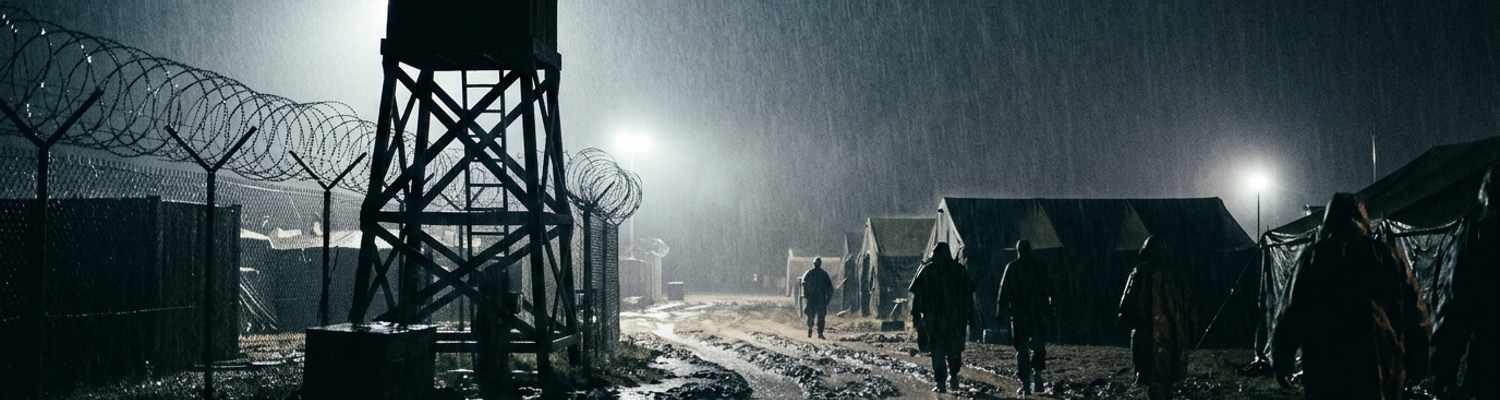

Koje-do Enclosure 76 Security Infrastructure
Guards manned the sandbagged watchtowers of Sector B. They gripped M1 Garands. Floodlights illuminated the mudflats. Diesel generators hummed.
Thousands of unseen men sat awake just beyond the wire.
US Army combat engineers installed high-voltage perimeter lighting across Koje-do Enclosure 76 in early 1952. Command directives from the 2nd Logistical Command required a continuous illumination barrier to deter nighttime escapes. Engineers from the 811th Engineer Aviation Battalion erected rough-hewn timber poles at forty-foot intervals along the exterior fences. They strung miles of uninsulated No. 4 AWG copper wire. This network connected a series of 500-watt incandescent floodlights enclosed in stamped steel housings. Three surplus Buda-Lanova marine diesel generators powered the entire grid. The military requisitioned these machines from the port of Pusan. These units fed into a central step-up transformer bank. The transformers pushed 2,400 volts through the primary distribution lines before stepping down to 120 volts at individual watchtower junctions.
Mechanics trenched shallow grooves in the rocky soil to run rubberized fuel lines directly from 55-gallon drums to the intake valves.
The salty coastal air rapidly degraded the exposed terminal connections on the transformers. Camp administrators viewed the continuous light as a highly significant security upgrade. The intense electrical draw pushed the aging generator coils to their maximum thermal operating limits on a nightly basis. A localized short circuit anywhere on the primary line would immediately trip the main breakers. This would leave the entire sector in darkness.
The camp held over 160,000 North Korean and Chinese detainees in dense compound enclosures.
Original engineering blueprints for the Koje-do facility outlined a maximum capacity of roughly 40,000 prisoners. The large-scale influx of captured enemy personnel following the Inchon landing overwhelmed this baseline design. Detainees from the North Korean People's Army and the Chinese People's Volunteer Army were packed into rudimentary dirt-floor pens. Triple-strand concertina wire surrounded these pens. Enclosure 76 housed the most highly organized and ideologically hardened communist factions on the island. A close review of operational logs indicates that up to 6,000 men were crammed into individual sub-compounds built to hold 1,200.
Space was nonexistent.
Each compound measured roughly 100 by 150 yards. The prisoners slept in tightly organized shifts inside surplus canvas squad tents. Latrine trenches overflowed into the narrow walkways during the frequent spring rains. This physical proximity allowed battalion-level command structures to form secretly within the prisoner population. Communist officers established highly disciplined subterranean communication networks. They used hand signals and buried messages. They coordinated chants that echoed across the valleys.
The human density physically pressed against the electrified boundaries of the camp.
When examining the historical record, the intersection of the overloaded electrical grid and the tightly packed prisoner population created a highly volatile tactical environment. The combat engineers had inadvertently routed the main 2,400-volt primary feed line directly over the northeast corner of Compound 76. They did this to save copper wire. Prisoners assigned to latrine detail mapped the shadow patterns cast by the overhead floodlights. They used small pieces of charcoal on discarded ration boxes to record the lighting arcs. They observed the distinct voltage drops occurring when the perimeter searchlights engaged simultaneously. The detainees recognized that the high-voltage system lacked redundant backup circuits.
Sabotaging the primary transformer would eliminate visibility from the watchtowers entirely.
Camp guards relied on the continuous illumination to monitor the tents. Measurements placed the main generator shed exactly 310 yards from the Enclosure 76 command tent.
Field Engineering and Generator Grid Vulnerabilities
Archival evidence shows the 811th Engineer Aviation Battalion faced severe material shortages during the electrical installation phase in early May 1952. Standard supply routes from the port of Pusan failed to deliver the required eight-foot copper-clad steel grounding rods. Department of the Army technical manuals specified these exact components. Field engineering teams utilized improvised grounding techniques for the high-capacity power generators. Mechanics scavenged discarded sections of pierced steel planking. They pulled rusted iron water pipes from a defunct Japanese internment camp located on the northern edge of the peninsula. Work crews drove these makeshift metal rods six feet deep into the highly saline mud of the coastal flats. They placed them directly adjacent to the main generator shed.
Sergeants secured the primary earth ground wires to these iron pipes using standard galvanized steel hose clamps.
They bypassed the required brass thermite welds. Galvanic corrosion began degrading the subterranean metal connections within forty-eight hours of installation. A close review of operational logs indicates the daily tidal shifts of the Korean Strait saturated the soil surrounding the generator shed. The mud became highly conductive saltwater. Dissimilar metals of the copper wiring and the iron pipes reacted aggressively in this brackish environment. Iron oxide built up rapidly in the tight spaces between the wire and the clamps. This chemical reaction steadily increased the electrical resistance along the grounding path throughout late April.
Three surplus marine diesel engines ran at a continuous 1,800 revolutions per minute.
They maintained a 60-hertz frequency across the Enclosure 76 perimeter. Heat buildup inside the step-up transformer banks reached dangerous levels. The cooling fans struggled against the erratic voltage bleeding through the compromised ground line. Maintenance technicians recorded casing temperatures exceeding 160 degrees Fahrenheit during the evening shifts. Base engineers had unknowingly created a fragile distribution system. It was entirely incapable of absorbing sudden electrical load fluctuations.
The grid operated on the absolute edge of mechanical failure.
On the evening of May 7, a detachment from the 71st Signal Service Battalion arrived at Compound 76. Command headquarters required updated photographic documentation of the perimeter security upgrades. A pending congressional review necessitated these images. Photographers set up three heavy-duty Mole-Richardson Type 410 carbon-arc illumination lamps near the main gate. They needed to capture wide-angle exposures of the new triple-strand concertina wire barriers. These specialized lamps required a massive initial amperage spike to ignite the internal carbon rods.
Signal Corps technicians completely bypassed the secondary watchtower junctions.
They wanted direct power. Specialists spliced their heavy rubberized cables straight into a primary 120-volt distribution box. This box sat thirty yards from the main generator shed. The lead photographer threw the ignition switch on the arc lamps at exactly 2140 hours. The sudden power draw hit the compromised transformers instantly. Cascading short circuits occurred during this routine visual record audit conducted by the Signal Corps photographers.
The massive amperage demand from the carbon-arc lamps overwhelmed the heavily corroded iron grounding rods.
Seeking the path of least resistance, high-voltage current arched violently across the interior copper busbars of the main distribution panel. This electrical arc melted the primary lead fuses in less than two seconds. Liquid copper dripped directly onto the wooden floorboards of the generator shed. The overload bypassed the safety breakers entirely. It traveled back up the main lines into the stator coils of the primary marine diesel generator. Internal copper wiring fused together into a solid block of molten slag. The engine seized completely. Every perimeter floodlight surrounding Enclosure 76 extinguished simultaneously. A sudden load drop then forced the two remaining diesel generators to over-rev. They snapped their heavy canvas drive belts against the stamped steel safety cages.
Perimeter Power Blackout and Communications Failure
At exactly 2141 hours on May 7, the molten copper slag inside the primary step-up transformer breached the secondary distribution housing. The resulting 2,400-volt surge traveled outward. Archival evidence shows this current moved along the uninsulated heavy-gauge exterior wires in a fraction of a second. It struck the stamped steel housings of the 500-watt incandescent floodlights mounted on the rough-hewn timber poles of Sector B. Inside each bulb, the tungsten filaments instantly vaporized under the extreme electrical load.
Glass casings shattered outward.
Hot debris rained onto the wet mudflats below. Total darkness enveloped the 100 by 150-yard sub-compounds of Enclosure 76. The blackout instantly erased the visual deterrent keeping the North Korean and Chinese detainees away from the inner concertina wire boundaries. When examining the historical record, the short circuits neutralized physical infrastructure extending far beyond the illumination grid. Signal Corps engineers from the 71st Signal Service Battalion had previously trenched the WD-1/TT field telephone signal lines alongside the main power cables on the eastern perimeter.
They chose this specific routing to bypass the impenetrable limestone outcroppings located near Grid Reference 44-92.
The high-voltage spike from the seizing generators arched across thirty inches of shallow, saturated dirt. It struck the buried communication lines directly. This stray current melted the high-density polyethylene insulation surrounding the twin copper-clad steel communication wires. Bare metal fused together. Solid, highly resistant nodes formed beneath the soil. Every EE-8 field telephone connecting the perimeter watchtowers to the 38th Infantry Regiment command post went dead simultaneously. Sentries assigned to the elevated catwalks frantically cranked the side-mounted magneto handles on their leather-cased handsets.
They generated no electrical signal.
The localized short circuit neutralized the physical lines required to relay voice commands. Camp commanders lost the ability to request emergency reinforcements from the centralized military police battalions stationed two miles away at the main port facility. Sector B watchtower personnel lost all contact with the outside world. A close review of operational logs indicates the sudden electrical collapse disabled primary camp alarm networks across the compound. The central alert system relied on a synchronized network of Federal Signal Model 2 klaxon horns. These were mounted on alternating guard towers.
The specialized motorized sirens required a continuous 120-volt alternating current feed.
This power spun the internal aluminum rotors up to their functional operating speed of 8,000 revolutions per minute. Base engineers from the 811th Engineer Aviation Battalion had wired the alarm relays directly into the same compromised distribution panel that serviced the external floodlights. The initial short circuit melted the primary copper busbars. This severed the feed to the alarm network's electromagnetic solenoids. Military Police corporals inside the Enclosure 76 command tent threw the red manual alarm switches mounted on the plywood walls at 2143 hours.
The switches closed empty, dead circuits.
No sirens activated to warn the sleeping reserve platoons stationed in the barracks half a mile down the valley. The centralized emergency response mechanism ceased to exist. The lack of a decentralized battery backup system compounded the mechanical failure across the installation. Department of the Army technical manuals explicitly required independent direct-current battery banks for all high-security detention facility alarm networks. Supply chain bottlenecks at Pusan delayed the delivery of the requested six-volt lead-acid batteries for three consecutive months.
Camp administrators approved the direct hardwiring of the primary alarm grid to the main diesel generators.
They implemented this as a temporary operational measure in late February. This specific command decision linked the facility's entire emergency signaling capacity directly to the fragile perimeter lighting circuit. The sudden electrical collapse left the 38th Infantry Regiment guards entirely dependent on obsolete visual signaling methods. Sentries pacing the catwalks of Watchtower 4 attempted to use standard M1911 brass distress flares to signal the command post. The heavy spring rains blowing off the Korean Strait had thoroughly soaked the unsealed wooden storage crates left exposed on the observation decking. The cardboard flare casings disintegrated in the guards' hands.
Detainee Compound Uprising and the Dodd Kidnapping
Archival evidence shows the communist leadership within Compound 76 initiated their assault within sixty seconds of the floodlights extinguishing. Colonel Lee Hak-ku, the highest-ranking North Korean captive on the island, had previously divided his 6,000 men into specialized assault echelons. Detainees assigned to the vanguard units retrieved heavy canvas tent halves and surplus wool blankets from their sleeping quarters. They sprinted blindly toward the eastern perimeter of Sector B. The sudden darkness neutralized the spatial advantage held by the 38th Infantry Regiment sentries stationed in the elevated watchtowers.
Guards peering into the pitch-black void over the mudflats could not track the mass movement of bodies rushing the inner fences.
Assault teams threw the thick canvas and blankets directly over the triple-strand concertina wire at Grid Reference 44-92. Hundreds of prisoners scrambled over the improvised fabric bridges. These vanguard units dropped into the narrow patrol corridor separating the inner and outer barriers. The sheer physical weight of the escaping detainees collapsed thirty yards of the primary perimeter fence. A close review of operational logs indicates the compromised communication lines left the ground-level guard details completely isolated.
Four military policemen patrolling the exterior walkway near Watchtower 4 found themselves surrounded by dozens of North Korean combat veterans.
The guards raised their M1 Garands. Prisoners wielding sharpened mess-tin handles and heavy wooden tent poles struck them down before they could chamber a round. Darkness prevented the tower sentries from providing covering fire. Firing blindly into the patrol corridor risked hitting their own personnel. Detainees rapidly stripped the unconscious guards of their rifles, ammunition belts, and standard-issue bayonets. The perimeter defense at Sector B disintegrated entirely by 2148 hours.
North Korean assault teams secured the main sally port from the inside and waited.
Brigadier General Francis Dodd, the commanding officer of the Koje-do installation, arrived at the Enclosure 76 main gate at exactly 2205 hours. He traveled in an unarmored Willys MB Jeep (serial number 2034451) from his headquarters two miles away after observing the total illumination failure across the valley. Dodd ordered his driver to halt directly in front of Sally Port 3. He intended to personally assess the security breach and negotiate a ceasefire with the compound leadership. The general stepped out of the vehicle accompanied by a single military police lieutenant.
Both men approached the heavy chain-link gate.
A specialized snatch squad of twenty Chinese and North Korean prisoners waited in the shadows directly behind the mesh. Camp regulations required the outer gate to remain locked at all times. The earlier power surge had shorted out the primary overhead floodlight illuminating the lock mechanism. The darkness obscured the fact that the detainees had already dismantled the heavy brass padlock using scavenged iron pipes. When examining the historical record, the kidnapping occurred with precise military coordination.
Unseen hands violently pushed the heavy steel gate outward on its hinges just as Dodd stepped within three feet of the barricade.
Six prisoners lunged forward. The lead attackers grabbed the general by his uniform jacket and web belt. The assailants physically lifted Dodd off the ground and dragged him backward into the pitch-black compound. The military police lieutenant drew his M1911 pistol. He hesitated to fire into the thrashing mass of bodies for fear of striking the camp commandant. The prisoners slammed the sally port gate shut and rapidly secured it with a heavy chain stripped from a disabled transport truck. The highest-ranking American officer on Koje Island vanished into the unlit depths of Compound 76.
International Propaganda Fallout and Command Reorganization
Archival evidence shows the communist leadership rapidly integrated the Koje-do blackout and subsequent kidnapping into their diplomatic offensive at Panmunjom. General Nam Il, the chief North Korean negotiator, possessed detailed situation reports of Brigadier General Francis Dodd's capture within forty-eight hours of the initial power grid failure. Communist printing presses located in the nearby city of Kaesong began producing tens of thousands of English-language leaflets detailing the breakdown of American military authority. Operators ran heavy-duty rotary mimeograph machines around the clock.
These devices churned out documents accusing the United Nations Command of gross incompetence and human rights violations against helpless detainees.
Detainees inside Compound 76 forced Dodd to sign a written confession. The document stated the US Army had fired upon unarmed prisoners. Couriers smuggled this signed paper out of the camp and transported it directly to the armistice village. Delegations physically brought these freshly printed stacks of confessions into the negotiation tents. When examining the historical record, the psychological warfare campaign targeted both the international press corps and frontline allied infantry units.
Chinese artillery batteries loaded specialized propaganda shells packed with the Kaesong leaflets.
They fired them across the 38th parallel into positions held by the US 2nd Infantry Division. The documents contained exact geographical coordinates of the failed generator shed on Koje Island. They also listed demands for immediate forced repatriation. At the negotiation table, Nam Il read aloud from manifestos smuggled directly out of Compound 76 via the same subterranean communication networks that had coordinated the assault. Vice Admiral C. Turner Joy sat across the wooden table. He listened to highly accurate, granular accounts of the 811th Engineer Aviation Battalion's faulty wiring.
The communist representatives demanded a formal admission of American war crimes in exchange for Dodd's release.
North Korean delegates stalled all discussions regarding the voluntary repatriation of prisoners of war for weeks. The minor electrical short circuit in Sector B had effectively frozen the entire peace process. A close review of operational logs indicates the Department of the Army responded by completely dismantling the existing detainee infrastructure. General Mark W. Clark assumed control of the United Nations Command in mid-May and immediately dispatched Brigadier General Haydon L. Boatner to Koje Island with orders to regain physical control of the enclosures.
Boatner deployed the 187th Airborne Regimental Combat Team and the 64th Tank Battalion to execute a total reorganization of the camp layout.
M46 Patton tanks crushed the makeshift barricades. Heavy treads tore through the triple-strand concertina wire of Compound 76. Infantrymen deployed non-lethal tear gas canisters to disperse the highly organized resistance blocks. Combat engineers bulldozed the massive 6,000-man sub-compounds down to the bare mud. Heavy equipment operators constructed new holding areas designed for a strict maximum capacity of 500 personnel. Construction crews poured reinforced concrete foundations for these new enclosures to prevent the digging of subterranean communication trenches. Engineers erected double lines of chain-link fencing spaced twenty feet apart around every individual block.
The US Army entirely rewrote its standard operating procedures for prisoner of war administration across the Korean theater.
New technical directives mandated the installation of independent, decentralized power generation systems for every security zone. Mechanics installed primary and secondary 15-kilowatt gasoline generators at the base of each newly constructed watchtower. Base commanders completely abandoned the centralized, high-voltage step-up transformer model that had caused the May 7 blackout. Guards received explicit orders to maintain overlapping fields of interlocking machine-gun fire covering the twenty-foot patrol corridors at all times. Camp administration banned the use of surplus canvas squad tents.
Work details forced the prisoners to build standard wooden barracks with elevated floor joists to eliminate hidden gathering spaces.
Infantrymen physically separated the North Korean officer corps from the enlisted detainees. Platoon leaders transferred the leadership cadre to a heavily fortified maximum-security facility on Cheju-do. Military police transported these high-risk prisoners in the holds of flat-bottomed Landing Ship Tanks under heavy naval escort. The manifests listed their final destination as the newly poured concrete isolation blocks located fifty miles off the southern coast.