
The Unseen Enemy at Sea
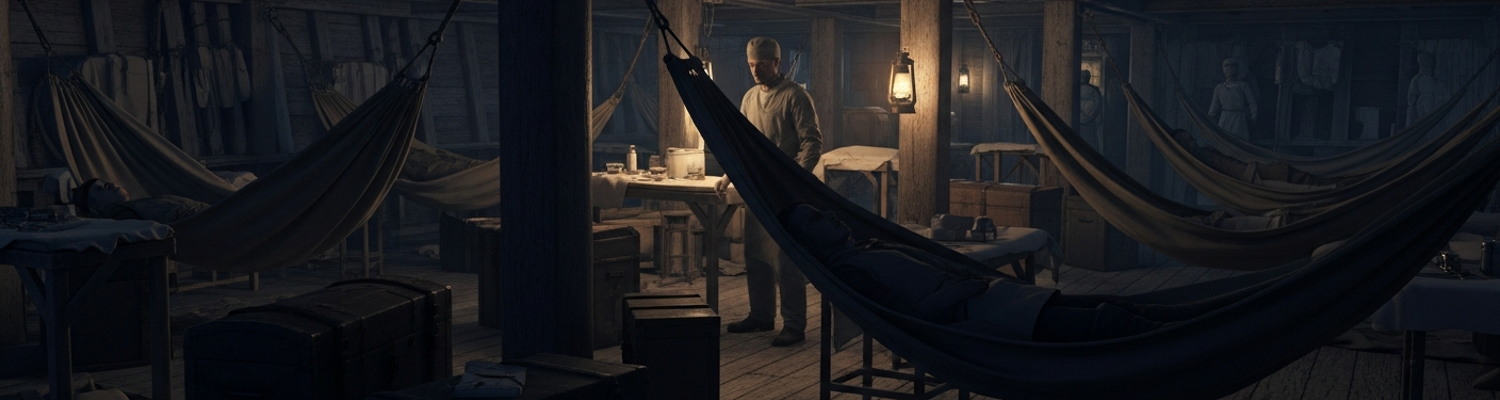
For the fledgling United States Navy in 1812, the Royal Navy represented the clear and present danger. British ships of the line were a tangible threat, their cannons capable of splintering American hulls. Yet, a far more insidious and persistent enemy stalked the mess decks and sick bays of every American frigate and sloop. This enemy was not wood and iron, but disease. Scurvy, yellow fever, and dysentery claimed far more sailors than British cannon fire ever would. The operational readiness of the US Navy during the War of 1812 hinged less on the valor of its captains and more on the brutal calculus of medical logistics. Leadership decisions made in Washington D.C. and on the quarterdecks of blockaded ships directly determined whether a crew could fight the enemy or would succumb to the invisible killers below decks. Below the gun decks, the air was a foul mixture of bilge water, unwashed bodies, and stale cooking smoke. This was the world of the common sailor, a world where the immediate threat was not always a British cannonball but the creeping rot within the ship itself and the men's own bodies.
Before the acceptance of germ theory, the medical world operated on different assumptions. Naval surgeons, though often skilled anatomists, operated within the framework of humoralism. They saw the human body as a vessel of four fluids, or humors: blood, phlegm, yellow bile, and black bile. Sickness was simply an imbalance. A feverish sailor had an excess of blood, demanding the application of leeches or the direct opening of a vein with a lancet. A lethargic one suffered from too much phlegm, requiring powerful emetics like antimony to induce violent vomiting. Treatments aimed to restore this balance through aggressive, often harmful, methods. The shipboard environment, with its damp, cramped quarters and monotonous diet of salted meat and hardtack often infested with weevils, was a perfect breeding ground for sickness. For a commander, a long voyage or a tour on a tropical station presented a greater threat from his own sick list than from any hostile fleet.
The Scurvy Siege
The first sign was a deep, bone-wearying fatigue. Then the gums would swell, turning a spongy purple and bleeding at the slightest touch. Teeth loosened in their sockets. Old, healed scars from years past would split open, as if the body were unmaking itself from the inside out. This was scurvy, the great plague of the age of sail. A deficiency of what we now know as Vitamin C, its effects were gruesome and debilitating. The British Royal Navy had largely accepted the preventative power of citrus juice by 1795, but the practice was far from universally or perfectly implemented. The US Navy, a much younger and less organized force, struggled mightily with this scourge. Just weeks after the declaration of war, Commodore John Rodgers' squadron, including his flagship USS President, put to sea from New York in June 1812. After a 70-day cruise that chased a British convoy to the English Channel, his ships limped back to Boston. The mission was aborted not by British action, but because hundreds of his sailors were incapacitated by scurvy, too weak to haul on a line, let alone serve a gun. This incident was a stark demonstration of a strategic vulnerability. A warship’s endurance was not just a matter of food and water, but of Vitamin C. Without it, the most powerful frigate became a floating hospital.
The challenge was fundamentally one of logistics. Fresh fruits and vegetables were the only known cure, but they were impossible to store on long voyages. This led to a desperate search for preservation methods. The most common technique was boiling citrus juice into a concentrated 'rob' or mixing it with alcohol, typically rum or brandy. These methods, however, were flawed. The heat from boiling often destroyed the fragile Vitamin C, rendering the expensive preparation useless. Dr. William P.C. Barton, a forward-thinking naval surgeon commissioned in 1809, was a vocal advocate for reform. He campaigned relentlessly for the systematic introduction of lemons and limes, once sending a bottle of lime juice directly to Secretary of the Navy Paul Hamilton to demonstrate its necessity. Barton's efforts highlighted a critical gap between medical knowledge and command policy. He saw firsthand how a simple, preventable illness could neutralize an entire warship, a strategic liability that leadership had yet to fully grasp.
Choked by Blockade, Stalked by Fever
The strategic decisions of the British Admiralty exacerbated the American logistical nightmare. Beginning in early 1813, the Royal Navy implemented a crushing blockade of the American coast. It began with the Chesapeake and Delaware Bays and systematically expanded until, by April 1814, it stretched from New England to Georgia. The blockade turned bustling ports like Philadelphia and Baltimore into stagnant backwaters. Merchant ships rotted at their moorings. The waterfront economy, which supplied everything from sailcloth to hardtack, seized up. For naval commanders, this meant their logistical umbilical cord to the nation was severed. Ships like Commodore Stephen Decatur’s powerful frigate USS United States were trapped in New London, Connecticut, unable to break out. While this protected them from British guns, it made them vulnerable to supply shortages.
With ports sealed, the flow of essential goods, including medical supplies, became a trickle. The acquisition of fresh provisions became a constant struggle for commanders. Captains had to rely on local foraging, a risky endeavor that could expose shore parties to enemy patrols. More critically, the blockade choked off the importation of vital medicines. The most important of these was Cinchona bark, also known as Peruvian bark, the only known effective treatment for the intermittent fevers (malaria) that plagued crews operating in the southern waters of the Atlantic and the Gulf of Mexico. The bark, sourced from the Andes, contained quinine, the alkaloid that could halt the disease’s debilitating cycle of fever and chills. By 1820, French chemists would isolate pure quinine, but during the war, the US Navy relied on the raw, imported bark. The British blockade turned this vital medicine into a scarce, high-value commodity. A captain’s decision to deploy to the Caribbean was a gamble not only against the Royal Navy but against a fever for which the cure might be unavailable.
This supply crisis placed immense pressure on naval leadership. Secretary of the Navy William Jones, who took office in January 1813, was a former merchant and sea captain with a keen understanding of logistics. He recognized that the war would be won or lost not just in dramatic ship-to-ship duels, but in the mundane details of supply chains. Jones’s policies focused on coastal defense and supporting the crucial battles on the Great Lakes, where supply lines were shorter and more defensible. His administration had to make difficult choices about resource allocation. When Jones sent Dr. Thomas Hamilton to support Commodore Joshua Barney’s Chesapeake Flotilla in 1814, he also sent a medicine chest and surgical instruments taken from the blockaded sloop of war Ontario, with strict orders to preserve them. Every vial of medicine, every scalpel, was a precious asset that could not be easily replaced. The health of the navy depended on these small, desperate logistical decisions.
The Surgeon’s Makeshift Battle
For the naval surgeon, the cockpit during battle was a scene of controlled chaos. Located below the waterline to protect from cannon fire, it was a dark, cramped, and foul-smelling space. The surgeon's domain was the cable-tier, deep in the ship's hold, lit by swaying lanterns and thick with the metallic smell of blood. The surgeon’s table, often just a set of sea chests, was laid out with the tools of the trade: capital saws for amputation, curved needles, and heavy tourniquets. Buckets of sand were spread on the deck to absorb the blood and provide a surer footing. The surgeon and his mates, often numbering only two or three for a crew of hundreds, had to be surgeons, dentists, internists, and pharmacists all at once, working amidst the screams of the wounded. Their medical chests contained a wide array of compounds, from opium and turpentine to rhubarb and nitric acid, which they had to mix into appropriate formulas themselves.
When effective remedies like citrus or Cinchona bark were unavailable, surgeons and sailors fell back on a host of traditional and often ineffective treatments. Against scurvy, men might be given spruce beer, vinegar, or various herbal concoctions like scurvygrass. None of these could halt the disease’s progress. Faced with fevers of unknown origin, surgeons resorted to the harsh humoral treatments of the day. A patient would be bled to reduce the 'fever,' then given powerful drugs to induce vomiting and defecation, all in an attempt to violently rebalance the body’s humors. That many patients survived these treatments speaks to human resilience rather than medical efficacy.
Despite the primitive state of their science, some surgeons fought for reform. Dr. Barton, beyond his advocacy for citrus, drafted rules for naval hospitals and was a pioneer in establishing professional standards for naval medicine. He was part of a generation of surgeons who, through direct and brutal experience, began to connect filth with disease and diet with health. They advised captains on the importance of airing out the damp lower decks with wind sails, cleaning the foul-smelling bilges, and keeping the crew’s bedding dry. They advocated for scrubbing the decks not just with water but with vinegar, a practice believed to cut through the 'miasma' that caused disease. The captain’s willingness to heed this advice had a direct impact on his crew’s health and the ship’s combat effectiveness. A commander who dismissed his surgeon’s counsel on hygiene might find his ship crippled by dysentery or typhus, unable to answer a call to action. In this sense, the ship’s surgeon was a critical adviser on operational readiness. The lessons learned in blood and fever during the War of 1812 forced the US Navy to confront the reality that a sailor’s health was a strategic resource, as vital as gunpowder and sailcloth. The failure to secure and manage this resource was a direct failure of leadership, with consequences as final as a broadside from an enemy frigate.