
Ninth Tactical Reconnaissance Group Intelligence Failures
Freezing rain mixed with sleet drove horizontally across the Thuringian Basin during the first week of April 1945. The precipitation turned chalky soil and ballast beds into ankle-deep clay. Surface temperatures fluctuated violently around the zero-degree Celsius mark. Biting icy squalls alternated with humid air that trapped stagnant moisture against the ground. Drainage ditches bordering the rail lines between Erfurt and Gotha overflowed with grey slush. Heavy tracked vehicles churned the soaked earth into impassable ruts. Ground-level visibility repeatedly shrank to less than four hundred yards under heavy industrial overcast.
Panic began in the darkrooms.
A close review of operational logs indicates that the crisis originated within the photo-interpretation cells of the Ninth Tactical Reconnaissance Group. Pilots flew stripped-down F-6 Mustangs (equipped with Fairchild K-17 and K-22 aerial reconnaissance cameras). They ran high-speed passes over the congested rail yards outside Eisenach and Neudietendorf. Technicians rapidly assembled stereoscopic photographic mosaics. They passed continuous film rolls through chemical fixing baths in poorly heated mobile laboratory trailers. Exposure to fluctuating ambient temperatures caused film emulsions to contract unevenly. This generated severe visual artifacts. Analysts then constructed mechanical target animation reels. Interpreters flipped rapidly between sequential frames to spot cargo transfers along the sidings. Heavy Allied strafing runs had already ruptured dozens of standard pressurized tank cars belonging to local synthetic fertilizer plants. These cylindrical transport cars held pressurized liquid ammonia and agricultural nitrogen compounds. Plumes of white chemical vapor vented from shrapnel punctures. The gas coated the rail ties in white crystallized ammonium salts. Photo interpreters worked without ground confirmation. Interpreters matched the dispersion patterns and cylindrical dimensions to German 250-kilogram chemical aerial bombs and fifteen-centimeter nerve agent artillery shells. The Ninth Tactical Reconnaissance Group intelligence annex cataloged the entire marshaling yard as an active depot containing persistent organophosphate munitions.
Commanders treated the misinterpretation as an immediate tactical emergency.
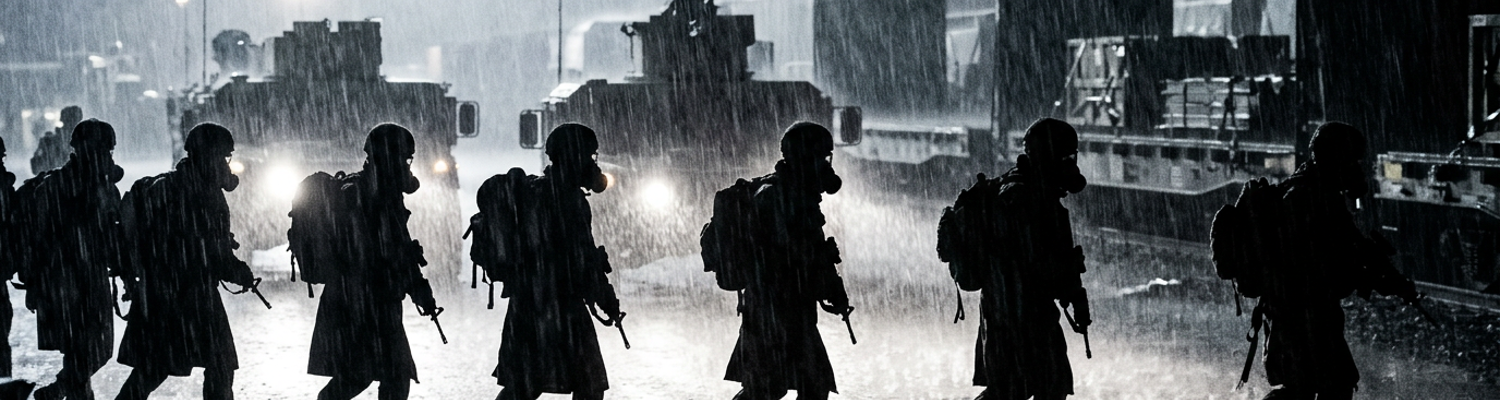
Archival evidence (NARA Record Group 338) shows that Twelfth Army Group headquarters transmitted urgent mobilization orders through priority teletype channels at 0340 hours on April 4. Field directives forced forward infantry elements of the 80th Division alongside attached chemical mortar crews directly into full presumptive chemical alert status. Soldiers had to pull non-breathable M1 toxicological protective suits and impermeable rubberized overalls over their damp wool service uniforms. This occurred before stepping out of their transport trucks. Men fastened heavy M3A1 diaphragm gas masks against raw skin. Rubber head harnesses were cinched tight enough to cause severe peripheral headaches within thirty minutes.
Winter Mobilization Along the Thuringian Ridgelines
Forward units marched three miles on foot into sub-zero slush. The freezing mud breached the seams of their uninsulated leather combat boots. Inside the airtight vulcanized rubber suits heavy physical exertion rapidly generated gallons of trapped body perspiration. The moisture could not evaporate through the synthetic barrier. Platoons halted in the freezing mud. That internal sweat chilled instantly. This induced widespread muscular cramping and rapid shivering fits. Visual fields narrowed dramatically as cold external air chilled the celluloid lenses. Thick frozen condensation coated the glass viewports.
Combat fatigue compounded every step.
Upon reaching the targeted rail sidings at Neudietendorf specialized chemical reconnaissance details deployed M9 chemical detection kits. Technicians tested the pooling slush and the ruptured steel tanks with bubbler tubes and reagent-impregnated test papers. Every colorimetric test strip registered negative for blister and nerve compounds. Air samples collected six inches above the ruptured tank valves revealed only diluted traces of commercial ammonia gas and dissolved atmospheric nitrogen.
The initial intelligence report was completely wrong.
Soldiers stayed sealed in their suits. Standing orders required secondary verification from division headquarters before unmasking. The 80th Division (attached to the Third Army) continued its advance toward the high wooded ridges south of Arnstadt. The terrain shifted from flat agricultural basins to steep limestone ravines covered in dense spruce and pine. Infantrymen carrying sixty pounds of gear slipped on the wet clay. Heavy boots slipped onto sharp rocks and jagged tree roots. The impermeable M1 suits offered no thermal insulation against the freezing rain. The rubberized fabric tore on barbed wire and splintered wood. This exposed the underlying wool uniforms to the freezing moisture.
Men struggled to breathe.
The M3A1 gas masks featured a heavy external filter canister attached directly to the left cheek. This design pulled the wearer head downward and to the left. Neck muscles cramped under the uneven weight distribution. Soldiers tried to adjust the harnesses with numb fingers. This action broke the airtight seal around their jawlines. Freezing rain leaked inside the facepieces. The water pooled in the chin cups. It mixed with sweat and saliva. Men had to tilt their heads back to keep the freezing liquid out of their nostrils.
Ad-Hoc Decontamination Details at Gotha Sidings
Archival evidence shows that by April 5 advance elements of the XX Corps found their chemical defense capabilities stretched past breaking point across the Gotha rail junction. At the central marshalling yard three ruptured Reichsbahn freight wagons were leaking unidentified chemical sludge across six parallel switching lines. The yard was located just south of the Gotha-Ost station tracks along the coordinates 50.953 degrees North and 10.725 degrees East. Exhausted Chemical Warfare Service teams had endured four straight days of continuous combat chemical sweeps without sleep. Forward tactical officers impress-ganged local manpower directly off the surrounding streets. They did not wait for rear-echelon decontamination companies.
American military police herded thirty-two captured members of the local municipal Volkssturm militia into the rail yards. Military police added forty-five liberated Polish and Ukrainian displaced persons from a nearby synthetic oil storage depot. Most of the displaced workers spoke no English or German. Field officers shouted conflicting physical directions while brandishing sidearms. Neither group had experience with chemical neutralizing agents. The conscripts had no experience with bleaching powders or basic decontamination protocols. US non-commissioned officers forced these civilians to shoulder forty-pound M3 slurry apparatuses and manual broom sweeps. Guards drove them forward to spread high-test calcium hypochlorite over the wet ballast beds.
Language barriers turned the rail yard into an uncontrolled collection area.
Quartermaster supply logs show that supply sergeants broke open crate seals on reserve stocks of M4 impregnated protective suits. Sergeants used these to cover the conscripted labor pool. These two-piece cotton twill garments were heavily treated with CC-2 chemical neutralizing wax. They were designed for standard American soldier proportions. The garments did not fit starved forced laborers or elderly municipal guards. Auxiliary workers received mismatched jackets and trousers. The fabric either dragged across the greasy ballast or tore open at the shoulder seams during manual labor. American personnel distributed M3 lightweight service gas masks directly from shipping crates. Personnel did not check head-harness adjustments. Nobody inspected rubber flutter valves for shipping deformation.
Untrained wearers received no instructions on clearing trapped air. Auxiliaries did not test for airtight perimeter seals. The untrained laborers could not manage canister resistance under heavy physical exertion. Internal facepiece humidity soared within minutes. Trapped sweat dissolved the caustic CC-2 impregnating paste along collar lines and wrists. This produced intense chemical contact dermatitis. The panicked auxiliaries mistook the severe rashes for active mustard agent burns. Men clawed at their headbands in wild claustrophobic hysteria. Workers tore their masks loose in the middle of active calcium hypochlorite dust clouds.
Three displaced persons collapsed from acute respiratory shock before the morning shift ended.
A close review of operational logs indicates that the physical breakdown of the detail was swift and total. American chemical technicians suffered from extreme auditory fatigue and forty-eight hours of continuous respirator usage. They could not maintain control over eighty panicking non-English-speaking civilians scattered between forty freight cars. The calcium hypochlorite powder reacted with pooling industrial solvents beneath tank car number 8412. This released dense clouds of chlorinated steam. The remaining militia members broke rank and fled toward the southern perimeter fence. Armed guards fired warning bursts into the ballast bed to halt the stampede. Men tripped over uncoupled pneumatic brake lines. The impregnated fabric ripped and drove powdered bleach directly into open skin lacerations. By 1100 hours rail clearance operations ground to a complete halt. Two hundred yards of track lay coated in unreacted neutralizer and abandoned decontamination equipment.
Atmospheric Interference and SCR-300 Radio Failures
A close review of operational logs indicates that by the late afternoon of April 6 signal propagation across the high wooded ridges south of Arnstadt had collapsed completely. The 80th Infantry Division pushed forward toward the crests of the Thuringian Forest near Crawinkel. Technical teams from the Chemical Warfare Service operated alongside them. Signal operators carried the standard backpack SCR-300 frequency-modulated transceiver (Signal Corps specification 71-1149). This was an eighteen-tube radio set tuned to the forty to forty-eight megacycle band. Heavy freezing rain saturated the dense canopy of spruce and pine. Water coated the flexible steel AN-130-A whip antennas. This drastically shifted their electrical resonance and sapped effective radiated power.
The rugged limestone and sandstone ridges blocked direct line-of-sight transmission. Low-lying ravines separated the forward elements from command posts positioned five miles to the north. Radio operators watched current meters on their BC-1000 chassis fluctuate erratically. Freezing moisture penetrated the canvas covers and rubber gasket seals.
Static drowned the FM receivers.
Archival evidence shows that the dry-cell BA-70 battery blocks powering the radios failed after less than two hours of continuous use in the near-freezing mud. The chemical electrolyte inside the battery casings cooled below operating thresholds. This dropped the high-voltage plate supply from ninety volts down to forty-five volts. This sudden drop extinguished the screen-grid bias in the set 1T4 and 1L4 vacuum tubes. Transmission power fell below half a watt. Technicians swapped depleted battery packs with numb wet fingers. The replacement stocks stored on open quartermaster trailers had also absorbed moisture through their paper wrappings. Dielectric loss across the saturated foliage absorbed the remaining high-frequency signal energy. Field operators attempting to establish contact across a two-mile ridgeline between coordinates 50.783 degrees North and 10.871 degrees East recorded absolute carrier silence.
This total electronic blackout directly paralyzed Chemical Intelligence Detachment 4. The unit had pushed two miles ahead of the main body into the valley of the Gera River. Technical specialists in the detachment completed rapid air-sampling operations outside an abandoned munitions bunker near Plaue. Specialists used M9 vapor detector kits and selenium dioxide tubes to analyze lingering mist clouds. The chemical technicians determined that the suspected agent vapors were non-toxic sulfur dioxide residues from burning rail ties. These were not persistent G-series nerve agents.
At 1615 hours the detachment commander ordered his radio operator to transmit the code word clearing the valley for unmasked infantry advance. Signalmen repeatedly adjusted the variable capacitor dial on the SCR-300 set. Operators shouted the message into the carbon microphones. Nothing reached the forward battalions of the 318th Infantry Regiment.
No runner could cross the slick ravines in time.
The all-clear message never broke through the atmospheric interference. Four hundred infantrymen stayed sealed inside impermeable rubberized M1 toxicological suits and restrictive M3 gas masks for six continuous hours. The column advanced uphill through sleet and knee-deep clay. Trapped body heat and condensed perspiration pooled inside the boots and gloves. This reduced skin integrity and caused severe trench foot before nightfall. Riflemen suffered acute respiratory restriction through saturated filter canisters. Twelve soldiers hyperventilated and lost consciousness along the ridgeline. Tactical commanders feared chemical contamination based on the missing clearance confirmation. Officers ordered their men to dig defensive slit trenches in full protective gear under zero-visibility darkness. By midnight a sodden dispatch runner finally reached the battalion command post on foot with the written clearance log. Thirty-eight combat effectives had to be evacuated for non-combat physical exhaustion and hypothermia.
Prolonged Respirator Confinement and Combat Fatigue
Isolation transformed protective procedure into physical torture.
Archival evidence shows that between April 6 and April 8 Company C of the 318th Infantry Regiment remained trapped in flooded slit trenches across the wooded ridges east of Crawinkel. The unit was pinned along coordinates 50.778 degrees North and 10.814 degrees East. Sleet severed the hard-laid WD-110-B field telephone lines. Tracked M4 tanks operating from the 4th Armored Division churned the remaining wire trunks into deep limestone mud along the access logging roads. Standing orders issued by the XX Corps chemical section prohibited any unmasking until forward chemical reconnaissance details could physically run paper verification logs to every isolated foxhole.
Over forty-eight continuous hours passed. Not a single runner penetrated the heavy German mortar barrages covering the ravine exits. Riflemen stayed sealed inside M3 lightweight service gas masks and rubberized hood assemblies. They were trapped in two-man scraped positions filled with eight inches of sleet and liquid clay. Drinking water from canteen caps required breaking the face seal. This act was punished by immediate court-martial under presumptive nerve agent alert conditions. Men starved and dehydrated in place.
Nausea turned the interior of the masks into closed hazard environments.
Operational logs from the 89th Chemical Mortar Battalion (File 314.7) document the biological breakdown of these isolated squads. Sustained inhalation of stale air through restrictive charcoal-and-cellulose filter canisters caused rapid carbon dioxide retention. Heavy concentrations of diesel exhaust from idling halftracks drifted into the low draws. This mixed with cordite fumes from adjacent artillery batteries. These caustic fumes triggered violent uncontrollable gastric spasms among soldiers already weakened by physical exhaustion. Men vomited directly into their rubber facepieces. The discharged semi-solid bile immediately clogged the lower M1 outlet flutter valves. This prevented the mechanical expulsion of air. Regimental medics later cataloged dozens of instances where soldiers aspirated their own vomit as they gasped for oxygen against blocked exhalation flutes. Debris coated the inner surfaces of the celluloid eyepieces. Riflemen gagged in complete darkness against acidic bile that pooled inside the chin cups and stripped the epidermal layer from their lips and jaws.
Visual isolation shattered the cohesion of the defensive perimeter.
When examining the historical record optical and auditory sensory deprivation precipitated rapid nervous breakdown under the freezing rain. Exterior temperatures fell to twenty-eight degrees Fahrenheit. This caused constant sheets of ice to freeze over the glass lens ports. The vulcanized rubber faceblanks lacked internal defroster tubes. Human breath condensed instantly against the chilled viewports. This blinded the men to anything beyond three inches from their eyes. Simultaneously the heavy rubberized hoods clamped over the ears muffled all ambient directional sound. German artillery strikes and falling spruce branches reduced to dull disorienting percussive thuds through the skull. Deprived of sight and unable to communicate except through muffled throat grunts. Cut off from visual contact with adjacent foxholes. Riflemen experienced acute panic-induced hyperventilation. The rapid shallow panting dried out the mucus membranes of the throat. This created an overwhelming sensation of suffocation while the filter canisters offered heavy mechanical resistance to accelerated breathing cycles.
The human nervous system broke down under the respiratory strain.
A close review of operational logs indicates that by the morning of April 8 acute psychological collapse had crippled twenty-six men in the second platoon alone. Respiratory alkalosis from uninterrupted hyperventilation caused severe tetany. This twisted soldiers hands into rigid carpopedal spasms that prevented them from holding their M1 Garand rifles. Claustrophobic hysteria spread through the flooded trenches. Four soldiers suffered acute dissociative episodes. The affected men screamed into their clogged facepieces and clawed at their harness buckles with broken fingernails. Two riflemen ripped off their masks in full view of their platoon sergeant. The two men sprinted blindly into an uncleared defensive antipersonnel minefield. Their boots detonated two Schu-mine 42 wooden box mines within twenty paces of the forward outposts. A relief column from the 80th Division finally reached the ridge with hand-carried all-clear clearances at 1420 hours on April 8. Litter bearers evacuated thirty-one soldiers directly to the 104th Evacuation Hospital for acute combat exhaustion and severe chemical dermatitis.