
Organizing the Battlefield Soundtrack
When the United States committed to the Great War in April 1917, the American Expeditionary Forces (AEF) confronted the monumental challenge of building a modern army from a small professional core. General John J. Pershing, commanding the AEF, understood that the spirit of this new force was as vital as its supply of ammunition. He viewed music not as a pleasantry but as a core component of military readiness. It was a tool for instilling discipline, reinforcing morale, and projecting American strength. Pershing’s observations of the highly proficient and integrated French and British military bands during his initial tours of the front solidified his resolve. He saw their ability to rally troops and impress civilian populations as a combat multiplier he intended to replicate and surpass.
Pershing acted decisively. He initiated a sweeping expansion and professionalization of the Army’s musical corps. Standard regimental bands, previously authorized at a mere 28 members, were expanded to a more robust 48 musicians. This increase provided greater sonic power and musical flexibility. Critically, Pershing championed legislation that granted commissions to qualified bandleaders, elevating their status to first lieutenant. This move professionalized the role, attracting higher-caliber musicians and giving bandmasters the authority needed to enforce high standards of performance and discipline, placing them on par with their European counterparts.
To standardize this rapidly expanding force, Pershing established a central training institution. He recruited Walter Damrosch, the celebrated conductor of the New York Symphony Orchestra, to consult on the project. In early 1918, they founded the AEF Bandmasters and Musicians School at Chaumont, France, the site of Pershing's General Headquarters. This school became the crucible for forging a unified AEF musical identity. The French Ministry of War detailed virtuosos from the Paris Conservatory to serve as instructors, teaching advanced techniques in conducting, harmony, and instrumentation. The institution processed hundreds of American musicians, systematically elevating the technical proficiency of bands across the AEF and ensuring a consistent quality of performance from the docks of Brest to the forward operating bases.
Pershing also demanded a premier ceremonial unit to represent the AEF on the world stage. He ordered the formation of a headquarters band modeled on the French Garde Républicaine Band, an ensemble renowned for its precision and artistry. This new unit, officially the A.E.F. General Headquarters Band, drew the most talented instrumentalists from across the force. The 125-piece ensemble, which became known simply as “Pershing’s Band,” performed at major state functions, troop reviews, and diplomatic events. It became a powerful symbol of American military prowess and cultural sophistication. Following the armistice, the band toured the United States to promote Victory Loan drives. Its success and prestige directly informed Pershing's 1922 order establishing The U.S. Army Band, “Pershing’s Own,” a direct institutional legacy of the Chaumont experiment.
Instruments and Stretchers
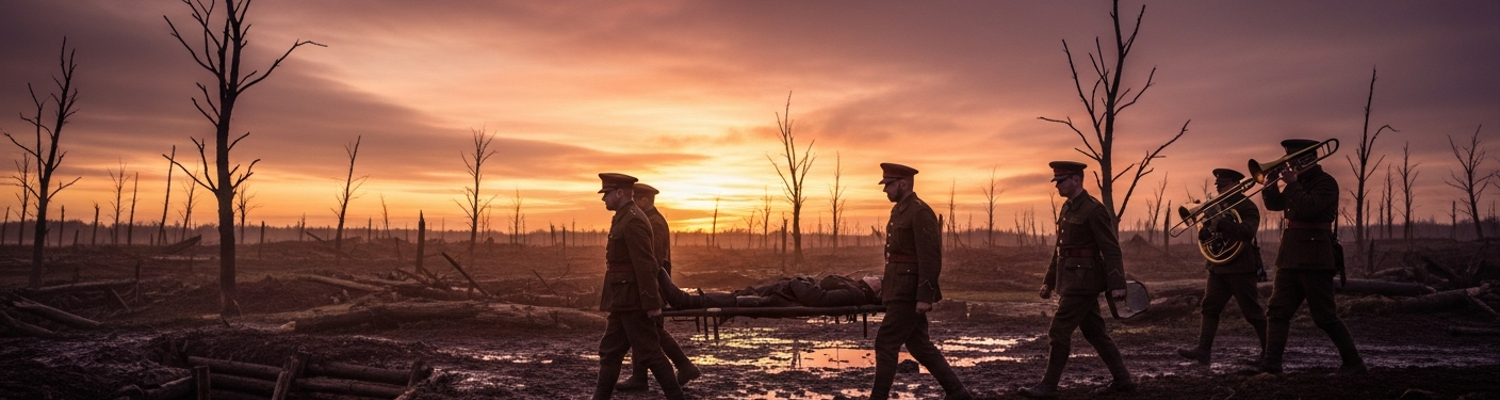
The existence of an AEF bandsman was defined by a brutal dichotomy. Their primary function was musical, yet their position within a regiment made them a ready reserve for the most harrowing duties of combat. When a unit moved to the front, musical instruments were cased and stored. The musicians were re-tasked as stretcher-bearers, casualty collectors, and burial details. The logic was one of cold battlefield calculus. The band was a cohesive, disciplined unit with its own internal command structure, making it simple to redirect for auxiliary medical support. While rifle companies drilled for the assault, bandsmen learned advanced first aid and the grim mechanics of casualty evacuation.
When the whistles blew for an attack, they advanced behind the initial waves, armed not with rifles but with stretchers, bandages, and morphine syrettes. This work was exceptionally dangerous. Stretcher-bearers moved across open, fire-swept ground to reach the wounded, often without the protection of Red Cross brassards that might have offered some immunity under the rules of war. They navigated landscapes of shell craters and barbed wire, exposed to machine-gun fire, artillery barrages, and poison gas. The physical toll of carrying a wounded man over broken terrain for hundreds of yards was immense. The psychological burden was heavier still.
Casualty rates among bandsmen were often as high as those in the line companies they supported. Some regimental commanders, after seeing their bands nearly wiped out in a single engagement, would reassign the survivors to non-medical roles like running messages or manning Stokes mortars. This was a desperate attempt to preserve the unit's core musical capability for when it rotated off the line. Personal accounts document the constant oscillation between two worlds. Musician Philip James of the 308th Infantry Band chronicled days spent playing concerts in liberated French towns to bolster civilian relations, followed by nights spent retrieving the shattered bodies of soldiers from no man's land. Bandsmen played solemn music for the funerals of comrades they had been unable to save hours earlier. This relentless swing between providing artistic comfort and confronting the raw violence of the front lines imposed a unique and profound strain on these soldiers.
Jazz on the Western Front
The AEF brought more than martial music to Europe. It served as the conduit for a new and revolutionary American sound, jazz. This cultural injection, delivered with military urgency, would permanently alter the European musical landscape. The most effective ambassadors of this new art form were the African American soldiers of segregated regiments, whose bands performed with an energy and rhythmic complexity that captivated Allied Europe.
Lieutenant James Reese Europe stood at the forefront of this movement. As bandleader for the 369th Infantry Regiment, the “Harlem Hellfighters,” Europe commanded what was arguably the most famous band in the AEF. He was already a musical giant in America, having founded the Clef Club, a union and orchestra for Black musicians that broke barriers with a 1912 concert at Carnegie Hall. When Colonel William Hayward recruited him for the 369th, Europe was tasked with creating a band of unparalleled quality, and he recruited top professionals from the New York music scene. The band’s instrumentation included a powerful saxophone section and a large percussion battery, tailored for rhythmic drive.
The 369th, serving under French command, endured 191 days in combat, a record for any American unit. When not holding the line, Europe’s band embarked on a performance tour that took them across France. Their syncopated, improvisational style was a complete novelty to European ears. Their first performance for French soldiers featured a rendition of the “Marseillaise” so infused with ragtime rhythms that the hosts reportedly failed to recognize their own national anthem at first. Sergeant Noble Sissle, a vocalist and drum major in the band, wrote that their music hit audiences like “fireworks.”
The Harlem Hellfighters’ band became a sensation, performing for massive crowds in Paris, at military hospitals, and for troops of every Allied nation. The excitement they generated ignited a French obsession with jazz that defined the postwar era. They were not alone. The 350th Field Artillery’s “Black Devils” band and the band of the 807th Pioneer Infantry, led by Will Vodery, also toured extensively, each contributing to the spread of this uniquely American music. James Reese Europe himself embodied the dual role of the soldier musician. He served as a line officer, leading a machine gun company in combat and becoming the first African American officer to face sustained combat in the war. He was wounded in a gas attack in June 1918. His battlefield experiences directly influenced his art, with compositions like “On Patrol in No Man’s Land” musically depicting the sounds of combat. These musicians were cultural vanguards, forging powerful bonds through the universal language of music.
Lessons for a Modern Force
The AEF’s organized deployment of military music offers a durable model for contemporary force development. Pershing’s command-level emphasis on professionalizing and standardizing musical units was a clear recognition of the human dimension of warfare. He did not treat morale as an abstract concept. He structured it, funded it, and inspected its delivery. This precedent argues that music and arts programs within a modern military are not peripheral expenditures but essential components of force readiness and strategic communication. The diplomatic work performed by ensembles like the U.S. Naval Forces Europe Band in building partner capacity and international goodwill is a direct continuation of this principle.
The dual-hatting of bandsmen as combat medics highlights a persistent challenge in force structure. While born of necessity, using highly skilled musicians as stretcher-bearers exposed a valuable and hard-to-replace asset to extreme risk. Future planning must account for the need for auxiliary support roles, but it should seek to distribute that risk more broadly. Modular training in combat life-saving and other critical tasks across a wider pool of support personnel can prevent the disproportionate attrition of a single specialized community, ensuring its primary capabilities are preserved.
The cultural shockwave created by the AEF bands, especially the introduction of jazz, demonstrates the immense potential of cultural assets in global engagement. The music of James Reese Europe and his peers did more than entertain. It projected a vibrant, creative, and confident image of America that resonated deeply with a European audience. This serves as a powerful lesson in the modern era of influence operations. A nation’s cultural output can be one of its most effective forms of soft power, shaping perceptions and building alliances in ways that kinetic operations cannot. The legacy of the AEF’s bandsmen is not confined to parade grounds. It is a story of resilience, innovation, and the enduring power of a new sound introduced to an old world at war.