
Victory's Hollow Echo
The United States Army’s 1898 war against Spain was a swift and decisive military success. The fighting in Cuba lasted mere weeks. Fewer than four hundred American soldiers were killed by Spanish bullets. This martial triumph, however, masked a profound and catastrophic institutional failure. A far more relentless enemy, one born of organizational neglect and logistical incompetence, stalked the American ranks. Disease, primarily typhoid, yellow fever, and malaria, killed more than 2,500 soldiers and put tens of thousands into primitive hospitals. Over ninety percent of the Army’s casualties were non-combat. This biological siege did more to destroy operational readiness, shatter morale, and expose the frailty of American military power than any Spanish Mauser rifle. The crisis revealed an Army medical and logistical apparatus completely unprepared for a large-scale expeditionary campaign. The institution had stagnated in the decades after the Civil War, shrinking into a small constabulary force of about 25,000 men focused on frontier policing. It was organizationally, intellectually, and materially unequipped for modern warfare. The disaster began not in the tropical hills of Cuba, but on American soil, in the sprawling, fetid mobilization camps where the small professional cadre was suddenly inundated by over 200,000 undisciplined volunteers.
The Stateside Contagion
The rapid expansion of the Army created the perfect breeding grounds for epidemic disease. At hastily constructed mobilization centers like Camp Thomas in Georgia and Camp Alger in Virginia, the Quartermaster’s Department failed to enforce the most basic principles of sanitation. These camps became dangerously overcrowded tent cities without adequate latrines, clean water, or waste disposal systems. At Camp Thomas, latrine pits were dug perilously close to company kitchens and water sources, guaranteeing the fecal-oral transmission of pathogens. Flies swarmed between the open cesspools and the soldiers' mess kits. The camp’s water supply was soon contaminated.
The result was a devastating outbreak of typhoid fever that swept through the volunteer regiments. Over 20,000 soldiers contracted the disease before they ever saw a transport ship. Entire units were gutted by sickness. The First Division of the Seventh Army Corps, for example, reported nearly one in five men sick at one point. The operational impact was immediate and severe. Regiments were quarantined, training schedules were abandoned, and the pool of healthy manpower available for the invasion of Cuba dwindled daily.
Commanders watched helplessly as their units, which had arrived healthy and eager, were systematically dismantled by an invisible enemy within their own lines.
A System Designed for Failure
The root of the failure lay within the War Department's ossified structure. Surgeon General George M. Sternberg was a respected bacteriologist, a pioneer in disinfection techniques. His scientific knowledge, however, was useless against the administrative inertia and logistical chaos that defined the department. Sternberg presided over a minuscule Medical Department that lacked both the authority and the resources to manage the crisis. He could recommend sanitary measures, but he had no power to compel line officers or the Quartermaster Corps to implement them.
The entire war effort was managed by Secretary of War Russell A. Alger, a politician and Civil War veteran whose primary qualification seemed to be his political connections. Alger proved utterly incapable of overseeing the immense task of mobilizing, equipping, and sustaining a force that had grown tenfold in a matter of weeks.
Procurement descended into a disorganized scramble. The Army rushed to purchase medical supplies, often accepting substandard or expired goods from civilian contractors. Quinine, essential for malaria prevention, was frequently in short supply or failed to reach the troops who needed it.
The transportation network was the system's most critical point of failure. The single-track railroad leading to the primary port of embarkation at Tampa, Florida, became a legendary bottleneck. Thousands of freight cars carrying food, ammunition, and medical supplies sat for weeks on sidings, their contents spoiling in the Florida sun. There was no coherent plan for loading ships. This meant vital medical equipment and rations were often buried in a ship's hold under tons of non-essential gear, operationally nonexistent for the soldiers at the front.
The Cuban Prostration
Following the July battles for Santiago, the situation for the American expeditionary force in Cuba became even more dire. Weakened by combat, poor rations, and heat exhaustion, the soldiers of the Fifth Army Corps began to succumb en masse to yellow fever and rampant malaria.
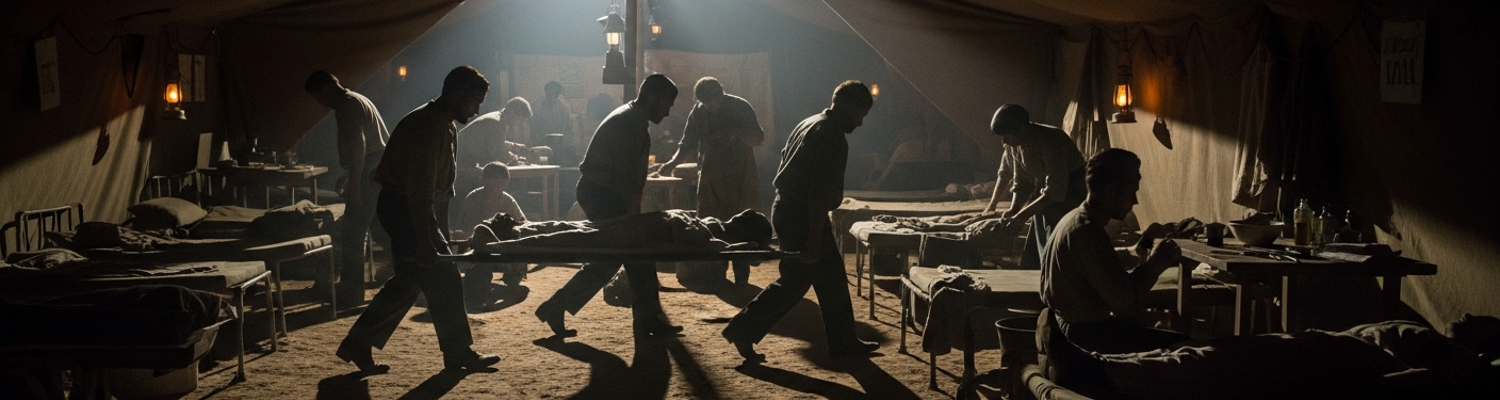
Medical facilities were appallingly primitive. They often consisted of little more than canvas tents lacking beds, mosquito netting, and basic sanitation. Overwhelmed surgeons operated in squalid conditions with dwindling supplies.
Within weeks of the Spanish surrender of Santiago, the Fifth Army Corps was effectively incapacitated by disease. Over 4,000 men, a huge percentage of the entire force, were on the sick list. The number grew by hundreds each day. The corps was no longer a fighting army. It was an army of invalids, slowly dying in the Cuban heat.
General William Shafter, the corp's commander, watched his victorious army dissolve before his eyes. The men who had charged up San Juan Hill were now too weak to stand, their bodies wracked with fever and dysentery. The Army was facing a complete strategic collapse due to medical causes.
The Voyage of the Damned
The logistical nightmare of evacuating thousands of sick soldiers became the defining scandal of the war. The Army had no dedicated hospital ships. It was forced to press into service transport vessels like the Seneca and the Concho, ships wholly unsuited for medical care. These transports were overcrowded, poorly ventilated, and lacked adequate medical staff or supplies. They became floating pesthouses.
Sick and dying men were packed onto decks, often lying in their own filth for the week-long journey home.
The arrival of these ships at Camp Wikoff, a hastily prepared quarantine station at Montauk Point, New York, shocked the nation. The American public, which had been celebrating a glorious victory, was confronted with the sight of emaciated, delirious soldiers, many looking like living skeletons, being carried off the transports.
The protracted, inefficient evacuation process caused immense suffering and many additional deaths. It starkly exposed the systemic deficiencies in military medical planning, resource allocation, and execution at every level.
This was not a failure of individual doctors or nurses. It was a failure of the entire military system to provide for the health and welfare of its soldiers.
A Reckoning for Reform
The mass evacuation from Cuba was only initiated after a group of senior officers, including a frustrated Colonel Theodore Roosevelt, took the extraordinary step of circumventing the chain of command. In early August 1898, they drafted and leaked to the press a document known as the 'Round Robin Letter'. The letter bluntly described the catastrophic health of the army and warned that keeping the troops in Cuba would lead to their complete destruction by disease. The letter, a direct challenge to the authority of Secretary Alger and General Shafter, created a political firestorm that forced President McKinley's administration to order the immediate withdrawal of the Fifth Corps.
The public outcry over the medical crisis served as a brutal but necessary catalyst for change. The Dodge Commission, appointed by President McKinley and led by Grenville M. Dodge, meticulously documented the administrative and logistical failures of the War Department. Its damning findings led to the resignation of Secretary Alger and paved the way for the sweeping reforms of his successor, Elihu Root.
The Root Reforms fundamentally reshaped the U.S. Army. They included the Army Reorganization Act of 1901, which created a General Staff to oversee military planning and a permanent Army Nurse Corps. The crisis also spurred scientific progress. The work of the Army's Yellow Fever Board, led by Major Walter Reed, definitively proved that mosquitoes transmitted the disease, a discovery that would save countless lives in the future.
The lessons of 1898, paid for with the lives of thousands of soldiers, laid the groundwork for a modern, professional logistical and medical system capable of supporting a global power.