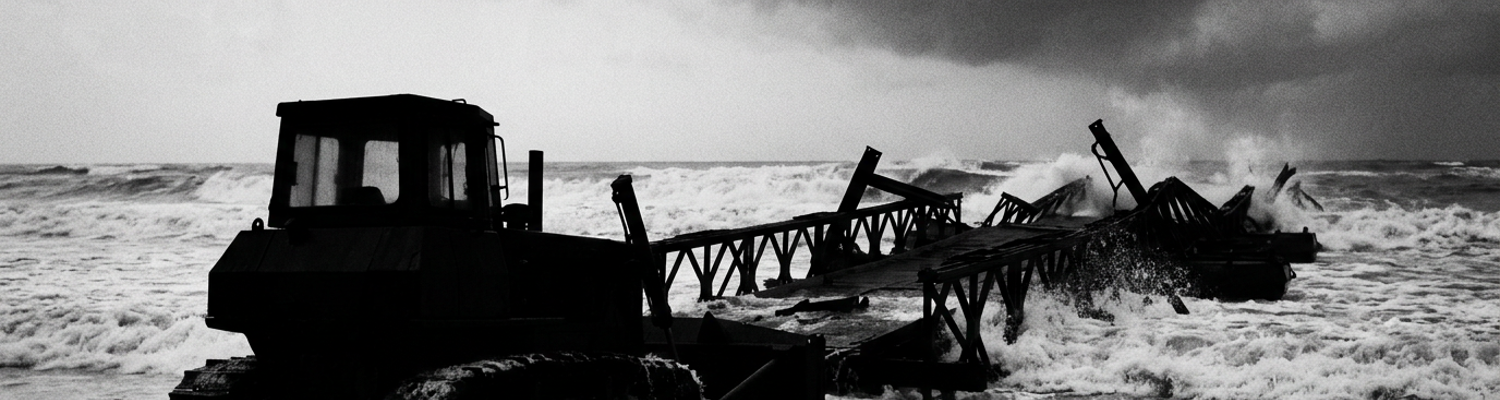

Breaker Line Ruptures at the Discharge Lanes
Naval civil engineering manuals guaranteed standard assemblies of steel pontoon causeways could absorb sustained littoral breaker forces up to six vertical feet. They failed. Along the northern Tonkin littoral on September 27, 1967, twelve-foot monsoon swells tore those structural tolerances apart within ninety minutes. A close review of operational logs indicates the sudden onset of the northeast monsoon generated short-period groundswells directly into the shallow gradient off the Quang Tri coastline. Company A, 3rd Engineer Battalion, observed the outer pontoon strings flex violently. Incoming sets pounded the discharge lanes. Heavy steel hinge pins locked under diagonal tension. The metal components sheared clean through their mounting brackets. Welded seams on two-ton P-1 steel flotation cells split under repetitive hydraulic shock. The air cavities flooded with hundreds of gallons of seawater.
Three hundred feet of interlocking causeway floated adrift.
Archival evidence shows Seventh Fleet Tank Landing Ships anchored two miles offshore aborted their approach runs. Deep-draft hulls could not navigate across the shallow breaker bar without an intact causeway head. Inside the darkened vehicle decks of vessels like LST-1156, thousands of tons of structural materials sat immobilized. Project Dye Marker depended directly on this maritime pipeline. Marine infantry dug in across forward fire support bases at Con Thien and Gio Linh faced round-the-clock Soviet-supplied 152mm artillery barrages. Platoon commanders waited on precast concrete bunker arches and heavy timber baulks to survive overhead detonations. Every pallet of structural hardware sat secured to deck tie-downs. Heavy offshore swells prevented crane ships from attempting open-water cargo transfers to smaller utility craft. The surf surge threatened to crush hull plating against the ship sides.
No cargo left the ships.
When examining the historical record, this physical separation severed the maritime replenishment chain. Daily offload volume along the coastal lanes collapsed from eight hundred short tons to zero. Attempts to bypass the broken causeway heads ended in severe equipment losses. Two LCM-8 utility hulls broached broadside on the inner shoals. Drifting steel connector cables wrapped around their propeller shafts. The cargo bays swamped before recovery crews could hook towing lines. Heavy diesel haulers and five-ton tactical trucks sat motionless across the sand staging areas. Beachmasters suspended lighterage operations across the northern coastline. Marine division supply depots lost their scheduled shipments of barbed wire and AM-2 aluminum runway matting. The entire supply effort diverted toward the narrow Cua Viet River mouth. North Vietnamese artillery spotters maintained observed fire over every passing barge.
Incoming North Vietnamese 130mm artillery shells impacted within two thousand yards of the stranded lighterage.
Heavy Surf Damage to Non-Propelled Pontoon Barges
A close review of operational logs indicates sustained nine-second wave periods from the South China Sea transformed the non-propelled pontoon barges moored along Beach Red North into untethered battering rams. Naval Support Activity Da Nang detachment crews watched fifty-ton assemblies of P-series flotation cubes buckle across their centerline joints. Longitudinal stringers fabricated from standard ten-inch structural steel channel sheared under repeated downward bending moments. Twelve-foot crests lifted individual modules. Adjacent sections dropped into deep troughs. Individual two-ton P-1 steel cells broke away from their structural angle-iron frames. Free-floating pontoon cubes tumbled end-over-end through the inner breaker line toward the sand. Wave velocity propelled these unguided metal boxes at twelve knots directly through the designated discharge corridors. Uncontrolled steel blocks crushed timber mooring dolphins. The fifty-ton cubes slammed into equipment staging pads along the low-water mark.
The inner surf zone turned into an impassable demolition field.
Archival evidence shows the mechanical failure of the barge hardware left the littoral seabed saturated with jagged underwater obstructions. Connection assemblies between pontoon strings depended on high-tensile three-inch steel pins. These pins seated within cast-steel interlocking lugs welded along the cube margins. Torsional forces generated by irregular cross-seas exceeded the yield strength of these connection points. The solid steel pins warped into hook-shaped metal hazards. The cast lugs ruptured outward. Reconnaissance divers from Mobile Construction Battalion 11 attempted hydrographic surveys. They found the shallow approach floor fouled by these severed fragments. Sharp lug horns stood upright in four to eight feet of sediment-choked water. Jagged one-inch tie-rod remnants protruded vertically from sunken framing baulks. The metal debris was completely invisible to incoming craft through the churned sand. Coxswains attempting to guide utility craft toward the beach faced dense fields of torn metal. This debris could peel open double-bottom steel plates. It could tear propeller assemblies clean off drive shafts.
Approach corridors were completely fouled.
When examining the historical record, the physical displacement of partially flooded pontoon segments onto the outer sandbars brought all remaining waterborne supply traffic to a dead stop. Four ruptured six-cube assemblies grounded firmly across the primary sand shoal two hundred yards seaward of the high-tide line. The units half-filled with seawater through cracked top-deck seam welds. Longshore currents deposited hundreds of tons of coarse littoral sediment around these immobilized hulls. The steel structures embedded four feet deep into the bar within four hours. This rapid silt accumulation created artificial metal breakwaters running perpendicular to the incoming swells. Incoming LCM-8 landing craft encountered a solid wall of grounded steel. Violent secondary breakers and chaotic hydraulic backwash surrounded the wreckage. Beachmasters from Naval Beach Group 1 attempted to designate navigable bypass gaps using fluorescent marker panels. Shifting sandbanks quickly sealed the remaining channels.
Combat engineers recorded three punctured utility craft hulls and six sheared rudders before noon.
Emergency Salvage of Drowned Shore Party Bulldozers
A close review of operational logs indicates rising surf and shifting sand submerged three Caterpillar D8H crawler tractors belonging to Company A, 3rd Engineer Battalion. Positioned along the low-tide apron at coordinates YD 324 662 to grade causeway approach ramps, the heavy earthmoving tractors weighed thirty-five tons apiece. Incoming breakers overtopped the vehicle track assemblies. Liquefied beach sand gave way beneath the thirty-inch steel track shoes. The undercarriages sank three feet below the wet seabed within twenty minutes. Seawater breached the elevated air cleaner pre-cleaners. The six-cylinder turbocharged diesel engines hydro-locked. Operators frantically attempted to reverse toward the high-water line. Cold surf flooded the master clutch housings. The twenty-four-volt starter circuits shorted. The generator armatures burned out. Coarse sand washed into the lower track guide rollers. The recoil spring assemblies jammed. The final drive sprockets locked solid. Hydraulic cylinders on the forward angle-dozer blades lost system pressure. Line mechanics could no longer raise the cutting edges.
Three front-line engineering tractors lay completely flooded.
Archival evidence shows combat engineers rigged hasty winching cables to tractor chassis before high tide swallowed the beach apron. Recovery teams from the shore party waded chest-deep into the surf zone across the exposed sand shelf. They worked against an operational deadline of 1240 hours. Breaker sets knocked mechanics off their feet. The men wrestled stiff two-inch braided wire-rope recovery pennants through the backwash. Underwater visibility dropped to zero within the suspended sediment. Soldiers dove repeatedly beneath the breaker crests with hand scrapers. They dug out wet grit packing the rear drawbars. The crews deliberately bypassed the dozer push arms. This prevented bending the C-frame members under recovery torque. Mechanics seated heavy forty-pound forged steel clevis shackles directly through the cast-steel towing pins located low on the main frames. Heavy swells pounded floating pontoon timbers against the divers. Personnel tightened high-strength steel cable clamps using standard box wrenches submerged beneath the foam. They secured two-part winching bridles before breaking water could crest the tractor cabs.
Every shackle pin had to be seated entirely by touch underwater.
When examining the historical record, unstable sandbars complicated mechanized recovery vehicles attempting to pull drowned equipment ashore. Shore party commanders positioned an M51 five-ton wrecker and two tracked M88 medium recovery vehicles on the exposed sandbar. They attempted to winch the trapped Caterpillars toward the secondary dunes. The ground gave way beneath the tracks almost instantly. Coarse littoral sand along this stretch of the Quang Tri coast exhibited low shear strength under vibration. The ground liquefied into slurry once the winches engaged. Recovery crews calculated the suction of the sunken dozers required more than ninety thousand pounds of line pull. This exceeded normal winch tolerances. The thirty-ton winches dragged the recovery hulls backward into the churning shoal. The steel tracks dug deep into the sandbar until their belly plates bottomed out. Recovery vehicle winch brake bands overheated and glazed within minutes. Battalion officers halted direct pulls. They ordered teams to dig anchoring deadman trenches with twelve-inch timber baulks along the firmer dune perimeter.
A two-inch steel recovery cable snapped under eighty tons of tension at 1140 hours.
Artillery Counter-Battery Exposure Along the Littoral Strip
A close review of operational logs indicates North Vietnamese Army forward observers situated north of the Demilitarized Zone had accurately registered firing coordinates onto the wreckage line along Beach Red North. Soviet-manufactured 130mm M-46 field guns belonging to the 84A Artillery Regiment fired from hardened reinforced-concrete casemates excavated inside the Cap Lay promontory. Incoming high-explosive fragmentation projectiles targeted the high-contrast profile of stranded tractors. The rounds struck across an eighteen-kilometer slant range. Airbursts fuzed with mechanical time-delay settings detonated thirty feet above the shallow water apron. The blasts sprayed steel splinters into the foam across a fifty-yard radius. Shrapnel sliced clean through the unarmored sheet-metal cowlings of winching trucks. Breaking surf registered ninety decibels. This completely masked the sound of incoming sonic cracks until projectiles actually struck the sandbars. Geysers of sea brine and pulverized sand thirty feet high repeatedly showered open bulldozer cabs. Thick ocean silt coated the diesel air intakes.
Engineers had four seconds between the visual muzzle flash on the northern bluffs and projectile impact.
Archival evidence shows Marine combat engineers from Company A maintained recovery operations across the breaker line despite the periodic indirect fire. Flak jackets soaked with sixty pounds of trapped seawater weighed down mechanics. The men maneuvered underneath half-submerged chassis. Steel slivers from 130mm airbursts punctured hydraulic hoses on the remaining operational M88 recovery vehicle. Pressurized fluid vented across the sand. Hydraulic line pressure to its forward anchoring spade died. Line sergeants rapidly shifted from heavy winches to manual block-and-tackle rigs anchored to timber deadmen set into the dunes. Corporal salvage riggers crawled beneath the submerged undercarriages with handheld oxyacetylene cutting torches. They severed warped three-inch track pins underwater. This freed track assemblies locked solid by packed littoral sediment. Blast shockwaves traveling through the dense water concussed divers. The riggers struggled to attach two-inch steel cables to the rear towing shackles of drowned D8H tractors. Mechanics used tractor hulls as partial defilade against horizontal fragmentation. They cleared cable fouls from winch drums with pry bars.
Saltwater corroded fresh shrapnel gashes within minutes.
When examining the historical record, defensive counter-battery cover required synchronized inter-service coordination between Marine Shore Fire Control Parties on the dunes and Seventh Fleet warships operating offshore. Tactical air control and naval gunfire spotters from the 1st Air Naval Gunfire Liaison Company deployed portable AN/PRC-25 radios. The spotters relayed radar-derived crater analysis and azimuth coordinates directly to Task Unit 70.8.9 holding station four miles out at sea. The guided-missile cruiser USS Providence and the destroyer USS Mansfield responded with rapid-fire 5-inch/54-caliber and 6-inch/47-caliber naval salvos. The ships saturated suspected NVA battery sites at Cap Lay and the coastal bluffs of the Ben Hai River. Naval gunners delivered five hundred and forty-two high-explosive rounds within fifty minutes. They utilized variable-time proximity fuzes to suppress open revetments and detonate exposed ready-service ammunition caches. Combat Information Centers aboard the offshore vessels adjusted battery trajectories using spotting corrections phoned in through beach master radio links. This offshore naval fire forced North Vietnamese gun crews to retract their artillery pieces back into subterranean tunnel complexes. Engineer recovery teams dragged two drowned tractors past the high-water berm by 1540 hours.
The third tractor remained submerged at grid coordinate YD 325 664 with a shattered final drive.
Supply Bottlenecks Across Forward Barrier Fortifications
A close review of operational logs indicates beachhead marshaling yards operated by Force Logistic Support Group Bravo reached total saturation along the Cua Viet coastal spit. Rough-terrain Anthony MLT-6 forklifts attempting to clear the narrow high-water landing apron bogged down to their planetary axles in unconsolidated beach sand at coordinates YD 331 668. Quartermasters had stacked twelve hundred pallets of Class IV engineering stores across an eight-hundred-yard strip between the water line and the secondary dunes. Continuous salt spray swept across uncovered cargo stacks. Tensioned steel strapping corroded. Water-resistant cardboard sleeves degraded until stacked crates disintegrated into the mud under their own weight. Beach clearance officers from the 3rd Shore Party Battalion diverted twenty-six available five-ton M54 cargo trucks away from line-haul supply missions. The officers needed them to pull drowned equipment from the surf. This diversion left the sorting yards completely gridlocked. Wind-driven sand accumulated four inches deep across temporary PSP steel planking within two hours. Transfer routes choked. Heavy diesel tractors could not maneuver trailers alongside the offload berms.
Twelve hundred tons of breakbulk cargo sat immobile within fifty yards of the surf.
Archival evidence shows the structural failure of the causeway completely cut off the delivery of defensive barrier components to forward positions. Combat engineers belonging to the 3rd Engineer Battalion depended on continuous shipments of ten-by-ten-inch rough-sawn Douglas fir baulks. The battalions needed corrugated fourteen-gauge steel revetment sheets and high-tensile concertina wire to assemble standardized bunker kits under Project Dye Marker. Seven thousand rolls of barbed wire sat secured inside the lower vehicle holds of Seventh Fleet landing ships anchored two miles out to sea. The material was entirely out of reach of shore personnel. At the primary inland distribution point at Dong Ha Combat Base, depot supervisors from Company C exhausted their reserve stocks of steel pickets and sandbags before noon. Convoys scheduled to haul timber baulks down Route 561 to forward battle positions were canceled on thirty minutes notice. Without revetment frames to shore up the unstable red clay soil, heavy earthmoving equipment at forward defensive belts sat idle. Engines were cut to conserve diesel fuel.
Front-line work parties received zero engineer hardware for forty-eight hours.
When examining the historical record, construction schedules across the strongpoint network anchoring the southern edge of the Demilitarized Zone fell significantly behind division operational timelines. Fortification efforts at Strongpoint Alpha-1, Gio Linh at Alpha-2, and the forward artillery base at Con Thien on Hill 158 dropped twelve days behind target completion markers within forty-eight hours of the pontoon rupture. Battalions from the 9th Marine Regiment excavated five-foot-deep weapons emplacements by hand. The infantry possessed no heavy baulks to construct double-layered overhead cover capable of resisting delayed-fuze 152mm artillery rounds. Sudden monsoon rains struck these unfortified works on September 28. The clay soil saturated. Mass cave-ins triggered along two miles of newly cut trenches. Unreinforced fighting positions filled with waist-deep water and collapsed mud. Communications wire lines laid along trench floors were destroyed. Faced with unprotected defensive sectors and zero arriving engineering shipments, 3rd Marine Division planners formally extended the construction timeline for the defensive obstacle barrier from October 1 to mid-November. Forward Marine garrisons were left exposed to continuous North Vietnamese artillery strikes.
Open fighting holes at Con Thien collapsed under rain before the first timber arrived.
The September 1967 Command Chronology Documentation
A close review of operational logs indicates the 3rd Engineer Battalion Command Chronology filed on September 30 recorded systemic lighterage interface breakdowns along the northern littoral. Across thirty typed pages prepared at Dong Ha Combat Base, operations officers itemized how the connection systems between naval lighterage craft and shore-anchored causeways broke down completely. Eight-inch braided nylon mooring hawsers parted under dynamic shock loads. Incoming utility landing craft surged against the pontoon heads. Steel chafing plates and four-inch timber rub rails bolted to the causeway discharge corners splintered away into the surf within sixty minutes of docking attempts. Navy coxswains maneuvering LCM-8 and LCU craft found their mechanical bow-ramp locking jaws repeatedly forced open. Eleven-foot swells drove ramps downward onto buckling pontoon surfaces. Cast-steel docking bitts snapped at their base welds under twenty tons of lateral shear force. Supply craft could not maintain a stable marry with the beachhead discharge lanes. Shifting shoals grounded auxiliary tugs attempting to hold craft in position against longshore currents. Marine engineers noted every lighterage transfer mechanism broke down once wave heights exceeded fifty inches. Routine coastal offload cycles transformed into violent collisions.
Standard naval lighterage couplings were never designed to absorb kinetic loads of this magnitude.
Archival evidence shows official reports detailed the engineering limitations of steel causeways facing monsoon sea states (NARA Record Group 338). Bureau of Yards and Docks technical publications rated standard assemblies of P-1 pontoon strings for littoral operations strictly within Sea State 2 parameters. Swell heights peaked at four feet in those conditions. The sudden onset of the northeast monsoon generated sustained Sea State 4 and 5 environments along the open coast of Quang Tri. The interlocking causeways were subjected to destructive hydrodynamic torsion. Welded A36 structural steel channels connecting adjacent strings sustained cyclic bending stresses exceeding forty thousand pounds per square inch. Hinge pin assemblies designed to accommodate five degrees of axial movement locked solid. Continuous twelve-foot swells twisted pontoon strings beyond eighteen degrees off-axis. Internal hydrostatic pressure from wave impacts compromised the rubber perimeter gaskets of pontoon inspection hatches. Thirty-ton buoyancy cavities flooded with seawater. Saltwater ballast accelerated metal fatigue across the submerged tie-rod anchor points. Combat engineers documented in structural addenda that the high wave-energy regime along the Demilitarized Zone littoral transformed rigid pontoon configurations into self-destroying structural hazards.
Steel sheared where standard engineering tables assumed elastic flexion.
When examining the historical record, staff officers frantically cataloged operational deficiencies while tracking equipment salvage rates along the surf. Battalion S-3 operations and S-4 supply personnel worked beneath canvas tents illuminated by gasoline lanterns. The clerks reconciled field reports flowing in from Company A beach masters at coordinates YD 324 662. Ledger sheets tracked the condition of forty-one individual pieces of plant equipment caught in the breaker line. Each machine was categorized by salvage status and component destruction. Mechanics recorded salt-water contamination in twenty-two diesel fuel injection systems. Three engine crankcases cracked from cold-water thermal shock. Eleven winch brake bands were scorched. Salvage teams achieved an initial recovery rate of forty-two percent for drowned heavy earthmovers. The crews successfully dragged two Caterpillar D8H tractors beyond the high-water line using improvised multi-part wire bridles. A third tractor remained submerged past its engine cowling. Wave action buried its lower track frames beneath six feet of sand. Battalion officers submitted urgent procurement forms to the Force Logistic Support Group for heavy-duty tractor waterproofing kits. They requested portable deep-well submersible dewatering pumps and extra five-eighths-inch braided winch lines.
Salt-caked logbooks recorded seventy-two distinct component write-offs before midnight.
Amphibious Lighterage Vulnerabilities and Doctrinal Revisions
A close review of operational logs indicates the destruction of Company A causeways at Beach Red North exposed the inherent physical vulnerability of rigid naval pontoon systems in open-sea surf zones. Standard Bureau of Yards and Docks P-1 pontoon cubes functioned as unyielding mechanical levers against fifteen-second swell intervals. The cubes were bolted together into ninety-foot strings using structural steel angles and three-inch high-tensile connection pins. Heavy seas struck the outer causeway head at coordinates YD 324 662. The vertical displacement between adjacent twenty-foot sections created dynamic shear stresses exceeding one million foot-pounds. Steel angle-iron chords buckled under reverse cantilever loads. Connecting lugs welded to the side plates of the two-ton flotation cells sheared along the heat-affected zones. The water seals on twenty-four separate buoyancy compartments broke. Internal ballast pumps failed to overcome thirty-gallon-per-minute seawater intrusion rates through cracked seam welds. The entire outer assembly lost positive buoyancy. The sinking metal dragged the intact landward sections into the shoals.
Rigid steel causeway strings possessed zero tolerance for the hydrodynamics of the South China Sea.
Archival evidence shows operational planners from Commander Amphibious Force Pacific Fleet and the 3rd Marine Amphibious Force formally recognized the doctrinal collapse of traditional lighterage practices across the northern military regions. Planning assumptions maintained since the Pacific campaigns of the Second World War rested on sheltered anchorages and gentle beach gradients to offload tank landing ships. Beach Red North possessed none of these features. Planners documented the open littoral north of the Cua Viet River offered zero natural sheltering features against the northeast monsoon. Pontoon systems were exposed to direct coastal shoaling and forty-knot onshore winds. The proximity of North Vietnamese 130mm and 152mm artillery positions within the Demilitarized Zone made prolonged static offload operations suicide. Navy and Marine staff officers conceded in emergency evaluations that deploying fixed pontoon causeways across open sandbars within range of Cap Lay field guns was fundamentally unworkable. The command officially declared standard causeway lighterage methods obsolete for tactical supply runs along the northern coast.
Every pending supply plan for northern I Corps had to be completely rewritten.
When examining the historical record, these findings forced sweeping structural revisions across Marine Corps sea-to-shore supply chains and amphibious offload planning in contested environments. Headquarters Marine Corps collaborated with the Naval Facilities Engineering Command. The agencies canceled procurement allocations for standard non-articulated P-series pontoon runs intended for forward littoral zones. Field training doctrine at the Coronado Amphibious Base substituted rigid causeway drills with flexible side-loadable pontoon assemblies equipped with rubberized shear-absorbing bushings. Division planners permanently diverted strategic tonnages away from exposed coastal surf heads. Heavy cargo offloads were redirected into the inland waterway corridor of the Cua Viet River toward the Dong Ha combat depot. Tactical planners revised Fleet Marine Force Manual publications. The officers inserted strict wave-energy limits and mandatory hydrographic gradient requirements before any sea-to-shore causeway deployment could receive operational authorization. Offshore discharge concepts shifted priority toward high-speed landing craft and heavy-lift Sikorsky CH-53A helicopters. These aviation assets delivered pre-slung palletized cargo directly to fortified combat bases. The breaker line was bypassed entirely.
Pacific Fleet naval engineers filed the definitive engineering revision packet in late October 1967 under Technical Report NAVFAC-TR-67-14, permanently closing Beach Red North to deep-draft amphibious shipping.