
Airhead Establishment at San Isidro Air Base
Operational planners at the Pentagon gave Lieutenant General Bruce Palmer Jr. fewer than eighteen hours to mount a strategic air assault. They ordered him to seize a foreign airfield and march an infantry force into an active urban civil war. A close review of operational logs indicates that the White House set an absolute zero-hour deadline for sunrise on April 30, 1965. This left zero buffer for staging delays. Mechanical failures were not factored into the timeline. Navigational drift was ignored. Flight crews at Pope Air Force Base received their destination coordinates while maintenance personnel were still pumping JP-4 fuel into wing tanks on the North Carolina aprons. Washington wanted ground troops in downtown Santo Domingo before foreign diplomats could coordinate an international protest at the Organization of American States.
The flight manifests allowed no margin for operational friction.
Elements of the 82nd Airborne Division landed at San Isidro Air Base on April 30, 1965. This initiated Operation Power Pack. Archival evidence shows that at precisely 0216 local time, the first Lockheed C-130E Hercules transports of the 316th Troop Carrier Wing touched down. They landed on the darkened concrete of San Isidro. This airfield was located fifteen miles east of Santo Domingo. Heavy transport planes followed at ten-minute intervals throughout the tropical morning. They delivered the 1st and 2nd Battalions of the 508th Infantry along with the 1st Battalion of the 505th Infantry. Jet exhaust heated the tarmac to over one hundred degrees. Ground personnel worked without forklifts. They rolled pallets of ammunition, AN/PRC-25 radio sets, and rations off rear cargo ramps by hand. Maintenance logs reveal that several C-130 hydraulic pressure lines cracked under the heavy landing cycles on the uneven Dominican runway. Major General Robert H. York set up his tactical command post directly inside an unpainted airfield maintenance hangar. Dominican loyalist officers under General Elias Wessin y Wessin hovered nearby in disarray.
San Isidro sat separated from the actual fighting by fifteen miles of hostile territory.
The operational mandate required rapid establishment of an overland route. Tactical orders directed York and his paratroopers to advance along the two-lane asphalt corridor of the Carretera Mella. They were to punch straight through the industrial outskirts. The objective was a physical junction with the 6th Marine Expeditionary Unit holding the International Security Zone five miles west of the river. Between those two American forces stood the Juan Pablo Duarte Bridge. This four-lane steel suspension span stretched over the broad Ozama River at coordinates 18 29 08 N, 69 53 02 W. Constitutionalist rebel fighters had dragged city buses across the bridge approach. They added oil drums and steel girders to form anti-armor barricades. Heavy .50-caliber machine guns and 75mm recoilless rifles were zeroed on the eastern ramps. These weapons fired from high-rise concrete tenements along Calle Josefa Brea.
Supply trucks could not move forward until infantry cleared that bridgehead.
York had only three M113 armored personnel carriers ready for the initial march. He also had twenty-two M151 utility trucks. His recoilless rifle crews carried thirty-six rounds of 106mm high-explosive anti-tank ammunition per tube. Company commanders spent the pre-dawn darkness counting combat loads. Field radios crackled with reports of intense small-arms fire erupting three miles to the west. Staff officers at San Isidro quickly realized that the paratroopers lacked sufficient five-ton transport trucks to ferry entire battalions at once. Troops would have to advance on foot down a single highway flanking sugar cane fields. Sniper fire began striking the perimeter wire near the airfield fuel farm at 0645.
Constitutionalist Defensive Strongpoints at Duarte Bridge
Archival evidence shows that by midday on April 28, Constitutionalist commander Francisco Caamano Deno had delegated tactical defense of the western bridgehead. He assigned this sector to Captain Manuel Montes Arache and elite naval frogmen from the Sans Souci base. Armed neighborhood commandos converged on the intersection where the Duarte Bridge ramp plunged into the working-class tenements of Villa Francisca and Mejoramiento Social. They operated under direct orders from the rebel command bunker in Ciudad Nueva. Working teams dragged heavy precast concrete sewer conduits across all four approach lanes at Calle Josefa Brea. They tilted sixty-inch cylindrical pipes onto their sides. They packed the interiors with gravel and wet masonry mortar. Civilian mechanics from nearby transport garages commandeered twenty-four municipal diesel buses. They stripped the steering linkages and punctured the tires. They chained the chassis together across the tarmac. Gas tanks were deliberately drained into five-gallon drums to prevent explosive cook-offs. Welders with oxyacetylene torches severed street signposts and light standards. They used these metal poles to anchor steel cables through the bus wheel wells.
No wheeled vehicle could penetrate the barrier without sustained engineering demolition.
Company-level combat journals indicate that the rebel defensive system relied heavily on improvised chokepoints constructed from commercial rolling stock. Mechanics positioned three Mack ten-wheel dump trucks filled with street paving stones in a chevron formation. These sat fifty yards behind the primary bus barrier. This created a secondary killing zone at coordinates 18 29 09 N, 69 53 08 W. Commando teams bulldozed commercial bread vans and flatbed lumber trucks into the embankments below the western abutment. This prevented flanking movements through lateral drainage ditches. Rebel sappers pulled commercial dynamite from local construction depots. They taped five-pound sticks against the rear axles of these vehicles. Remote pull-wire friction detonators ran directly into basement crawlspaces. Defending squads under Montes Arache systematically dismantled the sidewalk curbing along Avenida Duarte. They hauled chunks of granite and reinforced concrete into vehicle cabs. This shielded prone riflemen from incoming shrapnel.
The bridge ramp had become a dead-end corridor.
A close review of operational logs indicates that rebel combat leadership turned the surrounding multi-story urban zone into an integrated fire system. They targeted the four hundred yards of exposed bridge decking. Constitutionalist gunners mounted water-cooled Browning M1917 .30-caliber machine guns on steel tripods. They placed heavy M2HB .50-caliber weapons inside the upper floors of the Molinos Dominicanos flour storage structures. Additional guns were positioned in adjacent brick residential apartments lining Calle Barahona. Rebel snipers equipped with 7.62mm San Cristobal Model 2 carbines and Mauser bolt-action rifles occupied third-story concrete balconies. They cut interlocking firing loopholes through exterior masonry with hand chisels. Spotters situated on the zinc-roofed industrial warehouses had line of sight over the entire eastern bank. They zeroed their fire across the concrete parapets where loyalist armor had previously stalled. Gun crews deliberately knocked out window glass to eliminate reflective glare. They retreated deep into darkened bedrooms to obscure muzzle flashes from airborne observers.
Every square foot of exposed steel truss fell within overlapping fields of fire.
Tactical maps preserved from the operation show that rebel forces anchored their heaviest cross-river interdiction weapon in an unfinished two-story cinderblock residence. This was a 75mm M20 recoilless rifle located at the corner of Calle Teniente Amado Garcia Guerrero. The two-man crew maintained clear lines of sight straight down the bridge centerline from that elevated recess. They were ready to strike any target emerging from the eastern ramps. Ammunition carriers stacked thirty high-explosive anti-tank rounds beside the breach. Three riflemen with Cristobal carbines watched the external stairwell to repel sudden infantry rushes. Field telephone wires stripped from commercial lines ran along basement foundations. These connected this position back to the central commando headquarters at the Copello building. Loyalist tanks had previously probed the eastern ramp. Twin .50-caliber armor-piercing bursts from the flour warehouse ignited an armored car engine block within forty-five seconds during that probe. The burning hull was left stalled against the center median.
State Department Reporting and Communications Disconnect
Archival evidence shows that diplomatic cables drafted inside the State Department Operations Center completely detached from the ground fighting on the afternoon of April 30. This center was located on the seventh floor of the Harry S. Truman Building. Watch officers processed incoming traffic through the National Military Command Center. They summarized field cable traffic into neat daily situation reports for President Lyndon B. Johnson and Secretary of State Dean Rusk. State Department telegram summaries drafted in Washington mischaracterized operational conditions. They claimed transit corridors were already stabilized. Civilian analysts working in air-conditioned suites eight hundred miles away assumed paratroopers had walked across the Ozama River without opposition. They conflated initial perimeter expansion around the San Isidro runway tarmac with total pacification of the urban corridor. Diplomatic briefers relied on outdated morning telephone dispatches from Ambassador W. Tapley Bennett Jr. These dispatches asserted that rebel resistance had collapsed into sporadic sniping. Embassy communications personnel in Santo Domingo had sent early assessments based on wishful loyalist military forecasts rather than verified front-line reconnaissance. Staffers filed these optimistic status assessments directly into White House briefing folders. Infantry squads were taking heavy rifle fire along the Carretera Mella at that exact moment.
Washington believed the road was open.
Radio message logs from the 82nd Airborne Division Support Command reveal an entirely different scenario along the primary transit routes east of the river. Quartermaster convoys transporting Class III fuel and Class V ammunition were immobilized east of the Ozama River. Bridge blockades caused this halt. Drivers operating fifty-two M35A2 two-and-a-half-ton cargo trucks and M54 five-ton haulers sat with idling engines. They were three miles east of the Duarte Bridge ramps at coordinates 18 29 12 N, 69 51 45 W. Steel cargo beds held five-gallon jerrycans containing Class III automotive gasoline and JP-4 aviation fuel. These were stacked directly alongside wooden crates holding Class V small-arms munitions. These pallets carried 7.62mm linked ammunition for M60 machine guns. They also held 106mm high-explosive anti-tank rounds required for recoilless rifles. Rebel sniper fire from commercial warehouse rooftops pinged against metal tailgates. This forced quartermaster officers to halt the vehicular march along the roadside drainage ditches. Chained municipal buses and precast concrete sewer conduits blocked the bridgehead. Direct fire from concealed 75mm recoilless rifles covered the span. This turned the soft-skinned supply trucks into volatile targets packed with combustible fuel. Quartermaster officers ordered convoy personnel to dismount and take defensive positions in the grass. They were unable to risk fuel explosions on the narrow roadway.
The trucks could not move forward or backward.
A close review of operational logs indicates that the stranding of these Quartermaster columns rapidly degraded combat sustainability across the riverhead. Forward rifle companies of the 1st Battalion, 508th Infantry had expended over forty percent of their combat loads during the initial push toward the eastern bridge approaches. Artillery gunners assigned to Battery A, 1st Battalion, 320th Artillery positioned four M102 105mm howitzers in open dirt clearings near the San Isidro road. Their caissons held fewer than thirty-five high-explosive rounds per tube. Forty thousand gallons of Class III fuel sat stranded in the halted five-ton tankers. This prevented maintenance crews from refueling the division headquarters electrical generators and three M113 armored personnel carriers. Major General Robert H. York transmitted three emergency messages across the high-frequency division net. He requested armed scout sections to clear bypassed sniper positions along the Carretera Mella. Division staff officers scrambled to locate alternate routes through rural farm paths. Deep mud ditches prevented heavy transport trucks from bypassing the blocked paved highway. Forward infantry units stripped spare rounds from dead loyalist soldiers along the road shoulders while waiting for supply lines to break open.
The entire supply line terminated in a roadside ditch.
The 307th Engineer Battalion Under Direct Fire
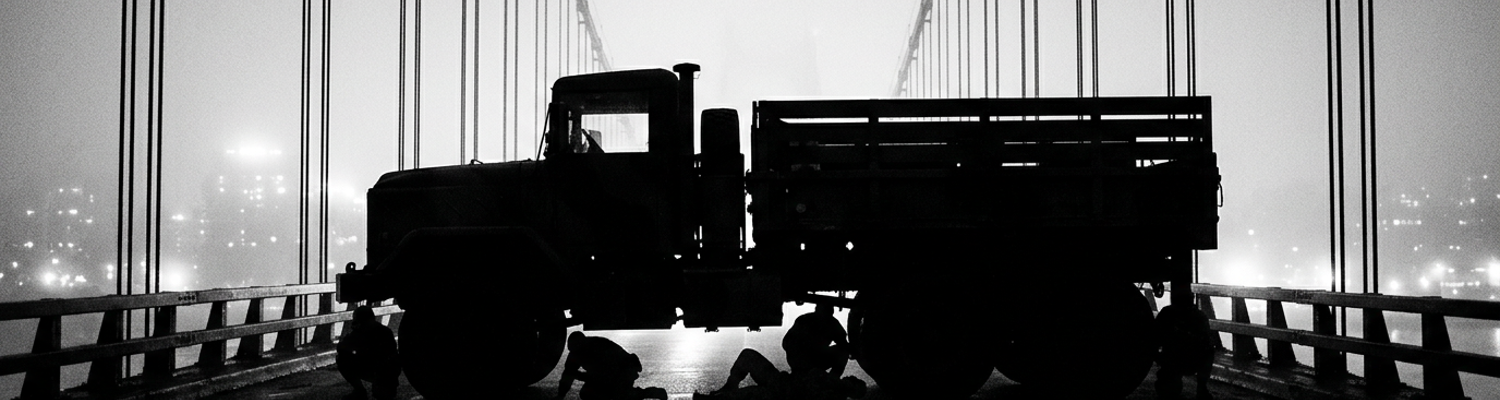
Archival evidence shows that at precisely 1311 on April 30, the entire western advance stalled along a four-hundred-foot section of the Juan Pablo Duarte Bridge. Captain Ronald Speer ordered twenty-four combat engineers from Company A, 307th Engineer Battalion to step past the forward rifle positions. These positions were established by the 1st Battalion, 508th Infantry. These paratroopers moved onto the exposed bridge deck to breach physical roadblocks and clear vehicle wreckage. They carried sixty-pound satchel charges, heavy bolt cutters, and steel tow cables. Forward vehicular movement had stopped cold behind a jagged wall of chained municipal buses and overturned dump trucks. This blocked the westbound lanes at coordinates 18 29 08 N, 69 53 05 W. Asphalt temperatures on the bridge roadway exceeded ninety-five degrees. Engineer squads crawled between the punctured tires and shot-out chassis of abandoned civilian sedans. They dragged steel tow lines connected to an M37 three-quarter-ton truck idling at the eastern abutment. Cutting torches flared against heavy security chains wrapping the bus axles.
The open steel deck offered zero lateral cover.
Company logs reveal that the clearing operation hinged on severing three high-tensile steel cables. These cables lashed two twenty-ton Mack dump trucks directly to the bridge floor beams. Sergeant First Class Donald Ray led a five-man breaching element equipped with M183 demolition assemblies. These contained sixteen blocks of Composition C-4 explosive packed into canvas satchels. Paratroopers wedged shaped charges into the wheel wells of the lead obstacle. They wrapped primacord around the bus steering linkages to fracture the chassis without blowing a crater through the reinforced concrete bridge deck. Hydraulic jacks were brought forward to lift the front axle of a disabled flatbed truck. These jacks failed when severed hydraulic lines dumped fluid across the asphalt. Combat engineers used twenty-pound sledgehammers to manually smash the cast-iron brake assemblies of the municipal buses. Each mechanical strike echoed across the Ozama River. This gave rebel gunners an exact acoustic fix on the engineer work details.
A single sniper bullet shattered the windshield of the recovery truck at 1313.
A close review of operational logs indicates that concentrated small-arms fire from urban high-rises pinned engineer squads against the bridge superstructure within seconds of that first strike. Gun teams firing from third-floor apartments on Calle Josefa Brea and the concrete grain silos of Molinos Dominicanos opened fire. They used 7.62mm San Cristobal carbines, water-cooled Browning M1917 machine guns, and .50-caliber M2 heavy barrels. Hundreds of armor-piercing rounds ricocheted off the steel suspension cables and vertical suspender ropes. This showered the prone engineers with zinc fragments and sheared structural rivets. Second Platoon took three casualties in forty seconds. Squad leader Staff Sergeant James Foster shoved two wounded men into the eighteen-inch steel recess between the curb and the main bridge truss girder. He pressed his body against the hot metal to escape direct fire originating from the upper balconies of an apartment complex two hundred yards west. Paratroopers could neither advance toward the barricade nor drag their injured back across the bullet-swept expanse of open roadway.
Between 1313 and 1315, the entire crossing turned on a single tactical alignment. An M151 utility truck mounting an M40A1 106mm recoilless rifle needed to align its sights with the primary sniper nest on Calle Barahona before the demolition charges cooked off on the bridge deck. An engineer specialist sprawled face down against structural gusset plates. He held the M60 blasting cap wire between his thumb and forefinger while copper-jacketed machine gun rounds ripped through his rucksack. Concrete fragments spalled from the bridge parapet. A 75mm rebel projectile tore through the railing three yards overhead. This sprayed powdered masonry into the eyes of the demolition team.
The blasting caps remained unprimed on the bloodied asphalt.
Manual Recovery of the Disabled M35 Truck
Archival evidence shows that at 1316, a single direct hit transformed the bridge choke point into a total mechanical bottleneck. A high-explosive round from the rebel 75mm M20 recoilless rifle smashed through the front right fender of an advancing M35 two-and-a-half-ton cargo truck. It detonated directly inside the engine compartment at coordinates 18 29 08 N, 69 53 04 W. The blast ruptured the radiator and snapped the front steering knuckle. It ignited the pressurized fuel delivery lines feeding the Continental OA-331 six-cylinder engine. Burning gasoline poured over the front axle assembly. This melted the forward pneumatic tires down to the steel rims in less than thirty seconds. The paratroopers had moved the transport vehicle forward to haul away the cut bus wreckage. Its broad eight-foot frame now sat diagonally across the westbound roadway. It was wedged hard between the concrete southern pedestrian railing and the structural steel truss. Thick black petroleum smoke roiled off the canvas cab cover. This completely blinded the American machine gun crews on the eastern ramps. Heat shimmers warped line-of-sight optics across the western riverbank. The sixty-foot clear lane carved out by the initial breaching charges was instantly gone.
The entire vehicular crossing narrowed to zero usable inches.
A close review of operational logs indicates that Company A commander Captain Ronald Speer had less than five minutes before the truck cargo bed cooked off. Thirty-two metal ammunition cans containing linked 7.62mm rounds were staged inside the wooden-slatted rear bed. Four cases of M26 fragmentation grenades sat beside them. Twelve spare five-gallon steel jerrycans filled with volatile automotive fuel rested against the tailgate. Shrapnel had already perforated two of the fuel drums. Ribbons of burning gasoline licked across the floorboards toward the stacked munitions crates. Backing an armored recovery vehicle onto the span was impossible. Stalled civilian sedans choked the narrow eastern approach ramp. Speer made the immediate command decision to forego salvage. He ordered his combat engineers to rig heavy recovery winches. They had to physically dump the burning six-ton vehicle over the side into the river before the internal blast severed the main suspension hangers of the bridge.
The ammunition boxes began popping at 1318.
Maintenance logs reveal that Staff Sergeant Donald Ray and three paratroopers from the 307th Engineer Battalion crawled seventy feet through direct crossfire to reach the burning frame. Rebel snipers stationed in the Molinos Dominicanos silos directed continuous bursts of armor-piercing .50-caliber fire into the road surface around them. This chipped three-inch deep craters into the asphalt deck. Ray carried a high-tensile three-quarter-inch braided steel cable. He pulled this from the front-mounted PTO winch of an M37 three-quarter-ton truck. That vehicle remained idling under partial cover behind the eastern abutment. An engineer specialist lay prone beneath the intense radiant heat of the engine fire. He looped the heavy cable eyelet around the rear axle housing of the M35. He slammed an eight-inch steel clevis pin home through the tow shackle with a three-pound hand mallet. A second engineer squad ran a manual six-ton ratchet come-along winch from the left frame rail of the truck to an exposed steel floor stringer along the outer structural edge of the bridge.
Steel cables strained against the charred chassis.
The recovery team executed the mechanical pivot under continuous small-arms fire between 1319 and 1321. Paratroopers pumped the manual ratchet lever while the motorized winch on the distant eastern abutment engaged. This placed over twelve thousand pounds of horizontal pulling tension across the rear axle assembly. The sideways pull dragged the rear dual wheels across the slick asphalt. It pivoted the burning bed seventy degrees toward the low concrete bridge railing. Ray swung an eight-pound sledgehammer against the damaged right steering knuckle. This freed the locked front hub from where it had jammed against the curb. Four engineers used five-foot steel pry bars to lever the front bumper upward. They fought the shifting dead weight while rifle bullets from Calle Josefa Brea shattered the remaining glass in the instrument cluster of the truck. The burning M35 tipped. It balanced on its side against the shattered railing for three seconds. It crashed eighty feet down into the muddy water of the Ozama River. This opened an eleven-foot-wide transit lane at 1321.
Improvised Battlefield Medicine on the Bridge Deck
Archival evidence shows that between 1322 and 1324, the medical situation on the eastern approaches deteriorated into a mass casualty event. No casualty evacuation corridor was available. Combat medics from the Headquarters Company medical platoon, 1st Battalion, 508th Infantry, crawled into the debris field immediately behind the breaching engineers. They operated at coordinates 18 29 08 N, 69 53 03 W. Traumatic shrapnel amputations caused by exploding 75mm high-explosive recoilless rounds and fragmented cast-iron bridge railings required immediate intervention directly on the open concrete roadway. Snipers positioned on the third-floor balconies of the Molinos Dominicanos industrial complex sustained continuous suppressive fire. They cracked 7.62mm and .50-caliber armor-piercing bullets against the bridge curbs where medics lay chest-down. Specialist Fourth Class aidmen had to perform manual arterial clamping and blunt tissue debridement while flat on their stomachs across the ninety-five-degree road deck. Hot concrete absorbed liters of arterial blood from paratroopers whose lower limbs were severed at mid-femur by flying steel from the destroyed M35 truck. Every movement above eighteen inches invited direct fire from concealed riflemen across Calle Barahona.
Rifle fire pinned the aidmen flat against the blood-slick pavement.
Battalion casualty reports indicate that five paratroopers suffered complete traumatic lower-extremity severances within a ninety-second span. Medical bags carried by the combat aidmen contained only standard Unit One supplies. These held basic morphine syrettes, triangular bandages, and small web tourniquets. These standard-issue friction-buckle tourniquets repeatedly slipped or severed soft tissue when applied over wet, torn uniform trousers. They failed to occlude severed femoral arteries under intense systolic blood pressure. Medical evacuation helicopters from the 82nd Aviation Battalion could not land on the suspension span. Hanging high-voltage utility cables and direct crossfire sweeping the riverbed prevented aerial extraction. Medics were forced to wedge severed limb stumps into narrow drainage scuppers along the bridge curb to prevent casualties from rolling into the line of fire. Fragments from secondary mortar bursts continued to strike the wounded. This sheared through canvas litters and embedded jagged metal fragments into muscle tissue before doctors at San Isidro could even be notified.
The division had completely exhausted its forward stock of web tourniquets by 1324.
A close review of operational logs indicates that aid personnel solved this mechanical failure by fabricating emergency tourniquets. They utilized WD-1/TT twin-conductor field communications wire and standard issue Carlisle model large pressure dressings. Paratroopers slashed lengths of heavy plastic-coated communications wire from tangled spools trailing behind destroyed AN/PRC-25 field radios and severed telephone poles. Aid personnel bound thick canvas-backed Carlisle dressings directly over the exposed arterial spurts. They packed the open wound cavities with sterile gauze pads before wrapping the insulated copper-and-steel wire loops around the proximal limb segments. Medics inserted aluminum M16 cleaning rod segments and M7 bayonet scabbards into the wire loops to achieve sufficient mechanical leverage to stop the femoral flow. They twisted them down like windlasses until distal pulses ceased. Field wire had high tensile strength. It resisted the tearing forces that destroyed the issued cloth straps. The improvised windlasses were secured to soldiers cartridge belts with friction tape to prevent catastrophic unwinding as casualties were dragged across the debris.
Twisted wire cut directly into charred muscle to halt the hemorrhaging.
Combat logs from the 508th Infantry confirm that this field improvisation saved four paratroopers from exsanguination between 1324 and 1326 while the bridge remained contested. Company aidmen dragged the stabilized casualties fifty yards eastward along the eighteen-inch concrete curb toward the shelter of an abandoned civilian cinderblock kiosk on the eastern abutment. Two medics sustained grazing gunshot wounds through their web gear while holding the improvised wire tourniquets in place. Staging casualties behind the bridge abutment allowed forward squads to reorganize their fighting positions without stepping over wounded men. Battalion surgeon Captain Samuel Hall received the first four amputees at the San Isidro field aid station sixty-eight minutes later. All four communications-wire tourniquets still held arterial occlusion intact.
Secured Cross-River Logistical Corridors
Archival evidence shows that at precisely 1328 on April 30, the first three M35A2 two-and-a-half-ton cargo trucks of the 82nd Airborne Division Support Command lurched out of roadside ditches at coordinates 18 29 12 N, 69 51 45 W. Clearing the bottleneck enabled stalled Quartermaster convoys to deliver emergency ammunition and fuel to forward elements in the capital. Captain Thomas Mercer engaged the double-reduction front-wheel drive on his command vehicle. He led a column of twenty-two trucks loaded with Class V small-arms crates across the severed steel cables on the eastern ramps. Quartermaster drivers pushed five-ton haulers through the eleven-foot gap cut by the combat engineers. They ground over spent brass casings and charred asphalt where the destroyed truck had tumbled into the Ozama River seventy seconds earlier. Forward rifle companies from the 1st Battalion, 508th Infantry had dropped to fewer than fifteen rounds per rifleman while defending the masonry abutments along Calle Josefa Brea. Hand-carried wooden crates packed with 7.62mm linked ball and tracer rounds reached isolated paratrooper squads crouched behind commercial brick walls within eight minutes of the span opening. Ground crews simultaneously rolled 106mm high-explosive anti-tank rounds directly to recoilless rifle crews on the front line. This neutralized two rebel machine gun posts on Calle Barahona before the gunners could reload.
Fifty-two stalled transport trucks entered the western bridgehead in single file under smoke cover.
A close review of operational logs indicates that the delivery of Class III fuel prevented the complete collapse of the mechanized forward posture. Six M49A2 five-ton fuel tankers pumped three thousand gallons of automotive gasoline directly into the dry tanks of three M113 armored personnel carriers idling near the Molinos Dominicanos complex. Field mechanics swapped clogged fuel filters on four M151 utility trucks while sniper rounds sparked off the steel pump housings. Battery A, 1st Battalion, 320th Artillery received two hundred rounds of 105mm high-explosive ammunition by 1345. This refilled gun caissons that had been completely empty since midday. Quartermaster specialists unloaded fifty-five-gallon steel drums of JP-4 aviation fuel into dirt holding areas. This restored power to trailer-mounted MEP-002A generators that ran the tactical radio arrays of the division. With primary battery banks recharged, York reestablished direct high-frequency linkups with divisional command posts at Pope Air Force Base without relay through airborne command aircraft.
Ten tons of small-arms ammunition crossed the bridge deck every twenty minutes.
Tactical movements through that afternoon confirm that the Duarte Bridge corridor established the definitive supply route linking the San Isidro staging base with the International Security Zone. Staff planners designated this three-mile overland transit route the All-American Expressway. It stretched from the runway aprons fifteen miles east, crossed the suspension bridge at coordinates 18 29 08 N, 69 53 02 W, and sliced straight through downtown rebel territory along Avenida San Martin. Lieutenant General Bruce Palmer Jr. ordered elements of the 2nd Battalion, 505th Infantry to secure every lateral intersection flanking the paved corridor. They established fortified checkpoints that severed rebel lines between Villa Francisca and Ciudad Nueva. Armored columns pushed through heavy sniper resistance to link up with the 6th Marine Expeditionary Unit holding the western perimeter around the Hotel Embajador at coordinates 18 27 50 N, 69 55 45 W. Marine M48 Patton tanks met lead M113 carriers at the intersection of Avenida Maximo Gomez at 1510. This secured physical contact between airhead logistics east of the river and naval logistics on the Caribbean coast.
Division route security teams deployed thirty sandbagged positions along the asphalt roadway. They anchored .50-caliber machine guns on reinforced concrete building roofs every two hundred yards. Convoys of five-ton cargo haulers ran the corridor in five-vehicle packets at forty miles per hour. They bypassed burning civilian vehicles while snipers fired from elevated water tanks. Medical evacuation ambulances used the return route to transfer sixty-two surgical cases directly back to the field hospital established in the San Isidro aircraft hangars. Tactical communications wire laid along the bridge curbs connected the Marine command center at the US Embassy with forward tactical headquarters without reliance on vulnerable radio nets. Rebel commanders under Francisco Caamano found their combat forces geographically split into two isolated pockets. They were unable to shift heavy weapons across the sealed avenue. Maintenance teams from the 782nd Maintenance Battalion towed fourteen disabled civilian trucks off the roadway shoulders to widen the clear zone to thirty feet. They completed the transit grid before dark.