
Command Dysfunction on the Niagara Frontier
A close review of operational logs shows the Niagara frontier in late 1813 as a theater defined not by strategy, but by systemic collapse. The American war effort, which began with assumptions that capturing Upper Canada was a simple matter of marching, had devolved into a desperate struggle for footing. Following the amphibious assault and capture of Fort George in May 1813, American forces held a tenuous enclave on the Canadian side of the Niagara River. This initial success, achieved with overwhelming numbers, was squandered through months of indecision. By autumn, the strategic imperative had shifted east. The bulk of seasoned regular soldiers were withdrawn from the Niagara to participate in a grand, and ultimately futile, offensive against Montreal. This left the position at Fort George and the occupied town of Newark (now Niagara-on-the-Lake) under a dangerously weakened command.
Responsibility for this vulnerable front fell to Brigadier General George McClure of the New York State Militia. His position was fundamentally untenable from the start. McClure, a lawyer and politician, was not a career soldier. His command consisted not of the regular troops who had captured the fort, but of militia whose short-term enlistments were set to expire as winter approached. His force was rapidly dissolving as men simply crossed the river and went home. Records indicate that by December 10, McClure was left with as few as 60 effective regular troops to defend Fort George. The situation was dire. British forces under Colonel John Murray were actively harassing his outposts, and a probing American force had been soundly defeated, signaling a clear shift in tactical momentum.
The entire American campaign hinged on a hollowed-out garrison with disintegrating morale.
This is the context in which the pivotal command failure occurred. The decision to burn Newark was the direct result of a breakdown in military leadership. Secretary of War John Armstrong had, in an October communication (per War Department correspondence dated October 4, 1813), provided McClure with discretionary authority to destroy Newark. This authority was conditional, to be used only if it became necessary for the defense of Fort George, specifically if the British used the town as shelter to mount an attack. McClure inverted this logic. Faced with an untenable defensive position and a force that had all but vanished, he decided to abandon Upper Canada entirely. On the frigid night of December 10, 1813, he ordered the destruction of Newark before evacuating Fort George. It was an act not of tactical necessity but of perceived desperation.
The execution of the order was delegated to a detachment of Canadian Volunteers. These were men who held personal grievances against the British crown and carried out the burning with a particular efficiency. Nearly 150 buildings were razed. Approximately 400 civilians, mostly women, children, and the elderly, were turned out into the freezing snow with only a few hours' notice. This was not a calculated military action against an advancing enemy; British troops were not occupying the town. It was a needless destruction that provided no tactical advantage and instead ignited a furious response. The British retaliation was swift, leading to the capture of Fort Niagara and the burning of Buffalo and Black Rock. McClure was subsequently relieved of command and dismissed from the army, his decision repudiated by the United States government.
Wilkinson’s Distant and Destructive Directive
The ultimate responsibility for Newark's destruction traces back to the highest levels of the American command structure, specifically to Major General James Wilkinson. A review of the operational chain of command shows that while Secretary of War John Armstrong authored the initial communication, it was Wilkinson, as commander of the Ninth Military District, under whose authority the Niagara front operated. The order itself was not a direct command to burn the village; it was a discretionary authorization. Archival evidence indicates the directive permitted Brigadier General George McClure to destroy Newark only if it became a tactical necessity for the defense of Fort George. This was a critical contingency, predicated on the British using the village’s buildings for shelter during an assault on the American-held fort. Wilkinson, however, was geographically and strategically detached from the realities of the Niagara theater. His focus, and the bulk of his regular forces, were directed hundreds of miles east toward the grand St. Lawrence campaign aimed at Montreal. This strategic preoccupation created a command vacuum on the Niagara, where ambiguous, conditional orders were sent to a junior officer facing the collapse of his front. Wilkinson’s failure was one of remote leadership, issuing a powerful and destructive allowance without direct oversight or a clear understanding of the rapidly deteriorating local conditions.
Brigadier General George McClure was a man ill-equipped for the task of interpreting this ambiguous directive. By early December 1813, his position at Fort George had become completely untenable. The veteran regular troops who had captured the fort months earlier had been withdrawn for Wilkinson’s Montreal offensive, leaving McClure with a garrison of militia whose enlistments were expiring daily. His effective force had dwindled to fewer than 100 men to hold a major fortification. He panicked. He fundamentally misinterpreted, or intentionally distorted, the conditional nature of his orders. The directive from Armstrong and Wilkinson was for the defense of Fort George, but McClure had already decided to abandon the fort and retreat across the Niagara River. His decision to burn Newark was not a defensive measure; it was an act committed during a full-scale evacuation. McClure delegated the execution of this order to Lieutenant Colonel Joseph Willcocks and his Canadian Volunteers, a unit composed of American sympathizers and men with personal grievances against the loyalist residents of Newark. This choice guaranteed the burning would be carried out with thoroughness, transforming a questionable military order into an act of revenge.
On the night of December 10, 1813, the village of Newark was systematically destroyed. Willcocks' Canadian Volunteers, acting on McClure’s command, moved through the settlement with torches. Civilians were given only hours to evacuate their homes into the freezing snow. Approximately 400 inhabitants were turned out into the harsh winter conditions. Accounts describe sick residents being carried from their beds and left in the snow to watch their homes burn. Over the course of the night, nearly 150 buildings were razed to the ground, leaving the once-thriving village a smoldering ruin. This was not a tactical action against an imminent threat. British troops were not occupying Newark. The destruction provided no advantage to McClure’s retreating force and instead ignited a furious cycle of retaliation that would lead to the burning of Buffalo and other American settlements by avenging British forces.
Pre-Existing Logistical Vulnerabilities
The American war effort on the Niagara frontier was compromised long before the first torch was set to Newark. A close review of operational logs reveals an army systematically undermined by its own supply chain. The decision to abandon Fort George and burn the adjacent town was not a choice born of immediate enemy pressure; it was the final act of a force that had been hollowed out by months of neglect, starvation, and exposure. The true catalyst for the disaster was a logistical framework that had failed on every conceivable level.
This failure was most acutely felt by the men in the ranks. Chronic shortages of basic winter clothing were standard operating procedure for the American army in the north. As autumn rains turned to freezing sleet in late 1813, hundreds of militia and regular troops at Fort George lacked greatcoats and serviceable boots. Archaeological evidence from forts on the frontier confirms that soldiers were often forced to purchase their own wares or make do with whatever they brought from home. This was not a matter of discomfort, but of survival. Frostbite and hypothermia became constant threats, while diseases like pneumonia and dysentery ripped through the exposed and weakened garrison. The very structures meant to house them were insufficient. After the destructive American bombardment that preceded its capture in May 1813, much of Fort George was a ruin, and hasty repairs were inadequate for a winter occupation. This lack of adequate shelter compounded the effects of insufficient clothing, creating a force physically incapable of sustaining a defense. Morale disintegrated not under fire, but under the persistent misery of cold and damp. The rapid dissolution of General McClure’s militia was a direct consequence; men whose enlistments were expiring saw no reason to endure such conditions and simply walked home.
The supply chain was broken.
This state of deprivation was guaranteed by a complete reliance on distant and deeply flawed supply lines. The primary depots for the Northern Army were located far to the east, in places like Albany. From there, a fragile network of civilian contractors was supposed to move food, ammunition, and equipment westward. This system was crippled from the start. The Quartermaster Department had only been hastily established on the eve of war (formed in March 1812), lacking the experience and infrastructure to manage such a complex undertaking. Contractors frequently failed to deliver, sometimes due to corruption, but more often because the task was simply impossible. British forces often found it easier to purchase fresh beef and supplies from American farmers in northern New York and Vermont than the U.S. Army did through its own official channels. This inconsistency meant that even when supplies were available somewhere in the state, they rarely reached the forward positions on the Niagara in time.
Even if supplies had been procured, the physical challenge of moving goods to the Niagara frontier was a separate battle. The roads were little more than unimproved dirt tracks carved through dense forest. In the autumn of 1813, incessant rains transformed these paths into impassable quagmires of deep mud that could swallow wagons whole. As winter approached, the mud froze into jagged, iron-hard ruts capable of snapping axles. While heavy snow and solid ice could improve movement with sleighs, the transitional period of freezing and thawing in early December was the worst of all worlds. Every mile of this terrain was a slow, grinding struggle against the environment that consumed time and destroyed equipment. The logistical chain shattered, ensuring that the men at the end of the line, the soldiers at Fort George, were left with nothing.
The Collapse After the Conflagration
The fires in Newark had not yet died to embers before the American evacuation began. This was not a phased, tactical withdrawal but a panicked scramble to abandon Upper Canada. As the last buildings collapsed into ruin on the night of December 10, 1813, Brigadier General George McClure’s handful of remaining troops were already in motion. They abandoned Fort George, the very position the burning of Newark was supposedly meant to defend, leaving behind munitions and hastily spiked cannons. The retreat across the Niagara River was a desperate affair. Soldiers overloaded the few available boats, navigating the freezing water and treacherous ice floes in the dark. This immediate abandonment reveals the complete strategic bankruptcy of McClure's decision; the destruction of the village served no defensive purpose for a force that was already in full flight.
They had burned their own potential shelter.
By reducing Newark to ash, McClure engaged in an act of profound logistical self-sabotage. The explicit military justification was to deny winter quarters to advancing British forces, but in doing so, he obliterated a critical, if unplanned, supply depot for his own men. The 150 structures destroyed were not just empty houses. They were barns filled with grain and hay, workshops containing blacksmith forges, and cellars stocked with preserved foods. These were resources that a competent commander, even in retreat, would have inventoried and systematically removed or destroyed as part of a planned withdrawal. Instead, everything was consumed by the fire. The conflagration vaporized tons of forage essential for the army’s few remaining draft animals, thousands of rations that could have fed the starving garrisons on the American side, and the very lumber and shelter needed to house them. The decision to indiscriminately burn the town, rather than methodically stripping it of assets, guaranteed that the American army would derive no benefit from its seven-month occupation of the area.
The immediate effect of the retreat was the severe worsening of an already dire humanitarian and supply crisis on the American side of the river. The soldiers who fled Fort George and Newark now descended upon Fort Niagara and the small surrounding settlements like Lewiston, which were completely unprepared for the influx. These posts were themselves at the end of a broken supply line and already suffered from shortages of food, medicine, and winter clothing. The addition of McClure’s disorganized and demoralized troops stretched their meager resources past the breaking point. Soldiers who had been quartered in the partially repaired barracks of Fort George now found themselves without any shelter, exposed to the full violence of a Niagara winter with only tents or hastily constructed huts for protection. Sickness, which had already plagued the American forces, now ran rampant through the crowded, unsanitary encampments. The burning of Newark, therefore, did not secure the American frontier. It did the opposite, triggering a panicked retreat that collapsed the army’s logistical structure and created a crisis of exposure and starvation for the very men who had lit the flames.
A Humanitarian Catastrophe
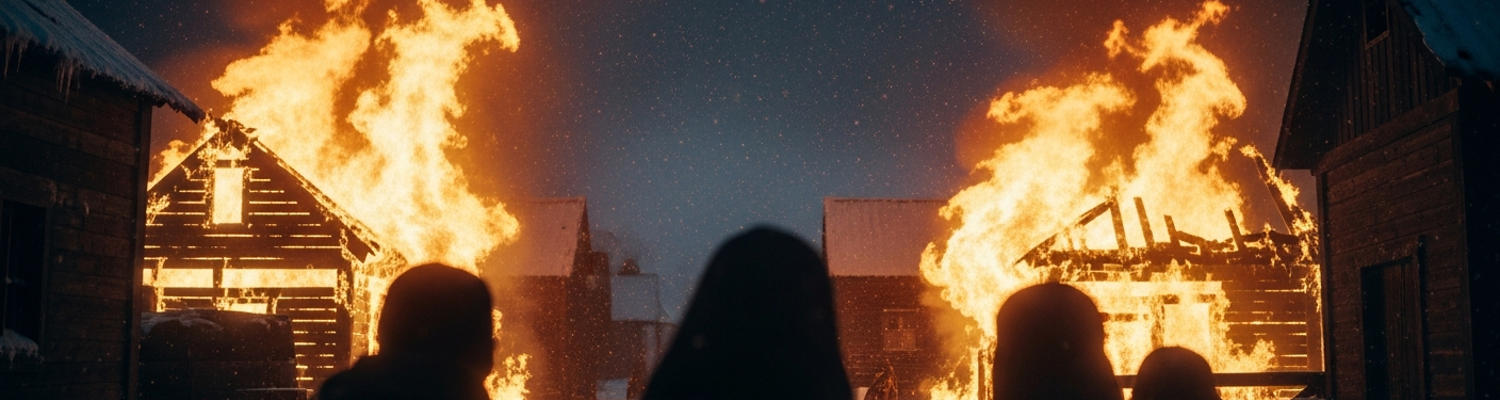
The order was executed with efficiency on the frigid night of December 10, 1813, with snow blanketing the ground. Joseph Willcocks' Canadian Volunteers moved through Newark with torches. Approximately 400 civilians, the majority of them women, children, and the elderly whose husbands and fathers were away on militia duty, were given as little as two hours' notice. They were forced from their homes into the freezing darkness. Period accounts describe sick residents, like Charlotte Dickson, being carried from their beds and left in the snow to watch as their houses and all their possessions were consumed by fire. Nearly 150 buildings were systematically razed, not as a consequence of battle, but as a deliberate act during a full-scale American retreat.
This was a calculated act of terror.
The destruction created a sensory hellscape, visible for miles. The conflagration of over a hundred homes and barns cast a terrifying, flickering orange glow against the night sky, illuminating the heavy snowfall. The sound was a roar composed of the crackling and collapsing of massive wooden beams, the shattering of superheated window glass, and the overwhelming rush of the fire itself. Layered over this cacophony were the sounds of the dispossessed. The air grew thick with choking, acrid smoke, a blinding pall that carried the stench of burning pine, personal belongings, and livestock trapped in barns. For the roughly 400 inhabitants driven into the open, the physical shock was twofold: the searing heat radiating from their burning homes and the biting cold of the December air on their exposed skin. They were left with nothing, huddled in the snow, watching the complete obliteration of their world.
Retaliation was a certainty. The orange glow in the sky over Newark was the first signal to British outposts across the Niagara River. This was immediately followed by a flood of freezing, desperate refugees who made their way to British lines, carrying with them stories of the sudden destruction. A review of British command correspondence reveals a reaction of fury. Lieutenant General Gordon Drummond, the new commander for Upper Canada, and his subordinates viewed the burning not as a legitimate military action but as an attack on a defenseless civilian population, a violation of the established conduct of war. This outrage provided a powerful and deeply personal justification for a counter-offensive. The suffering of the Newark civilians became a rallying cry. Nine days later, on December 19, British regulars under Colonel John Murray crossed the river in a snowstorm and took Fort Niagara in a surprise night attack. This was the opening move in a deliberately punitive campaign. Over the next two weeks, British forces and their Native allies, explicitly citing the events at Newark, marched down the American side of the river, systematically burning the settlements of Lewiston, Black Rock, and finally, Buffalo.
The Escalation on the Niagara Frontier
A review of British command correspondence shows the reaction to the burning of Newark was one of fury. Lieutenant General Gordon Drummond, the newly arrived commander for Upper Canada, did not view the act as a legitimate military operation. He saw it as an attack on a defenseless civilian population, an egregious violation of the unwritten codes of conduct that had, until that point, largely governed the conflict in the region. Retribution was now official policy.
Nine days after Newark was destroyed, on the night of December 19, 1813, Colonel John Murray led a force of over 500 British regulars across the Niagara River during a snowstorm. They stormed Fort Niagara in a surprise bayonet attack, showing little mercy to the unprepared American garrison. With the fort secured, the punitive phase of the operation began. British troops, accompanied by their Native allies, descended upon the village of Lewiston. The small American contingent there was quickly overwhelmed, and the settlement was torched. This was not a tactical maneuver; it was a deliberate act of vengeance, with the British forces methodically destroying every building in their path as they moved south, mirroring the American action at Newark.
The war on the Niagara was no longer against armies.
The initial strike on Fort Niagara and Lewiston was only the prelude to a wider campaign of devastation commanded by Major General Phineas Riall. On December 30, Riall's force of British regulars and several hundred allied Native warriors crossed the river farther south. Their objective was the destruction of the key American supply depots and settlements of Black Rock and Buffalo. The American defense, a collection of around 2,000 militia, proved entirely inadequate. Archival accounts note that many of the militia fled upon hearing the first musket shots and the war cries of the advancing warriors. The British forces quickly outflanked the remaining defenders and drove them into a full retreat. What followed was the systematic destruction of both settlements. Over a hundred homes and dozens of stores and barns were burned, along with four naval schooners docked at Black Rock. This act cemented the shift from conventional warfare, where armies engaged each other for tactical position, to a destructive, retaliatory cycle. The burning of Newark had provided the British with a powerful justification to escalate the conflict to a new level of intensity, one where civilian infrastructure and populations were now considered legitimate targets.
The immediate effect was a massive humanitarian crisis during the winter of 1813-1814. The burning of settlements on both sides of the Niagara River created thousands of refugees, displacing civilian populations and leaving them to fend for themselves in the freezing cold. The frontier, once a relatively populated area, was transformed into a scorched wasteland, stripped of shelter and supplies. This had a significant effect on subsequent military strategy. When the United States launched another invasion of the Niagara Peninsula in the summer of 1814, both armies found it nearly impossible to live off the land. The very logistical assets, the barns full of grain, forage for animals, and shelter for troops, that could have sustained a campaign had been destroyed in the preceding winter's fury. The bloody battles of 1814, such as Chippawa and Lundy’s Lane, were fought across a desolate landscape, a direct consequence of the decision to make the civilian population a target.