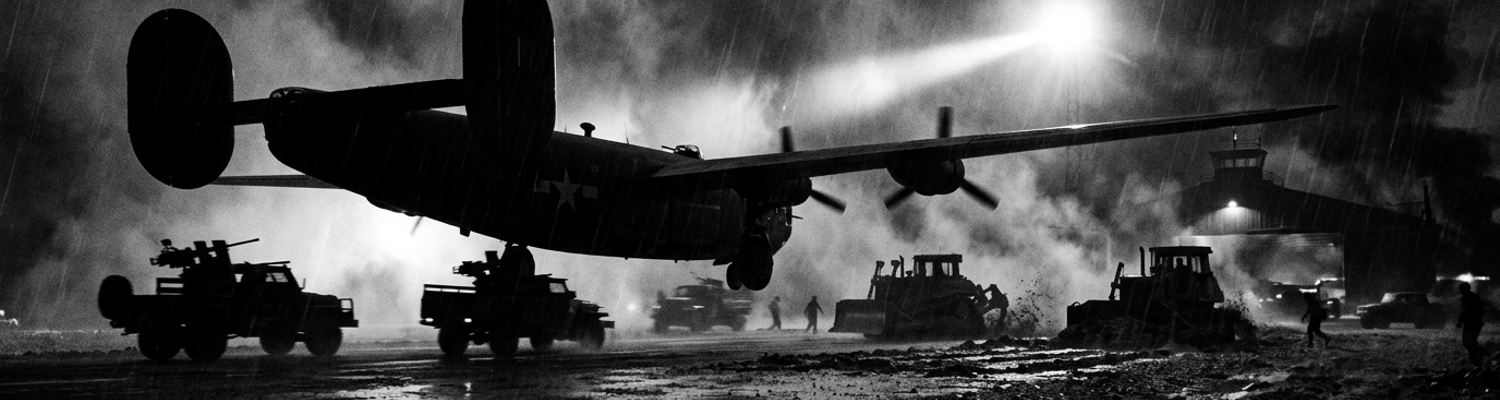

Initial Superfortress Staging at Isley Field
Archival evidence shows that converting the captured Japanese Aslito airfield into a base capable of launching heavy bombers required earthmoving on an unprecedented scale. Marine infantry cleared the original Japanese strip on June 18, 1944. They left behind a cratered 3,900-foot runway. This surface was entirely inadequate for fully laden four-engine aircraft. The Army 804th Engineer Aviation Battalion and the Navy 121st Construction Battalion undertook the complete reconstruction. They worked under frequent Japanese sniper fire from nearby caves. Engineers expanded the footprint into two side-by-side 8,500-foot runways. These were designated Runway A and Runway B. Each measured 200 feet wide and featured a surface of compacted crushed coral. Heavy Caterpillar D8 bulldozers cut through thirty-foot ridges. Power shovels excavated millions of cubic yards of solid limestone from coastal quarries. Wet coral had to be spread and rolled with sheepsfoot compactors. It was chemically set with sea water within hours of excavation. Equatorial heat hardened the material into brittle and unmanageable mounds.
Equipment failures threatened construction schedules daily.
A close review of operational logs indicates that the operational baseline shifted dramatically on October 12, 1944. The first Boeing B-29 Superfortress touched down on the newly compacted coral of Runway A. Brigadier General Haywood S. Hansell Jr. relocated the headquarters of the XXI Bomber Command to Saipan. He established operational jurisdiction over the four bombardment groups of Brigadier General Emmett O'Donnell Jr.'s 73rd Bombardment Wing. Between late October and November, over one hundred heavy bombers from the 497th, 498th, 499th, and 500th Bombardment Groups flew in via Kwajalein Atoll. The arriving flight crews faced catastrophic mechanical instability. Wright R-3350-23 Duplex-Cyclone eighteen-cylinder engines suffered chronic valve failures. Magnesium crankcase cracks were caused by extreme cylinder head temperatures during tropical climbouts. Improvised field modifications became mandatory. Airfield mechanics stripped engine cowlings and adjusted secondary fuel mixtures. They hand-filed ignition points on open coral hardstands without service hangars or overhead cranes.
Coral grit systematically destroyed the precision hydraulic seals of the landing gear assemblies.
When examining the historical record of these initial staging weeks, maintenance records demonstrate that ground crews were forced to cannibalize freshly delivered airframes. They did this simply to keep a fraction of the wing airworthy. The dual runways lacked hard taxiways. Ground tractors towed sixty-ton bombers through unpaved mud channels. Main gear tires repeatedly sank down to the wheel hubs. Aviation fuel distribution failed under constant pressure drops. Supply personnel pumped hundred-octane gasoline directly from fifty-five-gallon steel drums by hand into fuel cells containing thousands of gallons. On November 24, 1944, O'Donnell led Operation San Antonio I against the Nakajima Aircraft Company plant outside Tokyo. One hundred and eleven bombers rolled down the unlit coral strip of Runway A with minimum fuel reserves and malfunctioning cylinder cooling flaps.
Photographic Mapping Sorties of the Third Photo Reconnaissance Squadron
Archival evidence shows that long-range photographic intelligence gathering over Honshu fell entirely to Flight A of the 3rd Photographic Reconnaissance Squadron. They operated specialized F-13A conversions of the standard Boeing airframe. These aircraft were modified at the Continental-Denver modification center. They arrived at Isley Field stripped of defensive armor plate and forward gun turrets. This accommodated an unpressurized aft photographic bay. Captain Ralph D. Steakley took off from Runway A on November 1, 1944. He piloted an F-13A (serial number 42-24621) across fourteen hours of open ocean. This flight conducted the first American pass over Tokyo since April 1942. Steakley leveled off at thirty-two thousand feet over the Japanese coastline. He initiated runs with a battery of Fairchild K-17, K-18, and long-focal-length K-22 aerial cameras. These were mounted in vertical and trimetrogon split-vertical cradles. Subzero ambient temperatures reaching minus sixty degrees Fahrenheit caused immediate mechanical failures inside the camera compartments. Standard factory lubricants congealed into thick paste within the motorized drive gears. This snapped focal-plane shutters and caused celluloid film rolls to turn brittle and shatter inside the magazines.
Camera shutters froze solid across the camera bay midway through the target run.
Flight crews encountered severe physical conditions while attempting straight-and-level photographic runs over industrial centers in Kanagawa and Tokyo prefectures. Jet stream winds exceeding one hundred and forty knots battered the airframes. This generated ground speeds so unpredictable that automated intervalometers failed to space exposures correctly for stereoscopic overlap. Unescorted and unarmed across vast enemy territory, the lone bombers drew immediate pursuit. Imperial Japanese Army Nakajima Ki-44 and Kawasaki Ki-61 interceptors scrambled from bases at Atsugi and Chofu. Japanese antiaircraft batteries around Tokyo Bay bracketed the high-altitude tracks with heavy flak. Shrapnel went through unpressurized skins and destabilized the gyroscopic camera mounts. Flight engineers tackled continuous inflight emergencies. They manually hand-cranked twenty-four-inch camera rolls through jammed transport rollers. They breathed pressurized oxygen from portable walk-around bottles in unheated sections of the fuselage.
Mechanics on the Saipan flight line washed the camera gear trains in pure kerosene. This stopped standard petroleum lubricants from solidifying at altitude.
A close review of operational logs indicates that the exposed reconnaissance negatives directly produced the primary planning documentation for subsequent XXI Bomber Command strikes. Technicians inside mobile darkroom trailers at Isley Field rushed the nine-inch by eighteen-inch film rolls through chemical wash baths. They worked in sweltering tropical heat that repeatedly blistered photographic emulsions before drying. Intelligence officers and photogrammetrists from the 73rd Bombardment Wing compiled these contact prints into the standardized 3-a series damage assessment charts. These charts mapped industrial Tokyo down to exact building footprints. They prioritized Target 357. This was the Nakajima Aircraft Company Musashino engine plant located on the western outskirts of the capital. Interpreters adjusted baseline maps using optical stereoscopes. They cross-referenced pre-war architectural blueprints to isolate propeller assembly halls, casting foundries, and heat-treatment shops.
The 3-a damage assessment series established specific aimpoints for combat groups. It calculated structural roof stress, building square footage, and clear firebreaks between factory blocks. Cartographers pasted high-contrast aerial cutouts onto grid sheets. These were marked with radial kilometer increments centered on the Nakajima test cells. This provided bombardiers with definite offset radar targets when cloud cover obscured ground optics. Post-strike reconnaissance runs flown by Steakley's squadron in late November 1944 yielded follow-up exposures. These were laid directly over the original 3-a base templates. Photo interpreters measured blast craters, counted collapsed truss roofs, and documented unexploded ordnance patterns. They calculated exact percentage drops in Nakajima radial engine output.
Photographic interpretation of the Musashino complex on November 27 confirmed that high-altitude bomb scatter had left ninety-eight percent of the target structures undamaged.
Japanese Counterattacks Staged from Iwo Jima Airfields
Archival evidence shows that Japanese naval and army air commanders realized early Marianas operations could only be disrupted by striking Isley Field directly at its logistical root. Staging squadrons gathered twin-engine Mitsubishi G4M Type 1 and Mitsubishi Ki-67 Hiryu bombers roughly six hundred miles north of Saipan. They operated from Airfield Number 1 at Chidori on Iwo Jima. Shortly past midnight on November 27, 1944, Japanese strike elements descended to wave-top height across the northern maritime approaches. The incoming formations slipped beneath the long-range beam of island-based SCR-270 and SCR-527 radar installations. They skimmed the surface swell at altitudes under fifty feet. Isley Field lay fully illuminated by construction floodlights. Heavy equipment operators rushed runway compaction details. Anti-aircraft batteries had received no radar plot. Low-altitude bombers roared over the south perimeter fence at one hundred and fifty meters. They raked the strip with 20mm cannon rounds and machine-gun fire.
Floodlights exposed eighty heavy bombers parked in neat lines.
When examining the historical record of airfield engineering, priority had gone entirely to runway extensions rather than protective revetments. Construction battalions had arranged the Boeing B-29s wingtip-to-wingtip across unrevetted coral aprons. They packed dozens of fuel-laden aircraft into tight dispersal sectors. Only fifteen feet separated the main assemblies. Japanese pilots released strings of thirty-kilogram Type 2 fragmentation bombs directly across these congested hardstands. The fragmentation ordnance detonated against the compacted limestone substrate. It threw thousands of razor-sharp steel shards sideways through thin duralumin aircraft skins. One Superfortress erupted into a tower of flame. Ruptured tanks dumped thousands of gallons of high-octane aviation fuel across the open apron. Shrapnel perforated eleven neighboring B-29s assigned to the 73rd Bombardment Wing. Pressurized fuselage bulkheads, rubber hydraulic lines, and exposed ignition cables severed under the blast wave. Fire swept across the unshielded coral.
A close review of operational logs indicates that ground crews and combat engineers met the sudden destruction with improvised technical triage directly under falling debris. Staff mechanics from the 497th and 498th Bombardment Groups dashed into the fire zones without protective equipment. They hauled steel tow cables by hand to pull unignited bombers away from spreading gasoline pools. Bulldozer operators from the 804th Engineer Aviation Battalion rammed their heavy blades into flaming wing debris. They physically shoved burning engines off the operational taxiway. Maintenance personnel cannibalized shattered bombers on the spot to preserve flyable airframes for upcoming daylight raids against Tokyo. Flight mechanics cut away jagged fuselage metal with ordinary tin shears. They replaced shredded hydraulic tubing with sections of copper pipe stripped from ruined bomb-bay bulkheads. Spliced electrical circuits were hand-soldered using open gasoline blowtorches behind hasty sandbag barricades.
Wounded mechanics worked through the smoke with hand tools.
Night raiders staging through Iwo Jima struck again in the early morning of November 29. They penetrated Saipan airspace at one o'clock. Japanese twin-engine bombers skimmed the coastline at tree-top height. They dropped antipersonnel cluster munitions that scattered jagged iron shards across the operational dispersal areas. Antiaircraft gunners brought down one low-flying attacker across the runway threshold. Blast fragments had already peppered the newly repaired hardstands. Repair troops cleared thousands of square yards of coral with improvised magnetic rakes and hand shovels. This kept fragments from slicing through heavy pneumatic landing tires. Maintenance crews plugged fuel cell punctures with vulcanizing patches and chemical sealant mixed inside cut-open ration cans. By daylight, ground mechanics had patched nine shrapnel-raked B-29s back into flight status.
Auxiliary Militia Integration via Island Command Civil Affairs
Archival evidence shows that Island Command Civil Affairs section leaders turned directly to the civilian internment compound at Camp Susupe to resolve the perimeter security deficit around Isley Field. Established along the western coast south of Garapan, the camp held over thirteen thousand displaced islanders. This included large populations of indigenous Chamorros and Carolinians. Military government personnel screened young men from both communities. They prioritized those possessing working Japanese language comprehension and lifelong familiarity with southern Saipan's dense flora. Civil Affairs officers mustered these recruits into an auxiliary scout militia. This unit was assigned to bolster airfield security detachments and the 6th Provisional Military Police Battalion. Uniforms consisted of standard olive drab herringbone twill fatigues stripped of insignia. They were marked only by painted civilian police brassards or white cloth armbands. Arming the detachments required drawing on depot surplus. Supply officers distributed early-production M1 carbines, twelve-gauge Winchester Model 1897 pump shotguns, and captured Japanese Type 99 rifles. Thousands of rounds of 7.7mm ammunition sat stacked in captured supply bunkers.
Standard military police units could not negotiate the jagged limestone terrain in total darkness.
A close review of operational logs indicates that Island Command deployed these indigenous scouts across sectors where conventional American perimeter sweeps consistently broke down. South and east of the compacted coral runways, the terrain fractured into deep ravines, razor-sharp karst outcrops, and dense tangan-tangan scrub. This completely concealed bypassed Japanese combat elements. Remnants of the Imperial Japanese Army 43rd Division and 31st Army had formed organized stay-behind cells inside subterranean sinkholes. They staged nocturnal sorties to mortar parked B-29s. Chamorro and Carolinian scouts entered these unmapped corridors without heavy radios or bulky field gear. They operated in four-to-six-man tracking teams. They tracked crushed vegetation, discarded food tins, and faint footprints left in the volcanic clay along the ridgelines flanking Nafutan Point and Mount Tipo Pale. The scouts used machetes and specialized local knowledge of natural sinkholes. They ambushed Japanese infiltration squads along narrow goat paths. They collapsed hidden cave entrances with satchel charges before enemy mortar teams could position high-angle tubes within range of Runway A.
A severed water pipe meant grounded bombers.
When examining the historical record of base engineering, the freshwater distribution network represented the airfield's most exposed operational vulnerability. Construction battalions had routed thousands of feet of three-inch and six-inch cast-iron and galvanized steel pipe directly over open ground. This ran from artesian pump stations near Lake Susupe across exposed limestone flats. It fed boiler plants, radial engine wash racks, and radiator coolant mixing stations on the flight line. Japanese demolition squads repeatedly targeted these surface conduits under cover of night. They used hacksaws, pipe wrenches, and small satchel charges to cut the water supply. Indigenous scouts established stationary listening posts along the pipeline right-of-ways. They dug concealed foxholes within twenty feet of primary junction manifolds. The scouts operated under absolute light discipline. They used hand signals and pre-arranged whistle codes to coordinate movements. They frequently engaged Japanese infiltrators at point-blank range with shotguns before the saboteurs could ignite fuse cord.
Field dispatch records list forty-two distinct night skirmishes along the pipeline corridor between November 15 and December 12.
Weapons Salvage from Destroyed Bomber Airframes
Archival evidence shows that by midday following the November 27 strike, the 73rd Bombardment Wing faced an acute deficit of flyable airframes and defensive armament across the four operational groups. Aviation ordnance technicians from the 9th and 13th Service Squadrons moved across the smoldering debris fields surrounding Runway A. They carried cutting torches, socket sets, and sledgehammers. Their primary target centered on the shattered General Electric remote-controlled gun turrets and waist blister sighting stations of obliterated B-29s. Concussion waves and thermal exposure had warped the exterior magnesium skins. This froze the azimuth drive rings and seized the 28-volt turret rotation motors. Armorers unbolted the twin Browning AN/M2 .50 caliber machine guns from their internal cradles. They worked inside toxic clouds of burned hydraulic fluid and melted rubber. Technicians disconnected the electric firing solenoids. They freed scorched ammunition booster motors and cut through twisted stainless steel feed chutes using hand saws. Every extracted receiver required immediate field servicing. Grit and soot were scrubbed using aviation gasoline. Headspace and timing gauges were adjusted to compensate for thermal distortion of the barrel extensions.
Scorched metal cooled slowly under the midday sun.
A close review of operational logs indicates that salvaged weapons did not remain idle in parts depots. Ordnance officers reallocated thirty-four stripped AN/M2 receivers directly to perimeter security detachments. These units defended the southern fuel farms and bomb storage dumps along Nafutan Ridge. These aircraft-pattern machine guns possessed high cyclic rates of eight hundred rounds per minute. They lacked standard infantry shoulder stocks or grips. Machinists in mobile maintenance trailers fabricated improvised spade grips from discarded flight-control yokes. Ground crews welded scrap steel water pipes to truck brake drums to manufacture heavy pedestal mounts. Positioned every fifty yards along the unpaved outer taxiways, these salvaged guns formed a continuous interlocking defensive ring. This gave ground troops the rapid firepower required to break up low-altitude strafing runs and nocturnal foot infiltrations.
Cannibalization became standard maintenance protocol.
When examining the historical record of depot-level repairs, the salvage effort shifted toward the charred center sections and wing roots. Functional system hardware survived the flames in these areas. Electrical specialists from the 330th Service Group crawled through collapsed bomb bays. They stripped miles of shielded 28-volt copper wiring, selenium rectifiers, and heavy-duty rotary inverters. Supply ships from the continental United States took weeks to deliver replacement switchgear. Airframe mechanics instead salvaged undamaged push-button circuit breakers, voltage regulators, and flap-actuator drive motors from downed planes like serial number 42-65229. Ground crews pulled structural chrome-molybdenum 4130 steel tubing and heavy extruded duralumin stringers from wing spars using gas-powered cutting torches. Engineers transported these high-tensile structural sections to field workshops. They fashioned custom engine-pulling A-frame cranes, heavy-duty tow bars, and bomb-bay door rigging jigs. Without these shop-built tools, line mechanics could not change the massive Wright R-3350 engines or hoist four-thousand-pound bombs into surviving bombers.
Wreckage yielded essential hardware.
Inspection records from December 2 document that service crews stripped four scorched B-29 hulks down to bare keel beams within seventy-two hours. Mechanics salvaged forty-eight undamaged instruments, twenty landing gear hydraulic actuators, and over two thousand feet of unbroken control cables. Technicians cataloged every extracted bolt, clevis pin, and turnbuckle directly into open wooden crates. These crates were parked alongside the revetment walls of the 498th Bombardment Group. By December 5, components extracted from burned airframes had restored twenty-one grounded heavy bombers back to operational flight readiness.
Improvised Gun Truck Fabrication and Circuit Rewiring
Archival evidence shows that by November 28, 1944, Island Command faced an immediate security emergency across the southern perimeter of Isley Field. Japanese infiltration parties from the bypassed 31st Army were slipping through the limestone gullies bordering Nafutan Ridge. They dragged Type 97 81mm mortars within range of the parked B-29 bombers. Standard perimeter defense detachments lacked mobile automatic firepower to suppress these rapid mortar displacements across the broken karst scrub. Captain Frank Henderson of the 804th Engineer Aviation Battalion coordinated with maintenance shops of the 330th Service Group. They fabricated motorized gun platforms directly on site. Welders commandeered eight GMC CCKW 353 2.5-ton six-by-six cargo trucks from airfield supply pools. They stripped away the canvas covers, wooden troop seats, and stake racks to clear the six-foot by twelve-foot flatbed cargo decks. Ground crews hauled salvaged structural steel channel beams, ten-gauge boiler plating, and cracked aircraft landing-gear struts from the scrap piles near Runway B. Fabrication teams bonded four-inch schedule-40 industrial steel pipe vertically to the center longitudinal frame members of each truck chassis. They used gasoline-powered Hobart arc welding units. Structural gusset plates cut from wrecked B-29 wing ribs were welded at ninety-degree intervals to anchor the base flanges. This stiffened the flatbed floor to prevent the deck from warping under recoil forces. Machinists lathed custom steel top collars to receive the dual-mount trunnions of salvaged AN/M2 .50-caliber aircraft machine guns. This provided gunners with an unrestricted three-hundred-and-sixty-degree traverse.
Molten slag hissed against the wet timber beds.
A close review of operational logs indicates that the physical transformation of the 2.5-ton cargo trucks generated severe mechanical challenges for the automotive mechanics. The weight of heavy scrap steel armor shields bolted to the front cab cowlings collapsed the leaf springs of the front suspension. This reduced ground clearance across unpaved coral roads to under five inches. Mechanics reinforced the front axle assemblies by welding secondary leaf sections pulled from disabled Dodge WC-51 weapons carriers directly over the primary spring bundles. Twin AN/M2 aircraft machine guns fired at a cyclic rate exceeding eight hundred rounds per minute. This generated sudden downward recoil loads that cracked the factory oak bed stringers during initial live-fire tests on the southern apron. Engineers resolved this structural failure by welding transverse I-beams directly across the CCKW frame horns. This secured the truck platform against catastrophic frame twisting during high-deflection traverse firing.
Darkness stripped away all working margins.
When examining the historical record of airfield electrical maintenance, the conversion of the salvaged aircraft guns into ground-operable weapons required complex electrical triage under active fire. Aircraft-pattern Browning AN/M2 machine guns utilized twenty-eight-volt direct-current electrical solenoids to depress the sear mechanisms. This arrangement was completely incompatible with the standard six-volt electrical systems of the GMC CCKW trucks. During the night infiltration attack of December 2, Japanese sniper teams on the ridgeline fired sixty-five-millimeter Arisaka rounds through the workshop tents. Type 89 knee-mortar shells detonated thirty yards from the assembly line. Electrical technicians worked in the mud beneath open truck beds. They shielded their red-filtered flashlights with canvas tool bags to avoid drawing fire. Mechanics bypassed the inoperable vehicle batteries by mounting two salvaged twelve-volt aircraft storage batteries in series inside the truck beds. They built an isolated twenty-four-volt power circuit to drive the gun solenoids.
Sniper fire punched clean holes through the unarmored truck radiators.
Ordnance specialists wired manual dead-man switch circuits into the improvised firing linkages. This prevented accidental discharges across crowded taxiways. Technical teams adapted spring-loaded microswitches pulled from salvaged B-29 bomb-bay safety interlocks. They soldered them directly to the dual control handles of the fabricated pedestal mount. Soldiers were forced to hold down the spring-loaded safety paddles with their palms before the firing switches would send current to the heavy solenoid coils. Technicians hand-twisted rubber-insulated aircraft wire through copper terminal lugs. They crimped connection points with standard pliers while mortar fragments pelted the chassis armor. Electrical shorts from tropical condensation caused solenoids to seize open. Mechanics spliced secondary mechanical tripwires directly into the weapon trigger bars. They ran bare stainless-steel control cable to foot pedals mounted on the truck floorboards. Dispatch records from 0340 hours on December 3 document the immediate deployment of three completed gun trucks. They suppressed an enemy mortar pit located four hundred yards south of Runway A.
Nocturnal Coral Runway Repair Under Bombardment
Archival evidence shows that during the nocturnal Japanese air attacks between November 27 and December 7, 1944, bomb impacts across Runway A threatened to halt XXI Bomber Command operations entirely. Explosive ordnance dropped from low-flying Mitsubishi G4M bombers punched conical craters measuring up to twenty-five feet in diameter and ten feet deep through the primary takeoff strips. Returning B-29 Superfortresses were scheduled to touch down at dawn low on fuel. Brigadier General Haywood Hansell ordered runway surfaces patched within ninety minutes of any air raid. Companies of the 804th Engineer Aviation Battalion stationed adjacent to Aslito road maintained round-the-clock emergency dispatch teams. Dump trucks from the 2nd Platoon hauled unprocessed crushed coral aggregate directly from coastal excavation pits at Agingan Point straight onto the smoking runway surfaces. Unsorted coral rock was mined with dynamite and run through mechanical jaw crushers. It contained varying fragment sizes ranging from fine dust to jagged six-inch limestone chunks. Enlisted men shoved the largest boulders into crater voids by hand to form an interlocking subterranean ballast layer before backfilling with damp, powdery coral fines.
Crater detonations ripped through the compacted runway subgrade.
A close review of operational logs indicates that the physical properties of Marianas limestone dictated every step of the rapid backfilling sequence. Raw coral aggregate quarried from below the water table possessed a high natural moisture content. It required immediate distribution before atmospheric exposure evaporated internal water and caused premature surface crusting. Dump truck drivers operated with their cab doors unlatched. They backed four-cubic-yard loads directly to the edge of still-smoking craters under sporadic sniper fire from the southern ridge. Aviation engineers dumped hundreds of tons of crushed aggregate per hour. They flooded the aggregate matrix with brackish seawater pumped from tank trailers to activate the chemical binding of calcium carbonate. Hand tamping proved useless against the scale of the craters. Laborers pushed three-inch pneumatic air tampers driven by trailer-mounted LeRoi compressors into the aggregate. This eliminated subterranean air pockets that would otherwise collapse under the sixty-ton impact load of an arriving heavy bomber.
A single undetected void beneath the patch would shear off a landing gear strut.
When examining the historical record of base maintenance, keeping the strip level during sustained air raids depended on the continuous operation of heavy Caterpillar bulldozers running with hooded blackout drive lamps. Operators from Company C kept four Caterpillar D8 tractors running without engine shutdowns for thirty-six consecutive hours. They were refueled while moving by ground crews running alongside with five-gallon jerrycans. Military police enforced strict light discipline across Isley Field. They banned open vehicle headlamps that could guide incoming Japanese bomb runs from Rota or Iwo Jima. Mechanics modified the factory headlamp cowlings by welding three-inch sheet-metal hoods over the upper lenses. They inserted slotted sheet-iron blackout baffles lined with blue cellophane. These hooded apertures cast a faint horizontal sliver of light illuminating only eight feet of ground directly in front of the blade. The tractor chassis remained completely invisible to spotters flying at five hundred feet. Bulldozer drivers sat exposed on unsprung metal seats. They craned their necks sideways over hot engine hoods to track crater lip edges through thick dust clouds and drifting smoke.
Blackout hoods reduced forward driver visibility to eight feet.
Operating in near-total darkness introduced acute mechanical and human attrition across the 804th Engineer Aviation Battalion. Equipment operators suffered head trauma, fractured wrists, and crushed fingers. Bulldozer blades struck jagged crater margins at low operating speeds. This threw drivers forward against steel steering clutch levers. Corrosive coral dust was sucked through radiator cooling fins by direct-drive tractor fans. It caked heavy grease seals and clogged oil-bath air cleaners within three hours of continuous blading. Mechanics crawled beneath tractor bellies under falling mortar fire. They stripped oil filters with pipe wrenches while boiling radiator coolant splashed over their bare arms. Bulldozer tracks regularly snapped their drive sprockets when loose limestone boulders jammed into the track recoil springs. Repair teams burned through track pins with oxyacetylene torches. They hammered replacement drive links into place on active aprons as incoming Type 99 machine-gun fire ricocheted off the bulldozer moldboards. Company morning reports from December 8 record that six D8 bulldozers pushed four thousand tons of coral into fourteen separate craters along Runway B. They completed surface leveling twelve minutes before the first returning bomber made its final approach.
Logistical Preservation of the Strategic Air Offensive
Archival evidence shows that XXI Bomber Command refused to alter its rigid launch timetable for strikes against mainland Japan despite three separate night attacks during the first week of December 1944. Ground echelons of the 73rd Bombardment Wing worked around the clock on open coral hardstands. They kept eighty heavy bombers mechanically certified for high-altitude strike patterns. Wright R-3350-23 Duplex-Cyclone radial engines required valve clearances reset by hand after every forty flight hours. Tropical humidity fouled leaded hundred-octane fuel mixtures and fouled spark plug gaps. Flight A of the 3rd Photographic Reconnaissance Squadron demanded identical maintenance priorities. They kept four converted F-13A airframes ready for long-range pre-strike passes over Nagoya and Tokyo. Line mechanics washed engine pushrod housings with kerosene. They adjusted supercharger wastegate linkage tolerances with steel feeler gauges. They replaced shrapnel-perforated oil scavenge lines while unexploded Japanese ordnance still lay buried fifty yards from the main revetments.
A single grounded Superfortress disrupted the entire staggered combat box formation.
When examining the historical record of depot-level turnaround, maintenance chiefs faced rigid schedules to mount the December 13 strike targeting the Mitsubishi Aircraft Works at Nagoya. Service crews had forty-eight hours to clear seven blast-damaged bombers from the flight line. They stripped shattered empennages to patch neighboring airframes. Mechanics bolted cold-rolled sheet duralumin patches over jagged flak punctures. They worked without hydraulic rivet presses. They hand-bucked thousands of solid rivets across fuselage skin joints. Instrument specialists spliced burned wiring bundles feeding the Central Fire Control computers. They balanced resistance loads with soldering irons heated in gasoline fire pots. By sunrise on December 13, seventy-five B-29s rolled out of their revetments on schedule. Their engines ran smooth after eighty continuous hours of field triage.
Flight lines operated under red alerts without aborting a single scheduled takeoff.
A close review of operational logs indicates that the vulnerability of Isley Field compelled Pacific Ocean Areas command to abandon passive airfield defense in favor of aggressive offensive neutralization across the Volcano and Bonin Islands. Japanese strike groups continued to refuel at Airfield Number 1 and Airfield Number 2 on Iwo Jima. These were located at 24 degrees 47 minutes North, 141 degrees 19 minutes East. This directly exploited the six-hundred-mile gap between Honshu and the Marianas. Base defense commanders realized land-based antiaircraft batteries and patrol fighters on Saipan could not guarantee protection against low-altitude night intruders skimming radar horizons. Major General Willis H. Hale directed VII Bomber Command to begin systematic interdiction of these intermediate stepping stones. Consolidated B-24 Liberators from the 11th and 30th Bombardment Groups based on Guam and Saipan mounted daily cratering missions against the two operational runways on Iwo Jima. They dropped five-hundred-pound general-purpose bombs fitted with delayed-action fuses to disrupt Japanese runway repair operations.
Naval surface forces integrated directly into this neutralization schedule on December 8, 1944. Rear Admiral Allan E. Smith led Task Group 94.9. This consisted of the heavy cruisers Chester, Salt Lake City, and Pensacola. They moved into position off the southern coast of Iwo Jima to bombard airfield installations with eight-inch naval gunfire. Warships fired over one thousand five hundred heavy shells into the runway aprons. They smashed Japanese revetments and detonated forward aviation fuel storage tanks near Mount Suribachi. Seventh Air Force bombers coordinated their strikes to hit Chidori airfield forty minutes after naval gunners checked fire. This kept Japanese repair bulldozers off the runways and forced Imperial Japanese Army Ki-67 bombers to abort staging attempts toward Saipan. Navy and Army aircraft dropped three million pounds of bombs across Iwo Jima and Chichi Jima between December 8 and December 24. Japanese counter-raids against Isley Field dropped to scattered single-aircraft sorties.