
The final American transport cleared the port of Archangel in early June 1919. It marked the end of a disastrous nine-month military intervention at coordinates 64.54° N, 40.52° E.
The genesis of this withdrawal began on September 4, 1918, with the arrival of the American Expeditionary Force, North Russia. The AEFNR was a collection of approximately 5,000 soldiers, primarily the 339th Infantry Regiment, composed of draftees from Michigan and Wisconsin often called Detroit's Own. They were supported by the 1st Battalion of the 310th Engineers, the 337th Field Hospital, and the 337th Ambulance Company. These were elements of the 85th Division, diverted from their intended path to the Western Front.
After training in England, they were re-equipped with Russian-made weapons and sailed from Newcastle upon Tyne. The voyage itself was a dark precursor. The Spanish Influenza pandemic swept through two of the three transport ships, killing 72 men before they ever set foot on Russian soil. Upon arrival, these American troops were placed under the overall command of Major General F.C. Poole of the British Army, an arrangement that created persistent command friction.
Archival evidence shows a mission born from confused and contradictory objectives. President Woodrow Wilson’s formal policy, outlined in a July 1918 aide-mémoire, was deliberately limited. The stated goals were to guard Allied war materiel at Archangel from German or Bolshevik seizure and to aid the rescue of the Czechoslovak Legion. Wilson’s instructions explicitly cautioned against interference in Russia’s internal political affairs.
British and French commanders on the ground held a different agenda. Their goal had shifted from containing the Germans to actively assisting White Russian forces in overthrowing the Bolshevik government. The American commander, Colonel George E. Stewart, immediately faced pressure from his British superiors to use his troops in offensive operations against the Red Army. This directly contradicted his own president’s orders. This fundamental conflict between guarding supplies and fighting a civil war created a strategic vacuum from the first day. Company-grade officers and enlisted men were left with no clear understanding of why they were being ordered to fight hundreds of miles south of Archangel.
The initial composition of the AEFNR was mismatched for the environment. The men of the 339th Infantry were trained for static trench warfare, not the fluid, guerrilla-style combat of the Russian wilderness. Their standard-issue wool uniforms and leather boots offered little protection against sub-zero temperatures, leading to widespread frostbite. Commanders urgently requested thousands of pairs of skis, snowshoes, and moccasins, but these supplies were slow to arrive. The M1903 Springfield rifles, while effective weapons, had lubricating oil that froze in the extreme cold. The 310th Engineers were tasked with building blockhouses and repairing railways but found the ground frozen solid and their tools ill-suited for the task. The entire force, scattered across a 450-mile front, was almost immediately on the defensive against both the Bolsheviks and the elements.
Planning assumptions made in London and Washington D.C. did not survive contact with the Russian winter. The initial logistical framework, largely managed by the British, was designed for a static garrison force occupying a small port city. The reality was a sprawling front stretching into dense forests and frozen swamps. Troops were scattered in small detachments hundreds of miles from their supply base. Medical supplies, already strained by the influenza outbreak on the transport ships, were quickly depleted. Food and ammunition requirements, calculated for a defensive posture, ballooned as British commanders pushed the American 339th Infantry Regiment into offensive operations.
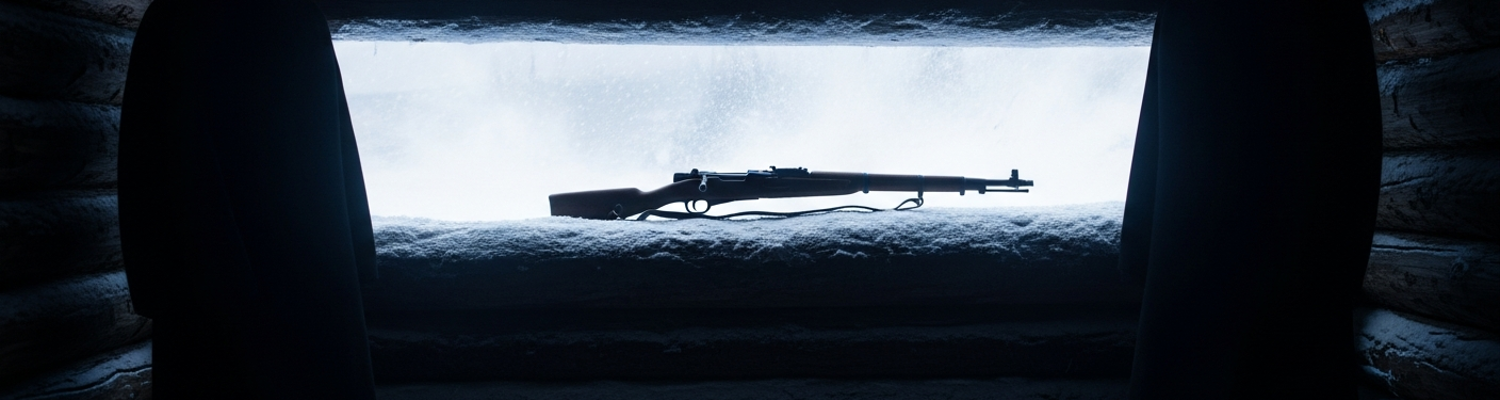
This failure extended to the arms issued to the men. Soldiers were sent into temperatures that reached fifty degrees below zero with equipment designed for temperate climates. The lubricating oil for the M1903 Springfield's bolt action would congeal, effectively turning the repeating rifle into a single-shot weapon that had to be thawed over a fire to be cleared. While some units were later re-equipped with Russian-made Mosin-Nagant rifles, more accustomed to the environment, the initial deployment was marked by this critical flaw.
The force’s automatic firepower came from Vickers and Lewis machine guns. The water-cooled Vickers faced the constant danger of their cooling jackets freezing and cracking the barrel shroud. Crews were forced to add antifreeze, drain the jackets when not in use, or periodically fire rounds just to keep the water warm. The air-cooled Lewis gun, while lighter, was still susceptible to the intense cold affecting its mechanical action. Specialized winter equipment like skis and snowshoes, essential for mobility in the deep snow, were almost entirely absent from the initial tables of equipment. They arrived only in small, insufficient quantities much later.
Heavy firepower and transportation were practically nonexistent. The expedition was allotted a scarcity of heavy artillery. Records and photographs show American troops manning Russian 76.2mm field guns or an occasional 155mm piece mounted on a railway car, but these were few and far between. Transport was an exercise in improvisation. Standard motor vehicles of the era were useless. Their engines could not cope with the cold and their tires could not find traction. The primary arteries of movement were the frozen Dvina and Vaga rivers and the single-track Vologda railway line. Away from these routes, all supplies had to be moved on local horse-drawn sleds, known as sani. The 310th Engineers and the North Russia Transportation Corps, which arrived in 1919, fought a losing battle against the elements with inadequate tools. One archival photograph captures the situation, showing a field-expedient replacement cart wheel for a 75mm artillery piece hastily fashioned from wood with an axe.
The environment was not a backdrop for combat, but an active antagonist. For months during the winter of 1918-1919, the temperature hovered at extremes, sometimes dropping to fifty degrees below zero. The standard-issue lubricants for rifles and machine guns congealed into thick paste, rendering firing mechanisms inoperable. Troops had to keep weapons near a fire to ensure they would function, a practice that dangerously exposed their positions. Movement itself became a monumental task. Snowdrifts, often chest-high, turned simple patrols into grueling ordeals that could exhaust a platoon before it ever made contact with the enemy. Numerous official reports documented cases of trench foot from constant exposure to wet and freezing conditions in the marshy, snow-covered terrain.
Whiteout blizzards frequently descended upon the front. These were tactical events that paralyzed all operations. Visibility dropped to a few feet, making navigation between blockhouses a life-threatening gamble. Patrols became lost. Units were completely isolated for days. A 1920 British War Office report noted that during winter months, there was little light during the whole 24-hour period, a condition that blizzards compounded into a state of total sensory deprivation. The storms severed physical communication lines, the wires snapping under the weight of ice and wind. For the small, isolated detachments of American soldiers positioned along the Dvina River and the Vologda railway, a blizzard meant they were utterly alone, amplifying the psychological strain of an undeclared war.
The relentless, simultaneous assault by thousands of small, debilitating problems overwhelmed the AEFNR’s operational capacity. Rations froze solid, requiring an axe to break apart. Leather boots and harnesses became brittle and cracked. The simple act of digging a defensive position in the iron-hard permafrost was a back-breaking, tool-shattering task. The cumulative effect was a constant degradation of military effectiveness. Morale plummeted as soldiers questioned why they were fighting Bolsheviks in the arctic long after the armistice with Germany had been signed. Casualty figures reflect this. Of the more than 500 casualties suffered by the men who called themselves the Polar Bears, a significant number were from disease and exposure, not direct combat.
The mechanical support of the AEFNR consisted of a single, vulnerable railway and primitive sleds. The few standard-issue motor vehicles brought to Archangel were almost immediately rendered useless. Lubricants in engines and transmissions congealed into sludge. Rubber tires froze and cracked. Engines failed to function in the consistent sub-zero temperatures. This left the entire Allied force dependent on the single-track Vologda railway line for all major movements of men, ammunition, and food to the southern front. The 310th Engineers and the later-arriving North Russia Transportation Corps fought a constant battle to keep this line open against Bolshevik sabotage and the elements. Away from the railway, all transport reverted to horse-drawn sani. These sleds, with their limited capacity, were the only means of supplying the dozens of isolated blockhouses and company-sized outposts, turning every resupply mission into a slow, perilous journey.
This failure of modern transport had a direct and crippling effect. Ammunition shortages became chronic at forward positions. Rations were severely limited. There was no capacity for rapid reinforcement of a position under attack or for the tactical movement of reserves. An outpost under assault was on its own.
Secure communications did not exist. The system relied on telegraph and telephone wires strung on temporary poles through hundreds of miles of snow-covered taiga. These lines were exceptionally vulnerable. Heavy snow and ice caused them to snap. High winds knocked over the poles. Bolshevik patrols and sympathizers regularly cut the wires, isolating American units for days at a time. When the wires went down, communication reverted to human runners on skis or snowshoes, a method that was dangerously slow and exposed messengers to ambush. Headquarters in Archangel often had no clear picture of the tactical situation on the sprawling front. It created a profound psychological toll on the soldiers in distant blockhouses, who knew that if they were attacked, no one would hear their calls for help.
The medical support system collapsed almost immediately. The 337th Field Hospital and 337th Ambulance Company were organized for a European battlefield. The medical detachments were broken up and scattered among the forward positions, diluting their effectiveness. The most significant challenge was casualty evacuation. A soldier wounded in a firefight on the Vaga River faced a life-threatening ordeal just to get to an aid station. No motorized ambulances were available. Evacuation meant being loaded onto a horse-drawn sled for a multi-day journey over frozen, rutted trails in temperatures that could drop to 30 degrees below zero. Medical personnel watched as soldiers with survivable wounds succumbed to shock and exposure during the evacuation process. At the aid stations themselves, the environment crippled effective care. Morphine syrettes froze solid. Metal surgical instruments were so cold they could cause frostbite on contact with skin. The system was quickly overwhelmed not by combat casualties, but by environmental ones. Frostbite, trench foot, and influenza filled the limited hospital beds.
War Department records indicate Brigadier General Wilds P. Richardson was selected by General Pershing for a singular task. Chosen for his extensive experience in Alaska, Richardson was not sent to win the war in North Russia, but to end American involvement. He arrived at the ice-clogged port of Archangel on April 17, 1919. The command he inherited from Colonel Stewart was a force on the verge of disintegration. The men were physically depleted and psychologically broken. Morale was abysmal. President Wilson had already ordered the planning for a withdrawal two months prior, on February 16, 1919, yet the troops remained locked in combat. This environment had already produced instances of mutiny, most notably within Company I of the 339th Infantry, which had refused orders to move to the front at the end of March. Richardson's first actions were not those of a commander preparing an offensive. He immediately began a series of personal inspection tours of every American position.
His mission was one of extraction.
Upon assessing the state of his troops, Richardson made a decision that created immediate friction with his Allied counterparts. The British commander, General Edmund Ironside, still focused on prosecuting the war against the Bolsheviks, expected Richardson to commit his American forces to a planned spring offensive. Richardson’s correspondence and subsequent actions show he unequivocally refused. Having seen the condition of his men and understanding his directive was to withdraw, he deemed any further offensive operations to be a reckless waste of American lives. Richardson’s orders were to extricate the AEFNR at the earliest possible moment. He made it plain to Ironside that American soldiers would no longer be used in British-led attacks. The AEFNR would shift to a purely defensive posture, holding its ground only as long as necessary to facilitate an orderly evacuation once the port of Archangel thawed.
The planning for this withdrawal was a logistical nightmare. The port of Archangel, the only viable exit, would not be free of ice until June. Richardson had to hold a disintegrating front for more than two months with a force that was spent. The single-track railway was in a state of constant disrepair, forcing a reliance on the newly arrived North Russia Transportation Corps to keep it minimally functional for the eventual retreat. Richardson’s plan involved a carefully phased consolidation of forces. He ordered the scattered American detachments along the Dvina and Vaga Rivers and the Vologda railway to pull back into more concentrated, defensible positions. This shortened the defensive perimeter and removed troops from the most exposed outposts. He had to manage this strategic contraction while also dealing with the simmering discontent in his ranks. The withdrawal itself, beginning in early June 1919, was a staggered operation coordinated with the arrival of British relief forces and the Royal Navy. The last American combat and engineering units finally cleared the port by June 27.
The spring thaw of April and May 1919 brought no relief. The winter’s ice had paralyzed movement, but the thaw transformed the landscape into an impassable quagmire of mud and floodwater. The frozen rivers that had served as highways became raging torrents, turning the already swampy terrain into a vast, shallow lake. Roads dissolved into viscous mud capable of swallowing horses and sleds. For the men of the 310th Engineers, tasked with keeping the single-track railway open, the thaw meant fighting against ground that was constantly shifting and sinking. The withdrawal from forward blockhouses became a grueling slog through knee-deep mire, all while being stalked by swarms of mosquitoes and black flies that hatched in the stagnant water.
This physical decay was mirrored by a near-total collapse in troop morale. The men knew the war in Europe was long over and that President Wilson had ordered them home. Yet they were still locked in combat, taking casualties in a war they did not understand. This sentiment had curdled into insubordination. In March, several soldiers of Company B were threatened with courts-martial for circulating a petition protesting their continued service. Richardson inherited a command that was disintegrating from within. He was faced with the challenge of holding a defensive line against determined Bolshevik attacks while managing a force where discipline was frayed to the breaking point. The knowledge that ships were coming created a dangerous mentality, making every order that involved risk seem like a pointless gamble.
The withdrawal was executed in stages through early June 1919, covered by newly arrived British relief troops who were themselves preparing for a final evacuation. As American units pulled back to Archangel, they fought rearguard actions against Bolshevik forces who pressed the attack until the very end. The last American units sailed from Archangel in late June, leaving behind their heavy equipment, their abandoned outposts, and the graves of their comrades. In total, the AEF North Russia suffered over 500 casualties, with more than 210 deaths from combat, disease, and accidents.