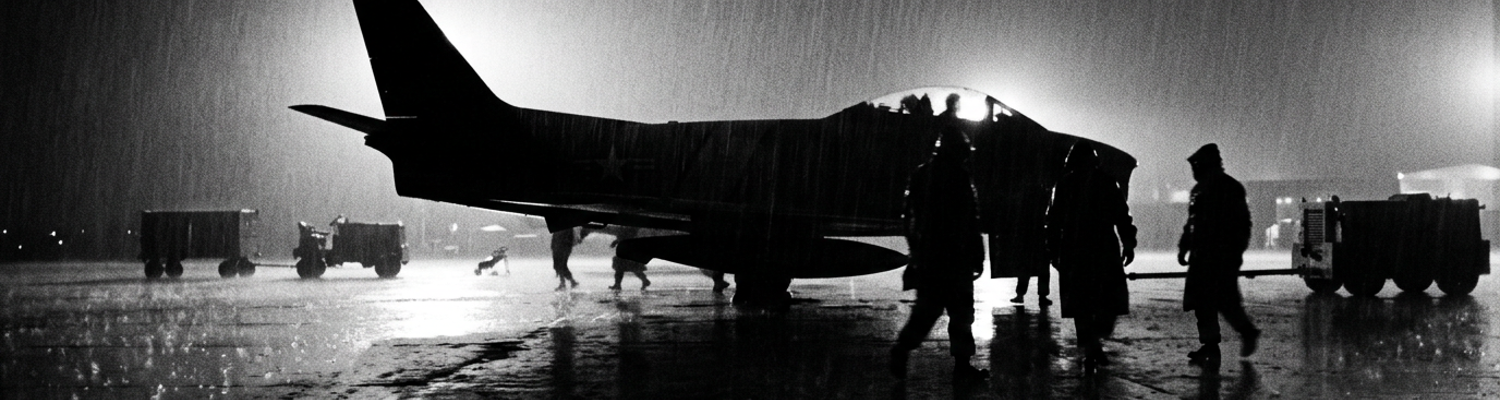

F-86D Sabre Dog Deployment to Tao Yuan
Men rested against the wet concrete of the revetments after sixty straight hours of loading rocket trays. Rations had not caught up with the rapid deployment schedule. Mechanics survived on stale crackers and lukewarm coffee. Ground crews marched four miles a day across the tarmac. Transport jeeps lacked fuel. Sleep deprivation caused hands to shake. Armorers attempted to wire 2.75-inch rockets in the dark.
Not by choice. By direct order.
A close review of operational logs indicates the September 1958 crisis began with an aviation supply network operating beyond its designed capacity. The United States Air Force directed the immediate relocation of F-86D night interceptors to Tao Yuan Air Base. This facility sat at coordinates 25°03'20"N 121°14'33"E on the northwestern coast of Taiwan. Task Force 74 commanders pulled the 25th Fighter-Interceptor Squadron from their garrison at Naha Air Base in Okinawa. They thrust the unit into a primitive operational environment. The F-86D Sabre Dog was a highly complex machine. It was built around the Hughes E-4 fire control system and the AN/APG-36 radar. This specific aircraft variant lacked cannons entirely. It relied on a retractable ventral tray containing twenty-four Mighty Mouse folding-fin aerial rockets.
The humid air of the coastal Taiwanese base immediately degraded the fragile vacuum tubes housed within the E-4 system.
Ground crews logged a seventy percent failure rate on the radar scopes during ground checks within the first three days. Moisture corroded the micro-switches controlling the ventral rocket tray. The weapon system jammed in the closed position during test flights. Squadron commanders ignored these maintenance warnings. They ordered the interceptors to maintain a five-minute alert status on the runway. Pilots sat strapped into their seats for hours. Electronics overheated in the sealed canopies.
Across the Formosa Strait, the People's Liberation Army Air Force initiated a systematic campaign of night probes. They mapped the response times of Western air defenses. Archival evidence shows these incursions were highly calculated tactical flights. PLAAF crews operating Ilyushin Il-28 twin-engine bombers departed from bases in Fujian province between 0100 and 0300 hours. The bombers dropped to an altitude of five hundred feet. This masked their approach from the primary early warning radars stationed on Makung Island. Ten miles from the median line of the strait, the Il-28s initiated a steep climb to fifteen thousand feet.
This maneuver was designed specifically to trigger the American AN/FPS-8 search radars.
It forced the GCI controllers to scramble the Tao Yuan interceptors. Navigators aboard the Il-28s recorded the exact radio frequencies used by the Makung controllers to vector the American fighters. Chinese ground commanders tracked the time delay between the initial radar contact and the moment the F-86Ds rotated off the Tao Yuan runway. Once the F-86Ds achieved flight velocity, the Chinese bombers banked hard west. They dove back below the radar horizon.
The interceptors arrived at the designated coordinates to find empty airspace.
These frequent night probes exposed the severe mechanical limitations of the F-86D in a rapid-scramble scenario. Standard intercept procedure required the AN/APG-36 radar to warm up for several minutes. This achieved a stable lock on a target. The compressed timeline of the PLAAF pop-up tactics forced American pilots to push their throttles to military power before the fire control systems had fully initialized. Airborne telemetry records from September 14 show three separate instances where F-86D pilots achieved a visual tally on the exhaust flames of retreating Il-28s. They could not fire. Their E-4 computers had failed. The pilots attempted to manually cycle the system power while flying at Mach 0.8 in total darkness.
Attempting to reset a frozen vacuum-tube computer during a high-speed pursuit resulted in complete electrical failure.
Mechanics at Tao Yuan resorted to wrapping the radar components in waterproof canvas tarps between flights. This fought the moisture intrusion. This improvised solution caused the units to overheat instantly upon activation. Supply officers submitted emergency requisitions for replacement E-4 modules. Transport planes prioritized artillery shells for the ground forces on Kinmen. The squadron was left cannibalizing grounded aircraft. They kept a fraction of the interceptors flight-worthy.
AN/APG-36 Fire Control Systems and Subtropical Corrosion
Archival evidence shows the 25th Fighter-Interceptor Squadron deployed directly into a highly corrosive atmospheric zone during the late summer of 1958. Weather data from the Tao Yuan Air Base meteorological station recorded sustained relative humidity levels exceeding ninety-two percent throughout September. Ambient temperatures rested at ninety-four degrees Fahrenheit. Winds blowing off the Formosa Strait carried dense concentrations of airborne sodium chloride directly into the unsealed fiberglass nose radomes of the F-86D aircraft parked on the flight line.
The AN/APG-36 radar system was engineered by Hughes Aircraft for operation in dry environments.
It was designed for high-altitude intercepts or climate-controlled hangars in the continental United States. Exposure to the coastal Taiwanese environment immediately compromised the system's unsealed physical architecture. Salt spray accumulated on the silver-plated coaxial connectors. These links connected the radar receiver to the E-4 fire control computer. This chemical reaction formed thick layers of silver chloride and copper oxide across electrical pathways. It happened within forty-eight hours of the squadron's arrival. Moisture condensation pooled inside the hollow magnesium waveguides. These tubes were designed to channel microwave energy from the magnetron to the primary radar dish.
Water accumulation inside these transmission lines altered the internal physical geometry of the waveguides.
It caused the high-frequency radar pulses to arc internally. A close review of operational logs indicates these environmental factors rapidly destroyed the combat effectiveness of the interceptor fleet. Ground crews working on the flight line discovered that powering up the radar systems while damp caused catastrophic electrical shorts. These shorts arced across the E-4 computer's sixty individual vacuum tube sockets. The resulting voltage fluctuations degraded the APG-36's ability to maintain a continuous lock on moving targets. The signal-to-noise ratio dropped below operational thresholds. Mechanics submitted emergency requisitions to the 13th Air Force logistics command for heated dehumidification carts and replacement desiccant packs. Supply flights from Naha Air Base failed to deliver this equipment. They prioritized ammunition over ground support gear.
Maintenance personnel resorted to blowing compressed air across the exposed circuit boards.
They made a futile attempt to dry the components before the nightly scramble orders arrived from the Makung Island early warning sector. By the third week of September, squadron commanders reported that only four out of twenty-two assigned aircraft possessed fully functional fire control systems. Declassified telemetry from the night engagements over the strait indicates the degraded avionics directly caused systemic tracking errors during active intercepts. The F-86D relied on the Hughes E-4 computer to fly the final phase of an attack profile automatically via an integrated Lear F-5 autopilot link. Pilots vectored toward People's Liberation Army Air Force MiG-17f formations near the Kinmen islands at coordinates 24°26'N 118°19'E. They frequently reported sudden radar failures just seconds before reaching firing parameters for their 2.75-inch rockets.
As the corroded silver connectors dropped the target signal, the APG-36 outputted an instantaneous zero-voltage reading to the E-4 computer.
The automated system interpreted this sudden loss of telemetry as an imminent mid-air collision or a complete intercept failure. This false data input triggered a hardwired safety protocol known as the automatic break-X maneuver. The uncommanded intercept aborts violently threw the Sabre Dogs out of their attack vectors. Flight control systems commanded maximum elevator deflection. The aircraft entered a sudden five-G pitch-up and a sharp roll away from the target track. Pilots flying at six hundred miles per hour in zero-visibility conditions could not manually overpower the hydraulic actuators fast enough to salvage the intercept.
Chinese radar operators on the mainland observed the American fighters approaching the median line.
They watched the blips suddenly execute erratic evasive maneuvers into empty airspace. Major General Fred M. Dean ordered a mandatory grounding of all F-86Ds exhibiting voltage drops in the E-4 system. This followed three near-fatal spatial disorientation incidents caused by these automatic aborts. Squadron armorers spent September 24 manually disconnecting the autopilot interface cables from the radar receivers.
Hazardous Field Modifications of Mighty Mouse Trays
Archival evidence shows the 25th Fighter-Interceptor Squadron's armament crews resorted to unauthorized electrical alterations to keep their aircraft armed. The F-86D possessed no internal cannons. Its sole offensive capability relied on a fiberglass ventral tray housing twenty-four 2.75-inch Mk 4 Folding-Fin Aerial Rockets. Standard intercept procedure required this pneumatically actuated tray to drop into the supersonic slipstream exactly one-half second before the Hughes E-4 fire control computer issued the launch command. Saltwater corrosion at Tao Yuan Air Base heavily degraded the Type 33 micro-switches. These switches were responsible for confirming the tray had locked into the fully extended position.
When these switches failed to register, the system's safety interlocks blocked the firing voltage to prevent an internal misfire.
Armorers working under canvas tarps on the flight line recognized a supply chain failure. They could not procure replacement switches through the overloaded Pacific Air Forces network. They began systematically cutting the factory-installed wiring harnesses out of the AN/AWG-3 rocket control systems. Mechanics bypassed the tray-extension safety interlocks entirely. They spliced the firing circuits directly to the primary intervalometer using unshielded copper wire scavenged from broken ground power carts. These field splices completely severed the mechanical timing link between the tray deployment actuators and the rocket ignition sequence.
A close review of operational logs indicates these unsanctioned modifications generated highly dangerous voltage irregularities within the armament bays.
The factory wiring utilized heavily insulated connectors. These were waterproof. They were designed to isolate the 28-volt firing signal from the aircraft's surrounding aluminum structure. The field-modified copper splices lacked this environmental protection. Nighttime humidity levels at the Taiwanese coastal base saturated the exposed wiring within hours of the maintenance shifts. Water pooling in the bottom of the fuselage created a conductive bridge between the newly exposed ignition circuits and the Sabre Dog's main electrical bus. Stray static charges began seeking the path of least electrical resistance directly into the rocket primers.
Bypassing the moisture-induced ignition delays solved the immediate problem of failed firing passes over the Formosa Strait.
It introduced severe premature detonation hazards. The original safety interlocks prevented the Mk 4 rockets from receiving ignition voltage until the tray cleared the internal structural bulkheads. The field-modified aircraft now allowed the firing pulse to reach the rocket motor primers the instant the E-4 computer calculated a firing solution. This happened regardless of the tray's physical location. Pneumatic actuators corroded by the subtropical air often struggled to push the heavy rocket pod into the airstream against the aerodynamic drag of a fighter traveling at Mach 0.9. Telemetry data from September 27 records a specific incident. An interceptor's tray jammed halfway through its deployment cycle during an attack run on a suspected Ilyushin Il-28. The modified wiring delivered the firing signal immediately.
The pilot aborted the intercept when he heard the rocket motors attempting to ignite inside the closed bay.
Ground crews inspecting the aircraft after it returned to Tao Yuan found scorch marks across the internal titanium blast shields. The solid-propellant exhaust from the partially ignited Mighty Mouse rockets had melted the surrounding hydraulic lines controlling the main landing gear. The intense heat boiled the red MIL-H-5606 hydraulic fluid inside the aluminum tubing. Had the primary high-explosive warheads detonated within the confined space of the fuselage, the resulting blast would have instantly destroyed the lower half of the interceptor. Squadron commanders quietly ordered the armament officers to halt all unauthorized wiring bypasses the following morning. Mechanics spent the next three days manually rewiring the fleet back to factory specifications. They used salvaged parts stripped from severely damaged fighters parked at the edge of the runway.
Eight interceptors remained entirely unarmed on the flight line while awaiting replacement micro-switches from Okinawa.
ROCAF Controller and USAF Interceptor Spectrum Conflicts
When examining the historical record, the joint air defense network over Taiwan in September 1958 operated on a fundamentally flawed communications architecture. The United States Air Force 25th Fighter-Interceptor Squadron relied on AN/ARC-27 ultra-high-frequency transceivers. They received steering commands from the Ground-Controlled Intercept station on Makung Island. Republic of China Air Force supply officers had previously allocated the 225.0 to 399.9 megahertz spectrum to their own day-fighter squadrons. American planners arriving at Tao Yuan Air Base failed to establish a dedicated frequency plan for the newly deployed F-86D night interceptors. Both allied air forces attempted to push their command traffic through the exact same narrow band of UHF channels.
The electromagnetic spectrum over the Formosa Strait collapsed under the sheer volume of uncoordinated transmission traffic.
A close review of operational logs indicates severe radio frequency overlap jammed communications between the Makung radar operators and the airborne American pilots. ROCAF F-86F Sabre formations returning from mainland patrol routes broadcasted their landing sequences on 238.5 MHz. The USAF interceptors utilized an adjacent frequency at 238.6 MHz for their primary tactical control link. Standard AN/ARC-27 radios possessed a channel spacing tolerance that could not separate two high-powered signals broadcasting within one-tenth of a megahertz of each other. The vacuum-tube receivers inside the American fighters combined both transmissions into a single audio output. Squelch circuits designed to filter out background static overloaded instantly.
American pilots flying in total darkness heard ROCAF flight leaders calling out fuel states.
This audio was simultaneously layered over the American GCI controllers attempting to broadcast intercept vectors. The overlapping sine waves canceled out the distinct audio frequencies of the human voice. This reduced the cockpit headsets to continuous static interference. Airborne crews attempting to acknowledge steering commands depressed their transmit buttons. This only added a third layer of interference to the saturated frequency band. Radar operators watched their intercept geometries fail as pilots missed heading adjustments.
Archival evidence shows language protocol mismatches between ROCAF controllers and USAF crews caused frequent target misidentifications during the night intercepts.
The Makung Island air defense sector employed Taiwanese radar officers. These men had learned English aviation terminology through outdated Royal Air Force training manuals. American pilots from the 25th FIS expected standard Pacific Air Forces brevity codes. This doctrinal disconnect manifested immediately during the high-speed geometry of a night scramble. ROCAF controllers issued altitude instructions using the British angels system combined with localized pronunciations of numerals. A Taiwanese controller attempting to vector an F-86D toward an incoming People's Liberation Army Air Force Il-28 at fifteen thousand feet broadcasted a heavily accented command. The American pilot interpreted the distorted audio as a command to descend to five thousand feet.
The interceptor dove directly into the heavily trafficked commercial air corridors off the coast of Hsinchu.
The specific terminology used to describe radar contacts generated further operational hazards. ROCAF controllers used the designation bandit to describe any unidentified radar return crossing the median line. American doctrine strictly reserved that specific designation for a confirmed enemy aircraft. Telemetry records from September 18 detail an incident where a Makung controller tracked an aircraft at coordinates 24°45'N 120°55'E. The controller ordered a USAF F-86D to execute a kill on the unidentified track. The American pilot believed the target was already visually identified as hostile by forward observers. He armed his twenty-four Mighty Mouse rockets. He initiated the Hughes E-4 fire control radar lock. The E-4 computer generated a firing solution for a target traveling at two hundred knots.
The pilot aborted the attack run only after visually identifying the rotating anti-collision beacon of a ROCAF C-46 Commando transport plane.
Squadron commanders at Tao Yuan reacted to these near-fatal misidentifications by forcing all American pilots to carry handwritten phonetic translation cards strapped to their kneeboards. Pilots flying at Mach 0.8 had to look down with red-lens flashlights to decode the heavily accented grid coordinates broadcasted over the static-filled radios. Maintenance crews physically locked the AN/ARC-27 channel selector dials to a secondary emergency frequency using safety wire. This prevented pilots from accidentally switching back to the jammed primary control channels. The 13th Air Force command staff recorded forty-one aborted night intercepts directly attributed to communication failures before the end of the month.
Wasted Salvos and Demystification of Night Intercepts
Archival evidence shows the tactical execution of American night intercepts completely disintegrated upon contact with Chinese probing flights. On the night of September 19, 1958, Makung Island radar operators tracked a high-speed contact moving east at coordinates 24°50'N 119°55'E. A pair of 25th Fighter-Interceptor Squadron F-86Ds launched from Tao Yuan to intercept. Closing the distance, the lead aircraft achieved a radar lock at twelve miles. Hughes E-4 fire control systems engaged the autopilot to fly the final attack geometry.
Inside the cockpit, the pilot monitored the glowing displays as the distance collapsed to two thousand yards.
The circuit closed. A fiberglass ventral tray snapped down into the supersonic slipstream. Twenty-four 2.75-inch Mk 4 folding-fin aerial rockets ignited in a blinding sequence of solid-propellant flashes. The glare temporarily destroyed the pilot's night vision. The entire volley sailed into the empty black expanse over the strait. A close review of operational logs indicates the mechanical properties of the Mighty Mouse rockets practically guaranteed these misses. Engineers originally designed the unguided Mk 4 to saturate the airspace in front of slow Soviet bombers. It was a dumb-fire area weapon.
Once the rockets left the internal tray, four spring-loaded fins flipped open at the rear of the fuselage to provide spin stabilization.
Dense air off the Chinese coast altered the aerodynamic resistance against these fins. Environmental friction caused the rockets to spin up too slowly. Dispersion patterns of a twenty-four-rocket salvo widened from a lethal shotgun-style cluster into an erratic spread spanning hundreds of yards. Degraded AN/APG-36 radar systems compounded this ballistic flaw. Corroded electrical pathways fed delayed positional data into the fire control computer. Automated targeting calculations generated lead angles based on where the Chinese Il-28s had been three seconds prior. Pilots repeatedly watched their rocket exhaust trails burn out miles behind the retreating engine glow of the target aircraft.
Armorers at Tao Yuan reloaded empty ventral trays for returning interceptors that had zero confirmed hits to report.
Post-action military reports generated by the 13th Air Force command staff dismantled the illusion of American night air superiority. Evaluators arrived at Tao Yuan in early October to audit the squadron's combat logs. Highly classified assessments detailed the expenditure of over four hundred Mighty Mouse rockets during the month of September. These documents recorded zero confirmed enemy aircraft destroyed by the F-86D fleet. Investigators directed severe criticism toward the command structure at Task Force 74. Senior officers had demanded high sortie rates to project strength against the mainland. Mandated aggression forced squadron commanders to authorize weapons releases on unverified radar contacts just to register offensive actions in the daily sitreps.
Command staff ignored repeated warnings from maintenance officers regarding the E-4 computer's tendency to lock onto atmospheric inversion layers and dense maritime cloud formations.
American pilots were firing high-explosive ordnance at the weather. Final PACAF evaluation boards isolated specific tactical failures at the highest levels of the regional command. Ground controllers at the Makung radar station frequently vectored the Sabre Dogs into geometric disadvantages. People's Liberation Army Air Force bombers routinely executed hard defensive turns long before the American fighters reached their firing parameters. Rigid adherence to automated intercept profiles stripped the pilots of their situational awareness. Command protocol explicitly required the F-86D crews to leave the autopilot engaged even as the target geometry collapsed. Mechanical flight computers stubbornly flew the interceptors into empty quadrants of airspace and commanded full tray releases at phantom radar returns.
The review concluded on October 12. Staff officers immediately issued a command directive stripping the 25th Fighter-Interceptor Squadron of its autonomous fire authority. New engagement rules required all pilots to establish direct visual contact with an enemy aircraft exhaust plume before arming the rocket tray. The automated intercept era over the Formosa Strait ended in total mechanical failure.