
Sixth Fleet Standoff South of Crete
Driving horizontal rain lashed the steel decks. Visibility dropped to zero across the Eastern Mediterranean. Ten-foot swells slammed into grey hulls. The kinetic force buckled poorly welded plating on older escort vessels. Salt spray froze onto radar antennas during the night. A punishing humid heat baked the superstructure steel hours later. The sea state south of Crete offered zero margin for error.
Archival evidence shows this unforgiving environment masked a rapidly escalating confrontation between two superpowers.
On October 24, 1973, the Joint Chiefs of Staff transmitted an encrypted flash message to the U.S. Sixth Fleet. This order elevated all units to Defense Readiness Condition 3. The Yom Kippur War had erupted eighteen days earlier following a coordinated armored assault by Egyptian and Syrian forces across the Suez Canal and Golan Heights. Washington initiated the DEFCON 3 alert when Soviet General Secretary Leonid Brezhnev threatened to deploy airborne divisions to enforce a ceasefire. Aboard the aircraft carrier USS Independence (CV-62), operating just south of the Cretan landmass at coordinates 34°15'N 25°30'E, the mechanical tempo shifted instantly. Boiler technicians in the deep engineering spaces secured cross-connect valves. They pushed the ship's eight Babcock & Wilcox boilers to maximum operating pressure to achieve thirty knots. Aviation ordnancemen hauled live AIM-7 Sparrow air-to-air missiles up the heavy armored elevators. Deck crews loaded these munitions onto the pylons of F-4J Phantom II interceptors spotted on the flight deck. Vice Admiral Daniel J. Murphy ordered Task Force 60 to consolidate its dispersed destroyer screens into a tight anti-aircraft and anti-submarine formation.
Every radar console in the Combat Information Center tracked incoming contacts.
Soviet naval vessels closely shadowed American carrier strike groups during these high-tension patrols. Elements of the 5th Eskadra surged their operational strength to nearly one hundred surface ships and submarines in the basin. Kashin-class guided-missile destroyers and Kynda-class cruisers acted as dedicated tattletales. These ships aggressively maneuvered within one thousand yards of the American carriers. Soviet intelligence collection ships matched the speed of the American formations to record radio traffic. These heavily modified trawlers bristled with interception antennas. A close review of operational logs indicates that Soviet commanders frequently ordered their helmsmen to cut directly across the bows of U.S. supply ships. This tactic forced emergency rudder angle adjustments to avoid collisions. The Soviet cruiser Grozny maintained a continuous track on the USS John F. Kennedy (CV-67). The cruiser kept its SS-N-3 Shaddock anti-ship missile tubes elevated and pointed directly at the carrier's island superstructure. American electronic warfare technicians sitting in the carrier's dark command center recorded continuous pulses from Soviet targeting radars locking onto their hulls. The proximity of the vessels required American bridge officers to rely on manual optical rangefinders and physical bearing sights to calculate the closing speed of the approaching warships.
This specific tactical decision to maintain close-quarters shadowing created a localized crisis for underway replenishment operations.
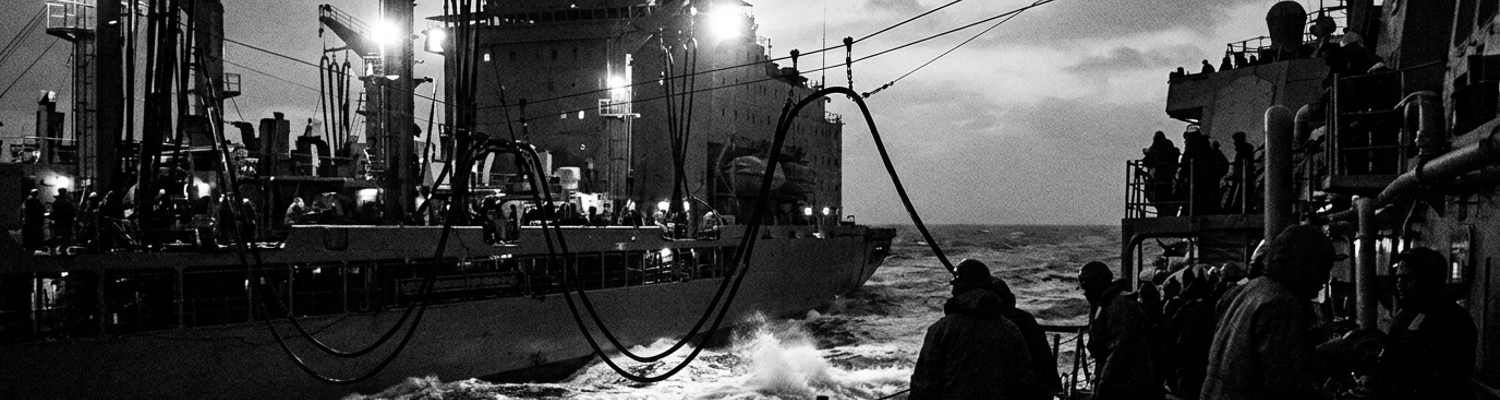
American logistics ships needed to connect heavy fuel hoses and tensioned steel cables to the carriers while steaming at a steady fifteen knots. The fast combat support ship USS Seattle (AOE-3) served as the primary supply node for the formation. Soviet destroyers actively exploited this vulnerability. They positioned themselves in the blind spots of the replenishment ships. The Soviet captains waited for the exact moment the fuel rigs were passed across the open water. A minor course correction made by an American helmsman to avoid a crowding Soviet frigate would instantly alter the tension on the one-inch steel span wire connecting the two ships. If the distance increased by even twenty feet, the physical limits of the tensioning winch would be exceeded.
A snapped span wire under 15,000 pounds of load would slice through steel bulkheads.
When examining the historical record, the logs of the destroyer USS Richard E. Byrd (DDG-23) show four aborted refueling attempts on October 25 alone. The ship broke away from the oiler and maneuvered hard to port after a Soviet Echo II-class submarine surfaced directly in its intended track.
High-Speed Night Replenishment Operational Demands
A close review of operational logs indicates that the fast combat support ship USS Seattle executed dozens of underway replenishment maneuvers in total darkness to supply Task Force 60. Naval doctrine normally dictated daylight transfers to ensure visual confirmation of safe distances between 50,000-ton vessels. Soviet surveillance aircraft and surface combatants tracked the American strike groups continuously during the daylight hours of the October crisis. Vice Admiral Murphy ordered all logistics ships to conduct resupply strictly between the hours of 2200 and 0400 under Emission Control condition Alpha. Electronic emissions and exterior lighting were completely secured across the fleet. Deck crews aboard the Seattle operated on the weather decks wearing early-generation infrared goggles (AN/PVS-2) to locate the receiving stations on the adjacent warships. Boatswain's mates communicated using sound-powered telephones to coordinate the passing of the shot lines. Winch operators relied entirely on tactile feedback through the mechanical brake levers to maintain proper tension on the heavy steel span wires connecting the hulls.
A single miscalculation on the hydraulic brake instantly dropped seven-inch rubber fuel hoses into the turbulent wake.
Strict operational timelines governed these night maneuvers to minimize the window of vulnerability. Task Force commanders allocated exactly forty-five minutes for a guided-missile destroyer to approach, connect, refuel, and break away from the logistics ship. Steam-powered escorts like the Charles F. Adams-class destroyers consumed thousands of gallons of Navy Standard Fuel Oil daily just to maintain their defensive screening stations ahead of the main body. The Seattle pumped fuel at a rate of 3,000 gallons per minute through the primary rigs to meet these exacting schedules. Engineers in the main control spaces monitored the discharge pressure gauges constantly to prevent pipe ruptures under the extreme flow rates. Transferring ordnance simultaneously required deckhands to operate heavy electric forklifts on wet, pitching steel plates. These crews moved one-ton pallets of ammunition to the sliding pad-eyes. Any delay in the fueling sequence forced the entire carrier group to steam on a predictable, straight-line course. Soviet submarines utilized passive sonar to track the acoustic signatures of the unmaneuverable formations during these specific windows.
Archival evidence shows the USS Seattle transferred over two million gallons of aviation fuel during a single four-day period.
High-speed fueling became an absolute necessity to keep the carrier strike groups fully operational while maintaining their integrated defensive formation. Standard underway replenishment protocols called for ships to match speeds at a relatively safe twelve knots. The constant presence of Soviet Echo II-class submarines armed with Shaddock anti-ship missiles forced the American formations to increase their base speed. The ships steamed at eighteen or twenty knots during the transfers. Moving massive hull structures through the water at these elevated velocities generated severe hydrodynamic forces across the entire length of the vessels. Water displaced by the bows of the adjacent ships accelerated rapidly as it passed through the narrow eighty-foot channel between them. This physical phenomenon created a low-pressure zone that actively pulled the two parallel hulls together. Helmsmen on the receiving destroyers fought this powerful suction effect by applying constant outward rudder angles ranging from five to fifteen degrees depending on the sea state. The engineering plants on both ships ran near their maximum continuous pressure ratings to sustain the high-speed transit while powering the transfer pumps.
The aircraft carrier USS Independence demanded continuous inputs of JP-5 jet fuel to sustain round-the-clock combat air patrols.
When examining the historical record, the mechanical strain of these high-speed maneuvers caused frequent equipment failures across the logistics force. The Seattle utilized the Standard Tensioned Replenishment Alongside Method. This system relied on a complex network of pneumatic rams and sliding blocks to keep the hoses suspended above the water. Pumping high-density fuel across a span wire while both ships pitched in heavy swells at twenty knots pushed the steel components past their designed load limits. On the night of October 27, a sudden course alteration by a screening frigate caused the distance between the Seattle and the guided-missile cruiser USS Little Rock (CG-4) to increase by thirty feet in seconds. The automated tensioning winch failed to spool out the one-inch wire rope fast enough to compensate for the sudden lateral movement.
The primary load-bearing pin sheared off the receiver bracket and embedded itself into the forward bulkhead of the cruiser.
Bypassed Hydraulic Valves and SOP Violations
A close review of operational logs indicates that on the night of October 26, the engineering department aboard the USS Seattle initiated a highly dangerous mechanical alteration to the ship's portside refueling station. The requirement to transfer fuel at eighteen knots while evading Soviet sonar tracks compressed the standard forty-five-minute resupply window down to just twenty minutes per ship. Machinist's mates targeted the Vickers Mk-4 hydraulic tension valve governing the Standard Tensioned Replenishment Alongside Method rig to meet this aggressive schedule. This specific control valve regulated the hydraulic fluid pressure acting on the massive pneumatic rams. These rams kept the one-inch steel span wire taut between the pitching vessels. Factory specifications limited the transfer rate to 3,000 gallons per minute to prevent the seven-inch synthetic rubber hoses from whipping under internal pressure. The ship's engineers manually disassembled the valve housing. They inserted locally fabricated steel shims directly into the bypass assembly.
This unauthorized mechanical override instantly doubled the fuel delivery rate to 6,000 gallons per minute.
Archival evidence shows this field modification directly contravened Naval Sea Systems Command procedural directives for underway replenishment operations. Standard operating procedures dictated by NAVSEA Manual 0948-044-9010 required the hydraulic tensioner to maintain a strict 15,000-pound load limit on the span wire. If a sudden course correction caused the receiving destroyer to drift away from the supply ship, the unaltered valve would automatically vent hydraulic fluid into a holding tank. Venting the fluid allowed the primary winch drum to rapidly spool out excess wire rope to compensate for the increased distance. The inserted steel shims completely disabled this fail-safe mechanism by blocking the fluid return ports. Chief petty officers operating the winch control booths made the deliberate choice to run the transfer system rigid. The continuous presence of Soviet Kashin-class destroyers aggressively crowding the formation left the American crews with almost no physical space to maneuver during the transfers. Escort ship commanders demanded maximum fuel flow to get their vulnerable destroyers detached from the logistics ships and back into the anti-aircraft defensive screen as fast as physically possible.
The bypassed hydraulic valve transformed the flexible steel cable into a rigid iron tether.
When examining the historical record, the cascading effects of this procedural violation materialized during a midnight transfer sequence with the guided-missile destroyer USS Richard E. Byrd. The destroyer approached the Seattle at coordinates 34°10'N 25°45'E in total darkness under strict Emission Control Alpha conditions. Heavy Mediterranean swells running at ten feet crashed continuously over the main decks of both vessels. The supply ship's deck crew fired the shot line across the eighty-foot gap and hauled the tensioned wire over to the destroyer's receiving bracket. Cargo pumps located deep in the engineering spaces of the Seattle spun up to their absolute maximum capacity. They forced dense Navy Standard Fuel Oil through the hoses at unprecedented velocities. This caused the heavy rubber lines to vibrate violently against their suspended steel saddles. A minor helm adjustment on the destroyer to counter a rogue wave suddenly increased the lateral distance between the two hulls by twenty-two feet.
The shimmed tension valve failed to release a single inch of wire.
Hydraulic pressure inside the blocked winch control unit spiked past 4,500 pounds per square inch in less than two seconds. The physical stress transferred directly from the unyielding span wire down into the mechanical foundation of the rig. Four primary structural mounting bolts securing the winch bedplate to the deck sheared cleanly through the steel framing. Shrapnel from the shattered bronze valve casing tore through the aluminum bulkheads of the operator's booth.
Mechanical Failure and Acoustic Flare Incident
A close review of operational logs indicates the immediate destruction of the portside STREAM rig aboard the USS Seattle occurred at exactly 0114 hours local time. Bypassing the relief valves trapped rapidly expanding hydraulic fluid inside the main accumulator tanks located directly beneath the winch operator's booth. The primary pneumatic tensioners locked completely solid under the extreme internal pressure. These tensioners were engineered to absorb the violent kinetic shock of a pitching 4,500-ton destroyer. Without any mechanical give in the system, the kinetic energy generated by the ships pulling apart transferred straight into the one-inch steel span wire connecting the two warships. The wire stretched to its absolute yield point of 115,000 pounds of force while deckhands scrambled for cover behind heavy steel bulkheads. Steel strands began snapping in rapid succession. This produced a sound similar to heavy artillery fire across the weather deck. The heavy iron block housing the tensioner assembly fractured cleanly along its central structural weld seam. High-pressure hydraulic fluid aerosolized instantly upon breaching the cracked manifold. The fluid sprayed a highly flammable mist across the exterior lighting fixtures.
The main load-bearing kingpost crumpled inward toward the flight deck.
Archival evidence shows the catastrophic structural failure of the tensioning rig immediately compromised the high-rate fuel transfer lines. Deep in the engineering spaces of the Seattle, steam-driven cargo pumps were actively forcing Navy Standard Fuel Oil at 6,000 gallons per minute through twin seven-inch synthetic rubber hoses. The suspended steel saddles supporting these heavy fuel lines lost all vertical tension when the span wire parted under the extreme load. The entire hose assembly dropped forty feet straight down into the turbulent eighty-foot gap between the fast combat support ship and the USS Richard E. Byrd. The sheer weight of the falling hoses combined with the extreme internal flow pressure of the fuel. This caused the heavy brass coupling flanges to violently rip away from the destroyer's receiving bell. Unleashed from their secure connections, the severed rubber lines whipped wildly against the steel hulls of both warships.
Thick black bunker oil erupted from the flailing nozzles under maximum pump pressure.
Engineers deep inside the Seattle required ninety seconds to recognize the pressure drop and manually secure the primary transfer pumps. During this specific window, an estimated 9,000 gallons of unrefined fuel oil and highly combustible JP-5 aviation grade kerosene poured directly into the ocean. The slick spread rapidly across the surface. It coated the waterline armor belts of both vessels in a thick toxic layer. Heavy Mediterranean swells churned the spilled fuel into a dense emulsion that fouled the sea-water intakes of the destroyer's cooling systems. The physical rupture of the equipment generated an acute mechanical shockwave below the waterline. Violent parting of the tensioned steel cable occurred. Microseconds later, the explosive decompression of the 4,500-psi hydraulic accumulators produced a sharp acoustic flare. Sound propagates through dense saltwater nearly five times faster than through air. The Mediterranean's specific thermal layers channeled this sudden burst of low-frequency noise outward for dozens of miles.
The acoustic signature of the snapping wire registered as a massive broadband transient on passive sensors.
When examining the historical record, Soviet naval intelligence units actively exploited this exact type of mechanical failure. Operating at a depth of four hundred feet, the Project 675 Echo II-class nuclear cruise missile submarine K-131 trailed Task Force 60. Soviet sonar technicians monitoring the MGK-100 Rubin low-frequency passive arrays detected the acoustic flare at a range of fourteen nautical miles. This sudden noise spike instantly shattered the strict Emission Control Alpha conditions masking the American strike group from underwater surveillance. Acoustic transients provided the submarine's fire control team with a precise bearing to the exact center of the carrier formation. Target tracking protocols initiated immediately as the Soviet captain focused his attack center on the source of the mechanical explosion. Helmsmen brought the boat to a new heading of 310 degrees to match the calculated acoustic intercept vector.
Soviet Submarine Response and Strategic Escalation
A close review of operational logs indicates that the explosive decompression of the USS Seattle's pneumatic tensioners propagated outward through the deep sound channel south of Crete. The Mediterranean Sea at coordinates 34°10'N 25°45'E features a highly specific thermal gradient during late October. Surface water temperatures exceeding seventy degrees Fahrenheit sit above a dense cold subsurface layer. This creates an acoustic duct that traps and accelerates low-frequency sound waves. The instantaneous shearing of the one-inch steel span wire and the subsequent rupture of the hydraulic accumulators generated a high-decibel acoustic energy spike. This mechanical shockwave traveled outward at roughly 4,900 feet per second. Operating at a depth of four hundred feet, the Project 675 Echo II-class nuclear cruise missile submarine K-131 intercepted the signal. Soviet sonar technicians stationed in the cramped forward compartment monitored the MGK-100 Rubin low-frequency passive arrays. They recorded an abrupt violent noise spike that completely saturated their cathode-ray tube displays.
The broadband transient registered on the submarine's acoustic readouts identically to a depth charge detonation.
Archival evidence shows the Soviet crew immediately initiated emergency combat protocols in response to the sudden acoustic signature. Captain Second Rank Valentin Zverev commanded K-131 under strict orders from the Soviet Navy Main Staff to shadow Task Force 60. He was ordered to prepare for preemptive strikes if American forces engaged Egyptian units. Hearing an unprovoked explosion within the carrier formation, Zverev assumed hostilities had commenced. He ordered the helmsman to bring the 4,900-ton submarine up to a depth of one hundred and fifty feet. This specific vertical maneuver was required to establish a firing solution for the boat's P-6 Shaddock cruise missiles. Fire control technicians in the missile command center powered up the Argument targeting radar system. They flooded the outer doors of missile tubes one and two. The submarine's nuclear reactor plant was pushed to full power. This raised the primary coolant loop pressure to support maximum tactical speed.
Weapons officers armed the conventional 1,000-kilogram high-explosive warheads on both anti-ship missiles.
The localized mechanical failure on the surface nearly provoked an unintended tactical response from the American defensive screen during the heightened DEFCON 3 standoff. Aboard the guided-missile destroyer USS Richard E. Byrd, the sudden parting of the refueling rig created immediate tactical confusion. The acoustic blast of the shattered bronze valve casing and snapping steel cable slammed into the destroyer's AN/SQS-23 bow-mounted sonar dome. American sonar operators sitting in the darkened Combat Information Center misinterpreted the deafening mechanical screech of the failing winch gears. They classified the noise as the high-speed cavitation of a Soviet 53-65K wake-homing torpedo entering the water. Bridge officers reacted to the sonar report by executing standard anti-submarine evasion tactics. The helmsman ordered the rudder hard to starboard. This threw the steam-powered warship into a sharp unannounced turn away from the crippled logistics ship.
This aggressive evasive maneuver placed the destroyer directly on an intercept vector with the rising Soviet submarine.
When examining the historical record, the intersection of these two blind tactical decisions pushed the Sixth Fleet to the absolute edge of a shooting war. The Richard E. Byrd activated its active sonar transmitters. The ship sent powerful acoustic pings through the water column to locate the suspected incoming torpedo. These active sonar pulses struck the hull of K-131 just as the Soviet submarine reached its launch depth. Zverev interpreted the active pinging and the rapidly closing propeller noises of the American destroyer as an imminent depth charge attack. He ordered his torpedo room to load two SET-65 heavy acoustic homing torpedoes into the forward tubes for immediate self-defense. The weapons officer locked the submarine's fire control computers onto the bearing of the approaching destroyer. Aboard the American vessel, the anti-submarine warfare officer inserted firing keys into the RUR-5 ASROC console. He prepared to launch a Mark 46 lightweight torpedo at the submarine contact. Fire control circuits established an active electrical connection to the forward rocket cells.
The American sonar supervisor identified the secondary acoustic signature as flailing rubber hoses hitting the steel hull, halting the firing sequence exactly four seconds before missile ignition.