
Evacuation Pipeline Operational Myths
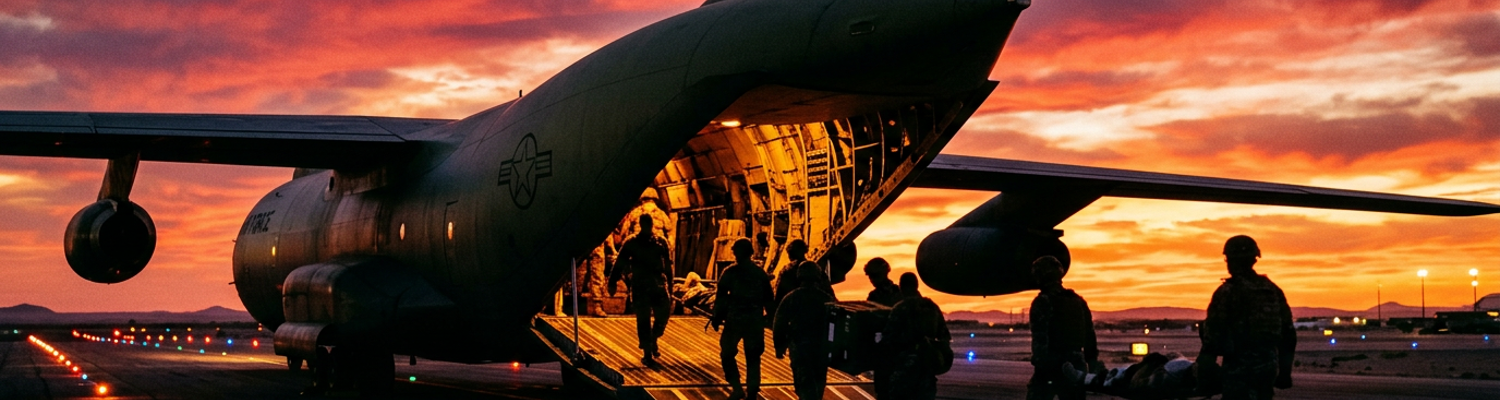
Airmen scrambled across the concrete floor of the mobilization hangar to meet an urgent twenty four hour departure deadline. Mechanics checked hydraulic seals on C-141 Starlifter cargo doors while technicians stacked olive drab canvas litters onto wooden pallets, bolting portable oxygen tanks and suction units into steel transit racks. Popular depictions of flawless combat aeromedical extraction concealed deep post Cold War operational limitations during this physical rush to deploy. Supply sergeants struggled with corroded litter brackets, dead battery packs, and missing electrical adapters required to plug heart monitors into aging aircraft generators. Flight commanders sorted through personnel files on folding tables and discovered that most assigned physicians had spent their careers far away from high stress emergency bays.
Physicians arrived at the mobilization hangar with clinical backgrounds suited for base family clinics rather than battlefield emergencies. Military medical staffing before 1994 prioritized domestic clinical specialties like pediatrics and obstetrics over frontline trauma care. Peacetime military health networks focused their budgets and staffing quotas on delivering babies and treating childhood illnesses for dependents living on domestic military installations. Pediatricians and obstetricians stood on the drafty hangar floor receiving hasty briefings on how to manage blast trauma, chest tubes, and severe arterial bleeding under flight conditions. Flight nurses loaded these hesitant doctors and their crated supplies into the cargo bays of waiting transport planes.
Cargo planes ferried these medical teams directly into forward staging bases where the 1991 Persian Gulf War exposed dangerous logistical vulnerabilities in casualty staging and aeromedical transit pipelines. Sandstorms and desert heat quickly overwhelmed temporary triage tents in Saudi Arabia, clogging delicate ventilation filters and shorting out portable suction machines. Evacuation coordinators operated without reliable radio links or computerized tracking systems, losing contact with field hospitals and leaving transport aircrews unaware of how many patients waited on forward runways. Litter teams carried wounded troops into crowded holding areas on canvas stretchers, scribbling patient blood types and injury details onto cardboard tags with grease pencils because electronic manifests failed to function. Clerks shoved paper medical charts into vinyl envelopes taped to patient blankets, leaving flight crews unable to read shifting vital signs before takeoff.
Aircrews loaded hundreds of unstable casualties into noisy cargo holds without functioning inflight monitoring networks or dedicated electrical outlets for life support equipment. Technicians hung intravenous fluid bags from webbed cargo straps and knelt on bare metal deck plates to check pulses by hand in the dark. Pilots pushed their engines to maximum continuous thrust to clear hostile airspace, forcing aeromedical technicians to crawl between tightly stacked litter tiers to secure slipping oxygen masks during severe turbulence. Staging bottlenecks on the ground in Germany and England backed up the entire evacuation pipeline, stranding transport aircraft on crowded aprons with wounded troops still strapped to their cargo decks. Hospital commanders diverted incoming flights to secondary bases across Europe, ordering ground ambulances to collect casualties directly from the tarmac as fuel supplies ran dangerously low.
Section 733 Study Findings
Ambulance crews loaded shivering patients into civilian transport vans across crowded European airfields while Pentagon officials cataloged the mechanical failures and airfield gridlock. Congressional committees reviewed these after action logs, noting that a single regional campaign in the Persian Gulf had nearly paralyzed the entire aeromedical evacuation system. Lawmakers demanded an objective accounting of military medicine, ordering defense planners to determine how many doctors, nurses, and hospital beds the armed forces actually needed to sustain real combat operations. Pentagon leadership answered this mandate in April 1994, when the Department of Defense delivered the congressionally directed Section 733 Study titled The Economics of Sizing the Military Medical Establishment. Couriers delivered copies of the thick report to Capitol Hill and military command centers, challenging decades of assumptions about how the armed services organized their medical commands.
Analysts opened the report and reviewed complex computer simulations that measured hospital operations against realistic battlefield casualty estimates. Economic modeling showed the military medical establishment was disproportionately configured for peacetime domestic healthcare rather than wartime surge demands. Researchers discovered that base hospitals across the United States consumed the vast majority of medical funding and staff hours by providing routine outpatient visits, pediatric examinations, and family healthcare for active duty dependents and military retirees. Flight surgeons and theater evacuation planners operated on shoestring budgets with outdated transport litters, neglected cargo bay electrical adapters, and critical shortages of trained trauma specialists. Decades of peacetime operation left theater commanders without the trained surgical teams required to treat incoming combat casualties.
Rosters examined in the study confirmed that the military maintained thousands of uniformed clinicians whose day to day medical specialties had no operational role in an active war zone. Pentagon analysts revealed that only a small percentage of active duty medical billets were operationally justified for theater combat scenarios. Calculations indicated that supporting two simultaneous regional wars required only a tiny fraction of the active duty medical personnel then wearing uniforms. Specialists like pediatricians, obstetricians, and dermatologists occupied vital active duty billets, while the military faced acute shortages of the anesthesiologists, trauma surgeons, and burn technicians required to keep wounded soldiers alive aboard evacuation aircraft. Auditors concluded that keeping thousands of non deployable specialists on active military payrolls drained defense funding away from frontline trauma units.
Officers in the Office of the Secretary of Defense used these findings to draft sweeping plans to downsize the active duty medical corps and restructure theater evacuation units. Air Force aeromedical leaders realized they could no longer expect massive waves of hospital based doctors to reinforce staging facilities during an overseas crisis. Flight commanders began designing lightweight specialized trauma teams that could perform advanced life support inside noisy cargo bays rather than relying on bloated hospital networks across Europe. Logistics officers dismantled redundant peacetime wards on domestic bases and shifted procurement funds toward modern inflight oxygen generation systems, durable patient monitors, and standardized litter racks. Technicians hauled crates of new portable medical gear onto staging aprons, initiating a complete overhaul of how flight crews prepared to triage and transport battlefield wounded.
Theater Hospital Logistical Failures
Forklift drivers pushed these fresh equipment crates past rows of rusted shipping containers that still held the bulky components of traditional Cold War hospital units. Standard Cold War doctrine relied on establishing massive deployable 400 bed theater hospitals that placed severe burdens on military airlift. Planners designed these sprawling hospital complexes with hundreds of tons of heavy steel support beams, rigid surgical trailers, canvas ward tents, and noisy diesel generators. Moving a single installation consumed the cargo capacity of dozens of dedicated C-141 Starlifter and C-5 Galaxy transport planes, monopolizing flight schedules and crowding parking ramps across active airbases. Air Mobility Command officers repeatedly diverted the limited fleet of heavy airlifters to priority combat cargo, stranding thousands of tons of crated hospital shelters on concrete staging ramps thousands of miles from the front.
Cargo planes failed to deliver these grounded hospital packages into fluid expeditionary operating environments where combat lines shifted by dozens of miles each day. Combat engineers required days or even weeks to grade remote airstrips, pour concrete slabs, assemble climate controlled operating rooms, and install sanitation lines for a single static facility. Mechanized brigades sped forward across open desert and rough terrain, widening the physical gap between frontline troops and their designated surgical care centers. Ground units moved forward anyway, carrying wounded soldiers back toward small isolated frontline aid stations rather than fully equipped theater hospitals.
Medics crowded into these small aid stations as waves of combat casualties arrived from the front lines. Forward medical posts faced catastrophic triage bottlenecks when confronting complex blast polytrauma, severe burns, and traumatic amputations without rapid evacuation channels. Surgeons knelt in the dirt beside rows of stretchers, clamping severed femoral arteries and inserting plastic airway tubes while their sterile supplies dwindled. Battery powered suction machines failed after hours of continuous use in fine sand, forcing corpsmen to clear thick blood from patient airways with manual bulb syringes. Flight dispatchers at regional airfields could not promise timely aeromedical pickup because transport aircraft remained tied up hauling heavy equipment or grounded by mechanical breakdowns.
Surgeons improvised local holding areas on dirt taxiways while awaiting delayed evacuation flights, using empty wooden ammunition crates as makeshift stands for intravenous fluid bags. Doctors pushed whole blood through hand pumps into patients suffering from severe hemorrhagic shock, rationing their limited plasma supplies as hours turned into days. Corpsmen covered shivering burn victims with wool blankets, monitoring faint radial pulses by hand when electronic vital sign monitors ran out of battery power. Orderlies carried expired litters to collection points behind the tents, clearing scarce cot space for the next convoy of incoming field ambulances. Corps surgeons loaded the surviving critical patients onto unpressurized tactical trucks to begin agonizing twelve hour journeys across open desert toward distant rear airbases.
Air Transport Team Development
Trucks ground to a halt beside rear echelon staging airstrips carrying casualties who had slipped into irreversible shock during the rough twelve hour ride. Field surgeons discovered that holding trauma victims at rear airbases until they stabilized was a fundamentally flawed doctrine that cost lives in modern warfare. The Section 733 findings forced the Air Force and Joint Staff to abandon rear echelon holding strategies in favor of active en route resuscitation. Aeromedical planners decided that advanced intensive care had to move directly into the aircraft cabin so life saving interventions could continue without interruption during long transit flights across theaters of war.
Commanders established specialized three person Critical Care Air Transport Teams consisting of an intensivist physician, a critical care nurse, and a cardiopulmonary technician to deliver this continuous hospital level care inside operational cargo planes. Intensivist physicians directed all inflight resuscitation procedures, inserted chest tubes, placed central venous lines, and managed complex polytrauma patients while navigating the physiological stresses of flight. Critical care nurses calculated delicate medication dosages, titrated vasoactive drug infusions to stabilize failing blood pressures, and continuously tracked heart rhythms on battery powered screens strapped to aircraft litter stanchions. Cardiopulmonary technicians calibrated portable mechanical ventilators, operated miniaturized blood gas analyzers, and ensured that damaged lungs received precise oxygen mixtures inside noisy semi pressurized fuselages. Instructors trained these three clinicians to function as a self contained mobile trauma bay inside darkened altitude chambers, teaching them to secure failing airways and treat sudden hemorrhages amid deafening engine noise and violent atmospheric turbulence.
Technicians adapted standard transport aircraft into airborne intensive care units using portable medical equipment suites for these newly trained crews. Engineers packed rugged vital signs monitors, compact mechanical ventilators, automated suction pumps, and portable defibrillators into standardized aluminum transit cases that strapped directly to aircraft floor tie down rings. Electricians mounted universal power converters onto the cargo bay bulkheads of both the C-130 Hercules and C-141 Starlifter so high tech medical machines could draw clean electrical currents directly from aircraft engine generators. Riggers verified that these portable medical equipment suites could function independently on internal battery power during engine shutdowns, refueling stops, or sudden electrical failures in midair.
Loadmasters guided litters carrying critical blast casualties and burn victims through the rear cargo ramps of the modified transport aircraft and locked them into floor mounts. Medical personnel immediately took charge of each patient, connecting monitoring leads to chest walls and attaching portable ventilator circuits before the turboprop or jet engines spooled up for takeoff. The intensivist physician, critical care nurse, and cardiopulmonary technician adjusted intravenous fluid rates, corrected dropping arterial pressures, and delivered continuous sedation while the aircraft climbed toward cruising altitude. Pilots adjusted their flight profiles to maintain lower cabin altitudes whenever mission safety permitted, minimizing the danger that falling atmospheric pressure would expand trapped gas inside patient chest wounds or brain injuries. Transports landed at tertiary military medical facilities thousands of miles away, where team members wheeled living mechanically ventilated patients down the cargo ramps directly into the hands of waiting surgical trauma teams.
TRICARE Transition and Divestment
Surgeons wheeled these ventilated patients into hospital operating rooms while defense planners examined the immense financial and logistical burden of running domestic military hospitals. Military leadership realized that maintaining hundreds of sprawling garrison clinics to treat civilian dependents and retirees consumed billions of dollars and thousands of uniformed medical billets that combat commanders desperately needed in the field. The Department of Defense offloaded routine domestic and dependent care to the regional contractor managed TRICARE network. Regional civilian healthcare networks signed multi year contracts with the Pentagon to handle standard family medicine, pediatric care, routine prenatal visits, and elective surgeries for military families in local communities. Military hospital commanders systematically shut down inpatient pediatric wings, civilian focused maternity wards, and general outpatient clinics across domestic airbases to eliminate unnecessary peacetime overhead expenses. Supply clerks stacked metal desks and examination tables into storage warehouses, repurposing garrison clinic spaces into rapid mobilization hubs and pre deployment processing staging bays for overseas medical personnel.
Officers reorganized active duty personnel rosters across domestic airbases to eliminate non deployable clinical duties and strip away civilian style medical specialties. Divesting garrison medical obligations allowed the Military Health System to refocus uniformed billets strictly on operational trauma readiness. Planners transferred active duty billets out of subspecialties like dermatology and allergy medicine, reallocating those positions to critical care physicians, emergency trauma surgeons, and flight nurses trained for combat conditions. Active duty clinical teams left quiet domestic base dispensaries to complete demanding operational rotations inside high volume civilian trauma centers in major metropolitan cities. Doctors and nurses treated severe penetrating gunshot wounds, crush injuries from high speed motor vehicle crashes, and catastrophic burn trauma under the direct supervision of veteran emergency surgeons. Clinicians spent hundreds of training hours strapped into darkened hypobaric altitude chambers and vibration test rigs, learning how to adjust ventilator pressures, secure loose endotracheal tubes, and stop sudden arterial bleeding while wearing bulky flight helmets and survival vests inside noisy aircraft fuselages.
Aircrews loaded these specialized medical personnel onto transport planes for operational deployments across the Middle East, Africa, and Central Asia. Defense planners integrated these three person intensive care units into Air Mobility Command flight schedules, deploying them alongside combat troops to replace the slow static field hospitals that had failed during earlier post Cold War conflicts. Technicians turned standard C-130 Hercules, C-17 Globemaster III, and KC-135 Stratotanker cargo bays into flying intensive care suites within two hours using modular life support equipment strapped to aircraft deck rings. Flight crews evacuated thousands of service members with severe blast polytrauma, traumatic brain injuries, and limb amputations directly from austere desert airstrips to advanced tertiary surgical suites at Landstuhl Regional Medical Center in Germany. Intensivist doctors and critical care nurses continuously adjusted intravenous sedation, titrated vasoactive drugs, and monitored lung volumes on portable mechanical ventilators while climbing through turbulent airspace at thirty thousand feet. Loadmasters secured the final litter racks into floor mounts, verified that electrical power converters fed uninterrupted current to life support monitors, and signaled the flight deck crew to close the heavy cargo ramp for immediate tactical departure.