
Southern Sector Defense Command and Perimeter Architecture
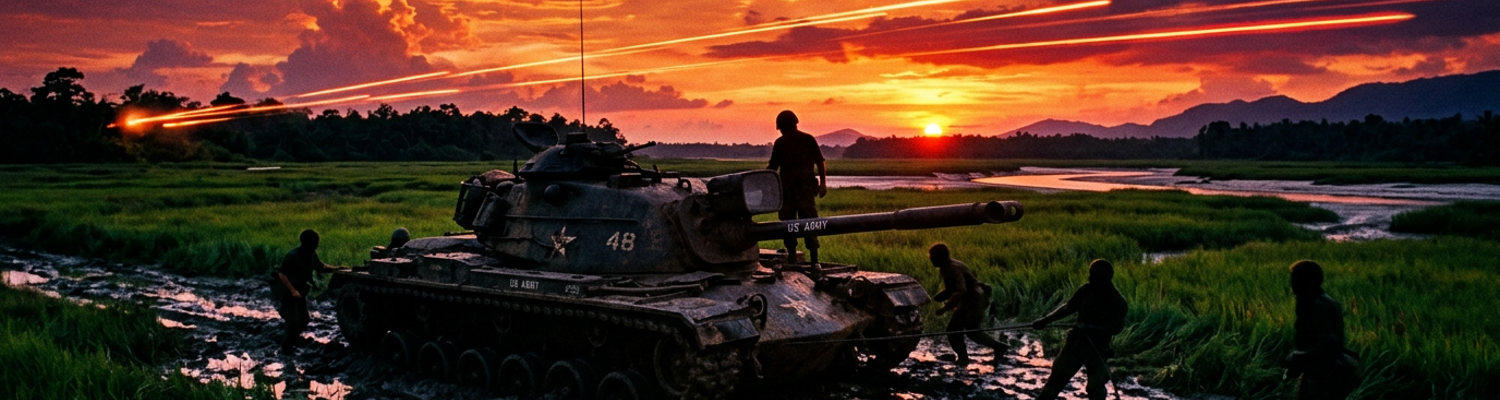
Sergeant Vance swung an eight-pound sledgehammer against the sheared steel track pin of his M48A3 Patton tank, driving a battered punch into the mud-caked suspension. Thick gray silt from the tidal flat sucked at his combat boots and coated the heavy track blocks, resisting every hammer blow as his loader cranked a manual track-jack against the rear idler wheel. Metal fragments flew across the marsh when the sledgehammer struck home, but the fractured pin refused to budge and instead cracked completely across the center steel bushing. Engine heat radiated from the rear exhaust louvers of the fifty-two-ton tank, mixing with the damp river air and the sharp odor of scorched friction clutches as the driver attempted to pivot the trapped drive sprocket. Radio static hissed across the crew intercom as the heavy vehicle slipped six inches deeper into the river mud, cutting off their line of sight to the nearby bridge guards and leaving the vehicle stranded on the low ground.
Mud and marsh grass blocked the view of those nearby bridge guards, leaving the fifty-two-ton vehicle completely isolated on the low ground. Marine crews from the 1st Tank Battalion operated in small scattered detachments like this across the Southern Sector Defense Command in late 1968 because higher headquarters broke armored companies apart into isolated platoon and section outposts. Tactical commanders spread these ninety-millimeter gun tanks across miles of flooded paddies, coastal sand dunes, and dense tree lines to establish a layered perimeter south of the vital military hub. The Southern Sector Defense Command assigned the dispersed vehicles to reinforce infantry strongpoints, shore up perimeter barbed wire, and plug gaps between scattered military police and regional force outposts. Distance and marshy ground made mutual support almost impossible, forcing isolated tank commanders to maintain their own local security without immediate infantry backup. Mechanical breakdowns became tactical emergencies under this scattered posture, because a single cracked track pin could strip an entire grid square of its primary heavy firepower before repair teams arrived.
Concrete bridge abutments at the Song Cau Do and Song Tuy Loan river crossings housed the nearest repair teams, anchoring this fragile defensive perimeter to hold the vital waterways that shielded Da Nang from southern ground assaults. First Tank Battalion positioned Patton tanks in dug-in static revetments along the riverbanks to cover the water obstacles with heavy machine guns and canister shot, while other crews ran mobile security sweeps along the northern banks. Enemy sappers frequently targeted these water crossings with floating demolition charges and swimmer reconnaissance, knowing that knocking out the highway bridges would sever the overland lifeline between rural outposts and the main military base. Vance had positioned his tank on the marshy southern approach to block any infiltrators attempting to bypass the road checkpoint by wading the shallows at low tide. The sudden collapse of the tank track assembly left the southern river bank exposed to North Vietnamese spotters.
North Vietnamese spotters operated inside the dense tree lines across the water to construct hidden firing pits for spin-stabilized 122mm rockets aimed directly at the Da Nang airbase complex. Marine armor crews answered these threats by running aggressive direct-fire counter-rocket missions, elevating their ninety-millimeter main guns to blast suspected launch sites the moment observation posts reported rocket flashes or suspicious movement. High-explosive shells from Patton tanks broke up enemy firing teams before they could wire their ignition circuits and launch devastating salvos into the crowded aircraft revetments five miles to the north. Vance had loaded a ninety-millimeter white-phosphorus round into the breech specifically to mark and suppress those rocket sites, but the immobilized chassis now threw his gun tube off its pre-registered defensive target. Gunner Corporal Ortiz cranked the manual elevation handwheel inside the darkened turret, fighting the seized hydraulic locks while green trip-flare smoke billowed from the reeds directly in front of their stuck bow.
Mechanical Attrition in the Quang Nam Mudflats
Smoke from the trip flare drifted past the turret as Ortiz wiped red hydraulic fluid from his face. High-pressure hydraulic lines had cracked under the strain of the uneven ground, spraying petroleum oil across the turret floorplates and filling the fighting compartment with suffocating fumes. Abrasive river sand had worked its way into the armored bearing race and sliced through the turret hydraulic seals, bleeding the high-pressure system until the power drive failed entirely. Fine alluvial silt ground between the ring gears and the hull race, transforming smooth mechanical traverse into complete mechanical traverse lockups that resisted the physical weight of the gunner on the handwheel. Sergeant Vance dropped down through the commander hatch to brace his shoulder against the gun cradle alongside Ortiz, throwing their combined leverage against the stuck gears to bring the main barrel onto the source of the trip flare. Metal sheared inside the manual gearbox with a dry screech, leaving the fifty-two-ton turret frozen ten degrees short of the target area while shadows darted along the water edge.
Shadows moving along the waterline exploited the immobilized hull, which remained trapped in the tidal flat by the thick mud. Heavy rains pushed water levels over the sponson boxes twice a day, submerging the lower road wheels in a slurry of decomposed vegetation and river grit. Thick monsoon mud and alluvial silt packed solid behind the road wheels and idler arms during every seasonal downpour, hardening under engine heat into a dense crust that prevented the track shoes from seating properly. Constant strain against this trapped silt warped drive sprockets, twisting the heavy steel teeth until they slipped out of alignment with the track links. Excessive rotational stress ripped through the suspension until brittle steel end-connectors sheared completely in two, throwing track shoes loose from the guide horns. Snapped track pins littered the river crossing approaches throughout Quang Nam Province, stranding patrol tanks in open mudflats where repair crews had to crawl through tidal muck under hostile sniper fire to hammer out fractured steel.
Steel components piled up at forward staging areas because depot supply bottlenecks within III Marine Amphibious Force logistics blocked the delivery of fresh replacement parts to these stranded maintenance crews. Cargo ships unloaded thousands of wooden crates at the deepwater piers in Da Nang, but river lighters, washouts along Route 1, and paper requisition backlogs delayed delivery of track pins, seals, and sprockets to field units for weeks. Shortages forced tank company commanders to run operational patrols with missing track pads and leaking hydraulic fittings, knowing that no spare parts existed in battalion supply tents. Unrelenting environmental wear caused operational attrition to outpace combat damage across the 1st Tank Battalion, putting far more M48A3 tanks out of action through mud and mechanical failure than enemy rockets or landmines ever achieved. Armor detachments routinely stripped abandoned hulls in staging yards to salvage usable hydraulic lines and suspension links, but these cannibalized parts failed just as quickly under the grinding river silt. Vance released the safety latch on his cupola-mounted caliber fifty machine gun, gripped the dual spade handles, and swung the heavy barrel toward the shifting reeds by hand.
Tactical Isolation and Communications Interruption
Reeds parted thirty yards beyond the bow as a Viet Cong sapper squad emerged from the river shallows with canvas satchel charges slung across their bare chests and RPG launchers leveled at the tank. Vance pressed the butterfly trigger to spray a heavy burst into the marsh grass, but the sudden click of a sheared feed pawl left the machine gun disabled in his hands. Tidal mud and river silt held the immobilized M48A3 tank trapped on the flats south of the Song Cau Do Bridge after the sheared track pin worked free of the guide horns. River water crept steadily over the lower road wheels as the incoming tide deepened the marsh, preventing the driver from rocking the fifty-two-ton hull loose from the riverbed. Vance dropped through the commander hatch into the fighting compartment, knowing that the crew faced a critical five-minute window before the enemy sappers reached the hull to plant their explosives. Vance seized the armored microphone to call the company command post for emergency artillery suppression.
Artillery requests died in the AN/VRC-12 radio transceivers, which produced only static when Vance keyed the microphone switch to reach the company command post. Complete radio failure struck the entire vehicle communications network after moisture and grit penetrated the unsealed power cables, blowing the primary electrical fuses across the receiver shelf. Ortiz tapped the side of the metal housing and turned the channel selectors through every assigned company frequency, but the dials remained unlit and unresponsive. River water and salty dampness had eaten away the rubber junction gaskets during weeks of monsoon rain, creating an electrical short circuit that severed all voice transmissions across the river basin. Total isolation cut the four-man crew off from defensive artillery batteries at Da Nang and isolated them from neighboring outpost bunkers along the southern river perimeter. Vance hung the useless handset back onto its spring clip and ordered Ortiz to abandon the electrical systems entirely.
Power failures forced Ortiz to throw his entire body weight against the manual traverse crank to fight the jammed ring gear and bring the ninety-millimeter cannon onto the advancing sapper squad. Abrasive river sand packed inside the turret race ground against the metal teeth, forcing Vance to grip the auxiliary manual handle beside the gunner to add his own physical strength. Rocket-propelled grenade teams outside the hull darted between scrub mounds in the tidal flats, searching for flat angles against the thin side armor of the Patton tank. Steel satchel charges packed with high explosives swung from the hands of the lead infiltrators, who waded chest-deep through drainage cuts to reach the blind arc behind the rear engine grilles. Rifle fire cracked against the outer hull plates as North Vietnamese snipers covered the sapper approach, showering the vision blocks with lead fragments and obscuring the view from inside the turret. Vance watched through the periscope as the lead sapper dropped to one knee thirty yards away and hoisted an RPG launcher to his shoulder.
Miller shoved a ninety-millimeter canister round straight into the open breech to answer the kneeling rocket gunner, driving the brass case home with a closed fist as the steel wedge snapped shut to lock the cannon. Traverse gears screeched inside the armored race as Vance and Ortiz wrenched the manual wheel together, forcing the heavy turret barrel around degree by degree toward the kneeling rocket gunner. Sappers sprinted through the remaining open ground toward the track assemblies, closing the final gap of their five-minute approach before the main gun could settle. Mud slowed the feet of the demolition team as they raised their satchel charges to heave them over the sponson boxes and into the open commander cupola. Ortiz locked the elevation handwheel in place, leveled the reticle crosshairs onto the chest of the rocket grenadier, and squeezed the manual firing solenoid.
Manual Turret Traverse and Sapper Repulsion
Solenoid clicks triggered the main gun, sending steel pellets bursting from the muzzle as the point-blank discharge of the M336 90mm canister round struck the marsh grass directly in front of the Patton tank. Over 1,200 steel pellets fanned out across thirty yards of open mudflat, striking the lead sappers and cutting down the kneeling rocket gunner before his weapon could trigger. Blast overpressure from the ninety-millimeter cannon flattened the tall river reeds and detonated one of the fallen satchel charges in a violent shockwave, hurling mud, river water, and hot casing fragments against the front glacis plate. Acrid white smoke billowed past the driver periscopes, obscuring the view to the immediate front while surviving North Vietnamese riflemen on the left flank opened fire with automatic weapons. Copper-jacketed bullets struck the turret face and shattered two exterior vision blocks, showering the interior cupola with glass dust. Ortiz grabbed the manual elevation wheel and locked the gun cradle, yelling for another canister round while enemy fighters darted toward the immobilized left road wheels.
Viet Cong fighters rushing the left flank forced Vance and Ortiz to engage their manual hand cranks simultaneously to swing the seized ninety-millimeter gun turret without hydraulic assistance. Stiff mechanical teeth resisted every rotation where dried silt and shredded hydraulic packings jammed the turret race. Both men braced their boots against the spent shell baskets on the turret floor, throwing their full body weight against the auxiliary handles to turn the heavy cannon degree by degree toward the flanking infiltrators. Miller shoved another M336 canister round into the smoking chamber, driving the brass case home with his fist and latching the breech block shut. Crosshairs in the gunner sight settled on the secondary sapper team as the fighters rose from an exposed mudbank with primed satchel charges. Ortiz tripped the firing foot pedal to unleash another point-blank discharge of over 1,200 steel pellets, killing the flanking assault group and detonating their explosives in the marsh before they reached the track assembly.
Explosions in the marsh sent mud raining down on the commander cupola while surviving enemy fighters in the tree line concentrated their automatic weapons on the turret roof. Vance scrambled upward into the cupola hatch to establish defensive perimeter protection under direct fire, using a screwdriver from his pocket to clear the jammed feed pawl on the M2 .50-caliber machine gun. Hostile rounds chipped the steel vision housing around his head while he pulled the heavy charging handle to seat a fresh belt of linked ammunition. Vance sighted along the heavy fifty-caliber barrel and pressed the butterfly trigger, firing repeated bursts of armor-piercing rounds into the muzzle flashes along the riverbank. Tracers struck the brush and suppressed the remaining enemy firing nests, driving the snipers back into the mangrove roots. Two sappers broke from the reeds and charged the rear deck with satchel charges to reach the blind spot beneath the machine gun depression angle.
Armor blind spots beneath the machine gun depression angle protected the attackers until Miller threw open the spring-loaded loader hatch and raised his M16 rifle over the turret coaming. Five quick rounds dropped the lead infiltrator into the river mud, detonating his chest harness before he could scale the rear exhaust louver. Vance pivoted the cupola ring to bring the M2 .50-caliber machine gun down onto the second attacker, catching the runner in a sweeping burst that threw the canvas satchel harmlessly into the tidal pool. Driver Jackson leaned out of his forward hatch with a standard forty-five caliber service pistol, adding short-range defensive fire to secure the vulnerable bow against any crawling survivors. Emptied brass shell casings tumbled across the rain-swept turret deck as the combined volume of machine gun and small-arms fire finally silenced the ambush line across the marsh. Vance scanned the dark waterline through his commander periscope, keeping his thumb resting on the fifty-caliber trigger while the four Marines held their defensive perimeter around the stranded Patton.
Operation Mameluke Thrust Armored Reaction Operations
Patton crews held their defensive perimeter until diesel exhaust cut through the marsh fog thirty minutes later as two M48A3 tanks from a reaction platoon churned down the river causeway. Headquarters officers had formed these specialized armor reaction platoons during late Operation Mameluke Thrust, stationing them at key road junctions so they could roll out in direct support of infantry sweeps whenever Marine rifle companies encountered fortified resistance. Foot patrols from the 5th Marines and 7th Marines frequently ran into well-concealed tree-line ambushes that small arms could not suppress, making the rapid arrival of the reaction tanks essential for pinning down enemy main-force units. Crewmen on the lead relief tank swung their vehicle onto the muddy verge, unhooked heavy steel towing bridles from their rear sponsons, and dragged the cables through knee-deep silt toward the mired suspension. Vance climbed down over the mud-coated hull to shackle the recovery lines directly to the front tow hooks, shouting details about the enemy sappers and their escape routes across the drainage cuts. Steel winches strained under full power as the two running tanks pulled together, slowly breaking the suction of the riverbed and dragging the crippled Patton onto the solid crushed-stone grade of the road.
Road gravel crunched under the heavy steel tracks as tank commanders from the relief section handed fresh ammunition belts and radio dry-cells to Vance. The relief section immediately swung their own ninety-millimeter cannons westward toward the Dai Loc corridor after resupplying the stranded crew. North Vietnamese Army gunners along that critical river corridor had carved out fortified, dug-in rocket emplacements and interconnected trench lines beneath thick bamboo canopy to stage strikes against allied bases. Marine gunners answered those fortified positions by delivering direct ninety-millimeter high-explosive fires straight into the earthen firing pits and log-reinforced bunkers at ranges under eight hundred yards. High-explosive shells struck the lip of the enemy trenches with flat-trajectory precision, pulverizing dirt parapets and triggering secondary blasts that tossed camouflaged rocket tubes into the air. Point-blank cannon fire systematically demolished the reinforced bunkers one by one, tearing apart the underground shelter complexes that had shielded enemy mortar teams and rocket technicians from air strikes.
Bunker complexes collapsed under the high-velocity cannon firepower, proving the destructive impact of these armored strikes to Marine Corps tacticians. Heavy cannons had proven indispensable for cracking hardened enemy defenses, but extreme terrain and logistical frictions constantly threatened to paralyze the armored force. Flooded rice paddies, tidal mudflats, and monsoon washouts easily trapped fifty-two-ton M48A3 tanks, while chronic supply bottlenecks at Da Nang deepwater ports left field units short of track pins, road-wheel bearings, and replacement hydraulic valves. Doctrinal updates balanced these brutal environmental and supply realities by pairing armored platoons with dedicated infantry screens and combat engineers who scouted soil conditions and cleared hidden obstacles ahead of the tracks. Rifle squads advanced abreast of the tanks to eliminate concealed anti-tank teams armed with RPG launchers, while the armor blasted fortified tree lines that pinned down foot soldiers.
Tree lines required constant armored pressure, forcing mechanics at forward maintenance staging areas to adjust their daily repair routines. Armor crews performed preventative track maintenance every evening, flushing tidal salt and abrasive alluvial silt out of the suspension housings with pressurized water before greasing every road-wheel hub. Supply sergeants established local salvage yards along Route 1 to rebuild damaged track sections and recondition blown hydraulic seals using parts stripped from burned-out hulls. Vance tightened the center guide horns on a replacement track link with a heavy box wrench, securing the left suspension so the driver could steer the vehicle onto the northern bridge approach. Drivers fired up their diesel engines and formed a tight convoy behind the reaction tanks, moving back across the Song Cau Do causeway to take up fresh firing positions guarding the airbase perimeter.