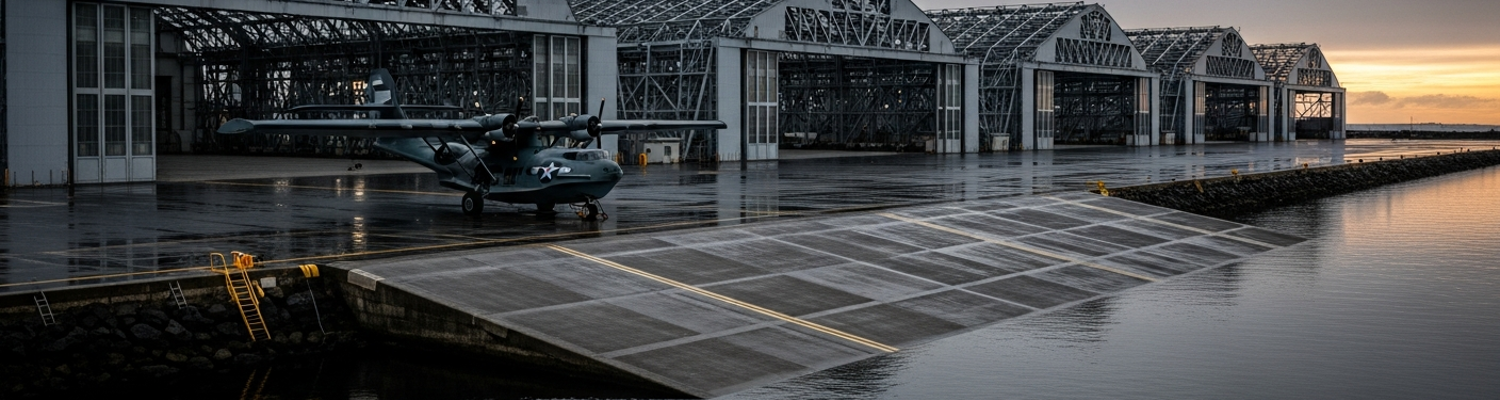

The story of American naval air power in the Second World War is often told through the lens of the aircraft carrier. Flight decks turning into the wind and dive bombers peeling off against enemy fleets define the Pacific conflict. A parallel and foundational story, however, unfolded on shorelines across the United States and on remote atolls. The U.S. Navy’s deliberate, difficult construction of a global network of land-based air stations formed the bedrock of its entire aviation strategy. This was not a secondary effort but a doctrinal imperative. It created a resilient, two-pronged air arm that projected power far beyond the range of a carrier’s deck. Establishing this infrastructure was an immense undertaking, a contest against terrain, distance, and time that was met with a determined foresight that paid dividends in a two-ocean war.
Concrete and Saltwater Engineering
The initial challenge was elemental, carving modern airfields from undeveloped, often inhospitable, terrain. The first dedicated Naval Aeronautic Center, established at Pensacola, Florida, in 1914, exemplified this struggle. The site, a former Navy yard abandoned since 1911, offered access to the sheltered waters of Pensacola Bay, a vital feature for the era’s dominant seaplanes. The ground itself was little more than sandy, swampy coastline. Early construction efforts were grueling. Creating functional facilities for flying boats and floatplanes required more than just flat ground. Engineers had to dredge deep, calm-water basins to serve as runways. They constructed enormous concrete ramps, strong enough to bear the weight of multi-ton aircraft like the PBY Catalina, to haul the machines from the water for maintenance and protection from corrosive salt spray. The work at Pensacola set a precedent for the immense civil engineering projects that would follow.
At Naval Air Station North Island in San Diego, designated the “Birthplace of Naval Aviation,” similar challenges emerged on a grander scale. Initially a sandy, uninhabited flatland shared with the Army, the Navy took full control in 1937 and began a massive expansion. This involved dredging 21 million cubic yards of material from the San Diego Bay. The spoils were used to increase the land area by over 600 acres, permanently connecting what was then North and South Coronado Islands. The construction of hangars at these new stations presented its own set of engineering problems. These were not simple shelters. To accommodate the growing wingspans of patrol bombers like the Consolidated PB2Y Coronado, hangars had to be vast, employing complex steel truss designs to create massive, unobstructed interior spaces. At NAS Alameda, steel-frame hangars for seaplanes were a major part of its development, while at Philadelphia’s Mustin Field, the Navy employed a monolithic concrete design using the German “Zeiss-Dywidag System” for its large seaplane hangar. These structures were essential industrial buildings, designed to protect aircraft from the elements and serve as frontline maintenance hubs. The scale was huge. By the war’s end, NAS Pensacola had expanded to include auxiliary fields like Saufley and Ellyson, becoming a complex that trained nearly half of all naval aviators who served in the war.
Sustaining the Air Arm
An air station was a small industrial city that required immense quantities of fuel, ordnance, and spare parts to sustain operations. The voracious fuel consumption of large patrol bomber squadrons necessitated the construction of vast, secure fuel farms. These facilities, often with tanks built into the ground or protected by thick concrete and earthen berms, held hundreds of thousands of gallons of high-octane aviation gasoline. At a station like Naval Air Station Pasco in Washington, storage for 200,000 gallons was constructed, a typical figure for many of the new training bases. Major operational hubs required far more. The Naval Supply Depot San Pedro, for example, became a key hub for fueling the Pacific Fleet, handling millions of barrels of petroleum products. This required a dedicated fleet of tankers and a complex system of pipelines and pumping stations just to keep the air stations supplied.
Equally important was the storage of ordnance. The Navy constructed dispersed, heavily protected ordnance magazines to house the bombs, depth charges, torpedoes, and ammunition required for anti-submarine and patrol missions. Pre-war depots on the East Coast were insufficient for a Pacific-facing fleet. This led to a massive expansion of magazine construction on the West Coast and at inland depots like the Naval Ammunition Depot Hawthorne in Nevada, where the remote location provided security from attack. These magazines were often igloo-style reinforced concrete structures, a design the Navy began using in 1928, built to direct an accidental explosion upwards rather than outwards. Getting a 2,000-pound Mark 13 torpedo from a stateside depot to a PBY squadron on a forward base like Espiritu Santo was a monumental logistical feat in itself, relying on a chain of ships, barges, and specialized handling crews.
The final piece of the logistical puzzle was a robust maintenance and overhaul infrastructure. While squadron-level mechanics handled routine repairs, major engine changes and airframe reconstruction required industrial-level facilities. The Navy established large Assembly and Repair (A&R) departments at major stations like NAS Alameda and NAS Norfolk. The A&R facility at Alameda, established in 1941, grew from 200 personnel to over 9,000 by the war’s end. It was capable of repairing everything from the F6F Hellcat to the massive Martin JRM Mars flying boat. These depots employed hundreds of different trades, with their own foundries, machine shops, and plating facilities, enabling them to manufacture needed parts from scratch. This capability for deep, stateside overhaul gave naval aviation its strategic endurance, ensuring a steady flow of mission-ready aircraft to the front lines and enabling rapid modification of aircraft with new systems like radar.
The Strategic Imperative
The immense investment in land-based infrastructure was driven by a clear and evolving doctrinal imperative. While carrier aviation was ascendant, key naval thinkers understood that it could not be the sole solution. Rear Admiral William A. Moffett, the first chief of the Bureau of Aeronautics, championed a vision of naval aviation as an integral part of the fleet, not an independent arm. He successfully argued before Congress against calls from figures like Billy Mitchell for a unified, independent air force. This resistance ensured the Navy developed a balanced and diverse air arm, including a role for long-range, shore-based patrol aircraft and dirigibles for scouting missions that complemented carrier operations.
A critical turning point came with the 1938 Hepburn Board Report. Tasked by Congress to assess the need for additional naval bases, the board, led by Rear Admiral A.J. Hepburn, submitted a landmark report that called for a massive expansion of shore-based air power. The report recommended the development of 41 new or expanded naval air bases, with a strategic focus on the Pacific. It advocated for creating new stations at key locations like Kodiak, Alaska; Kaneohe Bay, Hawaii; and island outposts on Midway, Wake, and Johnston Island. The Hepburn Board’s recommendations were a direct response to the growing threat of a two-ocean war and the vast distances of the Pacific theater. It codified the doctrinal necessity of a network of fixed bases to provide reconnaissance, security, and logistical support for the fleet, creating a layered defense in depth.
This network proved its value immediately upon America’s entry into the war. In the Atlantic, land-based naval aircraft, including PBY Catalinas and newly acquired B-24 Liberators designated PB4Y-1, became the primary weapon against German U-boats. Operating from bases in the U.S., Brazil, Argentia in Newfoundland, and Iceland, these long-range patrol bombers relentlessly hunted submarines. They helped to close the notorious “Mid-Atlantic gap” where convoys had been most vulnerable. In the Pacific, the network of advance bases, often built at astonishing speed by the Seabees, supported the long-range reconnaissance flights that were the eyes of the fleet. A PBY flying from Midway, stationed at a base recommended by the Hepburn Board, first spotted the approaching Japanese fleet, initiating the pivotal Battle of Midway. The shore-based network provided strategic depth. It allowed the Navy to control vast ocean areas, protect vital sea lanes, and stage forces for offensive operations, a mission that carrier groups alone could not have sustained.