
The Unseen Engine of Independence
The Continental Army, from its inception on June 14, 1775, faced a catastrophic deficit not of spirit, but of material. Muskets failed, cannons fractured, wagons broke down, and uniforms disintegrated. General George Washington, observing the rapid decay of his army’s equipment, understood a truth of warfare that transcended battlefield action. An army that cannot repair its tools of war is an army destined for defeat. Early attempts to solve this crisis were disorganized and insufficient. The army relied on detailing soldiers from the line, a practice that weakened his fighting strength, or hiring civilian craftsmen at exorbitant rates. The disastrous Canadian campaign of 1775-1776 provided a stark lesson in logistical failure, where soldiers starved and froze due to a broken supply chain. This dire situation prompted Washington to make urgent, repeated appeals to the Continental Congress for the establishment of a dedicated, militarized corps of skilled tradesmen. The fight for independence required not just soldiers, but smiths, carpenters, and wheelwrights enlisted for the duration of the war.
Forging a Formal Corps
Initial efforts were ad hoc. Companies of skilled civilians were raised by master artisans for specific, temporary tasks like building barracks. In early 1776, Maj. Gen. Charles Lee convinced the New York Provincial Congress to create a company of about sixty artificers, mirroring the pay of similar companies already at Cambridge. These piecemeal solutions failed to address the systemic rot in the army’s logistical spine.
The turning point came from the recognition that these skills were as necessary as those of an infantryman or a gunner. Congress and Washington moved to formalize these roles. On January 16, 1777, Washington ordered Colonel Benjamin Flower to raise a regiment of artillery artificers. This unit, organized in the spring of 1777 at facilities in Philadelphia and Carlisle, Pennsylvania, was specifically tasked with the production and maintenance of armaments and ammunition. It included a diverse array of craftsmen: carpenters, blacksmiths, wheelwrights, tinners, turners, and harness makers, later expanding to include coopers, nailers, and farriers. Concurrently, a second major branch of artificers formed under the Quartermaster’s Department, commanded by Colonel Jeduthan Baldwin, a veteran engineer from the French and Indian War. Baldwin’s Regiment of Artificers, formally organized in 1778 but with companies in service earlier, focused on engineering and logistical support, such as constructing fortifications, barracks, and bridges. These two regiments, Flower’s artillery artificers and Baldwin’s quartermaster artificers, formed the backbone of the army’s industrial and repair capabilities.
The Army's Integrated Workshop
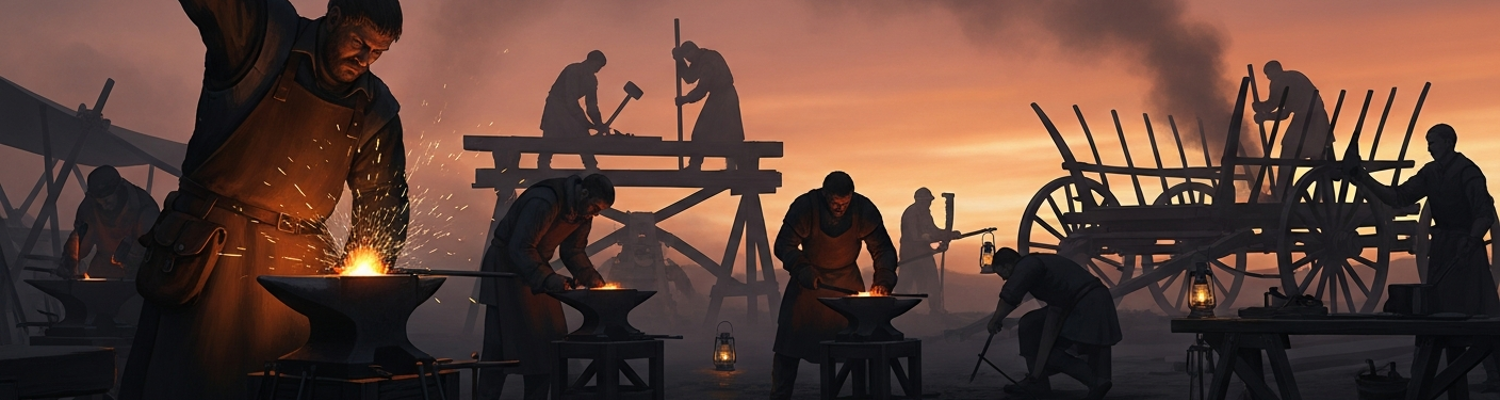
The range of tasks performed by artificers was immense. They were the army’s integrated workshop, providing services that kept the entire military apparatus functioning. At fixed installations like the Springfield Laboratory in Massachusetts and the ordnance center at Carlisle, Pennsylvania, they operated on an industrial scale.
The Springfield Arsenal, established in 1777, became a primary center for manufacturing cartridges, repairing thousands of small arms, and serving as a major storage depot.
At Carlisle, known then as Washingtonburg, artificers in Flower’s regiment cast cannon and manufactured shot for Henry Knox’s artillery. The process was arduous. They constructed furnaces capable of melting tons of iron, built clay molds for cannon barrels, and then bored the solid-cast tubes to precise calibers, a dangerous and technically demanding process.
Gunsmiths were in constant demand, servicing the army’s mismatched collection of firearms. They repaired damaged stocks, replaced worn flintlock mechanisms, and rebored damaged barrels on French .69 caliber Charleville muskets and British .75 caliber Brown Bess muskets.
Artillery artificers maintained the field pieces, ranging from small 3-pounder field guns to larger siege cannons, repairing gun carriages damaged by rough transport or enemy fire. They fabricated new iron fittings and replaced splintered wooden frames, ensuring the big guns could keep pace with the army.
Engineering Mobility and Survival
Beyond weaponry, the quartermaster artificers under Baldwin were essential for mobility and shelter. Carpenters and sawyers felled timber and constructed everything from soldiers' huts at Valley Forge to complex fortifications at West Point. They built bateaux, shallow-draft boats, for river crossings and pontoon bridges for entire armies. A single pontoon bridge could require dozens of specially constructed flat-bottomed boats, thousands of feet of planking, and miles of rope, all fabricated and assembled under pressure.
Wheelwrights and blacksmiths kept the army’s hundreds of wagons rolling. They fabricated new wheels from seasoned oak and hickory, forged iron tires, and repaired broken axles. Without their work, supply convoys would have ground to a halt on the rudimentary roads of colonial America, severing the army's lifeline.
Other specialists included saddlers and harness makers who repaired cavalry and artillery tack, tailors who mended tattered uniforms or sewed new ones from scarce cloth, and coopers who made the thousands of barrels essential for transporting salted meat, flour, and, most critically, black powder. A poorly made barrel could expose gunpowder to moisture, rendering it useless and silencing the army's muskets and cannons.
Behind the Lines at Valley Forge
The impact of the artificers was felt most profoundly away from the battlefield, in the grim encampments where the army’s will to fight was tested. During the brutal winter of 1777-1778 at Valley Forge, while line infantry drilled under Baron von Steuben, artificers engaged in a desperate battle against logistical collapse.
The supply chain had already broken down. It was Baldwin’s artificers who directed the construction of over 1,500 log huts according to Washington's own specifications, twelve by sixteen feet each, to house twelve men. They organized the felling of entire forests, creating a city from the wilderness and providing the shelter that prevented thousands more from perishing.
Blacksmiths kept forges burning day and night, repairing tools and shoeing the army’s few remaining horses. Gunsmiths worked to bring thousands of damaged muskets back into service.
Their relentless labor was a quiet, unheralded counterpoint to the more visible suffering, and it was this work that allowed the army to survive the winter as a coherent force. When the army emerged in June 1778, it was refitted and capable of meeting the British at the Battle of Monmouth. The same skills were tested again during the even more severe winter of 1779-1780 at Morristown, where deep snow and record cold paralyzed the region. Artificers again built the shelters and maintained the equipment that kept the army from disintegrating under unimaginable hardship.
Sustaining the Southern Campaign
Artificer contributions were not limited to static encampments. During the Southern Campaign, Major General Nathanael Greene conducted a brilliant war of movement against Lord Cornwallis. This strategy was entirely dependent on superior logistics and mobility, enabled by his artificers.
Greene’s small, mobile detachments of craftsmen moved with the army, constantly repairing wagons, shoeing horses, and maintaining weapons on the march. During the famed