
The Tyranny of Mexican Terrain
When the United States Army marched south across the Rio Grande in 1846, it carried the ambitions of a nation bent on expansion. It also collided with a brutal, immutable reality. The vast, arid, and mountainous expanse of Northern Mexico presented a logistical problem that threatened to stop the invasion cold. General Zachary Taylor’s Army of Occupation, tasked with projecting American power deep into hostile territory, found its conventional methods of warfare rendered almost useless. The eight hundred miles of broken country separating Taylor from Mexico City was not just a distance, it was an obstacle of continental scale. Traditional horse and ox drawn wagon trains, the logistical engine of European and eastern American warfare, shattered against the unforgiving landscape. Axles snapped on boulder strewn trails, wheels sank into sandy arroyos, and draft animals sickened and died from lack of forage and clean water. Standard field artillery, like the 6 and 12 pounder guns that formed the army's backbone, became dead weight, immovable anchors that bogged down columns and exhausted men and animals.
The terrain itself became the primary antagonist. The advance from the coast inland to Monterrey, and later toward Buena Vista, was a grueling ordeal. The main logistical depot established at Camargo on the Rio Grande, supplied by steamboats from the Gulf of Mexico, quickly became infamous. Soldiers dubbed it the “City of Death” as dysentery and other diseases swept through the camps, fueled by poor sanitation and oppressive heat. From this squalid starting point, every pound of ammunition, every barrel of flour, and every spare part had to be hauled overland. The crisis forced a radical reevaluation of mobility. The army had to adapt or see its campaign wither in the desert. The Quartermaster’s Department, under the direction of the capable Brigadier General Thomas Jesup, understood that projecting power into this environment required a complete departure from established doctrine. The solution was not a new invention, but a return to an ancient method of transport perfectly suited to the mountains and deserts. The pack animal, specifically the hardy and stubborn mule, became the key to unlocking the campaign. Thousands of them, organized into vast trains, formed a living, breathing supply chain that could traverse trails where no wagon could ever hope to roll. This was not a strategic choice, it was a stark necessity dictated by the geography of war.
The Mountain Howitzer Solution
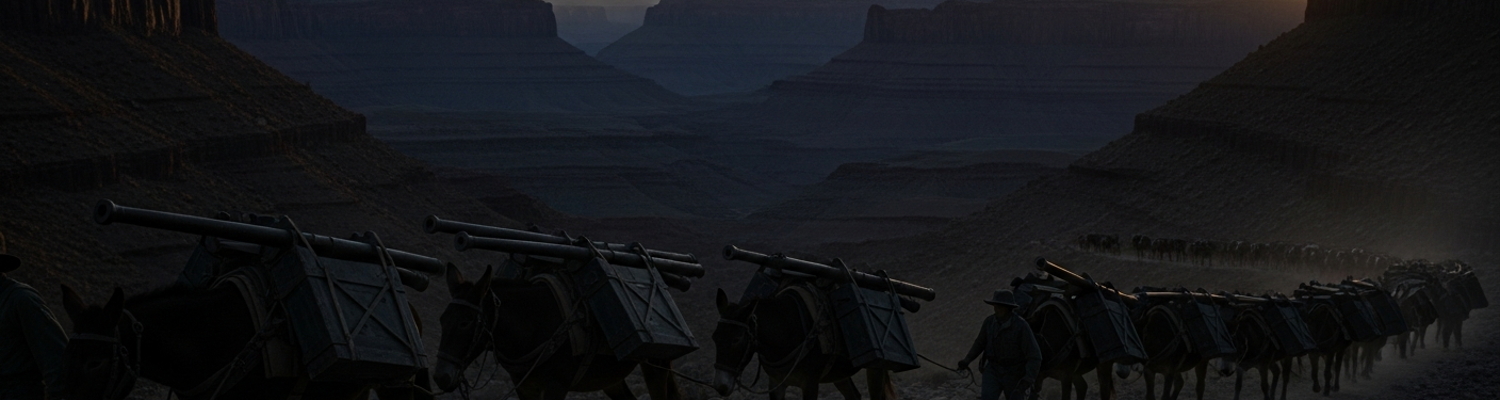
At the center of this tactical and logistical shift was a piece of ordnance designed for precisely these conditions, the M1841 12-pounder mountain howitzer. This bronze, smoothbore weapon was the army’s answer to a difficult question, how to bring meaningful, responsive firepower into roadless territory. The true innovation of the M1841 was its modularity. The entire system was engineered for disassembly, allowing it to be broken down into loads manageable for pack mules. The bronze tube itself weighed approximately 220 pounds and was secured to a specially designed packsaddle on one mule. The carriage, a two-part assembly of a trail and an axle, weighed a combined 270 pounds and was strapped to a second animal. The two wheels, at roughly 70 pounds each, could be carried by a third mule. Additional mules were required to carry ammunition chests, each holding rounds of shell, spherical case shot, or anti-personnel canister. A complete M1841 section, with its gun and ammunition, could therefore be moved by a small string of mules, reassembled by its trained crew in minutes, and brought into action wherever infantry could find a foothold.
With a 4.62 inch caliber, the M1841 was not a long range weapon, its effective range topping out around 1,000 yards. Its value lay in its extreme portability, which gave American commanders tactical flexibility that repeatedly surprised their opponents. This advantage was demonstrated with decisive effect during the Battle of Buena Vista in February 1847. There, General Taylor’s heavily outnumbered force of about 4,500 men faced a Mexican army of nearly 15,000 under General Antonio López de Santa Anna. Taylor chose his ground well, a narrow mountain pass named La Angostura, or “The Narrows.” The battle devolved into a chaotic series of attacks and counterattacks where artillery placement became the deciding factor. While the heavier batteries of Captain Braxton Bragg and Captain Thomas W. Sherman did bloody work breaking up Mexican infantry columns on the main road, the battle’s pivotal action took place on a high plateau to the east. Mexican forces under General Manuel María de Lombardini threatened to envelop the American left flank. In response, American commanders ordered artillery moved onto the plateau, a position inaccessible to conventional horse drawn guns. Sections of mountain howitzers, likely from the light artillery companies, were disassembled, hauled by men and mules up the steep slopes, and reassembled. From this commanding high ground, guns under officers like Lieutenant John F. Reynolds delivered devastating plunging fire into the dense Mexican formations below, stalling their assault and helping to stabilize the American line. At Buena Vista, the M1841 proved it was more than a support weapon, it was a battle winning asset that completely validated the concept of pack artillery.
Sustaining the Deep Advance
The operational success of the mountain howitzers and the army itself depended entirely on a sprawling, fragile, and complex logistical network. This was a hybrid military civilian enterprise of a scale the U.S. Army had never before managed. The Quartermaster’s Department was tasked with procuring, organizing, and managing the thousands of animals required. Fiscal year records from 1846 to 1847 show the Army of the West alone was furnished with 1,556 wagons, 3,658 draft mules, 516 pack mules, and an astonishing 14,904 oxen. These animals moved a mountain of materiel, ammunition, spare parts, medical supplies, tents, and, most critically, the very forage needed to keep the animal train itself moving. A mule required several pounds of grain and hay per day, meaning a significant portion of the logistical effort was dedicated to feeding itself, a classic challenge of expeditionary warfare.
This animal powered machine required immense human expertise. The army hired thousands of American civilian teamsters, blacksmiths, wheelwrights, and harness makers on six month contracts, often at premium wages, to manage the trains. This American workforce was supplemented by a vital contingent of local Mexican labor. Contracted or impressed Mexican arrieros, or muleteers, brought with them generations of experience in handling pack animals in precisely this terrain. They knew the secret trails, the locations of hidden springs, and the techniques for balancing loads that kept the columns moving. This reliance on a long, tenuous supply line operated by a mix of soldiers, American contractors, and local nationals created its own vulnerabilities. Mexican guerrilla fighters, led by figures like Antonio Canales Rosillo, constantly harassed the supply trains snaking their way from the Rio Grande. These attacks forced Taylor to detach significant numbers of combat troops to guard his lines of communication, slowing his operational tempo and demonstrating the inherent risk of a campaign fought at the end of a fragile logistical tether. The entire advance was a calculated gamble, balancing the need for deep penetration against the constant, looming threat of logistical collapse.
Lessons Forged in the Mountains
The Mexican War served as a crucible for American expeditionary warfare, forging doctrines and capabilities that would echo for a century. The conflict represents a clear inflection point, demonstrating a new capacity to project and sustain land power far beyond U.S. borders. The logistical lessons learned in the mountains of northern Mexico provided a foundational text for future conflicts in austere environments. The army’s pragmatic adoption of pack animal transport over its preferred wagon trains illustrates a timeless principle of expeditionary operations, the force must adapt its logistical methods to the environment, not the other way around. This principle holds true whether the solution is a mule train in 1847, a helicopter in 1967, or an autonomous ground vehicle in the 21st century.
The M1841 mountain howitzer itself embodies the enduring value of modularity and purpose built equipment. Its design, optimized for disassembly and transport by minimal means, is a direct ancestor to modern efforts to create lightweight, air transportable artillery and combat systems for rapid deployment forces. The ad hoc, hybrid logistical network of soldiers, civilian contractors, and hired local nationals that supplied Taylor’s army also provides a stark historical parallel to modern military operations in places like Iraq and Afghanistan, which rely heavily on contractors for transportation, security, and life support. The challenges of managing, protecting, and ensuring the loyalty of these mixed supply chains are not new. A cautious forecast, grounded in the Mexican War experience, suggests that as technology evolves, the fundamental problems of sustainment in contested, undeveloped theaters will persist. The tools will change, but the core challenges that confronted General Jesup’s quartermasters, moving men and materiel through hostile terrain to a decisive point, remain the central, unchanging problem for military planners. The gritty, improvised, and ultimately successful solutions of 1846 provide a vital case study in how that problem can be solved.