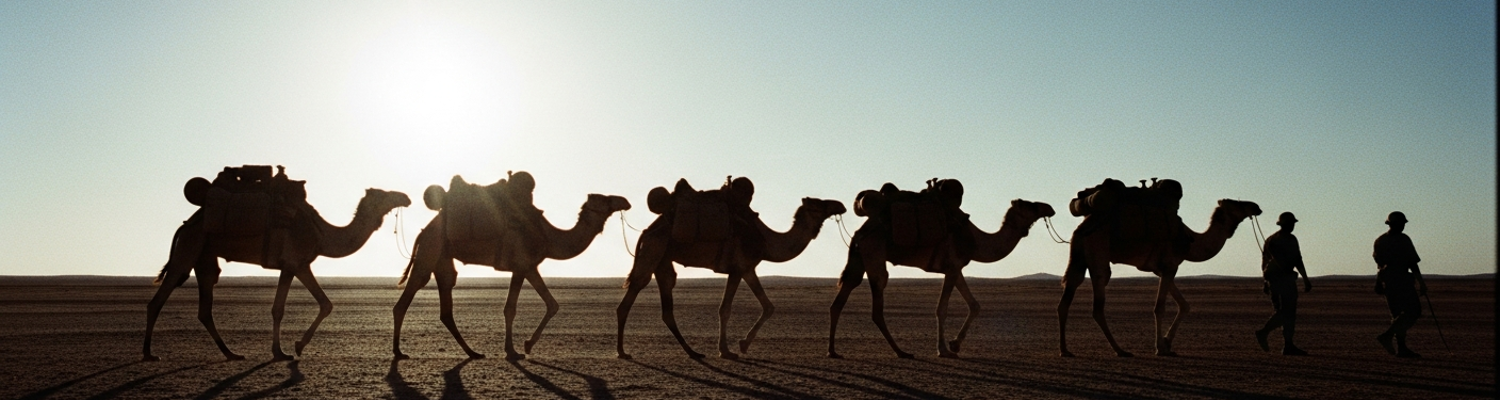

A Secretary's Desert Conviction
The territories seized from Mexico after the war left the United States Army with a logistical problem of continental scale. The vast, arid expanse, often dismissed as the “Great American Desert,” was a brutal environment that shattered conventional supply lines. An army’s reach was measured in the distance between water holes. The cost to maintain frontier posts across Texas, New Mexico, and California was unsustainable. Horses and mules, the backbone of military transport for centuries, faltered and died under the punishing sun. Into this operational deadlock stepped Secretary of War Jefferson Davis. A West Point graduate and veteran of the Mexican-American War, Davis understood the physical reality of desert campaigning. He had seen the bleached bones of pack animals firsthand. He knew that the Army’s doctrine was failing its men on the frontier. His proposed solution was so alien to the American military mind that Congress initially laughed it out of committee. Davis wanted to form a United States Army Camel Corps.
The idea was not entirely his own. As early as 1836, Army Major George H. Crosman had formally suggested using camels for operations in Florida. The concept was later studied in greater detail by Major Henry C. Wayne. These proposals gathered dust until Davis became Secretary of War under President Franklin Pierce in 1853. He possessed the executive authority to transform this fringe concept into a funded military experiment. He argued with force and persistence that the Army must innovate or fail in the Southwest. In his 1854 annual report, Davis formally requested congressional attention on the advantages of using camels and dromedaries for military purposes. His advocacy finally broke through the skepticism. On March 3, 1855, Congress appropriated $30,000 for the project, a sum worth nearly a million dollars today.
Procurement on the Barbary Coast
With funding secured, Davis selected Major Henry C. Wayne of the Quartermaster Corps to lead the procurement expedition. The mission, however, required a naval officer with experience in the Levant. Navy Lieutenant David Dixon Porter, a man whose father had served as a diplomat in the Middle East, was given command of the USS Supply. The vessel, a standard store-ship, was ordered to a naval yard for a bizarre refit. Porter, drawing on his own observations of the animals, designed a custom camel barn for the ship’s spar deck. It was a stable built for the sea, complete with specialized stalls, slings to support the animals in rough weather, and a ventilation system to manage the oppressive heat and odor. Porter knew the voyage itself would be a primary test of the animals’ resilience.
In the spring of 1855, the USS Supply departed New York for the Mediterranean. Wayne and Porter began their strange shopping trip, visiting ports in Tunis, Egypt, and what is now modern Turkey. This was not a simple livestock purchase. They consulted with French officers about their experiences with camel units in Algiers and observed a herd owned by the Duke of Tuscany. They were meticulous in their selections, seeking specific breeds. They acquired swift dromedaries for riding and reconnaissance and larger, two-humped Bactrian camels for their immense strength and potential in breeding programs. This was a transfer of doctrine, not just a purchase of animals. Wayne and Porter hired a handful of native handlers, men who possessed the generational knowledge needed to manage the difficult creatures. Among them were a Syrian named Hadji Ali, whose name Americans quickly corrupted to “Hi Jolly,” and a Greek man known as George Caralambo. These men were contracted to teach American soldiers the difficult arts of packing, riding, and caring for animals that were worlds away from a horse or mule.
The return voyage was a testament to Lieutenant Porter’s seamanship and planning. Setting sail in February 1856, the Supply carried a precious cargo of 33 camels. Porter enforced a strict regimen for their care, personally overseeing their feeding and exercise. The ship endured violent gales, yet the camel barn and its occupants held. The herd arrived at the port of Indianola, Texas, on May 14, 1856, with 34 animals. One had died, but two calves were born at sea. The first trip was so successful, spending only a fraction of the budget, that Porter was immediately ordered to return for a second load. He came back in February 1857 with another 41 camels. The United States Army now possessed a herd of 75 animals, the foundation of its Camel Corps.
The Crucible at Camp Verde
While Porter was on his second voyage, Major Wayne marched the first contingent of camels from the Texas coast to Camp Verde. This outpost, located about 60 miles north of San Antonio, became the experiment’s home base. Here, the human factor asserted itself immediately. The camels were unlike any animal the soldiers had ever encountered. Their pungent smell panicked horses and mules, their habit of spitting foul-smelling cud unnerved their handlers, and their sheer size was intimidating. The foreign handlers, with their different languages and customs, created another layer of friction in the rigid environment of a frontier army post. Mule skinners and teamsters, men whose identities and livelihoods were tied to their expertise with traditional pack animals, viewed the camels with open hostility. They saw not an innovation, but a threat.
Wayne, a methodical officer, pressed on with systematic trials. He pitted the camels against mules and wagons in direct competitions. In one early test, six camels were dispatched to San Antonio for a load of oats alongside horse-drawn wagons. The camels completed the 120-mile round trip in just over two days, each carrying over 600 pounds of grain. The wagons took nearly five days to make the same journey. The tests repeatedly demonstrated that a single camel could haul a load requiring three or four mules, and could do so over rougher terrain with far less water. They grazed on creosote bush and other desert forage that a horse would refuse. Despite these clear, quantifiable advantages, the cultural resistance within the ranks was a constant drag on the program. The animals required specialized saddles and packing techniques, alien to the Army’s established procedures.
Across the 35th Parallel
The War Department needed a real-world operational challenge to validate the experiment. They found it in the mission assigned to Lieutenant Edward Fitzgerald Beale, a seasoned naval officer and frontiersman. In 1857, Beale was ordered to survey and build a wagon road along the 35th Parallel, a route stretching from Fort Defiance in the New Mexico Territory to the Colorado River. This path would one day become the foundation for the Santa Fe Railroad and the iconic Route 66. To support this monumental undertaking, Beale was authorized to take 25 of the Army’s camels from Camp Verde as his primary pack animals. Beale, a horse and mule man by experience, began the journey with trepidation. His soldiers were deeply skeptical of their strange new assets. The expedition quickly changed their minds.
The camels proved their worth almost immediately. They carried water for the mules on dry stretches, hauled loads exceeding a thousand pounds, and navigated rocky passes where wagons could not follow. Beale developed a profound admiration for the animals, noting in his official reports that one camel was worth four of his best mules. He became particularly fond of his personal mount, a dromedary named Seid. Beale's journal entries document the camels' performance. During one leg of the journey, they traveled for days without water, subsisting on local brush while the other animals suffered. When the expedition reached the Colorado River, the horses and mules balked at the crossing, but the camels were led across without incident. Later, while camped in the Sierra Nevada mountains in several feet of snow, a supply wagon became hopelessly stuck. The six-mule team could not budge the empty wagon from the mud and ice. Beale sent the camels down. They were packed with the wagon's full load and brought the supplies through the difficult terrain to the camp. The expedition was an unqualified success. Beale’s final report to the Secretary of War, John B. Floyd, was a glowing endorsement, recommending the immediate purchase of a thousand more camels.
Institutional Inertia and Political Winds
Despite Beale’s enthusiastic reports and the clear operational success, the Camel Corps project began to unravel. The primary obstacle was human and institutional. The Army was a horse-and-mule organization. Its powerful quartermaster culture, along with the civilian freighters who supplied the frontier, resisted the change. Soldiers disliked the animals' difficult temperaments and the specialized care they required. The project’s fate was sealed by politics. When Jefferson Davis left his post as Secretary of War in 1857 to become a senator for Mississippi, the experiment lost its most powerful champion. His successor, John B. Floyd, supported the idea and recommended further funding, but Congress, increasingly paralyzed by the sectional crisis over slavery and states' rights, refused to act. A niche logistics program in the distant Southwest was a low priority for a nation spiraling toward civil war.
The Confederate capture of Camp Verde in 1861 effectively split the herd and the program's leadership. Major Henry Wayne resigned his U.S. Army commission and became a general in the Confederate Army. Lieutenant Colonel Robert E. Lee, who had used the camels on patrol in 1860 and praised their capabilities, also sided with the Confederacy, rendering his endorsement politically toxic to the Union government. The war was the final blow.
Ghosts of the Chihuahuan Desert
The Confederate forces at Camp Verde made little use of the captured camels, and the animals were reportedly mistreated or allowed to wander off. The Union herd, which had been moved to California under Beale’s care, was similarly neglected. The new Union Secretary of War, Edwin Stanton, viewed the camels as a useless relic of the old administration and ordered them sold. In 1864, the California camels were sold at public auction in Benicia. After Union forces recaptured Camp Verde, the remaining Texas herd of about 66 camels was rounded up and sold to a local merchant in 1866. The Army’s desert gamble was officially over.
The camels were scattered across the West. Some were sold to circuses, others to mining operations in Nevada and British Columbia. Many were simply turned loose to fend for themselves in the desert. For decades afterward, sightings of feral camels became a part of Southwestern folklore. Prospectors and soldiers reported encounters with these solitary, out-of-place giants. One particularly famous legend was that of the “Red Ghost,” a massive, reddish-colored camel said to roam the Arizona Territory, sometimes with a human skeleton strapped to its back. The handler, Hadji Ali, lived out his life in the west, working as a packer and scout before dying in poverty in Quartzsite, Arizona, in 1902. His grave is marked by a small pyramid topped with a metal camel, a lonely monument to a peculiar chapter in American military history.
The story of the Camel Corps is a hard lesson on military innovation. The technology, in this case the animal itself, proved its worth beyond doubt. The experiment failed because of institutional inertia, cultural friction, and the overwhelming political rupture of the Civil War. It was a sound idea that simply could not find a permanent home in an army, and a nation, unprepared to accept it.