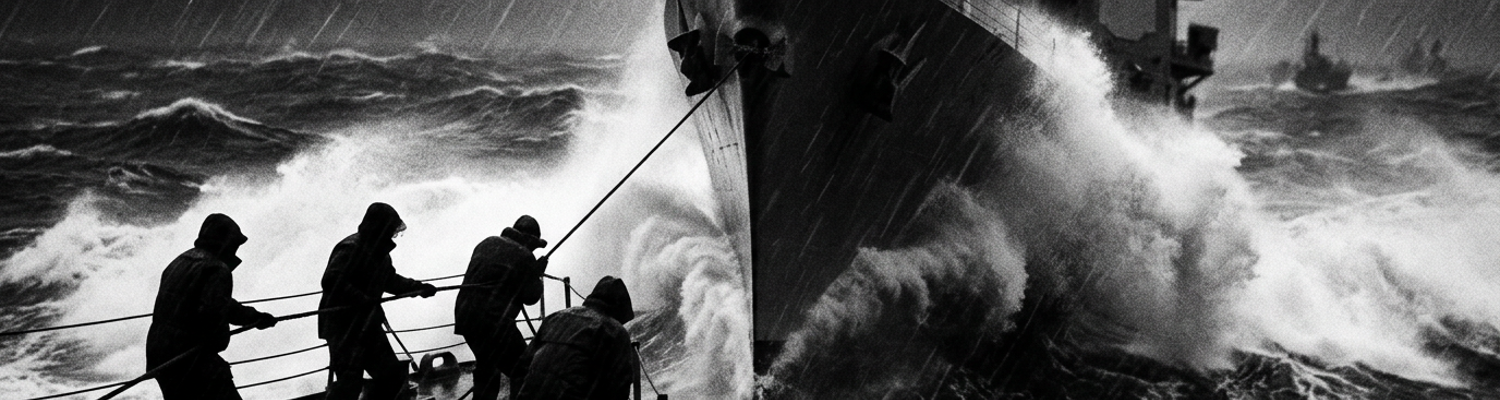

Meteorological Failures and Task Group Routing
Four thousand one hundred rounds of 5-inch/38 caliber antiaircraft shells sat secured in the forward magazines. One hundred and forty-four Mark 13 aerial torpedoes occupied the lower storage bays. Eight hundred and twenty 1,000-pound armor-piercing bombs lined the ordnance racks. Twelve hundred 500-pound AN-M64 general-purpose munitions filled the adjacent compartments. Four hundred thousand rounds of .50-caliber ball ammunition weighed down the storage vaults of USS Bennington (CV-20). One hundred and fifty thousand gallons of 100-octane aviation fuel filled the deep bunkers. Identical payloads packed the magazines of the fleet carriers, light carriers, battleships, and cruisers deployed across Task Force 38 off the Ryukyu Islands.
Weather rendered that firepower useless.
A close review of operational logs indicates that on June 4 and through the early morning hours of June 5, 1945, Task Group 38.1 steamed directly through coordinates 23 degrees north, 131 degrees east. This position placed the formation roughly three hundred miles southeast of Okinawa. Rear Admiral Joseph J. Clark commanded the group from his flagship USS Hornet (CV-12). The formation contained the fleet carriers Hornet and Bennington. It also included the light carriers Belleau Wood and San Jacinto. The fast battleships Massachusetts and Indiana provided heavy escort. A perimeter screen of heavy cruisers and destroyers surrounded the capital ships. Third Fleet Commander Admiral William F. Halsey had ordered the task force south. The objective was to take on fuel from replenishment oilers before launching scheduled air strikes against Japanese airfields on Kyushu.
Clark maintained a fleet speed of fifteen knots on southeasterly and southerly courses.
These specific command vectors locked the group onto an intercept course with the core of Typhoon Viper. Archival evidence shows that aerological forecasting across the Third Fleet failed completely. Sparse reconnaissance data across the Philippine Sea contributed to the error. Systemic reliance on erroneous barometric trend reports compounded the problem. Aerological officers aboard Halsey's flagship predicted the tropical disturbance would track along a stable north-northwest trajectory. They expected it to dissipate over open ocean. They missed the storm's rapid barometric deepening. They failed to detect its sudden recurvature toward the north-northeast during the dark hours of June 4.
The storm's internal pressure crashed past 935 millibars.
Translational speed accelerated to twenty-two knots. Because fleet routing failed to register this directional shift, Task Group 38.1 plowed directly into the typhoon's dangerous right front semicircle. Within this quadrant, the storm's counterclockwise rotational velocity combined directly with its forward movement. This created severe cross-currents. It cut off every viable lane for tactical evasion. Bridge bulkheads housed barometers. Those instruments dropped through the bottom of their printed scales. Sustained winds exceeded one hundred knots. Localized gusts estimated by aerological observers at over one hundred and twenty-five knots shredded the whip antennas across the carrier islands.
Surface waters rose into steep, pyramidal waves exceeding sixty feet in height.
Masses of conflicting swell hit the ships from three directions simultaneously. Driving spray reduced visibility across the formation to less than twenty yards. This fractured tactical station-keeping. It scattered the escort screens. Destroyer escorts took green water over their stacks. They rolled through arcs as wide as sixty-eight degrees. Their bilge keels stressed to mechanical limits. The broad forecastles of the Essex-class carriers slammed down into the ocean troughs. They took the kinetic weight of hundreds of tons of seawater directly onto non-structural deck assemblies.
Cantilevered Flight Deck Overhang Engineering
Archival blueprints from the Bureau of Ships reveal a fundamental structural vulnerability built directly into the Essex-class profile.
Navy designers treated the flight deck not as a structural hull component, but as an unarmored platform mounted atop a standard heavy hull. The armored strength deck terminated at the hangar deck level. This left the forecastle completely open to the elements. Forward of Frame 16, the flight deck jutted into empty air. It cantilevered more than fifty feet ahead of the structural stem post. This unarmored wood-and-steel expanse measured over one hundred feet in width. Built to maximize the operational run for launching Grumman F6F Hellcats and Curtiss SB2C Helldivers, the deck projected far past the narrow knife-edge of the lower displacement hull.
Naval architects at the New York Navy Yard drafted these lines for hulls like Bennington.
Bureau of Ships specifications prioritized rapid topside flight operations across calm sea lanes over structural enclosure. British carrier construction integrated an enclosed hurricane bow directly into the outer hull plating. American yards preserved the open forecastle to save weight. This decision sped up construction cycles. It permitted open-air engine warm-ups on the forward deck. Steel pillars bore the weight of that flight platform. When examining the historical record of shipyard stress calculations, forward flight deck stanchions were engineered almost exclusively to resist downward gravity loads. Heavy H-beam columns and vertical pipe stanchions tied the underside of the wooden flight surface to the forecastle deck plating.
These assemblies functioned adequately when supporting forty-ton aircraft impacts.
They possessed virtually no diagonal bracing. They lacked gusset plating configured to counteract upward vertical displacement. In the violent seas off Okinawa, pitch angles exceeded ten degrees. This thrust the flat underside of the overhanging flight deck directly into approaching wave crests. Solid sea water rammed the horizontal steel ceiling from below. The physics reversed instantly. Components designed strictly for compression were subjected to thousands of pounds per square foot of direct hydraulic tension. Without longitudinal trusses to distribute these upward shockwaves back into the keel, the vertical stanchions experienced instant tensile failure.
Structural rivets sheared cleanly under the shock.
This pulled stanchions away from deck beams. It left the forward flight deck completely unsupported against the weight of falling ocean water. Below that cantilevered roof, the hull form compounded the hydrodynamic trap. A close review of operational logs indicates that the defensive perimeter of the carrier converted incoming waves into a static deadweight. Protruding directly outward from the forward port and starboard hull bulwarks were the heavy forecastle gun sponsons. These housed Mark 2 quad 40mm Bofors antiaircraft mounts. These sponsons hung low over the waterline. They were constructed from heavy steel plating backed by deep structural brackets.
As Bennington dropped into fifty-foot swells at 0515 hours, these steel boxes functioned as massive hydrodynamic scoops.
Instead of shedding incoming seas outward along the flare of the hull, the sponson recesses trapped green water. Thousands of tons of solid ocean flooded the forecastle. Water pooled across the windlass room deck. It overflowed catwalks faster than standard scuppers could discharge it. This trapped ballast dragged the carrier bow down by six degrees. It submerged the frame forty-two waterline beneath three feet of green ocean.
Fleet Communications Hardware Destruction
When examining the historical record of Task Group 38.1, the destruction of structural communications hardware began along the island superstructures around 0430 hours.
Sustained gusts crossing one hundred and twenty knots caught the tall whip antennas mounted on the yardarms. These thirty-five-foot steel tubes were designed to flex under moderate sea conditions. Rapid cyclical rolling through forty-degree arcs induced severe harmonic vibration. Tensile stress ripped the antenna base mounts straight out of their welded deck seats. This snapped coaxial lead-in cables. It sent wire arrays trailing uselessly over the starboard side. Rigging halyards snapped across the mainmasts. This severed the feed lines for the Talk-Between-Ships voice radio transceivers. Within minutes, the CXHR transmitter sets dropped off the air.
Every voice radio circuit across the fleet went dead.
The primary tactical channel linking Rear Admiral Clark on Hornet to Bennington went entirely silent. Archival evidence shows that visual backups collapsed at the exact same moment. Horizontal sheets of driven saltwater blinded bridge lookouts. Zero-visibility rain squalls reduced line-of-sight visual range across Task Group 38.1 from twelve thousand yards to less than twenty paces. Signalmen attempted to cut through the gray murk using high-intensity carbon-arc twenty-four-inch searchlights. They deployed directional Aldis lamps mounted on the bridge wings. Salt crust coated the thick glass lenses instantly. Airborne spray scattered the focused beams into useless white halos.
The light failed to carry beyond the bow plating.
Signal flags were impossible to hoist. Gale winds shredded bunting into thread before halyards could clear the flag bags. Commanding officers lost all awareness of adjacent ships. They were cut off from Clark's tactical maneuvers. They operated without fleet radar contact due to severe sea clutter on the SG and SC radar screens. Battleship USS Massachusetts and carriers Bennington and Belleau Wood drifted blind within three thousand yards of each other in the storm's eyewall. Ship captains assumed isolated tactical command. They adjusted engine revolutions between five and twelve knots. They altered rudders manually to meet approaching swells head-on.
This prevented catastrophic broadside rolling and mid-storm collisions.
No central command authority existed off Okinawa. A close review of operational logs indicates that the physical exterior of Bennington took direct structural devastation while the ship pushed through these unguided heading changes. Mountainous sixty-foot seas slammed against the port and starboard bows. This scoured the exposed exterior walkways of all attached equipment. Steel brackets securing rectangular Carley life rafts sheared under hydrodynamic pressure. Dozens of multi-person balsa floats washed overboard into the swell. The kinetic force of water sweeping past Frame 20 tore away structural steel catwalks running beneath the flight deck edge.
Iron grating twisted like tin foil.
Wave fronts crashed directly into the circular gun tubs housing the forward 20mm Oerlikon batteries. This ripped three-eighths-inch rolled homogeneous steel splinter shields off their welded base rings. Solid ocean water stripped emergency damage-control lockers clean off the outer shell plating between Frames 4 and 16. Structural ladders and cable runs vanished. The entire forward perimeter was swept down to bare, distorted bulkheads.
Forward Hull Hydraulic Impact Mechanics
A close review of operational logs indicates that precisely at 0540 hours, Captain James B. Sykes held Bennington on an unguided southerly course directly into the eyewall.
Operating near coordinates 24 degrees north, 131 degrees east, the 27,000-ton carrier cleared a towering sea ridge. It dropped violently into an eighty-foot oceanic trough. Bennington buried its bow into a massive swell. This generated green water pressure that struck the underside of the flight deck. Pitch angles forced the forecastle downward by twelve degrees beneath the oncoming crest. The narrow displacement hull lacked forward buoyancy flare. Solid green ocean rushed beneath the overhang forward of Frame 16 at a relative speed of twenty-eight knots.
Upward vertical force exceeded four thousand pounds per square foot against the horizontal Douglas fir planking.
Heavy upward hydraulic shock sheared the mechanical rivets anchoring the vertical support columns. This lifted the deck structure off its forward foundation. Tensile failure rippled across the steel connection gussets in less than two seconds. It blew out the structural fasteners across three deck frames. Seawater filled every cubic foot of space below the forward flight line. Archival evidence shows that this upward hydraulic lift destroyed the structural integrity of the forward carrier envelope within four seconds. Gravity reversed the mechanical forces the moment the wave crest broke across the bow.
The unsupported forward twenty-five feet of the flight deck collapsed downward.
Deprived of all foundation support and weighted down by thousands of tons of ocean breaking over the ship, the deck pancaked into the forecastle gallery. Teak planking failed simultaneously across the full ninety-foot width of Frame 8. Three-eighths-inch steel plating buckled. Transverse frame brackets snapped. The entire forward flight surface dropped thirty-five feet into the hull. Catapult launching shuttles crashed straight down onto the machinery rooms of the forecastle deck. Safety netting and heavy tie-down tracks followed.
The collapse crushed the forward aircraft catapult control booths.
It buckled the catwalks. It jammed the emergency arresting gear pulleys. Steel wreckage flattened against the anchor windlasses. The forward edge folded down across the stem at a sharp angle. Twenty-five feet of mangled flight deck blocked the hawse pipes completely. When examining the historical record of shipyard damage surveys from Puget Sound Navy Yard, structural steel I-beams buckled under hydraulic force. They crushed forward lookout stations. They sliced through structural bulkheads. Heavy twelve-inch longitudinal steel girders twisted ninety degrees on their lateral axes under the downward impact of the folding flight surface.
These buckled metal sections slammed directly onto the port and starboard lookout stations at Frame 4.
This obliterated the enclosed watch shelters. It cut the primary battle-telephone circuits to Central Station. Falling beam flanges tore directly through three-eighths-inch steel bulkheads. These bulkheads separated the boatswain's storerooms from the forward crew berthing areas. Ruptured high-pressure steam pipes flooded the mangled forecastle spaces with superheated vapor. This drove damage-control parties backward. Severed four-hundred-and-forty-volt electrical trunk lines arced violently against the flooded deck plates. Emergency circuit breakers tripped across Main Distribution Board One. Cascading water flooded the forward ventilation ducts.
Hull seams between Frame 2 and Frame 10 split open to the sea.
Auxiliary Blackout Damage Control Operations
A close review of operational logs indicates that precisely between 0541 and 0546 hours, damage control teams entered complete auxiliary blackout.
They needed to assess progressive hull failures under the collapsed forecastle. After high-voltage distribution lines arced across the flooded deck plates, ship technicians severed the forward 440-volt circuits from Main Distribution Board One. This suppressed widespread electrical fires. This deliberate cutoff dropped the forward third of the vessel into pitch darkness. Members of Repair Party 1 moved into the swamped forward compartments beneath the hangar deck. They were equipped only with brass-cased battle lanterns and handheld sealed-beam lamps. They found accelerating structural disintegration.
Solid sea water surged through breached shell plating between Frame 2 and Frame 10.
It filled the anchor windlass room and paint lockers at hundreds of gallons per minute. Transverse bulkheads groaned under escalating hydrostatic pressure. Rivets sheared along the lower hull seams with sharp, metallic cracks that echoed through the dark hull. Water rose past the knees of the lead searchers within ninety seconds. When examining the historical record of shipyard damage surveys, carpenters and shipfitters rushed timber shores to brace sagging overhead bulkheads. They had to stabilize the structure before additional wave impacts could rip the flight deck completely off the hull. The downward displacement of the forward flight surface had bent twelve-inch transverse I-beams down by more than twenty-four inches.
This directly overloaded the vertical structural pillars at Frame 14.
If another towering green swell struck the mangled overhang, incoming hydraulic ramming threatened to catch the exposed lip of the torn flight deck. It could peel the wood-and-steel structure back toward the island. This would strip structural hangar frames down to the keel. Shipfitters from the damage control locker hauled six-by-six inch Douglas fir and yellow pine timbers through narrow scuttles into the compromised spaces. Working in teams of four under battery light, they measured, notched, and cut support posts using hand saws. Carpenters drove heavy oak wedges beneath the shoring timbers using sixteen-pound sledgehammers.
They forced the wood flush against buckled overhead steel.
These timber columns absorbed the continuous flexing of the hull. They redistributed downward loads to the reinforced lower deck framing. The ocean repeatedly hammered the exterior plating while the men swung their mallets. Archival evidence shows that corpsmen maneuvered through dark, flooding compartments to pull trapped personnel from crumpled forward gallery spaces. Forward Battle Dressing Station 1 deployed pharmacist's mates directly into the crushed living spaces beneath the forward catapult platforms. The mechanical drop of the flight deck had flattened the watch berthing spaces and lookout shelters at Frame 6 into compressed layers of steel and sheared furniture.
Sailors lay pinned beneath collapsed metal bunks.
Ventilation ducting and distorted structural stanchions trapped others. Corpsmen waded through oily, cold saltwater that reached their chests. They searched individual compartments by beam flashlights while holding medical satchels above the surface. Using manual hacksaws and crowbars, they pried away sheared steel lockers. They freed crewmen suffering from compound fractures, severe crush trauma, and internal hemorrhaging. Medical personnel dragged survivors through narrow, vertical escape scuttles leading up toward the main hangar deck. Shipfitters secured the final upright timber shore against the buckling overhead at Frame 12 at 0546 hours.
Aviation Fuel Vapor Mitigation Procedures
Aviation fuel vaporized inside the forward compartments.
A close review of operational logs indicates that the downward collapse of the flight deck forward of Frame 16 tore through the primary fueling infrastructure. As the forward flight surface pancaked into the forecastle deck, structural steel framing crushed the three-inch copper-nickel aviation gasoline transfer mains. These pipes supplied the forward catapult fueling stations. The sheer weight of falling deck beams sheared the pressurized pipes cleanly at the deck penetrations between Frame 8 and Frame 12. More than three hundred gallons of high-octane 100/130 aviation gasoline drained into the enclosed gallery and workshop spaces below.
The volatile liquid atomized immediately into the hot, humid compartment air.
This generated an explosive fuel-air vapor mixture across three deck levels. Just inches away from the ruptured lines ran the primary armored cable trunks. These carried 440-volt three-phase alternating current to the forward capstans and windlass motors. Saltwater spray had already stripped the vulcanized rubber insulation from several damaged junctions. Any residual spark from an energized wire or static friction between shifting hull plates threatened to trigger an internal detonation within the carrier's forecastle. The forward repair lockers went into action without power tools.
Damage control personnel confronted the explosive atmosphere using strictly mechanical procedures.
Chief damage controlmen ordered every electrical circuit breaker feeding the forward sections tripped at the secondary switchboards. This eliminated electrical ignition sources. Machinists and shipfitters descended into the unventilated forward compartments wearing Type N canister gas masks. They needed to locate the fuel lines. The hydraulic remote-control manifolds had been crushed under the collapsed deck. The men crawled through twisted framing to reach the manual riser cut-off valves located near Frame 14. Working with non-sparking beryllium-copper wrenches, they turned the frozen valve wheels by hand.
They locked down the isolation gates to stem the flow from the main gasoline storage tanks deep in the hold.
Crews hauled fifty-pound liquid carbon dioxide cylinders from the secondary damage control lockers on the hangar deck. Personnel shoved flexible discharge horns through ventilation louvers and dogged access hatches. They flooded the vapor-filled compartments with cold, inert carbon dioxide snow. This displaced the ambient oxygen. It reduced atmospheric concentrations below the eleven percent threshold required for fuel vapor combustion. Liquid fuel still coated the lower deck plates. Archival evidence shows that the physical clearing of the forward decks required direct manual labor under deteriorating sea conditions.
Seawater entering through the damaged stem plating mixed with the leaked avgas.
This formed an eight-inch churning slurry of saltwater, toxic fuel, and lubricating oils. It sloshed violently across the deck plating with every forty-degree roll. The toxic fumes burned the exposed skin of the crew. It caused chemical conjunctivitis among men working without full-face respirators. This chemical mixture backed up rapidly. Debris from shattered wooden flight decking and canvas flight gear had clogged the deck scuppers and internal overboard gravity drains. If the liquid accumulated further, the trapped weight threatened to pull the bow deeper into oncoming waves. It could spill down open ventilation trunks into the forward bomb magazines.
Men from the deck divisions waded waist-deep through the cold, flammable wash.
They needed to reach the drainage grates at the ship's margins. Working blind beneath the surface, sailors used bare hands, cold chisels, and crowbars. They tore away packed masses of saturated wood splinters, canvas fragments, and severed wire bundles from the scupper strainers. Gravity drains finally cleared at Frame 10. Four thousand gallons of contaminated liquid vented directly overboard into the sea.
Extreme Sea State Ship Handling Countermeasures
A close review of operational logs indicates that at 0548 hours, Captain Sykes evaluated the structural destruction on the forecastle.
He executed an immediate tactical maneuver to prevent the complete loss of the forward hull. Facing hundred-knot wind gusts and seventy-foot swells while driving directly south, Bennington was taking tons of green water over the crushed bow on every downward plunge. Sykes signaled the engine room to drop propeller shaft speed from twelve knots down to barely five knots. This brought the quadruple Westinghouse geared turbines down to forty revolutions per minute. He ordered the helmsman to put the rudder over hard to port.
The carrier swung through a punishing ninety-degree turn to run directly before the wind on a course of 340 degrees.
Bringing the gale onto the stern eliminated the explosive head-on hydrodynamic impact against the collapsed forward frame. Pitching amplitudes dropped instantly from twelve degrees down to less than four. This stopped the ocean from scooping directly under the buckled flight deck stanchions. Speed dropped to the minimum required for bare steerageway. Archival evidence shows that Engineering Department personnel under Damage Control Central initiated rapid counter-ballasting procedures at 0552 hours. They needed to lift the battered stem post out of the ocean.
Chief engineers started the four primary steam-driven fuel oil transfer pumps in Forward Pump Room 1.
They aligned manifolds to purge liquid weight from the compromised forward displacement zone. Fuel oil was pumped at a rate of six hundred gallons per minute out of double-bottom tanks 1-A and 1-B beneath Frames 4 through 18. They transferred the heavy bunker fuel through eight-inch armored cross-connecting pipes into void tanks and fuel bunkers located aft of Frame 160. Machinists opened sea chest bypass valves to flood aft ballast compartments with thousands of gallons of seawater. They ran auxiliary bilge suction lines dry in the flooded windlass compartments forward.
Shifting more than four hundred tons of liquid ballast to the stern altered the carrier's trim by four and a half feet.
This raised the torn forward flight deck apron clear of incoming wave crests. It prevented additional green water ingestion through the shredded forward hawse pipes. Trimming tanks aft altered the vessel's center of buoyancy within four minutes. Topside, flight deck divisions and shipfitters confronted jagged metal hanging directly beneath the waterline. When examining the historical record of shipyard repair reports, the downward collapse of the forward gallery had snapped three 1.5-inch steel arresting gear wire cables. This left frayed steel ropes and sixteen-foot slabs of buckled three-eighths-inch deck plating dragging down the carrier's port and starboard bow flare.
Driven by the ship's residual forward motion, these loose steel components whipped violently against the outer shell plating between Frames 2 and 14.
They acted as battering rams capable of puncturing fuel tanks and splitting outer seam welds. Repair parties wearing kapok life jackets crawled out onto the exposed catwalks. They carried portable oxyacetylene cutting torches and pneumatic wire rope shears. Operating in zero-visibility driving spray, shipfitters burned cleanly through distorted beam connections. They cut away four hundred feet of snarled high-tensile steel wire. Sailors wrapped hemp handling lines around four-ton sections of crushed flight deck framing. They leveraged them clear of the forward gun mounts using pinch bars. They jettisoned the steel plates directly into the following sea.
Postwar Hurricane Bow Structural Modifications
When examining the historical record of the Court of Inquiry convened under Vice Admiral George D. Murray at Naval Station Pearl Harbor on June 15, 1945, investigators focused directly on the battered hulls of Task Group 38.1.
Rear Admiral Joseph J. Clark and the commanding officers of USS Bennington and USS Hornet provided hours of sworn testimony regarding structural failures sustained in sixty-foot seas. Board members inspected photographs and metallurgical coupons taken from both fleet carriers. They documented identical patterns of forward collapse. Aboard Hornet, the storm had crushed the forward flight deck over a length of twenty-four feet. This drove buckled deck beams down into the forecastle and severed aircraft launching tracks. Bennington had lost twenty-five feet of its forward flight structure when the unarmored deck collapsed downward at Frame 8 under thousands of tons of green water.
Naval inspectors cataloged sheared rivets and warped twelve-inch longitudinal I-beams.
They documented crushed lookout stations and buckled transverse bulkheads throughout the forward berthing compartments of both vessels. The inquiry established that neither ship suffered mechanical powerplant failure. It identified structural compromise as the sole factor that neutralized their combat capability. Both fleet carriers were rendered incapable of launching or recovering combat aircraft. Archival evidence shows that naval architects and marine engineers within the Bureau of Ships conducted detailed hydrodynamic analyses of the Essex hull form following the court proceedings.
Technical calculations demonstrated that the open-bow configuration was inherently unsuited to continuous high-speed operations in heavy Pacific head seas.
Designers had constructed the wooden flight deck as an unarmored platform supported by vertical steel stanchions rather than integrating it into the primary hull girder. The structure forward of Frame 16 lacked upward tensile strength. Vertical columns rated to bear forty tons of downward compression gave way under upward hydraulic pressures exceeding four thousand pounds per square foot as wave crests rammed the horizontal overhang from below. Forward gun sponsons mounting quad-40mm Bofors batteries compounded this defect. They scooped tons of green ocean water into the forecastle instead of deflecting incoming swells away from the stem.
Engineers calculated that this hydrodynamic drag repeatedly pulled the bow down by six to eight degrees.
This submerged hawse pipes and exposed the underside of the deck to destructive wave action. Structural repairs using standard wooden shoring and heavier internal vertical pillars failed to solve the hydrodynamic trap. A close review of operational logs indicates that the failure of the open forecastle during Typhoon Viper forced the Bureau of Ships to fundamentally redesign the carrier bow structure in postwar modernization programs. The Navy initiated the SCB-27A conversions at New York Naval Shipyard and Puget Sound in the late 1940s.
Engineers developed an enclosed, all-weather hurricane bow to seal the open forecastle.
Outer shell plating was extended vertically from the waterline to the flight deck level between Frame 1 and Frame 20. This created a continuous, water-shedding boundary that eliminated the forward deck overhang. Exposed forward gun tubs and 40mm sponsons were removed from the bow to stop green water from pooling on the weather decks. The structural enclosure design proved highly effective. The Bureau of Ships made the hurricane bow a mandatory component across the SCB-110 modernization program for Midway-class carriers as well as subsequent fleet retrofits. Bennington received its enclosed hurricane bow and heavy welded structural framing during its SCB-27A overhaul at the Brooklyn Navy Yard. Shipyard cranes lowered the final welded bow section into place on March 12, 1952.