
Logistical Gridlock and the Encirclement at Chipyong-ni
Radio signals from SCR-300 receivers struggled to penetrate the freezing mountain valleys around Chipyong-ni, cutting effective communication down to broken static as Chinese forces tightened their ring around the 23rd Regimental Combat Team. Battery packs drained rapidly in the sub-zero cold, forcing radio operators at the Koksu-ri supply depot to press their headsets tightly against their ears to catch fragmented distress calls from the surrounded infantry perimeter. Supply clerks scribbled frantic requests for mortar rounds, rifle clips, and machine gun belts onto requisition forms that immediately ran into a frozen bottleneck of administrative procedures. Ammunition requests piled up on makeshift folding tables in the Koksu-ri rear area, stamped and cross-checked by logistics officers who refused to release combat reserves without proper division authorizations. Depleted supply tallies showed the men defending the Chipyong-ni perimeter were down to their final clips of small-arms ammunition, yet rear-echelon quartermasters continued to debate allocation priorities while five Chinese divisions pressed the siege.
Staff officers at division headquarters hesitated to commit relief forces along the narrow, single-lane dirt road running north from Koksu-ri toward the trapped garrison. Administrative command friction worsened throughout the morning as commanders debated whether a small armored thrust could break through heavily fortified Chinese roadblocks without massive infantry support. Corps headquarters demanded strict adherence to standard defensive doctrine, insisting units consolidate rear positions rather than risk valuable tanks on an unreconnoitered mountain corridor. Intercepted radio traffic from the 23rd Regimental Combat Team contradicted this cautious staff planning, reporting hand-to-hand fighting across the perimeter and artillery crews firing their howitzers point-blank into massed enemy assaults. Dispatch riders arriving at Koksu-ri confirmed the trapped regiment had already exhausted its air-dropped supplies, leaving frontline foxholes without enough rifle ammunition to survive another night of infantry charges.
Colonel Marcel Crombez recognized these bureaucratic hesitations over supply tallies would cost the 23rd Regimental Combat Team its entire defensive perimeter before morning. Crombez, commanding the 5th Cavalry Regiment, broke through the operational delay by organizing an ad hoc relief force of twenty-three medium tanks from Company A of the 70th Tank Battalion and Company D of the 6th Tank Battalion. Tank crews rolled past the stalled supply depots at Koksu-ri and halted on the frozen roadway to prepare their vehicles for a rapid, unescorted mechanized dash through enemy-held territory. Mechanics cleared frozen mud from tank tracks, topped off fuel cells directly from depot drums, and strapped extra wooden ammunition crates onto rear engine decks to bypass standard quartermaster paperwork. Tankers used heavy wire to lash tow cables across forward glacis plates, ensuring damaged vehicles could be dragged clear of narrow passes without halting the armored column.
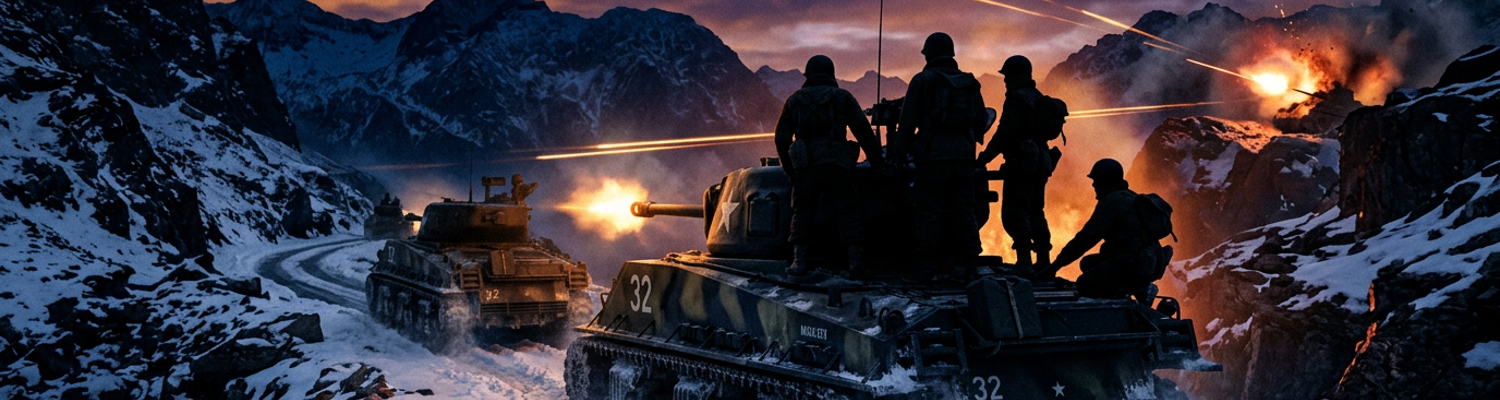
Riflemen from L Company of the 5th Cavalry Regiment climbed directly onto the bare steel hulls of the idling Shermans, taking exposed positions on the open engine decks without protective sandbags or armored shielding. Soldiers gripped turret handles, spare track links, and wire tie-downs with thick wool mittens, knowing any foot soldier knocked from the bare armor on the narrow road to Chipyong-ni would be left behind in the snow. Tankers clamped exterior field telephone boxes onto the rear hulls so the exposed infantry could talk directly to crews buttoned up inside the steel turrets. Crombez ordered the tank column forward out of the Koksu-ri staging area, cutting through logistical paralysis and committing his bare armor directly into the roadcut toward the surrounded regiment.
Organization of the Task Force Crombez Armored Spearhead
Sherman tanks shuddered into column formation along the icy shoulders of the road as Colonel Marcel Crombez assembled his twenty-three M4A3E8 medium tanks into a compact armored spearhead. Crombez formed the relief force by combining Company D of the 6th Tank Battalion with Company A of the 70th Tank Battalion, pooling 90mm-gun M46 Pattons and 76mm-gun M4A3 Shermans that could be pulled from the rear lines. Mechanics verified each vehicle had its wider track shoes and horizontal volute spring suspension intact to maintain grip over packed ice and frozen ruts. Tank commanders loaded their ready racks with high-explosive and white phosphorus rounds, leaving their main gun tubes locked forward over the glacis plates for direct fire along the narrow corridor. Crombez knew his tanks required accompanying infantry to prevent enemy foot soldiers from disabling the vehicles with magnetic charges or satchel explosives, but the operational timetable left no room to march riflemen on foot.
Division headquarters refused to provide motorized transport for the infantry, ruling wheeled trucks and canvas-sided utility vehicles would create an immediate traffic jam if disabled by enemy mortar fire along the single-lane pass. Staff planners insisted soft-skinned vehicles would be destroyed within minutes, effectively leaving the soldiers of Company L, 5th Cavalry Regiment without armored personnel carriers or trucks. Crombez rejected orders to leave the foot soldiers behind and decided to turn the tanks themselves into troop carriers for the rescue attempt. Exactly 160 soldiers from Company L assembled beside the idling vehicles, dividing their squads so roughly seven riflemen climbed onto each tank hull. Four combat engineers joined the riflemen, bringing demolition kits, wire cutters, and grappling hooks to clear barricades that might stall the armored advance.
Riflemen climbed onto the cold metal armor and lashed their web gear, ammunition bandoliers, and personal weapons directly to turret handholds, pioneer tool racks, and spare track brackets. Soldiers sat with their boots dangling over hot engine exhaust louvers, shivering as freezing mountain wind swept across the uncovered steel decks. Four combat engineers positioned themselves on the two lead tanks, securing bags of composition C explosives and friction igniters to the glacis plates where they could reach the gear instantly if trees or boulders blocked the trail. Tankers passed coiled tow cables through the track guides and tied tow hooks to front bumpers, giving the lead vehicles a fast way to drag damaged armor without making crews leave the fighting compartment. Company L soldiers tested the field telephone boxes wired to the back corners of the tanks, shouting through the heavy handsets to make sure the loaders and commanders buttoned up inside could hear their target warnings over the roar of the V8 engines.
Colonel Marcel Crombez climbed into the turret of his command tank, closed his hatch, and signaled the column forward onto the frozen dirt surface of the Chipyong-ni road. Drivers shifted into gear and pushed twenty-three tanks into a single file line with ten yards of spacing between hulls, churning up snow and grit as the column gathered speed. Riflemen leaned flat against the turret steel and gripped whatever metal bracket or wire tie-down they could find, bracing themselves for enemy rifle fire from the overlooking ridges. The lead Sherman accelerated into the shadow of the steep rock cut, guiding the overloaded force directly toward the first reported roadblocks of the Chinese encircling line.
Field Modifications and Mechanized Combat Preparations
Machine-gun tracers ricocheted off the rock walls ahead of the lead Sherman, illuminating the felled timber and boulders that choked the narrow mountain passage. Tank crews inside the column checked their ready racks under fire, having received only diminished basic loads of 76mm high-explosive rounds and linked coaxial ammunition from the exhausted Koksu-ri depots. Loaders carefully redistributed these scarce shells between adjacent vehicles during brief halts, passing heavy brass casings through open hatches so no single crew ran out of high explosive while battering through the barricades. Gunners cranked elevation handwheels to confirm each cannon could depress low enough to sweep enemy fighters out of the roadside ditches. Machine gun belts loaded with .30-caliber ball ammunition were stripped and reassembled to ensure every coaxial weapon had unbroken feeds in its steel trays. Loaders stacked the final steel cans of ammunition on the turret floorboards, locking the retaining bars shut as rifle bullets struck the cast armor.
Bullet impacts rang against the turret sides, forcing tank commanders to rely completely on the exposed cavalrymen riding on the engine decks to spot enemy ambush teams. Tank crews leaned out of their hatches into drifting illumination flares and a bitter propellant haze to finish jury-rigging exterior telephone boxes directly onto the rear hulls. Mechanics and loaders spliced heavy communications wire into the internal intercom circuits, wrapping friction tape around bare terminals to keep freezing slush from shorting the connection. Riflemen from Company L crouched low over the hot engine louvers, gripping the heavy Bakelite handsets to test their voice links against the roar of the V8 engines. Shouted messages over these wired headsets allowed the exposed infantry to guide main-gun fire and warn buttoned-up drivers about concealed satchel-charge teams. Tank commanders confirmed their headsets picked up every report from the rear deck before dogging their steel hatch covers shut against falling shrapnel.
Shrapnel from mortar bursts peppered the forward glacis plates as drivers and bow gunners jury-rigged heavy steel tow cables across the front bumpers under the glare of descending illumination flares and choking propellant haze. Tank crews recognized if the lead Sherman struck a buried mine or took an antitank rocket through its suspension, the entire column would be trapped on the single-lane road unless vehicles could drag each other clear without delay. Tankers threaded stiff steel cables through the front towing shackles, looping the thick wire lines over track horns and pioneer tool brackets so a trailing tank could hook up in seconds without sending men into the snow. Drivers tested the tension on these emergency cables by throwing their steering levers into reverse, confirming the heavy loops would not foul the sprockets during violent turns. Combat engineers lashed the excess cable length with soft copper wire that would snap cleanly away under heavy tension rather than bind around the hull. Mechanized recovery gear secured across every bow turned each vehicle in the spearhead into an emergency tow tractor capable of hauling disabled armor out of the killing zone.
Drivers stomped their foot throttles and pushed the column straight into the roadblock, relying on their rigged cables and redistributed ammunition to keep the advance moving through the ambush. Colonel Marcel Crombez tracked the assault through his periscope as the lead Sherman engaged the log barricade with point-blank coaxial machine-gun fire. High-explosive 76mm rounds slammed into the stacked timber, blasting frozen logs and enemy grenadiers into the rocky ravine below. Riflemen on the rear engine decks shouted target directions through their jury-rigged telephone boxes, guiding the tank gunners toward Chinese mortar crews hidden in the bluffs. Steel tracks crushed the remaining logs into splinters, opening a narrow gap along the icy roadbed and allowing the trailing Shermans to surge into the gap. The lead Sherman accelerated through the shattered barricade, keeping its cannon locked on the next bend as Chinese defensive lines broke open along the cut.
Chinese Ambush along the Koksu-ri Roadcut
Steel tracks churned through pulverized shale as the lead tank rounded the blind curve directly beneath Hill 397, where entrenched Chinese People's Volunteer Army forces triggered a massive ambush along the narrow secondary roadcut. Chinese riflemen and machine gunners concealed in ridgeline log bunkers opened fire from the crest, sweeping the bare armored hulls with concentrated bursts of small-arms fire. Plunging mortar salvos immediately bracketed the single-lane corridor, blasting frozen dirt and rock across the column while white smoke billowed between the sheer cliff walls. Exposed soldiers of Company L scrambled to press themselves flat against the bare engine decks behind the turrets, but the steep elevation of the hill gave the defenders clear firing lanes directly down into the uncovered decks. Shrapnel from the opening mortar barrage struck several cavalrymen before the tanks could bring their coaxial machine guns to bear against the rocky heights. Tank drivers kept their foot pedals down and held a steady speed, maintaining the column formation through the narrow defile where no vehicle could turn around without rolling off the road.
Chinese infantry charged down the steep slopes of the roadcut to exploit the restricted movement of the column, subjecting the mounted troops to concentrated barrages of satchel charges, pole mines, and mortar salvos. Attackers sprinted from concealed revetments to thrust long wooden pole mines beneath the tank road wheels and slap heavy canvas satchel charges against the lower hull sponsons. Heavy explosions tore through the exterior gear, obliterating the jury-rigged telephone boxes and blowing mounted cavalrymen directly off the vibrating steel plates. Riflemen from Company L fired their rifles at point-blank range into the rushing assault teams, killing enemy grenadiers within arm reach of the bogie assemblies. Pole mines detonated with concussive force against the track guides, but the horizontal volute spring suspensions absorbed the blasts and kept the twenty-three tanks rolling forward over the frozen ruts. Wounded soldiers lost their handholds on the icy steel and tumbled into the snow along the roadbed, unable to climb back aboard the roaring vehicles as secondary explosions rocked the hulls.
Gunners inside the buttoned-up turrets responded to the violent blasts by traversing their 76-millimeter main guns upward into the bluffs of Hill 397. High-explosive shells slammed into the forward Chinese mortar pits along the upper rim, collapsing timber revetments and scattering the enemy gun crews into the draws. Coaxial machine-gun fire raked the upper lip of the cut, cutting down additional Chinese assault teams attempting to descend the frozen embankments with magnetic charges. Continuous mortar rounds still exploded across the rear decks of the trailing tanks, igniting spare fuel cans and shredding the field packs lashed to the equipment racks. Tank commanders monitored the devastation through their periscopes but kept their steel hatches dogged shut, recognizing opening the hatches to pull wounded riders inside would expose the interior fighting compartments to incoming grenades.
Crombez enforced this ruthless operational discipline over the radio net, ordering every tank commander to maintain maximum cruising speed and disregard all casualties on the engine decks. Drivers shoved their steering levers forward to plow the medium tanks straight through burning debris and abandoned enemy mortar carts blocking the frozen tracks. Surviving riflemen pressed flat against the scorching exhaust grates, gripping the remaining hull brackets with frostbitten fingers as rifle rounds chipped the turret armor above their heads. Lead tanks pushed past the western shoulder of Hill 397, breaking out from the deadly crossfire of the roadcut into the broader agricultural approach road leading toward the 23rd Regimental Combat Team perimeter. Company L riflemen still clinging to the bare armor reloaded their weapons and scanned the opening fields, leaving fifty dead and wounded comrades scattered behind in the contested defile.
Point-Blank Defile Combat and Mounted Casualties
Riflemen from Company L barely raised their carbines before the road contracted again into a narrow sunken defile blocked by felled pine trunks and defensive earthworks. Sherman crews responded by firing point-blank 76mm high-explosive and coaxial rounds into the barricades to blast a passage while traversing the defile under non-stop rifle and machine-gun fire. High-explosive shells exploded against the logs only yards from the front hulls, throwing wood splinters and burning dirt into the air while clearing defensive obstructions that threatened to stop the column. Coaxial machine guns raked the earthen banks at point-blank range, destroying enemy firing pits and detonating Chinese grenade caches before foot soldiers could throw them down onto the tanks. Concussion waves from the 76-millimeter muzzle blasts ripped backward across the open decks, rupturing the eardrums of the riders and knocking dazed infantrymen off the vibrating armor into the path of trailing steel tracks.
Company L soldiers lashed to the bare armor decks sustained catastrophic casualties as Chinese machine gunners concentrated their plunging fire on the exposed men. Enemy snipers picked off riflemen who were tied by their web gear or wire cords to cargo racks, leaving dead men slumping against the engine grates while the tanks continued forward at top speed. Wounded soldiers screamed over the engine noise and tried to cut themselves free from their lashings, but heavy small-arms fire and mortar shrapnel struck down anyone who attempted to stand or jump clear into the frozen roadside ditches. Severely wounded infantrymen lost their grip on the icy hull brackets and slipped down the slick sponsons, leaving smears of blood across the olive-drab paint before falling beneath the twenty-three advancing vehicles. Exposed cavalrymen absorbed direct impacts from bullets and grenade fragments that ricocheted off the rounded cast-steel turrets, suffering mounting dead and wounded across every square foot of exterior deck.
Turret periscopes showed the tank commanders whole squads of mounted infantrymen had been killed, with lifeless bodies remaining tied to the exterior brackets. Sherman crews kept their coaxial machine guns firing steadily along both sides of the defile, clearing out trenches and defensive obstructions to protect the few cavalrymen who were still clinging alive to the rear engine decks. Gunners lowered their main gun barrels to the lowest depression limits and fired point-blank 76mm high-explosive rounds directly at enemy soldiers attempting to toss satchel charges between the tank tracks. Blasts from the cannon shells ripped apart Chinese defensive positions along the defile cut, throwing dirt, weapons, and enemy troops across the roadway. Shrapnel and burning debris fell heavily upon the surviving riflemen, who curled their bodies tightly around the exhaust boxes to protect their heads from the falling metal.
Drivers ignored the falling metal and mashed their accelerator pedals to push through the final cluster of defensive obstacles, crushing tree branches and pulverized stones beneath the wide tracks. Lead tanks broke through the northern exit of the defile as point-blank 76mm high-explosive fire eliminated the last fortified machine-gun bunker guarding the opening into Chipyong-ni. Company L was almost completely destroyed by the run through the defile, having sustained severe casualties that left fewer than thirty men able to fire their weapons when the tanks emerged from the mountain pass. Uninjured riflemen pulled their surviving comrades loose from the blood-stained lashings on the rear decks, dragging wounded men onto the snow as the relief column linked up with the outpost line of the 23rd Regimental Combat Team. Crombez halted his command tank beside the perimeter bunkers, opened his turret hatch into the sub-zero air, and directed his remaining Shermans to establish defensive firing positions facing the hills.
Breakthrough at the Twenty-Third Infantry Perimeter
Tank crews swung their 76-millimeter gun barrels toward the ridgelines as Lieutenant Lawrence DeSchweinitz steered the point tank through the last barricade of earth and concertina wire into the southern perimeter between 1655 and 1700 hours on February 15, 1951. Steel tracks on the lead M46 Patton crushed frozen timbers and sandbag revetments, flattening the barricade and cutting a broad gap through the defensive berm. Exhaust fumes from the heavy tank engines billowed over the frontline foxholes where exhausted riflemen of the 23rd Regimental Combat Team stood up from the frozen mud to wave the tanks inside. DeSchweinitz opened his top hatch into the bitter wind, identifying the camouflaged gun positions of Battery A, 503rd Field Artillery Battalion arranged across the southern edge of the village. Artillery crews from Battery A waved from their parapets as the armored spearhead rolled past their 155-millimeter howitzer emplacements.
Artillerymen hurried toward the idling Shermans with stretchers to assist the surviving riflemen of Company L who remained lashed to the engine decks. Medics from the 23rd Regimental Combat Team worked alongside the artillery crews, cutting bloodied canvas straps and carrying wounded cavalrymen into heated cellar aid stations. Tank loaders handed down metal boxes of .30-caliber linked machine-gun rounds and crates of rifle ammunition to frontline infantrymen who had been down to their final clips. Field telephone lines buzzed into life across the defensive sector as forward posts informed the regimental command bunker the southern gap was firmly closed. Mechanics tightened track pins and checked suspension bogies for blast damage, keeping the tank engines running to prevent fuel lines from freezing in the zero-degree cold.
Chinese forward observers on the slopes of Hill 397 tracked the exhaust plumes as the medium tanks integrated into the defensive lines beside Battery A, 503rd Field Artillery Battalion and rifle companies of the 23rd Regimental Combat Team. Chinese infantry regiments had spent forty-eight continuous hours battering the southern perimeter, but the presence of fresh armored cannons made further mass assaults over open snow impossible. Gunners in Battery A rapidly calibrated their 155-millimeter weapons to support the tanks, firing heavy high-explosive salvos into enemy staging draws south of the roadcut. Shrill whistle calls and bugle signals sounded across the surrounding ridges as Chinese regimental headquarters realized their window to destroy the isolated garrison had closed. This linkup with the 23rd Regimental Combat Team and Battery A, 503rd Field Artillery Battalion precipitated the withdrawal of five encircling Chinese divisions from the heights around Chipyong-ni. Chinese rear-guard squads began abandoning their forward entrenchments, carrying their wounded comrades northward through the frozen draws.
Patrols from the 23rd Regimental Combat Team pushed into the vacated draws to sweep remaining snipers from the southern approaches while the tanks maintained interlocking arcs of fire. Crombez met with regimental commanders near the artillery pits to organize fuel distribution and secure the newly opened corridor back through the roadcut. Tank crews refueled their Shermans from the artillery battalion's remaining fuel drums, keeping their main cannons loaded to repel any sudden night counterattacks. Riflemen cleared shattered logs and pole-mine fragments from the roadbed to ensure ambulances could evacuate wounded soldiers toward Koksu-ri. Cavalry soldiers stacked fresh ammunition crates alongside the forward revetments, training their machine guns on the northern draws where the last enemy rear guards retreated into the timber.