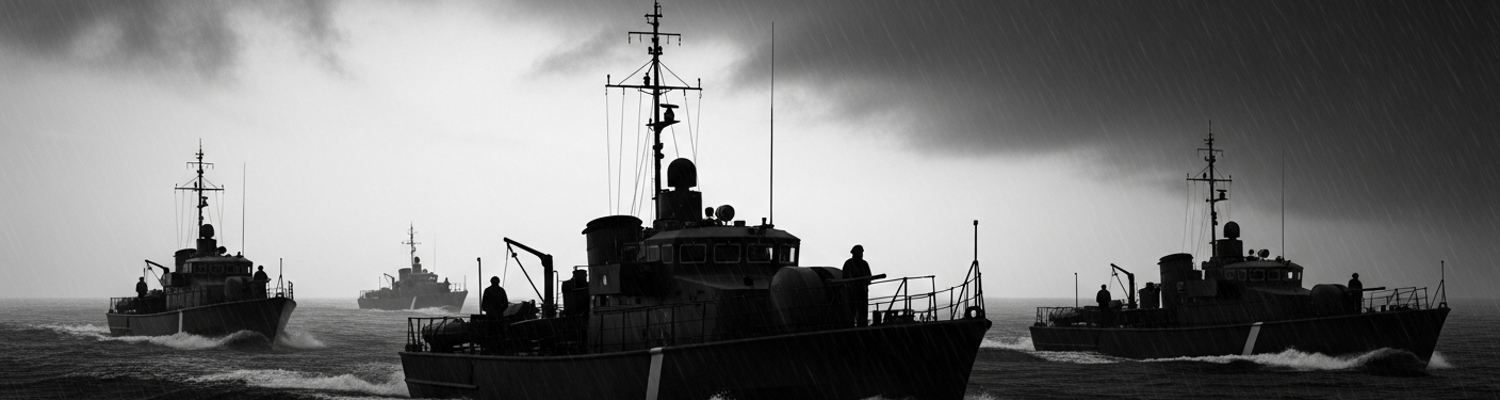

The night air over the Bismarck Sea was a mixture of high-octane gasoline and salt. A sudden jolt, a high-pitched mechanical scream, and the starboard Packard V-12 marine engine of a patrol torpedo boat died. The two remaining engines strained against the sea, their exhaust note becoming ragged. The primitive Raytheon SO radar, which had promised a contact, now showed only phantom echoes dancing in the squall-line static. Miles from their base at Dreger Harbor, the three officers and ten enlisted men were alone. A single plank of plywood and mahogany separated them from the deep water. Their primary task, to intercept a Japanese supply convoy, had disintegrated into a desperate struggle for mechanical survival. This was the minute-by-minute existence for the PT boat crews of 1944.
Their war was not one of fleet engagements.
It was a nocturnal campaign of interdiction. The main purpose of the PT boat in the Southwest Pacific had evolved into barge busting. Allied air power had systematically destroyed Japan’s ability to resupply its island garrisons with large transport ships. In response, the Japanese organized what they called ant runs. These were nightly treks of small, shallow-draft Daihatsu-class landing craft hugging the coastlines. The barges, often armored and armed with machine guns or 20mm cannons, carried the ammunition, food, and replacements that kept the Imperial Japanese Army in the fight on New Guinea and New Britain. A review of after-action reports indicates the PT boat was the designated counter. Its shallow draft allowed it to penetrate reef-strewn waters where destroyers could not go. Patrols were a nightly event, with boats operating in pairs or threes, using surface-search radar to locate convoys in the dark. Engagements were brutally intimate, often inside 100 yards. A chaotic exchange of tracer fire where the PTs’ numerous .50-caliber machine guns and 40mm cannons would shred the thin-skinned barges. The boats’ original weapon, the torpedo, proved largely ineffective against the shallow-draft targets, making the added-on guns the true workhorses of the fleet.
The epicenter of this shadow war was the Bismarck Archipelago. This complex network of volcanic islands, deep channels, and narrow straits formed a natural fortress and logistical chokepoint. The islands of New Guinea and New Britain were the scenes of protracted fighting. For the Japanese forces dug in there, the coastal sea lanes of the Bismarck Sea, particularly the Vitiaz and Dampier Straits, were their only lifeline. Motor Torpedo Boat Squadrons, such as Squadron 12 and 21, were tasked with severing that artery. Operating from advance bases that crept forward with the Allied advance, from Tufi to Morobe, and then to Dreger Harbor, the PT boats extended their reach deep into enemy territory. Some patrols were exceptionally long, covering over 350 miles from forward fueling barges to designated patrol zones. The environment itself was an adversary. Unpredictable weather, uncharted coral reefs, and dense mangrove swamps could conceal a Japanese ambush or trap a damaged boat.
A typical patrol objective in April 1944 was a lethal routine. A crew would be briefed to patrol a specific numbered sector off the coast of New Guinea, an area perhaps ten miles by ten miles, for eight hours. Their orders were simple: intercept and destroy all enemy watercraft. Secondary tasks often included rescuing downed airmen or providing harassing fire on shore installations. The boats would leave base in the late afternoon, idling their three supercharged Packard 1,500-horsepower engines to conserve fuel. Once in position, the engines would be muffled, running just above idle speed for hours, the crew listening to the hum of the generator and the crackle of the radio. The tension was palpable. The sudden appearance of a contact on the radar screen would turn the night into a flurry of shouted commands and frantic action. A full-throttle race toward the target, the roar of the engines, the blinding flash of cannon fire, and the violent, close-quarters battle was often over in minutes. Then, the long journey back to base, often with wounded men and a boat riddled with bullet holes, hoping to cross the reef into the safety of the harbor before the sun rose and the threat of enemy aircraft appeared. The boats were heavily armed for their size but possessed no armor, with a combat loss rate approaching 20 percent for all boats that served.
Operational logs from MTBRon 21 reveal the central threat dictating PT boat tactics was not the Imperial Japanese Navy’s remaining capital ships, but its ad-hoc logistical network of armed barges. With Allied airpower having swept the seas of conventional transports, the Japanese resorted to nocturnal supply missions executed by flotillas of shallow-draft landing craft. The workhorse of this effort was the Daihatsu-class landing craft, a 14-meter, steel-hulled vessel with a distinctive bow ramp. These were not simple transports. A typical Daihatsu could be armed with several light machine guns or up to three 25mm anti-aircraft cannons. Crews often bolted on improvised steel armor plating up to 40mm thick to protect personnel and mechanical components. Powered by diesel or kerosene engines, they were slow, making only about 8 knots, but exceptionally seaworthy and capable of carrying up to 70 men or ten tons of cargo. This capacity meant a single barge could deliver rations for over 6,000 man-days. A convoy of several dozen could move an entire infantry regiment. Variants, like the larger Toku Daihatsu, could even transport a medium tank. This fleet, estimated at 6,000 strong, was the lifeline for isolated Japanese garrisons, making its destruction the PT squadrons' primary objective.
The barges did not operate alone.
The coastlines they hugged were studded with defensive emplacements and concealed artillery. Japanese coastal defense doctrine relied on a mix of dedicated naval guns and repurposed heavy field artillery. Archival evidence shows these positions were expertly camouflaged, dug into the dense jungle overlooking key channels. Batteries could range from heavy machine guns to 75mm and 105mm field pieces. In critical areas like Rabaul, they included hundreds of dedicated anti-aircraft guns and large-caliber coastal defense cannon. The tactical problem for PT boat commanders was acute. Japanese gunners would often hold their fire, allowing the noisy American boats to close on a barge convoy before opening up from multiple, pre-sighted positions. A patrol boat committed to a high-speed attack run would suddenly find itself bracketed by shellfire from unseen shore positions. These guns, firing from stable land platforms, were far more accurate than any weapon a bucking PT boat could bring to bear. The operational records are filled with boats lost not to enemy naval action, but to shore batteries. PT-133 was destroyed by Japanese guns off New Guinea on July 15, 1944. A boat disabled by this fire was left helpless, a stationary target for the shore guns or a drifting wreck for the very barges it was sent to destroy.
This combination of armed barges and shore defenses was overlaid by a numerical imbalance. PT boats operated in small sections of two or three. They did so in waters controlled by an enemy who was superior in every category. The major Japanese base at Rabaul, though increasingly isolated, still garrisoned over 90,000 Imperial Japanese Army and Navy personnel by early 1944. The bypassed Japanese Eighteenth Army in New Guinea suffered immense casualties from starvation and disease but still represented tens of thousands of soldiers. For a PT crew whose boat was sunk or disabled, making it to shore meant being stranded behind enemy lines with virtually no hope of evasion among a hostile force. Even at sea, the threat of encountering superior Japanese naval units was a constant factor. While heavy cruisers had been driven from Rabaul by late 1943, the harbor still served as a mooring for smaller craft, and Japanese destroyers could still appear. A single Japanese destroyer would hopelessly outgun an entire squadron of PT boats, a reality that forced patrol commanders into a constant calculus of risk versus reward.
Analysis of Seventh Fleet documents reveals the severe mismatch when a PT boat section was pitted against a true naval warship. The Elco and Higgins boats, constructed of plywood and mahogany, possessed no armor. A single well-placed shell from a Japanese destroyer could obliterate one. The standard Japanese Fubuki-class destroyers, a common threat, brought multiple 5-inch gun turrets to a fight, weapons with effective ranges measured in miles. Against this, a PT boat crew could reply with .50-caliber machine guns, a 40mm Bofors cannon, and torpedoes that were notoriously unreliable. The Mark 8 torpedoes carried by the PTs were slow and often failed to detonate. Japanese destroyers carried the formidable Type 93 Long Lance torpedo, which was faster, longer-ranged, and devastatingly effective. This disparity forced PTs into a doctrine of ambush and high-speed night attacks. Even here they were at a disadvantage. A Japanese destroyer, with its superior speed and disciplined night-fighting training, could often detect the boats by the phosphorescent wakes thrown by their propellers, illuminate them with powerful searchlights, and destroy them with gunfire before they could get within effective torpedo range.
Daylight exposed the boats to their most feared adversary: aircraft. With unarmored wooden hulls and decks packed with fuel and munitions, PTs were exceptionally vulnerable to strafing. A passing Japanese Mitsubishi A6M Zero fighter or a G4M Betty bomber on patrol could turn a PT boat into an inferno with a single pass of its cannons. This forced all major patrol activity into the hours of darkness, creating a rigid operational clock where boats had to be back within the relative safety of their advance base before sunrise. Failure to do so was often fatal. Shore-based threats were a constant menace. Japanese forces on islands like New Guinea had become masters of concealing 75mm and 105mm artillery pieces that overlooked the very channels the PT boats had to use. These shore batteries, firing from stable, camouflaged positions, were far more accurate than any weapon on a speeding boat and could lay down a barrage of fire without warning.
Compounding these material vulnerabilities was the profound isolation of each patrol. A section of two or three boats would depart Dreger Harbor and proceed for hours into patrol sectors deep within enemy-controlled waters. Radio communication was primitive and unreliable, often limited to line-of-sight, leaving boats that suffered mechanical failure or combat damage completely on their own. The three Packard 4M-2500 V-12 marine engines were marvels of power, but they were highly complex and demanded constant maintenance. A fuel line could rupture, a cooling system could fail, or an engine could throw a rod miles from any support. A disabled boat drifting in the Bismarck Sea was a death sentence. The crew faced the choice of waiting for Japanese patrols to find them or attempting to make for a nearby shore, which meant landing on an island garrisoned by tens of thousands of enemy soldiers. The loss of PT-323 on December 10, 1944, cut in half by a kamikaze aircraft off Leyte, demonstrated that even if the boat's construction kept it afloat, its crew was left helpless in hostile waters.
The mechanical heart of every PT boat was its trio of Packard 4M-2500 engines. That heart was perpetually thirsty. Each of these supercharged V-12 power plants could consume 100-octane aviation gasoline at a rate approaching 165 gallons per hour when running at full throttle. A typical patrol boat carried 3,000 gallons of fuel. A high-speed chase could burn through fuel reserves at a shocking pace, leaving crews to calculate their chances of making it back to base. The supply of this high-grade fuel to forward bases like Dreger Harbor was a constant source of anxiety. Squadron records indicate that 100-octane gasoline was a scarce commodity throughout the Southwest Pacific. It arrived sporadically, first by tanker to a major port like Milne Bay, then trans-shipped by smaller vessels or barges up the coast. It often arrived in individual 55-gallon drums that had to be manhandled onto PT boat tenders and then hand-pumped into the boats’ tanks. This fragile chain meant that patrol schedules were dictated not by tactical necessity, but by the fuel gauge. It was not uncommon for entire squadrons to be stood down because there was simply no fuel.
This was a war against scarcity.
The Packard engines were also exceptionally delicate. Saltwater spray ingested by the superchargers would corrode internal components. Exhaust manifolds would crack under the intense heat cycles. The reverse gears were notoriously weak points. A major overhaul was recommended every 750 hours of operation, a lifetime consumed in just a few months of nightly patrols. The supply of spare parts to the forward bases was a logistical nightmare. A squadron commander might request a dozen new superchargers or a crate of specific gaskets, only to wait months for them to navigate the thousands of miles from the United States. When a shipment did arrive, it was often incomplete or contained the wrong components. The result was a culture of cannibalization. A boat damaged by a reef grounding was immediately descended upon by mechanics, who would strip it of every usable part, magnetos, fuel pumps, even sections of wiring, to keep its sister boats operational. Archival evidence (NARA Record Group 38, Action Reports) shows that at bases like Kana Kopa, it was common for a squadron of twelve boats to have only four or five truly seaworthy vessels available on any given night. The rest were either awaiting parts or had already been picked clean.
The supply chain's deficiencies extended far beyond engines and fuel. Ammunition for the .50-caliber machine guns and 40mm cannons was often in short supply. Torpedoes, already mechanically suspect, required expert maintenance that was difficult to perform in the primitive conditions of a forward tender. This constant shortage of material had a direct and debilitating impact on operational readiness. A squadron commander's decision-making was perpetually constrained by a grim arithmetic of what he had on hand versus what he had on hand. Orders for a multi-squadron sweep might be tactically sound but were impossible to execute when half the boats were mechanically unsound and there was not enough fuel for the other half. The operational logs of squadrons like MTBRon 12 are filled with entries detailing patrols cut short or aborted entirely due to mechanical failure. A severed fuel line, a failed clutch, an overheating engine that could not be repaired with the parts available. More PT boats were ultimately lost to accidents, groundings, and friendly fire than to direct enemy naval action, a direct consequence of boats being pushed to their limits with inadequate support.
Medical logs from the Southwest Pacific in 1944 reveal an adversary far more pervasive than Japanese naval power. For every two sailors lost to combat, five were lost to disease. The operating environment of the Bismarck Archipelago was a perfect incubator for pathogens. The hot, humid climate and stagnant waters of the mangrove swamps were ideal breeding grounds for the Anopheles mosquito, the primary carrier of malaria. Crews at forward bases like Dreger Harbor lived in primitive conditions, constantly assailed by insects. Beyond malaria, which up to 65% of American troops in the Pacific contracted, PT boat crews were plagued by dengue fever, dysentery from contaminated water, and persistent fungal infections known as jungle rot. A man could survive a close-quarters gunfight one night only to be felled by a 106-degree fever the next, his combat effectiveness erased by an invisible enemy.
The fall of the Dutch East Indies in 1942 cut off the Allied supply of quinine. In its place, the United States provided a synthetic substitute: quinacrine, distributed under the brand name Atabrine. While billions of doses were produced, the logistical chain to the forward PT boat tenders was fragile. The loss of a single transport ship could deprive an entire sector of its supply for weeks. A far greater problem was crew compliance. Atabrine came with a host of debilitating side effects, including severe nausea, headaches, and diarrhea. Most notoriously, it turned a man’s skin a ghastly shade of yellow. Compounding this was a highly effective Japanese propaganda campaign that spread rumors, widely believed by young sailors, that prolonged use of Atabrine caused impotence and sterility. Faced with turning yellow, feeling sick, and the fear of being unable to start a family after the war, many crewmen simply refused to take the medication, a failure of discipline that commanders were often powerless to enforce in the chaos of combat operations.
This biological breakdown had direct tactical consequences. The incapacitating fevers of malaria and dengue fever meant that a sick crewman was removed from the line for weeks. While an infantry company could absorb such losses, a PT boat’s crew of 12 to 17 men could not. The loss of a single indispensable specialist, the chief machinist’s mate responsible for the Packard engines, the radioman, or the executive officer, could render a multi-million-dollar warship non-operational. A squadron commander might have a dozen boats fueled and armed at their moorings, but if a third of his experienced gunners and engineers were shivering with fever in the sick bay, those boats were inert piles of plywood and steel.
Operational stand-downs due to illness became an accepted part of the routine. Archival evidence shows that entire military operations in the region were halted for months due to the catastrophic rates of malaria infection. For PT squadrons, this manifested as canceled patrols and an inability to meet the demands of headquarters. Commanders were caught between orders to interdict barge traffic and the physical impossibility of manning their boats. A squadron’s reported combat readiness, a simple number of mechanically available boats, told a dangerously incomplete story to strategists in Pearl Harbor or Washington. It was a story that failed to account for the debilitating, unseen attrition caused by disease that was crippling the fleet one man at a time.
Operational logs from the Southwest Pacific reveal a dangerous canyon between the war documented by squadron clerks and the one fought by the crews. Every morning, the squadron commander at a forward base like Dreger Harbor was required to submit a standardized status report to the flotilla and, ultimately, the Seventh Fleet Amphibious Forces command. This document was an exercise in quantitative abstraction. It contained neat columns for Boats Mission Ready, Fuel (Gallons), Ammunition on Hand, and Personnel Fit for Duty. A boat that had limped back to base with two of its three Packard engines barely functioning and a hull patched with scavenged planking would be marked Operational if its engines could still turn over. A crew that had been awake for 30 straight hours, running on coffee and adrenaline, was listed as Fit for Duty so long as no one had a fever high enough to be sent to the sickbay tent. These reports, often compiled on a typewriter in a sweltering tent, were the foundational data points for strategic planners in Brisbane or Pearl Harbor. They created a clean, statistical picture of combat power that was, in practice, a complete fiction.
The true condition of the fleet existed in a different medium. The private diaries and letters of the crewmen. Where the official report listed PT-150: Operational, a torpedoman's diary from the same day might describe the reality. It would speak of the constant vibration from a bent propeller shaft, the starboard engine that backfired every twenty minutes, and a Raytheon radar that only functioned if the operator braced his foot against the console at a specific angle. These anecdotal records, filled with exhaustion and black humor, documented the jury-rigged repairs and cannibalized parts that held the boats together. They told of patching bullet holes with wooden plugs and stopping fuel leaks with soap bars. This was the unquantifiable data of wear, stress, and imminent failure that never found its way into a morning report. The squadron commander knew the real story, but he was under pressure to report maximum readiness. To admit that only three of his twelve boats were truly combat-worthy was to invite censure from a distant headquarters that saw only numbers on a page.
This chasm between reported strength and actual capability was widened by a near-total breakdown in timely communication. A patrol returning at 0400 hours would be debriefed, but the after-action report might not be fully encoded and transmitted for another day. The standard radio aboard the boats was the Navy Model TCS, a rugged but low-power AM set with an effective voice range that was often less than 25 miles at night. Atmospheric interference, mountainous terrain, and enemy jamming could reduce that to nothing. A boat section ambushed by a shore battery or suffering a catastrophic engine failure was effectively on its own, a silent casualty. For headquarters, the picture of the battlespace was always hours, if not days, old. Orders for a coordinated sweep of a particular strait were issued based on intelligence that was stale on arrival, directing boats to patrol areas the enemy had already vacated, or worse, areas where the enemy had since concentrated its defenses. The commanders were fighting a ghost war, their decisions based on a distorted echo of events that had already transpired.
The relentless operational tempo of nightly patrols ground the men down with a unique form of exhaustion. It was a deep, systemic wear born from the unending vibration of the plywood hull, the deafening roar of the Packard engines, and the chronic lack of uninterrupted sleep. A man’s breaking point, the U.S. Army determined, could be reached in 60 to 240 days of sustained combat. For PT crews, there was no frontline to rotate away from. Their forward base was the front. The constant state of alertness required for hours spent idling in pitch-black, enemy-controlled waters induced a severe mental strain. This was followed by the violent, adrenaline-fueled chaos of a close-quarters gun battle, and then the tense journey back to base. This cycle, repeated night after night, eroded a man’s psychological resilience, leading to what was then termed combat fatigue. Symptoms documented in medical records included uncontrollable tremors, sensitivity to loud noises, and periods of amnesia. The condition was not cowardice but a physiological response to prolonged exposure to life-or-death situations.
This physical and psychological exhaustion led to a decline in morale. The mission itself, barge busting, while strategically necessary, felt like a thankless, attritional grind. Crews were acutely aware of their vulnerability. Their unarmored wooden boats were hopelessly outgunned by Japanese destroyers and susceptible to destruction from a single shell from a hidden shore battery. The loss of a sister boat on patrol was an intimate, frequent event that reinforced a pervasive sense of being expendable. When a boat was lost, the survivors, if any, were absorbed into other crews, concentrating men suffering from acute anxiety into single vessels and embedding a culture of fatalism. This was compounded by the isolation of the forward bases themselves, miserable collections of tents and huts on malarial shores, subject to enemy air attack. Japanese propaganda, disseminated via air-dropped leaflets, preyed on the insecurities of these isolated men, often depicting scenes of marital infidelity back home to degrade their motivation. The combination of fighting a nightly war of survival and living in squalid, dangerous conditions created a deep sense of hopelessness that permeated the squadrons. Layered on top of the psychological stress of combat was the debilitating war against tropical disease. A squadron commander might report ten boats as mission-ready, but if a third of his experienced radiomen, gunners, and engineers were physically weakened by dysentery or mentally broken by anxiety and night terrors, those boats were operationally useless. This biological attrition was a quiet crisis, officially undercounted but tactically devastating.