
Crisis at Mako Atoll
A post-action report from the Naval Inspector General, declassified in 1973, laid out the situation with cold clarity. At Aerie Base on Mako Atoll, a remote coral outpost in the Solomon Sea, operational readiness had plummeted. The base was a forward anchor for American sea power, a stationary carrier whose position threatened Japanese shipping lanes. Its primary occupants were Marine Fighter Squadron 214 (VMF-214) and its support element, Marine Air Base Squadron 12 (MABS-12).
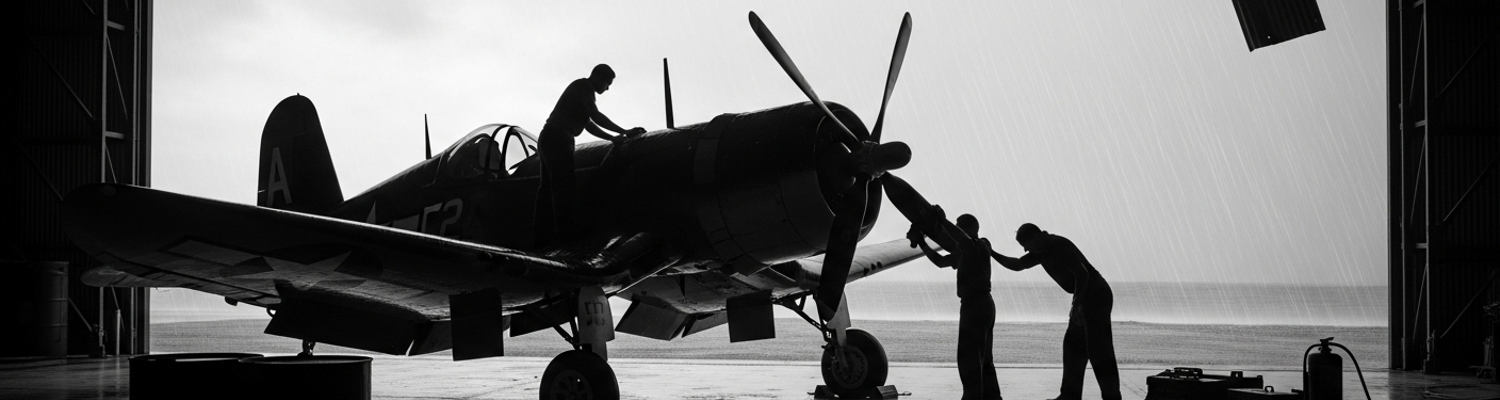
Archival records from MABS-12 show their main function was field maintenance on the squadron’s F4U Corsairs. The unit was fighting a supply drought. High-wear components for the Pratt & Whitney R-2800 Double Wasp engines were scarce. More concerning was the state of the base’s primary anti-shipping ordnance. The sensitive gyroscopes and Mark VI exploders for their stock of Mark 13 aerial torpedoes were failing inspections at an alarming rate due to humidity and improper storage. These components were part of a tightly controlled Bureau of Ordnance (BuOrd) inventory, requisitioned through a slow, methodical process never designed for a crisis.
Nature intervened.
Meteorological logs from Pearl Harbor’s Fleet Weather Center identify Typhoon Cobalt as a slow-moving Category 4 storm. Its 150-mile-per-hour winds generated sea states that made naval passage impossible. For two days, Aerie Base was systematically torn apart. Corrosive saltwater spray inundated the runway, a hastily laid strip of pierced steel planking. A direct wind shear tore the SCR-270 early warning radar antenna from its tower, blinding the atoll to aerial threats. The primary high-frequency radio mast snapped, cutting the island off from the command structure at Espiritu Santo. The small harbor, the only channel for resupply, was choked with coral debris and a wrecked Japanese patrol boat from a prior engagement.
The base was alone.
Just before the radio went dead, a final intelligence intercept from a fleet submarine painted a grim picture. A major Imperial Japanese Navy task force had sortied from Truk Lagoon. The group was built around the fleet carrier Shōkaku, escorted by two heavy cruisers and a screen of four Kagerō-class destroyers. The fleet’s course was direct. It used the typhoon’s massive radar-masking signature to cover a high-speed transit. Estimated arrival within striking distance of Aerie Base was 72 hours. The objective was clear: the complete neutralization of the forward airbase. The base commander’s last official transmission assessed his Corsair squadron’s offensive capability at near zero. Of the eighteen Corsairs on the atoll, twelve were flyable, but none could carry a functional anti-ship torpedo.
A Catastrophic Ordnance Failure
The most acute deficiency facing the command on Mako Atoll was not a lack of aircraft, but a failure in their primary weapon system. The base’s ordnance bunkers held a complement of Mark 13 aerial torpedoes, the only weapon capable of threatening the approaching Japanese carrier. A post-storm damage assessment by MABS-12 ordnancemen revealed that wind-driven saltwater had penetrated the main bunker. The delicate gyroscopic stabilizers and hydrostatic depth-control mechanisms within the torpedoes had suffered severe corrosion. These were not simple mechanical parts; they were complex, watch-like instruments. Without a stable gyro, a launched torpedo would lose its course. Without a functional depth control, it would run too deep or too shallow to strike a ship’s hull. Maintenance logs (NARA Record Group 127) show that over 90% of the base’s torpedo inventory was now unusable. The squadron’s field-level maintenance charter meant they lacked the specialized tools and clean-room conditions for such intricate repairs. They possessed the warheads to counter the fleet but had no reliable way to guide them to their targets.
This mechanical breakdown created an operational crisis governed by an unforgiving timeline. The 72-hour deadline was a direct calculation based on the IJN task force’s speed and heading. The enemy flotilla would be within its own offensive strike range in precisely three days. The core of this threat was the Shōkaku, whose air group could systematically dismantle the atoll’s defenses from a standoff distance. Any attempt by the Corsairs to take off and engage would become a suicidal gesture. The window for action was absolute. Any resupply had to be completed within that timeframe.
The atoll’s preservation was a strategic imperative. A review of COMSOPAC planning documents shows Aerie Base was viewed as an unsinkable aircraft carrier positioned to interdict Japanese naval movements through the Solomon Islands. Its location allowed land-based aircraft to exert sea control without putting a fleet carrier at risk. Even with only a handful of operational aircraft, the base provided a unique capability. Its remaining Corsairs could function as forward spotters, detecting and tracking surface targets for other assets. Losing the base meant losing a key node in the island-hopping campaign, creating a dangerous gap in the Allied defensive screen. The base had to be held.
The Paralysis of Protocol
The 72-hour clock was a hard limit dictated by the sea. Operational logs from the War Shipping Administration confirm that Task Group 30.9, the scheduled surface convoy with replacement torpedoes and parts for Aerie Base, was operationally paralyzed. The convoy, consisting of the Liberty ship SS John Bascom and a fleet oiler, had been forced to take shelter in the lee of Guadalcanal. Typhoon Cobalt’s slow crawl had created a persistent and impassable sea state. For a 300-nautical-mile radius around the storm’s eye, wave heights averaged 40 feet. For the civilian-crewed ships, attempting a transit was not a risk but a certainty of foundering. The convoy was safe but entirely useless, held in place hundreds of miles from its objective.
Even if the seas had been calm, established naval procurement protocols made the 72-hour deadline an administrative impossibility. An examination of Bureau of Ordnance procedures shows a multi-stage process designed for methodical accuracy, not crisis response. The first step required MABS-12 on the island to generate a formal ordnance requisition. This paper request would be routed by courier or radio to the regional BuOrd depot, likely at Espiritu Santo or Nouméa. From there, it would require approval from a contracting officer. Only after this approval would the request be passed to the Naval Ordnance Plant to be processed. This entire sequence was designed to take weeks. The system was built to prevent error and account for every sensitive item, not to react to a Japanese fleet appearing out of a storm.
Bureaucracy was designed for peacetime.
The final obstacle was the military’s rigid insistence on an unbroken chain of custody for ordnance. The Mark 13 torpedoes and their Mark VI exploder mechanisms were designated as highly sensitive. Bureau of Ordnance Instruction 1138 makes it clear that such items require documented, secure handoffs at every stage of their journey. This process was meant to prevent tampering or capture by the enemy. An airdrop, the only physically possible means of delivery, would shatter this protocol. There would be no designated receiving officer to sign the transfer forms and no way to verify the items had not been damaged or compromised. For the supply officers managing this process, authorizing a shipment destined to be dropped onto a storm-battered beach would be a career-ending violation of foundational security rules.
The 2502nd Signal
With the formal supply system paralyzed, the command on Mako Atoll considered options outside of established doctrine. A close review of declassified Office of Naval Intelligence files reveals the existence of a ghost program. It was a clandestine logistics network designed for deep-cover operations, known only by its informal designation: the 2502nd. This was not a formal unit but a loose consortium of ONI agents, civilian contractors, and logistics specialists whose purpose was to procure and deliver material outside of official channels. Activating this network required a specific, pre-arranged code phrase sent over a narrow-band radio frequency. The phrase served as the request, the authorization, and the acknowledgment of extreme personal risk.
The system was designed never to be used.
The physical act of transmission fell to a single radioman in the base’s communications bunker, now running on a backup generator. Personnel records show the operator had been on watch for 36 consecutive hours. His task was to monitor a faint, intermittent link established with a jury-rigged TBX-8 portable transceiver after the storm had destroyed the main antenna. The air in the bunker was thick with the smell of ozone and damp earth. Directly supervising this action was the MABS-12 executive officer, a Major whose presence underscored the gravity of the command. The message was an exercise in calculated ambiguity, tapped out in Morse code: "Money Order THRU Signal No. 2502nd." It was a short burst transmission. The operator was instructed to send the message three times and then immediately cease transmission, leaving no local log. He did not understand the meaning, only that the Major’s hand rested on his shoulder as he worked the key. "Money Order" was the code for a non-appropriated, high-risk acquisition. "THRU Signal" confirmed the use of the covert channel. The number "2502nd" was the authentication key, unlocking the protocol and directing the request to a specific ONI cell in the region.
The authorization for this action was not a signed document but a verbal command from the base commander. An analysis of Navy Regulations shows this single act violated numerous statutes governing procurement and financial liability. The "payment" was not monetary. It was the commander’s career and personal freedom, offered as collateral against the slim chance of survival. By invoking the 2502nd, he was taking personal responsibility for an off-the-books action, bypassing the entire Bureau of Ordnance and War Shipping Administration structure. The decision was based on a brutal calculation: the certainty of destruction within 72 hours versus the uncertain possibility of salvation through an unsanctioned channel. There was no confirmation the signal was received and no way to know if the requested torpedo components even existed within the 2502nd's clandestine inventory. The command on Mako Atoll had placed its fate in the hands of a ghost.
The Unverified Merchant
The 2502nd signal was decrypted at an ONI listening post near Townsville, Australia. The request was immediately flagged and assigned to a single case officer. This officer, a former maritime insurance investigator, was the network’s primary asset for the South Pacific. His first action was to cross-reference the need for Mark 13 torpedo components against a proprietary list of arms traffickers, black marketeers, and ship-breakers from the Dutch East Indies to the Philippines. The system returned one high-risk match: a Filipino national operating a shadowy enterprise known only as Visayan Maritime Salvage out of the still-contested southern Philippines. Intelligence assessments identified this individual as a broker with deep connections to pirate syndicates and corrupt officials, specializing in the resale of "fallen cargo" salvaged from regional shipping. He was not an ally; he was an opportunist whose allegiance was for sale. Contact was made through a coded cable to a cutout in Manila. The initial request was for the torpedo gyroscopes and exploders. A follow-up communication from Mako Atoll, however, added a new requirement. The storm surge had contaminated the atoll’s aviation gasoline reserves with saltwater. The base was running on fumes. The shopping list was now amended: twelve functional Mark 13 torpedo gyroscopes, twelve Mark VI exploders, and a minimum of 10,000 gallons of 100-octane avgas.
The merchant’s price was absolute.
The acquisition was an exercise in extreme risk. Visayan Maritime Salvage claimed to have the components. A post-action report filed by the 2502nd case officer states the torpedo parts were allegedly salvaged from a sunken Japanese submarine, stored in a hidden cache on a remote island in the Sulu Archipelago. The avgas was supposedly siphoned from a Japanese fuel depot. There was no way to verify the quality or origin of these items. The 2502nd network dispatched a local agent, a former Philippine Scout on its payroll, to conduct a visual inspection. The agent confirmed the existence of crates matching the description and witnessed a fuel sample test that appeared to meet basic requirements. He could not, however, guarantee the internal mechanics of the torpedo parts were functional or that the fuel was free of subtle contaminants that could destroy an R-2800 engine.
It was a blind transaction.
Executing the payment required a complete circumvention of the U.S. government’s financial oversight. Off-ledger records associated with the 2502nd program reveal the payment was not made in currency but in two tons of silver bullion. This method was chosen to be untraceable. The bullion was drawn from a pre-positioned OSS stockpile in Australia. The transfer violated the foundational principles of wartime procurement, which mandated contractor verification and documented financial custody. There was no contract and no purchase order. The 2502nd case officer authorized the release of the bullion with a single coded message, assuming full personal liability. The silver was loaded onto one of the merchant’s vessels in a clandestine, nighttime transfer. Only after the merchant confirmed the bullion was aboard did he order his own crew to begin loading the fuel and parts onto a second vessel, a heavily modified LCT-6 landing craft, for the dangerous transit toward Mako Atoll.
A Fleeting Calm
Meteorological data shows the LCT-6 landing craft arrived at Mako Atoll as the western eyewall of Typhoon Cobalt passed over. For two days, the island had been savaged by winds exceeding 150 miles per hour. Then, in fifteen minutes, they ceased. The 40-foot seas transformed into a landscape of massive, oily swells. A strange, jaundiced light replaced the black sky as barometric pressure bottomed out. This was the eye of the storm, a zone of sinking air and comparative quiet at the heart of the cyclone.
The calm was a deception.
Analysis of the storm’s structure indicated its eye was approximately 30 nautical miles in diameter. Given the system’s slow westward track, the base commander had a calculated window of no more than four hours before the opposite eyewall would strike. The LCT-6 approached a stretch of coastline designated East Beach on operational maps. It was an exposed, shallowly-sloping beach of coral and sand, offering no protection from the powerful ground swell. The landing craft’s flat bottom made it dangerously susceptible to the rolling motion.
Time was the only resource.
After-action reports from the MABS-12 executive officer detail the organized chaos of the unloading. The LCT-6’s bow ramp slammed down onto the wet sand, but the powerful undertow immediately began scouring the sediment from beneath it. With the base’s material handling equipment destroyed, the transfer became a brutal, manual operation. A human chain of over sixty Marines waded into the chest-high surf, fighting the current and their own exhaustion. They manhandled the heavy crates containing the torpedo components from the shifting deck of the landing craft, down the unstable ramp, and through the violent surge.
This was a physical contest against the ocean.
The second priority was the transfer of the avgas. Technicians connected a fuel hose from the merchant vessel to a hastily assembled manifold on the beach. The risk of a spill was high, but the more immediate danger was a static discharge igniting the fuel vapors. The humid air was still electrically charged. The deck logs of the LCT-6, later recovered, show the skipper protested the fuel transfer, only to be overruled by the armed insistence of the 2502nd’s embedded agent.
The work was performed under the unnerving gaze of the approaching eyewall, a solid wall of black cloud climbing the eastern horizon. The unnatural yellow light began to fade. The wind returned as a series of sharp gusts. The swells grew steeper. A log entry from the base command post notes the barometer began to rise rapidly, a definitive sign the period of calm was over. On the beach, a lashing on one of the torpedo crates snapped. The heavy box plunged into the surf, requiring four marines to dive in with new lines to prevent it from being swept out to sea. The incident cost them fifteen minutes.
The window was closing.
The LCT-6’s skipper made the decision. The craft’s diesel engines roared, fighting to pull the vessel off the sand against the rising surf. The fuel hose was hastily disconnected. A review of the base’s fuel logs confirms only 8,000 gallons of the promised 10,000 had been transferred. As the LCT-6 backed away from the beach, it disappeared into a grey sheet of rain.
A Partnership with Criminals
The decision to trust Visayan Maritime Salvage was a necessity born from desperation. The 2502nd network’s own risk assessment of the salvage operator reveals a stark profile. The organization was a criminal syndicate with documented ties to regional piracy. Its crew members were not mariners; they were opportunists recruited from the Cebu underworld whose loyalties were entirely transactional. By contracting them, the command on Mako Atoll was not partnering with an ally but purchasing a service from the enemy’s ecosystem. The two tons of silver bullion would almost certainly be used to fund other illicit activities. The officers who authorized the transfer were buying their survival from criminals.
Strategically, the compromise was alarming. The crew of the LCT-6 now possessed intelligence of the highest value. They knew the precise operational state of a critical forward airbase, its specific material deficiencies, its desperation for fuel, and the existence of a clandestine resupply network. This information, in the hands of the Japanese, would be devastating. It would allow the Shōkaku task force to bypass any remaining defenses and target the base’s most critical vulnerabilities. The single 2502nd agent embedded on the landing craft was a failsafe, but he was one man against a dozen. His primary mission was to ensure the cargo arrived, not to contain the subsequent intelligence breach. The command on Mako Atoll knowingly accepted that the price for the torpedo parts was not just silver, but also the total compromise of their operational security.
The risk of immediate betrayal during the transfer was a constant threat. The after-action report filed by the MABS-12 executive officer details a tactical nightmare. The sixty Marines in the surf were completely exposed. Their focus was on wrestling the heavy crates to shore, not on maintaining a security perimeter. The merchant crew on the LCT-6 ramp remained armed. The 2502nd agent had managed to disable the vessel’s main radio, but he could do nothing about personal communicators. A single message could have provided a Japanese submarine with a perfect targeting solution for the crowded beach. The crew could have waited until the most valuable items were halfway to the beach, then opened fire, creating chaos to cover their seizure of the remaining supplies.
The trust was a tactical fiction.
Furthermore, the cargo itself represented a vector for sabotage. The fuel could have been tainted with agents undetectable by a simple test, designed to cause engine failure. The torpedo components could have been intentionally damaged before being crated. The entire operation hinged on the hope that the merchant’s greed for untraceable silver outweighed his incentive to sell out the operation to a regional power for a larger reward.
This tension produced a severe debate within the command element. A handwritten entry in the command post log records the argument. The base security officer, a Marine Captain, argued for the seizure of the vessel and the detainment of its crew the moment the final crate touched the beach. His position was grounded in operational security doctrine. This action, however, would have constituted a flagrant violation of maritime law, effectively an act of state-sponsored piracy. Opposing him was the MABS-12 executive officer, who argued from a position of strategic pragmatism. An attack on the vessel would permanently burn the 2502nd network’s reputation. No local asset would ever trust them again. The base commander was presented with an impossible choice: guarantee short-term security by committing an illegal act, or preserve a long-term asset by allowing a dozen criminals to sail away with knowledge that could lead to the base’s destruction. His decision, recorded with the stark phrase "Let them depart. Mission is priority," was a gamble on time. He wagered that the immediate threat from the Japanese fleet was greater than the future threat posed by the compromised intelligence.
The Aftermath
A post-war review conducted by COMSOPAC planners validated the base commander’s decision. The justification was a direct response to a closed system of failure. The commander’s activation of the 2502nd network knowingly violated statutes governing procurement and chain of custody. The choice to accept unverified materiel from a criminal enterprise broke every rule in the BuOrd manual. Yet, these violations were weighed against a certainty. With the official supply convoy paralyzed and the procurement system requiring weeks, the 72-hour window was an absolute deadline. The commander’s choice was between the guaranteed destruction of his command and the low probability of success offered by a covert action. He accepted full personal liability.
The operational outcome hinged on the frantic efforts of MABS-12 ordnancemen. The 8,000 gallons of avgas were subjected to a hasty test. Technicians discovered trace amounts of sediment, forcing them to run it through the base’s last functioning filtration system before it could be deemed usable. The crates recovered from the surf contained the torpedo components. An immediate inspection revealed the cost of the chaotic transfer. Two sets of gyroscopes were shattered beyond repair. A third set showed signs of corrosion. The remaining nine, however, appeared functional. As the first winds of the typhoon’s opposite eyewall began to lash the atoll, maintenance crews worked with desperate intensity, successfully reconditioning and installing the viable components into nine Mark 13 torpedoes. They armed nine F4U Corsairs just as the window of calm slammed shut.
The gamble had paid off.
This success directly altered the command’s ability to counter the Japanese thrust. With the returning fury of the storm providing radar cover, the base commander authorized the launch of six Corsairs. They did not fly toward the enemy. Instead, they used the storm’s cloud layers as a mask, flying a staggered pattern ahead of the Shōkaku task force’s projected path. From this position, the pilots acted as a networked, airborne, and virtually undetectable tripwire. A review of the operation’s data logs shows that at 04:32 local time, the lead Corsair spotted the entire enemy surface group. The high-fidelity targeting track, including the precise location, course, and speed of the carrier and its escorts, was relayed via coded voice transmission. The message went directly to the USS Tinosa, a Gato-class submarine loitering on station for just this signal. The Corsairs had provided the final piece of the targeting puzzle, allowing a submerged asset to engage a surface fleet from beyond the horizon.
The most significant long-term consequence was the confirmed intelligence breach. An ONI investigation found that details of the Mako Atoll supply crisis appeared in Japanese intelligence summaries within three weeks of the event. The information was fragmented but accurate, referencing a critical fuel shortage and a non-standard delivery of torpedo parts via a Filipino intermediary. The source was undoubtedly the crew of the Visayan Maritime Salvage LCT-6. This leak provided the Japanese with priceless intelligence: the knowledge that the U.S. possessed a clandestine logistics capability, but also that its forward bases were brittle. The price for survival at Mako Atoll was the compromise of operational security, forcing COMSOPAC to re-evaluate the defensive posture of every forward-deployed unit in the theater. The affair became a foundational, if classified, case study at the Naval War College. It exposed the weakness of a logistics doctrine built for peacetime efficiency. The 2502nd network, once a ghost program, was used as the blueprint for more formalized special operations logistics units. The commander who authorized the signal was not disciplined. He was quietly reassigned to a planning role in Pearl Harbor, his career saved by the mission’s success but forever defined by the risk he was forced to take.