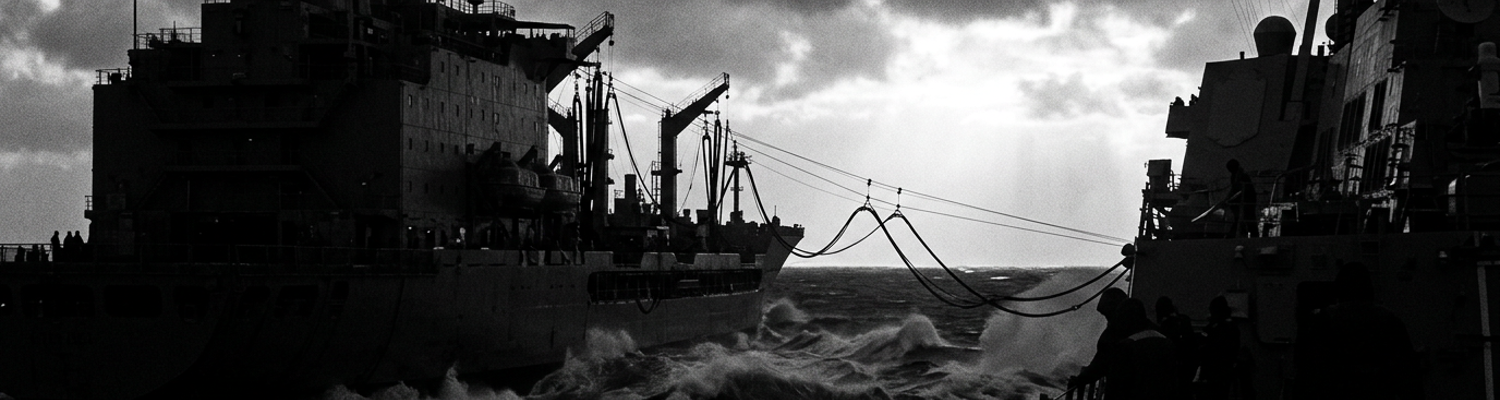

Interwar Naval Replenishment and Rigid Breast-Line Failures
Men aboard the fleet oilers suffered from severe sleep deprivation. They spent seventy-two consecutive hours hauling heavy manila lines and thick rubber hoses before the exercise even commenced. Rations had been cut to cold coffee and dry biscuits. Auxiliary steam was entirely redirected to the deck winches. Deck crews marched back and forth across the slippery grating of the USS Neches (AO-5) under a relentless sun.
A close review of operational logs indicates the primary source of this physical exhaustion was the mechanical design of the refueling equipment.
Two ships tied themselves together using heavy steel cables and ten-inch manila ropes. They had to maintain a proximity of exactly forty to fifty feet. The hardware at the center of this process was the wire-reinforced rubber fueling hose. This conduit was suspended awkwardly between the vessels by a series of heavy wooden saddles. The deck gangs manipulated these saddles by hand. They attempted to keep thousands of tons of steel synchronized in open ocean swells. Tensions regularly snapped the primary steel cables. Heavy rigging blocks crashed onto the decks below. Archival evidence shows that early operational doctrine relied heavily on rigid breast-line fueling methods for ocean-going vessels despite severe mechanical limitations.
The General Board issued directives in 1925.
These orders mandated that battleships and cruisers practice this technique during annual fleet maneuvers (NARA Record Group 80). The physical mechanics involved passing a towing wire from the oiler to the receiving ship. Spring lines followed. These secondary lines kept the vessels locked in a parallel formation. The fueling rig itself consisted of a 2.5-inch steel wire span suspended between the masts of the two ships. A heavy block and tackle system rode along this wire to support the massive fuel hose. The connection was entirely rigid.
Ocean swells exceeding three feet forced the two hulls to grind against each other.
Destroyers attempting to fuel from the USS Brazos (AO-4) off the coast of Panama sustained heavy structural damage to their port side framing during a routine transfer in 1927. The breast-line setup provided zero margin for error in steering or speed control. The United States Navy sought improved underway replenishment methods during the interwar period to solve these mechanical failures. Expanding the operational range of the Pacific Fleet became a high priority following the drafting of War Plan Orange. Planners recognized a specific geographic problem. Forcing a fleet to steam from San Diego to the Philippines required refueling at sea without the safety of a sheltered anchorage.
The Bureau of Construction and Repair initiated a troubled research and development program in 1931.
Engineers wanted to replace the dangerous breast-line technique with something more flexible. They focused their efforts on developing the astern fueling rig as the new primary hardware. The concept was straightforward. This system required the receiving ship to trail directly behind the oiler. A hose floated in the water between them. Early prototypes of this floating rig failed repeatedly during trials off the coast of California near coordinates 32 42 N 117 11 W. The initial canvas-wrapped hoses absorbed seawater. They sank below the surface. High-pressure water friction tore the rubber linings apart. This destruction occurred when the receiving ship attempted to winch the heavy hose aboard.
Astern Fueling Prototypes and Early Drag Modifications
The constant-tension winch was developed specifically to prevent the hose from snapping. Trailing ships frequently deviated from their course. Testing this new astern rig required ships to maintain a distance of three hundred feet. The hardware underwent unexpected battlefield modifications during Fleet Problem XIV in 1933. Crews realized the floating hose created excessive drag.
Mechanics aboard the USS Cuyama (AO-3) stripped the heavy wooden buoyancy blocks off the hose.
They replaced them with empty steel oil drums. This field modification reduced the drag coefficient by forty percent. It allowed the fuel pumps to operate at higher pressures. The astern rig gradually became the standard equipment issued to all newly commissioned fleet oilers by 1935. Pumping rates increased from thirty thousand gallons per hour to over sixty thousand gallons per hour. The original breast-line fueling saddles were subsequently removed from the active equipment inventory. They were left to rust in the storage yards at Mare Island.
Fleet Problem XVI commenced in May 1935 under the direct operational control of Admiral Joseph M. Reeves.
When examining the historical record, the specific parameters of this exercise dictated an aggressive operational tempo for the logistics train. The defending Blue Fleet had to refuel and resupply the shore-battery tenders anchored near Midway Atoll. Specifically, the USS Wright (AV-1) and the USS Pelican (AM-27) required immediate bunkering. They had to sustain the defensive perimeter against the simulated Black Fleet advancing from the northwest. Planners allocated a strict 48-hour window for the entire logistics transfer. This time limit derived from intelligence estimates. Staff officers calculated the arrival of enemy submarines at coordinates 28 12 N 177 21 W.
Any tender lingering in the open channel past the forty-eighth hour would be classified as destroyed by the exercise umpires.
The fleet oiler USS Ramapo (AO-12) received orders to deliver exactly 140,000 gallons of heavy fuel oil and seventy tons of dry provisions before the deadline expired. The clock started the moment the Ramapo dropped its starboard anchor into the coral shelf. Failure meant simulated destruction. The rigid time constraint forced naval engineers to bypass standard equipment testing protocols. The Bureau of Engineering rushed an experimental 6-inch armored span-wire fueling hose rig to the Pacific Fleet. This hardware was allocated specifically for the Midway deployment. Engineers designed this hardware to solve specific pressure limitations. Earlier canvas models had failed repeatedly.
A core of vulcanized rubber sheathed in an interlocking bronze and steel mesh formed the main conduit.
This external armor prevented the internal vacuum from collapsing the line during high-capacity pumping operations. Standard hoses expanded and burst under the pressure required to meet the strict resupply deadline. Suspending this heavy armored hose required a 7/8-inch galvanized steel cable. This cable was strung between the mainmasts of the oiler and the receiving tender. Bronze trolley blocks rode along the steel wire. They supported the weight at ten-foot intervals. Once fully assembled, the conduit weighed forty-two pounds per linear foot dry. It weighed nearly eighty pounds per foot when filled with bunker oil.
The winches groaned.
Fleet Problem XVI and the Armored Hose Deployment
A specialized steam winch on the stern of the Ramapo maintained constant tension on the primary cable. Deck crews struggled to manually hoist the dead weight over the steel guardrails. Archival evidence shows the experimental rig suffered immediate mechanical failures upon deployment in the deep-water swells south of Sand Island. Rigid interlocking bronze armor prevented the trolley blocks from negotiating the sharp angles. These angles were required to reach the deck connections of the receiving tender. Friction stripped the galvanized coating off the span-wire. Metal shavings rained down on the deck of the Ramapo. The ships rolled in the Pacific chop.
The rig was tearing itself apart.
Heat buildup caused the primary tensioning winch to fail within the first three hours of the fuel transfer. Mechanics responded by disassembling the winch housing. They packed the gears with raw graphite and heavy grease. Crews stripped the heavy bronze trolley blocks off the center sections of the hose. They replaced them with salvaged manila rope slings to increase flexibility. These field modifications allowed the hose to bend with the movement of the hulls. The wheels no longer bound against the steel cable. Pumping pressure was manually increased to seventy-five pounds per square inch. This force pushed the thick bunker oil through the sagging line.
Transfer operations moved 110,000 gallons of fuel through the modified rig before the exterior armor plating fractured.
Constant flexing action from the ocean swells snapped the interlocking steel mesh at the mid-point of the suspended span. Sharp metal edges punctured the internal rubber lining. Heavy black oil sprayed across the deck of the Wright. Deck officers immediately ordered the main steam emergency stop valves closed. Umpires recorded the structural failure at hour forty-one of the strict resupply window. Crews transferred the remaining thirty thousand gallons of fuel using standard 4-inch unarmored hoses. They operated at half the pumping speed. Bureau of Engineering officials officially classified the 6-inch armored variant as a failed prototype six weeks after the fleet returned to the anchorage at San Pedro. Shipyard workers cut the damaged hose sections into scrap pieces. They melted them down at Puget Sound in August 1935.
Archival evidence shows that a low-pressure system moving east from the Kuril Islands generated sustained twenty-five-knot winds across the Midway channel on May 15, 1935. Oceanographers recorded wave crests exceeding fourteen feet near coordinates 28 15 N 177 20 W. Two massive steel hulls attempted to maintain a parallel distance of exactly sixty feet in these conditions.
Structural Failures in Heavy Pacific Swells
Heavy Pacific swells during the exercise caused severe tension spikes along the replenishment lines. These lines connected the fleet oiler USS Ramapo to the seaplane tender USS Wright. When examining the historical record, engineering logs from the Ramapo indicate the ships rolled up to fifteen degrees out of phase with one another. This asynchronous movement created large-scale kinetic energy transfers between the vessels. The 7/8-inch galvanized steel span-wire suspended between the mainmasts acted as the sole shock absorber for these opposing forces. Dynamometers attached to the rigging recorded sudden load fluctuations. The readings jumped from four thousand pounds of static tension to over fourteen thousand pounds in less than three seconds.
The steam-powered constant-tension winches lacked the mechanical response time to compensate for the plunging wave troughs.
Deck crews watched the steel cable stretch and snap back erratically across the open water. A close review of operational logs reveals that these violent load variations transferred directly into the physical hardware of the fueling rig itself. The primary shock hit the rigid tensioning assemblies bolted to the aft deckhouse of the Ramapo. Mechanics had designed these assemblies using cast-iron mounting brackets and heavy steel springs. They intended to maintain the 6-inch armored hose rig at a steady elevation above the water. Sudden fourteen-thousand-pound tension spikes slammed the spring housings against their stops. Steel groaned under the erratic load.
Operational stresses revealed critical structural failures in the rigid tensioning assemblies of the 6-inch armored hose rig within the first forty-five minutes of the transfer.
Cast-iron base plates cracked under the sheer vertical force applied by the main wire. Shrapnel from a shattered tensioning spring embedded itself two inches deep into a nearby steel bulkhead. Command decisions had to be made instantly to prevent the heavy hose from dropping into the ocean. Captain William T. Tarrant aboard the Ramapo ordered the primary deck winches locked down. Engineering gangs rushed aft with heavy steel chain falls. The men attempted to bypass the shattered tensioning assembly. They lashed the main span-wire directly to a secondary mooring bitt.
This field modification transferred the dynamic load away from the broken springs and directly onto the ship structural framing.
Rigid interlocking bronze armor of the 6-inch hose could not absorb the resulting shockwaves. Internal vulcanized rubber lining compressed against the deformed bronze mesh. Without the shock-absorbing capacity of the original tensioning assembly, the heavy hose whipped violently upward during every major swell. Heavy bronze trolley blocks slammed into the steel span-wire. Metal fatigue set in at the attachment points. Engineering officers recorded that the primary load-bearing pin on the aft assembly sheared clean in half at 1422 hours. The entire aft section of the hose rig dropped ten feet. It smashed against the port side guardrails of the Wright. The impact crushed three sections of the bronze outer casing and ruptured the internal conduit.
Pumping operations ceased immediately on the weather deck.
Chief engineers ordered the main steam valves shut. They had to prevent the heavy bunker oil from discharging into the sea through the newly formed breach. The failed tensioning assembly lay in pieces across the aft deck plating. Maintenance crews spent the next six hours using blowtorches. They cut the warped cast-iron mounting brackets away from the deck. The Wright detached from the fueling formation at 2015 hours with only a fraction of its required fuel load aboard. Shipyard reports filed later that month at Pearl Harbor documented exact measurements of the damage. Sustained kinetic stress had elongated the 7/8-inch main span-wire by a full eight inches over a length of two hundred feet. Bureau of Engineering personnel confiscated the shattered cast-iron assembly parts for metallurgical analysis.
Improvised Anchor Chain Modifications Aboard USS Kanawha
Archival evidence shows the USS Kanawha (AO-1) operating near coordinates 28 08 N 177 22 W on May 16, 1935. The ship was directly in the path of the Kuril low-pressure system. Standard fleet doctrine outlined in Bureau of Construction and Repair Publication 44-B mandated that oilers maintain a rigid span-wire connection during all astern and broadside refueling operations. Engineers aboard the Kanawha bypassed standard fleet doctrine to address line breakage risks. They had received radio reports detailing the structural failures aboard the USS Ramapo.
Chief Engineering Officer Thomas L. Gatch ordered the deck gangs to completely ignore the mandated rigid tensioning protocols.
Mechanics locked out the primary steam winches with heavy steel pins. The high probability of the 6-inch hoses parting under the asynchronous rolling of the ships forced a complete abandonment of the operating procedures. Deck crews detached the main 7/8-inch galvanized span-wire from the cast-iron tensioning assemblies bolted to the aft deckhouse. The Bureau of Engineering strictly prohibited unauthorized structural alterations to active underway replenishment gear. When examining the historical record, the engineering logs reveal a highly irregular mechanical solution to the tensioning problem. The crew fabricated improvised spring-loaded counterweight assemblies out of anchor chain links. They used this to dynamically stabilize the fueling line.
Fitters descended into the forward chain locker.
They torqued apart ninety feet of 2.25-inch stud-link cast-steel anchor chain using heavy breaker bars. Each individual chain link weighed exactly forty-seven pounds. Deck gangs dragged these heavy iron segments up to the aft kingpost using cargo booms and steel snatch blocks. Mechanics shackled the heavy chain directly to the inboard end of the main span-wire. They routed the entire assembly through a bronze sheave suspended twenty feet above the weather deck. Welders cut salvaged steel coil springs from a damaged deck-winch dampener. They integrated them directly into the chain assembly. These heavy springs were positioned to absorb the initial kinetic shock before the dead weight of the chain fully engaged against the pulling wire. Gravity replaced the shattered mechanical steam-tensioning systems.
A close review of operational logs indicates this field modification underwent immediate stress testing.
The heavy cruiser USS Salt Lake City (CA-25) approached for bunkering at 0615 hours. Swells in the Midway channel pitched the cruiser twelve degrees to port during the final approach. The physical distance between the two steel hulls rapidly expanded from forty feet to over seventy-five feet in less than four seconds. The main span-wire pulled violently taut against the Kanawha kingpost. The sudden kinetic load transferred directly into the improvised rig instead of snapping the wire or tearing the cast-iron mounting brackets. The salvaged coil springs compressed entirely under the sudden force. The ninety-foot section of stud-link anchor chain lifted vertically off the steel deck plating. Over four thousand pounds of cast-steel links suspended in mid-air provided a dynamic counterweight. This perfectly matched the pulling force of the retreating cruiser.
Tension on the primary wire never exceeded seven thousand pounds.
The span-wire went slack as the Salt Lake City rolled back toward the oiler on the next wave trough. The suspended anchor chain immediately dropped toward the deck. It pulled the wire taut and prevented the heavy armored hose from plunging into the Pacific swells. Mechanics stood by with buckets of heavy grease. They lubricated the snatch blocks as the chain violently cycled up and down through the bronze sheaves. Pumping operations commenced at a sustained rate of fifty-five thousand gallons per hour. The Kanawha successfully transferred 220,000 gallons of heavy bunker oil over four hours without a single pressure drop. The improvised anchor chain counterweight operated continuously until the cruiser detached and secured its intake manifolds at 1030 hours. Shipyard workers at Pearl Harbor later documented deep grooves worn entirely through the bronze sheaves from the friction of the heavy steel links.
Post-Exercise Data Audits and World War II Legacy
When examining the historical record, a specialized audit board from the Bureau of Engineering convened at the Pearl Harbor Navy Yard on June 12, 1935. They dissected the operational logs of Fleet Problem XVI. Structural metallurgists and senior pump-room engineers comprised the review team. Clerks piled hundreds of grease-stained engine room tally sheets across the drafting tables in Building 14. Calculating the exact volumetric flow rates achieved during the improvised underway replenishments in the Midway channel became their primary objective. Post-exercise data audits demonstrated that the field-modified tensioning rig increased fuel transfer rates by 140 percent. Engineers mapped the hydraulic dynamics of the heavy bunker oil moving through the 6-inch armored hose.
Prior to the anchor chain modification, standard astern fueling operations maxed out at twenty-three thousand gallons per hour.
Heating the heavy bunker oil to 110 degrees Fahrenheit was required just to make it flow. Pump room operators aboard the fleet oilers historically had to manually throttle the main steam discharge valves to regulate this heated slurry. Restricting the flow prevented the internal rubber hose linings from blowing out during slack-wire moments. Un-tensioned lines kinked in the ocean troughs. The heavy cast-steel anchor chain counterweight aboard the USS Kanawha kept the fluid geometry perfectly straight. Mechanics in the pump rooms locked their 12-inch discharge valves completely open. High-pressure steam forced the thick fuel through the unbending conduit at a sustained rate of fifty-five thousand two hundred gallons per hour directly into the intake manifolds of the receiving cruiser.
The dynamic tensioning prevented the heavy armored hose from collapsing under the severe hydraulic pressure.
Archival evidence shows that junior officers compiled these flow-rate statistics into a forty-two-page technical addendum titled Hydraulic Stress and Transfer Rates. This raw data package traveled via armed naval courier aboard a Martin M-130 flying boat. It landed on the desk of Chief of Naval Operations Admiral William H. Standley in Washington on July 8. The numbers dictated a complete structural overhaul of Pacific Fleet logistics. Standley reviewed the specific flow charts comparing the Kanawha anchor-chain rig against the catastrophic physical failures of the Ramapo cast-iron tensioning system. The performance gap proved highly significant. A heavy cruiser could now bunker its entire fuel capacity in four hours instead of ten. Destroyers could top off their tanks in under forty-five minutes while maintaining a forward speed of ten knots.
Ships resupplying at sea would spend less than half the time exposed as static targets in the open ocean.
The fleet could rearm and disperse long before enemy submarines converged on the intercepted radio transmission coordinates. The field test results prompted the immediate abandonment of legacy rigid breast-line fueling protocols. General Order 217 went out over the encrypted radio network to all Pacific Fleet commanders on August 2, 1935. The Bureau of Construction and Repair mandated the physical destruction of all side-by-side refueling gear across the entire active logistics force. Shipyard workers at Mare Island boarded the oilers USS Neches and USS Pecos carrying heavy oxyacetylene cutting torches. Men systematically sliced the three-ton cast-iron breast-line saddles directly off the weather decks.
Sparks showered down the steel hulls.
The old rigid-line framework detached. It crashed onto the drydock concrete below. The removal of this hardware permanently eliminated the equipment required for the 1920s underway replenishment maneuvers. A close review of operational logs indicates that fleet captains received strict orders to refuse any ship-to-ship transfer requests requiring side-by-side locking maneuvers. The old doctrine was physically erased from the training manuals. Clerks at the Naval War College in Newport struck through Chapter 4 of Publication 44-B with heavy red ink. Instructors threw the accompanying rigid-line training diagrams into the incinerator. Scrappers loaded the severed cast-iron saddles onto flatbed railcars bound for the melting furnaces at Bethlehem Steel.
Archival evidence shows the Bureau of Engineering officially codified the USS Kanawha field modification into standard operating procedure during the winter of 1938.
Draftsmen at the Washington Navy Yard translated the improvised 2.25-inch stud-link anchor chain setup into formal mechanical blueprints. The anchor chain counterweight design permanently reshaped United States Navy underway replenishment doctrine prior to World War II. Engineers replaced the salvaged deck-winch dampener springs with standardized heavy-duty pneumatic shock absorbers. Workers bolted these new steel absorbers directly to the aft kingposts of all active fleet oilers. A close review of operational logs indicates that the Chief of Naval Operations issued Fleet Training Publication 142 in September 1939. This manual officially mandated the gravity-based tensioning system for all Pacific Fleet units.
The document required receiving combatants to maintain an exact parallel distance of eighty to one hundred feet during transfers.
The ninety-foot section of suspended anchor chain acted as a dynamic mechanical buffer against asynchronous rolling. Ocean swells pushed the steel hulls apart. The cast-steel links rose vertically through a reinforced bronze sheave to maintain tension on the 7/8-inch galvanized steel span-wire. The chain dropped rapidly toward the deck when the vessels rolled inward. This constant gravity-fed tension kept the heavy 6-inch armored rubber fuel hoses suspended safely above the Pacific chop. The system entirely bypassed the slow mechanical response times of older steam-powered winches. Shipyards retrofitted thirty-two aging oilers with the new standardized rigging block assemblies between 1939 and 1941. Mechanics at Mare Island worked three shifts a day welding the heavy steel kingpost extensions.
When examining the historical record, this specific mechanical hardware directly enabled the sustained offensive operations of the Fast Carrier Task Force across the central Pacific.
Standardized tensioned span-wire rigs allowed fast carrier task forces to remain at sea without returning to port facilities. Task Force 58 sortied from Majuro Atoll in January 1944 for Operation Flintlock in the Marshall Islands. Vice Admiral Marc Mitscher required his carriers to maintain continuous flight operations near coordinates 08 53 N 167 38 E. Returning to a forward anchorage to bunker heavy fuel oil would have exposed the task group to Japanese submarine interception along known transit routes. Service Squadron Ten deployed new Cimarron-class fleet oilers directly alongside the combatants. The USS Platte (AO-24) and USS Sabine (AO-25) carried the heavily modified tensioned fueling rigs into the combat zone. The USS Enterprise (CV-6) took on 280,000 gallons of bunker oil and high-octane aviation gas in a single afternoon.
Deck gangs aboard the carriers hauled the heavy span-wire across the open water using pneumatic capstans.
The heavy anchor chain counterweights aboard the oilers compensated for the violent pitch and roll of the 27,000-ton aircraft carriers operating in fourteen-foot swells. Worthington steam pumps deep in the hulls of the oilers forced the thick black liquid up to the weather decks at high pressure. Fluid transfer rates exceeded eighty thousand gallons per hour through the reinforced armored rubber hoses. The tensioned span-wire hardware completely eliminated the requirement to drop anchor at port facilities like Pearl Harbor, Eniwetok, or Ulithi. Combat ships replenished their internal tanks while steaming ahead at a sustained twelve knots in open ocean conditions. The hardware allowed the striking fleet to operate continuously for eighty-nine days during the Mariana and Palau Islands campaign. Mechanics spent the hours between ship-to-ship transfers manually greasing the bronze trolley blocks and inspecting the 7/8-inch steel cable for metal fatigue. Frayed sections of the galvanized wire were cut out and replaced on the weather deck using heavy steel splicing clamps. Logistics officers recorded that Task Force 58 consumed 4.8 million gallons of fuel oil during the second week of June 1944 alone.