
Operational Crisis Across Mutter Ridge
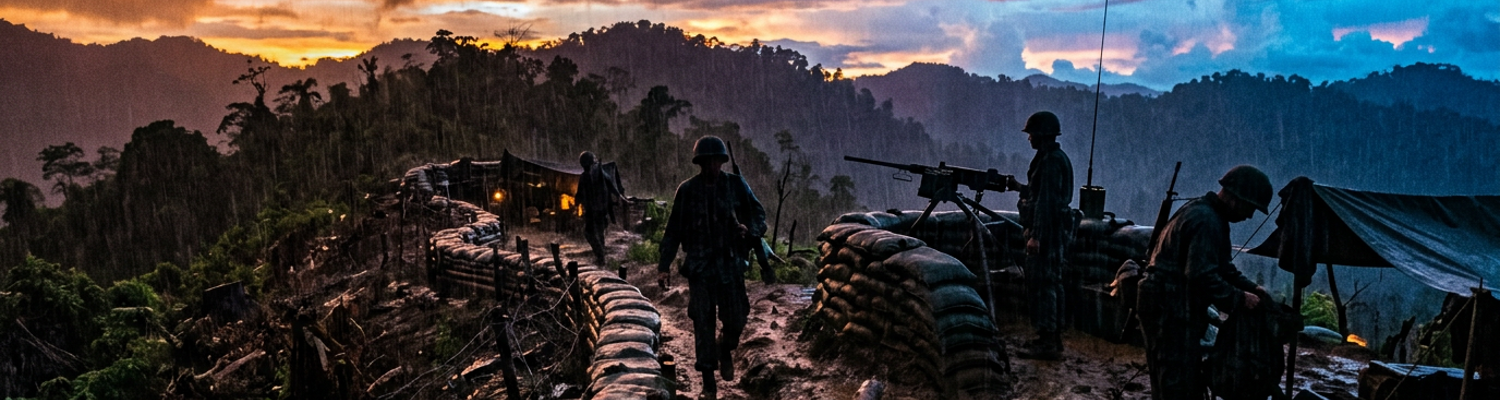
Mortar shells slammed into the saturated clay of Mutter Ridge, blowing apart sandbagged fighting holes and burying communication wire under thick red mud. Forward rifle companies occupied contested ridgelines including Hill 484 and Hill 400 under persistent indirect fire, unable to dig deep bunkers before incoming rounds detonated in the jungle canopy above them. Choking monsoon cloud cover pinned the infantrymen down inside waterlogged trenches while North Vietnamese Army forward observers adjusted heavy artillery salvos from fortified caves north of the Cam Lo River. Major General Raymond G. Davis watched his 3rd Marine Division face severe operational stagnation across Mutter Ridge by late November 1968, as his signature doctrine of rapid helicopter assaults collapsed against zero visibility weather and vertical jungle terrain. Marines scraped freezing rainwater from their rifle actions with broken toothbrushes and packed field dressings into shrapnel wounds without any hope of immediate air evacuation.
Helicopters attempting to reach those wounded riflemen circled blindly above the solid cloud deck, forced to turn back toward Dong Ha when blinding sheets of rain completely masked the jagged peaks below. Rotors threw spray across the treetops whenever a pilot tried to drop below the fog ceiling, drawing intense bursts of heavy machine gun fire from surrounding ridges that punctured fuel lines and cracked cockpit glass. Ground commanders on Hill 484 burned colored smoke grenades and waved signal panels along narrow drop zones, but the dense fog and swirling downdrafts obscured the markers before flight crews could spot them. Rigged cargo nets containing five gallon water cans, dry rations, and mortar ammunition crashed into steep ravines hundreds of yards off target, tumbling down rock faces into areas controlled by enemy patrols. Squad leaders dispatched small recovery teams down the muddy slopes to retrieve scattered supply bundles, only for sniper fire and concealed landmines to drive the men back into their perimeter.
Riflemen inside that battered perimeter conserved their dwindling magazines as the failed supply drops left front line platoons without fresh ammunition to repel nightly probe attacks. M16A1 rifles clogged with gritty silt jammed repeatedly during firefights, forcing gunners to pry stuck cartridge casings out of hot chambers with cleaning rods and bayonet tips. Wet cardboard mortar shell containers dissolved into pulpy mush, exposing delicate proximity fuses to damp air that rendered dozens of rounds defective. Battery officers at nearby fire support bases attempted to register protective artillery rings around Hill 400, but shifting monsoon winds and soaked forward observer maps caused high explosive shell bursts to impact dangerously close to friendly foxholes. Counterbattery radar sets situated on lower hilltops failed under the constant humidity, preventing Marine artillerymen from identifying and suppressing the enemy rocket tubes hidden across the Demilitarized Zone.
Commanders at the Dong Ha combat operations center tracked the unsuppressed rocket strikes across their tactical maps while casualty figures mounted by the hour. Planners drafted emergency overland relief plans to push tracked vehicles and foot columns through the dense elephant grass of the Razorback and Rockpile corridors, but washed out dirt roads halted every armored recovery vehicle within miles of the front. Division leadership ordered forward companies to hold their ridgeline fighting holes with fixed bayonets and strictly ration remaining small arms ammunition to fifty rounds per man. Exhausted company commanders on Hill 484 stacked sandbags over their dead, grouped shivering walking wounded along the inner trench line, and braced for the next salvo of North Vietnamese mortar fire.
Operation Dawson River in the Da Krong
Colonel Robert H. Barrow launched Operation Dawson River on November 28, 1968, to relieve departing United States Army units while front line companies absorbed constant mortar bombardment along the northern perimeter. Soldiers of the 101st Airborne Division handed over their defensive positions around the southern valleys, leaving behind sparse wooden watchtowers and deteriorating landing zones cut into the brush. Barrow directed his fresh battalions of the 9th Marines to push far beyond those static perimeter bases, seeking to draw enemy pressure away from the stalled defenses on Mutter Ridge. Marine infantry units pushed into the rugged western mountainous salient of the Da Krong Valley to disrupt North Vietnamese staging areas before enemy regiments could mass for attacks toward the coastal lowlands. Foot patrols carried heavy seventy pound field packs through steep river canyons, crossing fast moving mountain streams that soaked their extra uniforms, field radios, and paper map sheets. Radio operators wrapped battery casings in plastic bread bags to keep river moisture from shorting out vital tactical circuits during the grueling southward march.
Transmitter batteries struggled to hold a steady electrical charge as relentless drizzle leaked through the makeshift plastic seals and seeped into delicate wiring harnesses. Lead scouts hacked through tangled bamboo and thorny vines with heavy machetes, clearing narrow footpaths along steep cliff edges where a single misstep meant falling hundreds of feet into rocky ravines. Sweating riflemen hauled machine guns and heavy baseplates up slick granite slopes, driving their boot heels into wet loam to keep from sliding backward down the mountain. Thick canopy foliage blocked overhead sunlight and trapped humid air at ground level, rapidly exhausting the marching columns and causing dozens of heat prostration cases despite the steady rainfall. Corpsmen distributed salt tablets and treated severe jungle rot on waterlogged feet, but the men had to keep moving forward without dry socks or shelter halves. Point squads halted abruptly when fresh combat boot prints and telephone wire lines appeared along hidden ridgeline trails, signaling direct entry into active enemy rear areas.
North Vietnamese engineers had carved extensive supply complexes directly into the Da Krong hillsides, concealing log reinforced storage caves beneath thick layers of undisturbed brush and living bamboo roots. Marine search teams uncovered underground weapon caches packed with fresh crates of Soviet assault rifles, mortar rounds, and canvas bags of polished rice. Demolition experts used plastic explosive blocks to shatter the heavy timber bunker roofs and collapse the entrances of natural limestone caves used as field hospitals and weapons workshops. Secondary explosions rocked the narrow ravines as burning propellant stores detonated inside the sealed mountain shafts, throwing scorched dirt and burning wood fragments across the jungle floor. North Vietnamese rear guard security elements quickly responded by opening fire from concealed machine gun spider holes, pinning down the demolition teams along the valley floor.
Marine rifle squads returned fire with M16 rifles and shoulder fired rockets, crawling through thick undergrowth to flank the enemy gun emplacements before North Vietnamese reinforcements could arrive. Forward air controllers marked the hostile tree line with white phosphorus spotting rounds, calling in flight sections of Marine A-4 Skyhawks to deliver heavy ordnance through narrow breaks in the overcast sky. Exploding napalm canisters and five hundred pound general purpose bombs leveled the rocky spur, destroying the machine gun nests and blasting a crude landing clearing out of the splintered jungle. CH-46 Sea Knight helicopters hovered directly over the freshly cleared crater, lowering steel cables through the rotor wash to lift out wounded infantrymen while remaining platoons secured the surrounding ridgeline. Colonel Barrow ordered his companies to establish new blocking positions across the captured trail hub and prepare to push their sweep deeper into the western mountains.
Helicopter Groundings and Paralyzed Aerial Resupply
Riflemen digging those blocking positions into the captured trail hub hammered wooden stakes into the clay just as a thick layer of black storm clouds covered the surrounding mountains. Dense cloud cover and torrential monsoon rains grounded CH-46 Sea Knight resupply and medical evacuation flights across the entire northern tactical zone within hours of the order. Water poured off rotor blades and flooded flight lines at Dong Ha and Quang Tri, where maintenance crews watched rain gauges overflow while aircraft remained lashed to steel tie down rings. Squadron commanders refused to clear pilots for takeoffs into the mountain valleys because zero visibility fog concealed jagged limestone bluffs and trapped helicopters inside narrow canyon walls. Every emergency launch attempt ended with pilots fighting severe downdrafts before returning to coastal airfields with water pouring through their engine intakes and instrument panels. Flight dispatchers finally canceled all scheduled air corridors into the Da Krong, cutting off forward battalions from all logistical aviation.
Pilots stationed at coastal air bases shut down their twin turboshaft engines and listened to frantic radio calls from company commanders whose wounded men lay dying without surgical care. Corpsmen on the forward ridges packed field dressings and clean ponchos over compound fractures and sucking chest wounds, but open bleeding could not be halted without proper field hospital facilities. Infection set in rapidly across the wet clearing, turning minor shrapnel tears into swollen sores as litter patients lay stacked inside flooded artillery craters. Company officers sent patrol parties down the steep canyon walls to search for emergency overland pack trails, only to find mountain torrents tearing away footpaths and washing foot bridges into swollen river beds. Every foot soldier hauling litter patients through the saturated elephant grass slipped down the muddy slopes, forcing the carry teams to drag the stretchers back up into the exposed perimeter. Rifle squads placed their wounded inside wet bunker hollows and gathered what few supplies remained in their field packs.
Ammunition pouches and food tins emptied out within hours as isolated infantry companies experienced severe supply shortages, forcing Marines to ration dry ordnance, rations, and fresh batteries across every perimeter. Squad leaders inspected cartridge belts and ordered riflemen to hold fire until enemy probes approached within twenty yards of the perimeter wire, preventing wasteful shooting into the dense fog. Marines stripped water resistant plastic bags from spare mortar rounds to bundle together their remaining clean magazines, keeping red mud from jamming the delicate feed lips of their aluminum ammunition clips. Cardboard containers of combat rations dissolved into wet paste inside the trenches, leaving individual riflemen to share single cans of cold pork or beans over thirty six hour stretches. Radio operators collected dry BA-386 dry cell batteries from across the platoons, scraping corroded terminal contacts with combat knives to squeeze small electrical currents into their transmitters. Signal officers ordered company radiomen to turn off their AN/PRC-25 sets except for three minute communication windows every four hours, cutting off routine tactical chatter to preserve the final traces of battery power.
Runners moved through knee deep mud to carry handwritten orders between isolated fighting holes because radio silence left company commanders blind to flanking movements. Platoon sergeants counted out five rounds of five point five six millimeter ammunition per rifleman at sunset, locking extra brass casings in rubberized radio bags behind the company command post. Sentry posts along the perimeter wire fixed their M7 bayonets to M16 rifle barrels, preparing to fight off North Vietnamese reconnaissance teams in close contact rather than burning precious gunpowder. Cold rain continued to drum against steel helmets and plastic ponchos as night fell over the mountain, leaving the forward outposts without illumination flares or mortar registration rounds. Colonel Barrow marked the dead battery symbols and grounded flight routes on his tactical map table, ordering the men on the ridge to hold their positions until the monsoon broke.
Monsoon Exposure and Non-Battle Medical Casualties
Rainwater flooded down the red clay walls of those forward fighting holes, submerging boot tops and rotting canvas gear as the tropical deluge showed no signs of stopping. Frontline combat endurance deteriorated sharply as riflemen spent consecutive weeks in waterlogged defensive positions without dry uniforms. Wet utility trousers shredded at the seams, while damp cotton shirts rotted against human shoulders under the constant friction of heavy packs and cartridge belts. Freezing winds sweeping over the mountain crests dropped body temperatures into severe hypothermia, sapping the energy of troops who stood waist deep in red sludge for days at a time. Platoon corpsmen crawled through the muck to inspect forward sentries, finding that rotted socks had fallen apart inside wet combat boots and left bare skin pressed directly against soaked leather.
Leather boots trapped stagnant, muddy water against raw feet for weeks at a time, causing the outer layers of skin to soften, whiten, and peel away in large strips. Continuous rainfall and deep mud generated widespread non battle casualties from severe fungal infections and immersion foot. Hospital corpsmen logged dozens of riflemen who could no longer lace their footwear or stand guard because swelling and exposed nerve endings made every step painful. Thick red mud forced its way through cracked heels and bleeding blisters, introducing soil bacteria that triggered high fevers and severe inflammation across entire platoons. Medical personnel rubbed gentian violet onto open sores and dusted raw feet with talcum powder, but the lack of dry air and clean dressings neutralized basic field remedies. Stretcher bearers carried crippled infantrymen back toward company aid bunkers because these men could no longer walk along the slippery trench lines.
Bunkers overflowed with incapacitated troops as aggressive fungal infections spread from ruined feet up into groins and armpits. Riflemen clawed at raw, bleeding rashes beneath their saturated flak jackets, tearing away damaged skin that never received an opportunity to dry. Unchecked jungle rot stripped away the protective outer skin, allowing secondary bacterial infections to inflame lymph nodes and cause violent chills. Navy corpsmen ran out of antibiotic creams and clean dressings, leaving feverish patients to wrap wet ponchos and dirty rags around ulcerated limbs inside damp holes. Company officers watched their combat readiness decline as non battle medical conditions incapacitated more frontline troops than North Vietnamese artillery bursts.
Surgeons at rear aid stations recommended rotating these debilitated companies out of the trenches, but flooded river valleys and grounded aircraft prevented fresh replacements from reaching the heights. Platoon sergeants consolidated depleted squads into makeshift fire teams, ordering the few standing riflemen to pull six hour sentry shifts while feverish casualties cleaned mud from weapon bolts inside the pits. Exhausted sentries rested their rifles on crumbling parapets, shifting their weight between swollen heels to keep open sores above the standing water in the trenches. Squad leaders checked their men every morning for new fever cases and distributed leftover dry rations only to those who could still aim and fire an M16. Commanders ordered remaining riflemen to prop incapacitated squad mates against the sandbag walls to keep weapons manned along the perimeter wire.
Defensive Cave-Ins and Tactical Wire Failures
Timber roof beams cracked and snapped under the weight of waterlogged earth behind those sandbag walls, as the relentless northeast monsoon dumped feet of rainfall, triggering subterranean cave ins among timber reinforced bunkers on Mutter Ridge. Heavy logs and wet red clay crashed down into subterranean fighting pits, burying injured riflemen, communications gear, and crates of small arms ammunition under tons of thick sludge. Surviving Marines dug through the red muck with their bare hands and entrenching tools, hauling unconscious comrades out of collapsed underground chambers while shrapnel continued flying across the open crest. Collapsing bunkers forced rifle squads to abandon their primary cover and scatter into uncovered, water filled trenches, exposing soldiers directly to hostile North Vietnamese artillery bursts. Company commanders pulled their field desks out from beneath splintered timbers and retreated into shallow depressions scooped into the reverse slopes of the ridge.
Telephone cables running from those reverse slope positions snapped apart across the hillsides as rapid soil erosion and flash flooding washed away vital tactical telephone landlines connecting defensive positions across Leatherneck Square. Swollen torrents of brown water rushed through ravines and washed away heavy spools of WD-1 communication wire strung between company strongpoints and battalion command posts. Severed landlines stripped division officers of direct contact with forward outposts, leaving commanders unable to coordinate defensive crossfire or verify frontline positions during mortar barrages. Signal corpsmen ventured out along flooded gullies with splice kits and pliers, searching for broken cable ends hidden beneath layers of silt and tangled jungle roots. Flash floods repeatedly pulled fresh wire splices apart within minutes of installation, sweeping lines down toward swollen river channels and cutting off entire combat bases from the division network.
Radio operators attempted to restore communications across the division network using AN/PRC-25 backpack sets, but depleted batteries and dense rain clouds blocked their transmissions. Company officers therefore relied on foot runners to carry handwritten combat messages across the mud slick gaps separating isolated platoon strongpoints. Running riflemen sprinted between flooded shell craters under constant sniper fire, frequently losing paper coordinates and orders in the rushing surface runoff. Artillery batteries at Dong Ha could no longer register accurate defensive target grids without real time telephone corrections from forward observers on the ridge. North Vietnamese gunners capitalized on the silence across American wire networks, shifting their heavy mortars onto the uncoordinated Marine perimeter without meeting counter battery fire.
Mortar shells cratered the remaining trench lines as Marine riflemen crouched in open mud without bunker roofs or telephone links to divisional fire support. Platoon leaders gathered their remaining squad leaders, directing them to anchor their flanks using hand signals and whistle blasts instead of dead electrical lines. Rifle squads stacked wet ammunition crates against the slippery ditch banks and cleaned their rifle chambers with scraps of torn ponchos to prepare for ground assaults through the dense mist. Forward observers watched for muzzle flashes along the northern hills, calculating rough firing adjustments on soggy grease pencil map boards without battery power to verify their calculations. Marine infantrymen braced their rifle stocks against their shoulders and aimed outward through the perimeter concertina wire, awaiting the next enemy infantry rush into the ruined trenches.
The Presidential Bombing Halt and Restrictive Engagement
Riflemen peering through that tangled concertina wire saw red muzzle flashes erupt from North Vietnamese gun positions tucked along the limestone bluffs across the Ben Hai River. The November 1, 1968 presidential halt suspended all air, naval, and artillery bombardment north of the Demilitarized Zone, stripping division commanders of the authority to hit targets across the partition line. This sweeping political restriction abruptly barred American batteries from dropping high explosive shells on hostile positions across the boundary line, even when incoming salvos were actively chewing up American trench networks. Battery officers in the rear kept their 105 millimeter and 155 millimeter howitzers locked in defensive azimuths, watching coordinate readouts tick across tactical boards without being able to pull lanyards. Gun crews loaded fresh rounds onto ready racks and waited beside silent breech blocks as North Vietnamese crews serviced their heavy field guns in full daylight without fear of retaliation.
Gunners from the North Vietnamese Army rolled heavy 130 millimeter field pieces and multi tube rocket launchers onto forward firing aprons along the northern bluffs, unconcerned about American return fire. Strict new rules of engagement prevented the 3rd Marine Division from conducting counter battery fires against observable enemy launch sites, even when forward spotters pinpointed weapon tubes in plain view. Tactical air controllers circled overhead in twin engine light observation aircraft, looking straight down onto freshly dug trench systems and camouflage nets without the legal clearance to drop ordnance. Pilots radioed map coordinates back to combat operations centers at Dong Ha, reporting vehicle tracks and heavy gun tubes clearly visible through the breaks in the trees. Tactical commanders passed those target grids up through headquarters channels, only to receive immediate negative clearances from senior military authorities enforcing the diplomatic directive. Marine officers filed denial slips in cardboard map boxes while North Vietnamese gunners took their time calibrating their sights against Mutter Ridge.
Shells fired from those unmolested northern batteries crashed through the fog into the exposed American hill positions, blowing away log parapets that riflemen had spent days rebuilding. Forward observers scrambled into shattered weapon pits with grease pencils and compasses, writing down the exact compass bearings of the active launch sites. Radio operators patched those fresh bearing lines directly to artillery direction centers, begging fire direction officers for suppressive counter battery volleys to silence the enemy barrels. Fire direction officers refused clearance on every single request because the target coordinates fell directly inside the newly designated safe zone north of the boundary line. Battery crews dropped their brass shells back into wooden packing crates and stood alongside their unheated guns, unable to fire a single round to relieve the battered infantrymen.
Infantrymen on the ridge endured the uninhibited bombardment by dragging their dead and wounded into muddy crevices along the reverse slopes. Squad leaders used entrenching shovels to dig shallow scrape holes into the wet red dirt, knowing that no counter battery fire would silence the North Vietnamese artillery tubes across the border. Company commanders redistributed field bandages and half empty canteen cups, instructing sentries to keep their eyes locked on the concertina wire for advancing enemy shock troops. Division staff officers tracked the mounting casualty numbers on acetate map overlays, recording dozens of shrapnel injuries while American heavy guns sat entirely idle. Riflemen wiped rainwater from their gun sights and settled into the mud with their weapons aimed at the perimeter, preparing to absorb the next artillery salvo without defensive fire support.
PAVN Artillery Dominance from Northern Sanctuaries
Artillery shells detonated along the exposed perimeter wire moments later, sending jagged metal shards whistling through the mist into the muddy fighting holes. People Army of Vietnam artillery regiments massed inside the northern sanctuary to pound allied positions across northern Quang Tri Province. North Vietnamese gunners positioned their long range Soviet supplied 130 millimeter field guns and 152 millimeter howitzers inside deep reinforced caves, camouflaged revetments, and tunnel complexes just north of the Ben Hai River. These heavy weapon crews operated with absolute freedom from American air strikes or counter battery fire because the diplomatic bombing halt created an untouched operational safe zone above the seventeenth parallel. Ammunition supply trucks moved down well maintained all weather gravel roads in daylight, delivering wooden crates of heavy high explosive shells directly to the northern gun aprons. Target plotters calculated precise firing solutions against American trench networks using permanent survey stakes and established grid coordinates, walking concentrated volleys across every forward strongpoint along the southern border corridor.
Marine firebases throughout Leatherneck Square absorbed continuous heavy shelling without the ability to suppress enemy positions north of the DMZ. Outposts at Con Thien, Gio Linh, Cam Lo, and Camp Carroll shook under hundreds of incoming high explosive rounds every day, suffering heavy structural damage to their outer defenses. Exploding projectiles tore away layers of defensive barbed wire, collapsed heavy timber trench supports, and detonated surface fuel bladders before Marines could extinguish the flames. Shrapnel sliced through tactical radio antennas and severed electrical cables connecting defensive searchlights to diesel generators, plunging the fortified perimeters into complete darkness during night attacks. Repair teams struggled to shovel wet red soil into torn sandbags to rebuild shattered revetments, only to watch fresh shell impacts scatter the dirt across the muddy gun pits. Ammunition handlers worked inside flooded earth and log bunkers to stack heavy artillery rounds on wooden pallets, shielding delicate fuses from dampness while incoming shells shook dirt from the ceilings.
Radar crews inside nearby fire direction centers tracked those incoming shell arcs on green phosphor screens, tracing the ballistic paths directly back to the untouched northern bluffs. Electronics technicians operated AN/MPQ-4 counter mortar radars through the driving rain, producing exact eight digit map coordinates for active North Vietnamese gun emplacements within seconds of firing. Fire direction officers plotted those target coordinates onto acetate map sheets and fed the data into digital gun computers, preparing firing solutions for their own 155 millimeter and eight inch howitzers. Marine battery commanders requested immediate emergency counterfire missions over secure radio networks to silence the active hostile weapons, but higher headquarters denied every clearance request. Military rules strictly barred American artillery units from firing across the partition boundary into the northern zone under any circumstances, even while enemy gun barrels remained clearly visible through binoculars. Battery personnel had to stand down beside loaded howitzers, listening to distant thuds across the river while incoming rounds continued to slam into friendly base perimeters.
Gunners at forward artillery positions lowered their steel gun barrels back onto travel locks and retreated into reinforced bunkers to ride out the unsuppressed barrages. Corpsmen treated wounded Marines inside overcrowded medical bunkers lit by flickering battery lanterns, applying tourniquets to severed limbs while concussions cracked the overhead timber supports. Red mud seeped through torn sandbag walls and pooled around operating tables, forcing medical teams to cover open surgical wounds with clean rubber ponchos to prevent bacterial contamination. Frontline officers drafted urgent operational dispatches urging division leadership to authorize cross border artillery strikes or tactical airstrikes against the northern firing positions. Division headquarters forwarded those requests up the chain of command to higher military authorities, receiving strict orders to obey the political restrictions regardless of tactical conditions on the ground. Marine sentries stood watch in half submerged fighting positions along the razor wire perimeters, scanning the misty northern lowlands for advancing North Vietnamese infantry while another volley of unsuppressed artillery shells whistled overhead.