
JIATF South Deployment of Task Group 4.4
Handbooks issued to naval officers described counterdrug patrols as neat mathematical problems solved by airborne radar grids and instant satellite relays. Forward crews deploying into the Caribbean basin instead confronted blistering engine rooms, salt-caked antennas, and blinding tropical downpours that washed out radar returns. Joint Interagency Task Force South activated Component Task Group 4.4 across the Eastern Caribbean littoral in October 2006 to shut down maritime smuggling corridors. Watchstanders inside the secure operations center in Key West tracked computer screens that made the ocean look orderly, but their satellite links suffered delays of several minutes as tactical messages crawled between remote command posts. Planners in the command bunker routinely issued steering orders based on stale contact reports, leaving deck officers hundreds of miles away to guess where the targets had actually fled. Warships assigned to the task group pushed into the rolling waters between Grenada and Antigua with little real-time information to guide their patrols, their diesel engines vibrating heavily against rough ocean chop.
Warships cutting through that ocean chop carried multinational crews who faced severe legal restrictions whenever they located suspicious maritime traffic. Coast Guard Law Enforcement Detachments embarked aboard allied naval hulls to provide maritime law enforcement authority, giving foreign warships the legal right to stop and board civilian vessels suspected of smuggling. Boarding team members lived in cramped berthing spaces aboard British and Dutch frigates, stacking their tactical body armor, night-vision goggles, and carbines in narrow passageways directly adjacent to the boat decks. Allied ship captains had to route every sighting report back to Key West for verification before letting the American boarding teams enter the water, creating an administrative bottleneck that paralyzed frontline decision-making. Static hissed constantly across high-frequency radios as encrypted signals broke apart against island mountains, forcing captains to idle their engines in heavy seas while waiting for headquarters approvals that arrived long after targets had vanished. Coast Guard boarding officers stood on weather-beaten bridge wings alongside allied lookouts, watching darkness swallow potential contacts while waiting for remote authorization to deploy their pursuit craft.
Task Group 4.4 held those pursuit craft in reserve because operations targeted high-speed go-fast transports traversing the territorial waters of the Organisation of Eastern Caribbean States, where foreign military entry required formal diplomatic clearance. Headquarters commanders sitting in air-conditioned command suites in Key West scrambled to telephone foreign ministry liaisons to request entry approval while smuggler skiffs raced across territorial lines at forty knots. Smugglers loaded their narrow fiberglass hulls with hundreds of gallons of extra fuel and multi-ton cocaine shipments, hugging the shallow volcanic shorelines where allied deep-draft patrol boats could not follow. Officers in the headquarters bubble possessed satellite radar plots showing the smugglers crossing through island straits, yet diplomatic approvals crawled through international telephone lines so slowly that actionable intelligence became worthless by the time it reached the front line. Frigate crews repeatedly watched radar tracks flicker and disappear inside the territorial seas of Saint Lucia and Saint Vincent while waiting for a single radio transmission releasing them to engage.
Radio transmissions granting chase authorization finally crackled through bridge speakers hours after the contacts had vanished, forcing crews into desperate searches across open water. Allied warships surged forward at maximum speed, launching their small interceptor boats into turbulent swells that slammed boarding teams against aluminum gunwales and soaked navigation consoles. Coast Guard boarding officers used handheld spotlights and thermal imagers to sweep the empty surf lines, finding only discarded plastic fuel drums and abandoned beach tracks instead of intercepted contraband. Command staff at Key West logged the lost contacts into database files and retasked the warships to secondary search sectors further south. Boarding crews hoisted their battered interceptor boats back onto the frigate deck cradles, secured their weapons in shipboard armories, and refueled their outboard motors for another blind night patrol.
Nocturnal Interceptions in Heavy Caribbean Swells
Deck winches lowered the small craft back into the churning sea the moment allied lookouts spotted an unlit surface contact cutting through the pitch-black waves south of Saint Vincent. Boarding teams staged high-speed nocturnal interceptions against blacked-out go-fast narcotics transports that ran without navigation lights across the open Caribbean corridors. Coxswains gripped the throttles of their twin outboard engines to match the violent pace of the smugglers, guiding their craft down the faces of steep swells while windblown saltwater stung their exposed skin. Night-vision goggles gave the coxswains and boarding officers a grainy green view of the pitch-black water, revealing only foaming spray and the faint outline of a thirty-foot fiberglass hull skipping violently across the wave crests. Every sudden drop into the ocean troughs rattled the crewmen in their standing harness seats, forcing gunners to steady their rifles against the bouncing deck bars while coxswains struggled to stay alongside the unlit target.
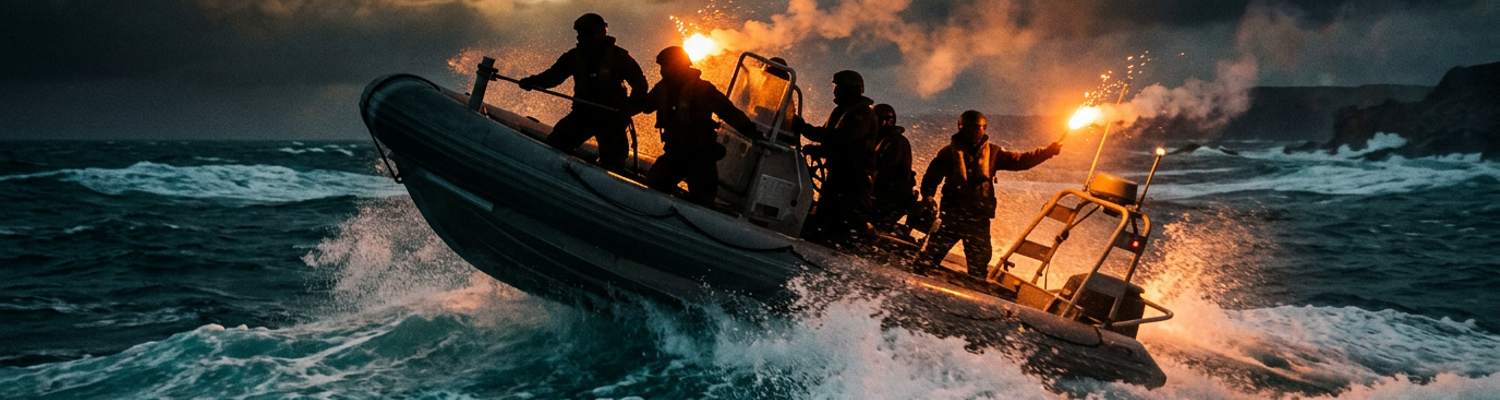
Rigid-hull inflatable boats operated in heavy open-ocean swells while pacing maneuvering target vessels that swerved violently to break the boarding crews pursuit angle. Smugglers dumped blue plastic fuel barrels directly into the wake of the pursuit boats to foul outboard propellers and force the boarding teams to break their pursuit line. Coxswains spun their steering wheels frantically to dodge the drifting barrels, slamming the inflatable hulls sideways into crashing walls of water that swamped floor drains and temporarily blinded the helm. Saltwater flooded the boat cockpits up to the knees of the boarding officers, who used manual hand pumps to keep the electrical systems from drowning while the engines roared at full throttle. Forward gunners fired illumination flares into the low cloud ceiling, bathing the surging waves in harsh magnesium light that revealed stacks of wrapped bales lashed inside the open smuggler hull.
Smugglers executed evasive turns toward shallow archipelagic waters to break tactical contact the moment the flares ignited overhead. The go-fast boat cut hard to the west, aiming directly for jagged coral reefs and uncharted rocky shallows surrounding the Grenadines where deep-draft pursuit craft risked tearing their fiberglass bottoms. Boarding officers shouted over the deafening engine roar, demanding warning fire authorization over the tactical radio net before the target crossed the twelve-mile reef barrier. Radio waves carried their urgent voice reports back to the parent frigate, which had to relay the tactical position across satellite uplinks to the Task Group 4.4 battle staff hundreds of miles away in Florida. Watchstanders in the Key West bunker crowded around green tracking displays, debating jurisdictional boundary lines and rules of engagement while the frontline coxswain watched the smuggler boat pull rapidly away toward the surf line.
Commanders in the Key West operations room hesitated over legal clearances, leaving the forward boarding team completely isolated in the rising sea. Satellite delays and command-post protocols stretched the decision-making cycle across ten critical minutes while the interceptor crew waited in the pounding spray. Tactical orders permitting warning shots finally crackled over the radio link, but the target vessel had already slipped into the unlit coastal shallows among the Grenadines. Coxswains pulled their engine throttles back to neutral just outside the breaking reef surf, preventing catastrophic hull damage as coral heads rose beneath the keel. Boarding officers secured their weapons and recorded the final geographic coordinates on grease-pencil plot boards, turning their battered inflatable boats back toward the deep water where the frigate waited.
Mechanical Attrition and Saltwater Weapon Degradation
Winches groaned under the weight of the waterlogged interceptors as allied deck crews hoisted the boats out of the rolling sea and lowered them into their cradle mounts aboard the frigate. Tactical boarding teams confronted rapid saltwater corrosion on M240 pintle mounts and small-arms receiver bolts within minutes of stepping onto the dry metal deck plates. Caribbean sea spray had soaked every exposed surface during the high-speed chase, evaporating under the heat of the frigate exhaust stacks to leave behind thick deposits of white salt crust. Gunner mates found the heavy brass and steel swivel pins of the machine-gun mounts jammed tight, requiring rubber mallets and pry bars just to break the mounts free for cleaning. Boarding officers pulled hard against the charging handles of their M4 rifles, finding the bolt carriers seized inside the upper receivers by rust that formed almost instantly in the humid tropical air. Crew members laid out canvas tarps across the open flight deck and began stripping the locked weapons into individual pins and bolt assemblies to stop the metal from fusing together completely.
Mechanics walked past the rows of disassembled rifles to inspect the twin two-stroke outboard motors that powered the battered interceptors. Outboard boat engines suffered persistent salt fouling and mechanical breakdowns during high-speed littoral pursuits that pushed the craft far beyond their intended operational endurance. Salt crystals packed tightly into the engine air intakes, blocking the flow of oxygen and choking the carburetors until the cylinders misfired under heavy throttle loads. Cooling passages inside the aluminum powerheads clogged with baked brine, causing engine temperatures to spike past safe operating limits while pursuit craft raced across the swell. Watchstanders inside the air-conditioned command bunker in Key West saw none of these mechanical failures on their digital tracking maps, recording the boats as fully mission capable assets ready for instant redeployment.
Coast Guard personnel performed emergency underway weapons and engine clearing actions without shore-based maintenance support to keep those damaged craft ready for the next launch. Support bases in San Juan and Key West were hundreds of miles away, leaving the embarked boarding teams with only the spare parts and hand tools they carried in their canvas kit bags. Boat engineers balanced against the heave of the deck to pull out fouled spark plugs, scraping carbon and salt deposits from the electrodes with wire brushes and pocket knives. Petty officers rigged plastic siphon hoses to fresh-water storage tanks, running gallons of drinking water through the engine cooling jackets to dissolve the rock-hard salt dams choking the exhaust ports. Team armory specialists soaked rifle bolts and M240 gas pistons in buckets of lubricating oil, rubbing steel wool over pitted surfaces to restore smooth cycling action before the next operational sortie.
Technicians snapped the cleaned bolt assemblies back into the rifle receivers and cycled the actions repeatedly to ensure the weapons would fire without jamming. Engine crews tightened the last cowling latches on the outboard motors and pull-tested the manual starter cords, listening for even compression in the rebuilt cylinders. Headquarters commanders in Key West broke the radio silence with an encrypted priority alert ordering Task Group 4.4 to intercept another suspicious surface radar track off the coast of Grenada. Allied lookouts sprinted across the frigate catwalks to clear the boat davits while boarding team members grabbed their reassembled weapons and strapped their body armor back on. Coxswains climbed back into the cockpits, opened the fuel valves, and signaled the deck officer that the interceptors were ready to plunge back into the dark water.
Satellite Telecommunication Latency in Key West
Steel davit cables lowered the interceptor craft toward the churning Caribbean sea, but the coordinates guiding their launch fell out of date inside distant control hubs. Strategic headquarters commanders in Key West and Washington experienced recurrent satellite telecommunication latencies that disrupted their operational picture of the Caribbean basin. Secure digital data links carrying tactical tracks had to travel tens of thousands of miles into orbit and back down to receiver stations, slowing transmission lines with long processing delays. Wall-sized digital projection screens inside the Joint Interagency Task Force South command center showed smooth, continuous tracks that gave staff officers a false sense of real-time control. Watchstanders monitored glowing green target icons that moved along fixed courses across electronic maps, unaware that tropical squalls and equipment lags had paused incoming position reports for twenty minutes.
Satellites relayed delayed command-and-control feeds that created substantial gaps between real-time intercepts and headquarters tracking displays during these transmission blackouts. Smugglers piloting twin-engine go-fast craft altered course at thirty-five knots across the waves while the digital icons representing their hulls remained motionless on tactical screens in Key West. Tactical airborne surveillance planes flew sweeping circles above the open sea, logging fresh coordinates that sat buffered in queue lines waiting for high-frequency uplink bandwidth. Staff officers gathered behind the duty commander to calculate intercept angles using math based on ship positions that had ceased to exist ten miles back. Operators tapped keyboard commands into tactical terminals, broadcasting vector updates to warships based on outdated radar returns.
Commanders inside isolated command centers made operational decisions detached from live tactical vectors on the water by enforcing these outdated course directions. Strategic planners in Key West and the Pentagon retained tight jurisdictional authority over pursuit permissions, barring ship captains from executing course alterations without explicit shore approval. Frigate captains stood on open bridge wings in the southern Caribbean, pointing searchlights into pitch-black waves where headquarters claimed a target was idling, only to find empty water. Deck officers requested permission to break off and sweep east toward shallow archipelago channels where engine noise had been reported, but their encrypted voice requests queued behind incoming administrative data traffic. Staff directors hundreds of miles to the north rejected the captains field adjustments, insisting that the digital plot on their Key West monitors took precedence over visual reports from the ship bridges.
Helmsmen spun their brass steering wheels to comply with the rigid headings mandated by Florida, turning warship bows away from the actual escape routes of the narcotics transports. Boarding craft idling in the dark swell burned precious fuel waiting for Key West to reconcile conflicting radar reports with Washington liaison desks. Telecommunication lags stretched the authorization window beyond thirty minutes, giving smuggler crews time to run their go-fast boats into shallow, unmonitored coves around the Grenadines. Radio operators on the parent warship finally received authenticated pursuit orders just as local island lookouts reported that the smugglers had already beached their craft and unloaded the contraband into the coastal brush. Allied captains ordered the interceptors hoisted back into their cradles, leaving the task group steaming on blind patrol lines while technicians in Key West refreshed their satellite terminal modems.
Boarding Authorizations at Foreign Maritime Boundaries
Radio transmitters hummed uselessly in the equipment bays as the digital reboot failed to reopen the data path between Key West and the patrol hulls. Lookouts on the forward bridge wings spotted a twin-engine fiberglass craft skimming the dark water just six miles off the coast of Saint Lucia, heading straight for the twelve-mile territorial sea boundary. Bridge officers transmitted emergency status reports over ultra-high-frequency radio channels to request formal boarding clearance from the joint task force commanders. Communication blackouts paralyzed the transmission of Statements of No Objection during critical intercept windows, leaving message queues locked on encrypted terminals while the target gained speed. Operations officers in the frigate combat information center stared at blinking red warning prompts on their computer consoles, unable to confirm whether flag-level legal teams in Florida had secured diplomatic authorization to board. The suspect vessel churned white wakes across the calm coastal shelf, closing the remaining distance to sovereign foreign waters at over thirty knots.
Sailors assigned to the boarding team pulled laminated legal reference binders from shipboard metal lockers as the target closed within three miles of foreign territorial waters. Tactical teams navigated bilateral agreement requirements under extreme time constraints without flag-level legal clarity, spreading out treaty checklists across the chart table to verify specific operational permissions. The United States maintained bilateral maritime agreements with eastern Caribbean governments, but each pact had different provisions regarding vessel pursuits, shiprider presence, and entry into sovereign island waters. Some agreements allowed pursuit into foreign waters only if an official foreign shiprider was physically aboard the vessel, while other agreements required direct radio authorization from the partner nation coast guard headquarters. Watch officers called out distance updates from the radar displays every thirty seconds, warning the boarding team that the window to act in international waters was vanishing. The absence of real-time legal guidance from Key West forced the embarked team members to interpret complex treaty language themselves under the dim red lights of the bridge.
Deck officers improvised boarding authority before fleeing suspect vessels crossed into foreign territorial waters, declaring an immediate right of approach under international law to justify the tactical intercept. Watch captains ordered the ship sirens sounded and instructed the bridge team to log the maneuver under emergency pursuit provisions rather than waiting for shore command approval. Coxswains gunned their twin outboard engines on the davits, dropping the rigid-hull inflatable boat into the churning black wake of the frigate just as the smuggler crossed within one mile of the island territorial line. Boarding personnel gripped the aluminum grab rails and switched on their blue law enforcement flashing lights to signal the fleeing boat to cut its throttles. Smugglers dumped burlap-wrapped bales of narcotics into the sea to lighten their craft, banking their hull in a sharp turn to outrun the cutter before reaching the boundary. Boarding officers leveled their shotguns over the bow of the inflatable craft and fired non-lethal pepper-ball munitions into the go-fast cockpit, forcing the fleeing helmsman to pull his throttle levers back into neutral inside international seas.
Coxswains maneuvered the inflatable boat alongside the wallowing target hull, keeping the twin outboards idling in reverse against the ocean chop. Coast Guard boarding officers leaped across the wet gunwales with loaded sidearms drawn, ordering the three crewmen onto the floorboards before they could destroy remaining navigation gear. Deck crewmen from the frigate lowered grappling hooks and cargo nets to retrieve floating packages of cocaine drifting toward the nearby reef line. Navigators on the frigate bridge carefully marked the exact latitude and longitude of the seizure in the ship deck log, proving that the entire physical interception had occurred two hundred yards seaward of the foreign territorial boundary. Encrypted teletype printers in the frigate radio center finally rattled to life forty minutes after the seizure, spitting out an obsolete message from Key West asking whether the task group had visual contact with the target. Boarding officers ignored the late dispatch, secured the contraband in the frigate hold, and placed the detained smugglers into shipboard custody cells under the authority they had established on the water.