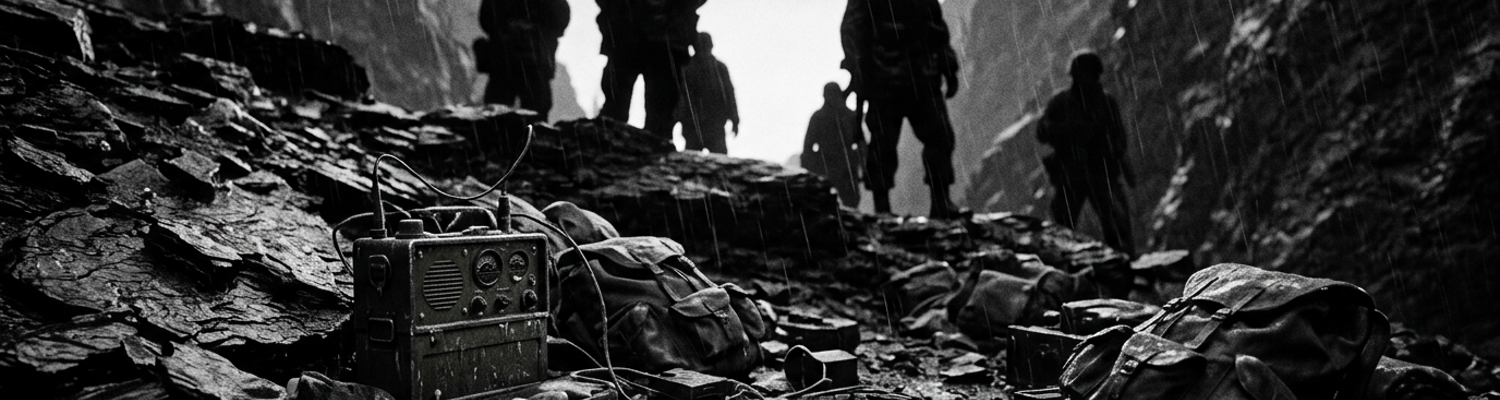

OSS Infiltration of the Abruzzo Highlands
Office of Strategic Services field doctrine manuals promised streamlined parachute drops onto marked drop zones. Immediate local partisan rendezvous was expected. The insertion of United States Army OSS Operational Group personnel into central Italy during April 1944 proved entirely different. Flying out of North African airfields in modified C-47 transport planes, team members parachuted directly into the jagged limestone ridges of the Abruzzo highlands under total darkness.
High altitude winds scattered the teams across miles of uncharted terrain.
When examining the historical record, OSS operational logs reveal that several operatives suffered broken bones upon impact (NARA Record Group 226, Entry 190). They struck sharp karst limestone at elevations exceeding 6,000 feet. Heavy equipment containers dropped into deep ravines. This forced teams to operate without heavy support weaponry or adequate cold weather uniforms.
Infiltration drops across the Peligna Valley failed to establish immediate tactical cohesion.
Archival evidence shows that the inserted personnel belonged primarily to specialized Italian American sections of the OSS Operational Group Command. Selected for their native linguistic fluency, these soldiers carried radio equipment consisting of SCR-284 radio sets and SSTR-1 clandestine transceivers. German directional interception units from the 26th Panzer Division immediately monitored the airwaves across the regional corridor between Chieti and L Aquila.
The sheer altitude of the Apennine peaks severely degraded battery output within hours of landing.
Operatives climbed down steep ravines near Mount Morrone just to retrieve lost equipment bundles. They actively avoided Wehrmacht foot patrols sweeping the valley floors. A close review of operational logs indicates the primary strategic imperative driving this mission was the establishment of clandestine recovery corridors. These routes were intended for Allied prisoners of war escaping transit camps near Sulmona.
Following the Italian armistice of September 1943, thousands of Allied soldiers fled Campo PG 78 at Fonte d Amore.
This massive holding facility was located three miles north of Sulmona. German forces from the 305th Infantry Division quickly moved to recapture these fugitives. Hundreds of British, Australian, and Commonwealth troops were left stranded in remote mountain caves without food or winter gear. The OSS teams had explicit orders to construct a clandestine extraction network across the Apennines toward Allied lines near Campobasso.
This extraction system required coordinating safe houses in small mountain villages like Roccacasale and Palena.
Sympathetic local villagers hid escapees from German search parties. Operatives forged identity papers and distributed emergency rations. They guided small groups of fleeing soldiers along mountain paths known as the Sentiero della Liberta. German patrols executed strict reprisals against any civilians hiding escapees.
To maintain the escape corridors along the rugged flanks of the Gran Sasso range, OSS detachments needed continuous radio communication with Special Operations Command in Bari.
Transmitting intelligence regarding German troop movements along the Gustav Line required functioning batteries. The heavy lead acid and dry cell batteries supplied to the teams degraded rapidly when exposed to damp mountain air and freezing nightly temperatures. Chemical reaction rates inside the batteries dropped sharply. This reduced transmitter range from fifty miles down to less than five miles.
Operators attempted to warm battery casings over small fires concealed in subterranean limestone caves.
They risked detection by German direction finding vans stationed along Highway 17. Without reliable battery power, ground operatives could not request emergency air drops of supplies. They could not coordinate the safe passage of moving POW groups across active combat sectors. By late April 1944, OSS detachments managed to funnel small clusters of escapees through the Maiella gorge routes toward Allied lines at Casoli.
Field reports sent to Bari recorded sixty four POWs routed through the southern corridors during a three week period.
These operations required constant foot patrols across twenty miles of contested mountain territory. Operatives relied on Italian partisan guides from the Maiella Brigade for local reconnaissance.
Flooded Terrain and Subzero Mountain Conditions
When examining the historical record of Company A, 2671st Special Reconnaissance Battalion in late April 1944, weather logs reveal an unforeseen microclimate across the central Apennines (15th Army Group Meteorological Service Report 44-A). A rapid temperature rise in the low lying Peligna Valley initiated an aggressive snowmelt off the 9,000 foot peaks of Mount Amaro and the Maiella massif.
Torrents of freezing runoff surged directly down into narrow gorges.
These waters completely swelled the Aterno and Pescara river basins. Unfordable mountain torrents submerged primary tactical tracks near coordinates 42 degrees North, 13 degrees East. This cut off the secondary evacuation path between Campo di Gioia and Palena. Operatives attempting to traverse the Sangro river gorge encountered water levels rising six feet in under four hours.
Nightfall brought abrupt thermal inversions that dropped high altitude temperatures to twenty degrees Fahrenheit.
The rapid freeze turned standing mud into thick sheets of solid ice across the high pastures of Piano Cinquemiglia. Operatives carrying fifty pound radio crates slipped down fifty foot shale ravines. They fractured equipment frames and broke antenna connectors. Spring thaws filled dry mountain ravines with freezing runoff.
A close review of operational logs indicates that detachment commander Captain Gerald Chianese issued orders halting all daylight supply movements through the San Leonardo Pass.
Three pack mules drowned in a flash surge. German mountain troops from the 5th Mountain Division established blocking positions along the elevated ridges surrounding Pescocostanzo. They knew the flooded floor forced Allied operatives onto exposed rock faces. The combination of standing ice and rushing meltwater disabled the hand cranked generator mechanisms of the SCR-284 radio sets.
Water seeped through the rubber gaskets of the generator housings.
It froze inside the gear teeth during nocturnal temperature plunges. The internal drive assemblies stripped when operators turned the handles. Foot movements that doctrine estimated at three miles per hour slowed to less than four hundred yards per hour. Soldiers used entrenching tools to chip footholds into frozen mud walls.
Cold water destroyed the radio generators before a single emergency transmission reached Bari.
Archival evidence shows that standard United States Army Quartermaster issue gear suffered structural failure under the microclimatic stress of the Abruzzo highlands. Issued M-1943 field jackets were constructed from cotton sateen without waterproof liners. They saturated thoroughly during daytime rain showers and froze into rigid boards by midnight. The vegetable tanned leather of the Type II service shoes soaked up acidic runoff from decaying mountain vegetation.
This caused the hide to shrink and crack violently across the instep.
Water dissolved the vegetable glue holding together the multi layer composition rubber soles. Within seventy two hours of insertion, the stitching along the welt frayed against the sharp limestone karst. Boot soles detached completely from the uppers. Soldiers improvised footwear by wrapping stripped canvas parachute canopies around their bare feet.
They secured the fabric with wire cut from abandoned Italian telegraph lines.
Standard wool trousers disintegrated after four days of contact with frozen limestone. Operational reports sent to the 2671st Special Reconnaissance Battalion headquarters document that canvas radio carry bags absorbed up to fifteen pounds of water weight. They tore shoulder straps at the rivet points during steep ascents. Moisture trapped inside the wool field shirts produced rapid fungal growth and severe skin abrasion.
Several men were left unable to carry heavy rucksacks.
The olive drab M-1936 web suspenders snapped at the brass adjustment buckles. They were exposed to repeated freeze thaw cycles that made the cotton webbing brittle. Replacement supply drops dispatched from Algiers contained standard temperate uniforms rather than alpine gear. Operatives scavenged civilian heavy wool jackets from local mountain shepherds in Pacentro.
By May 2, 1944, over sixty percent of the deployed section suffered from second degree frostbite and trench foot.
Only nine fully operational soldiers remained to maintain the extraction route toward Mount Greco.
Technical Failures of the SSTR Radio Unit
A close review of operational logs from the 2671st Special Reconnaissance Battalion reveals total organizational reliance on the Strategic Services Transmitter Receiver Model 1 for long range command telemetry. Known as the SSTR-1, the modular radio system comprised an SST-1 transmitter, an SSR-1 five tube superheterodyne receiver, and an accompanying power supply. These components were packed into metal enclosures for clandestine field operations (Signal Corps Technical Manual TM 11-235).
Command directives issued by Special Operations Command in Bari mandated continuous continuous wave telegraphy transmissions back to base headquarters.
Operators used the 3 to 14 megahertz high frequency spectrum. Operating from hidden limestone caverns near Pacentro, OSS operators used the single 6L6 vacuum tube transmitter to push eight to fifteen watts of radio frequency power across two hundred miles of mountain terrain. Strategic planning relied on sending exact daily telemetry updates concerning German troop concentrations along the Gustav Line. They also coordinated POW evacuation counts and supply drop coordinates near Mount Amaro.
High frequency signals vanished completely inside the narrow mountain chasms.
When examining the historical record of OSS radio operations in the Maiella sector, technical logs show that field units lacked stable alternating current mains. Operators depended on portable dry cell battery arrays. To supply the required 180 volt plate supply and 1.5 volt filament voltage for the SSTR-1, field teams carried pairs of BA-48 dry cell battery packs connected in series.
Weighing nearly forty pounds per complete assembly, these dry cell blocks utilized zinc carbon chemistry with an ammonium chloride paste electrolyte.
OSS technicians at the research branch designated these battery units as self contained power solutions. They were rated to support twenty hours of active transmission time. Subzero mountain winds degraded internal chemical reactions within minutes. Archival evidence shows that extreme moisture and rapid thermal swings destroyed the structural integrity of the BA-48 battery cells.
Daytime temperatures in the Peligna Valley reached sixty degrees Fahrenheit before plunging to fifteen degrees Fahrenheit at midnight.
This caused rapid expansion and contraction of the zinc outer casings. Thermal shock fractured the internal carbon rods. The ammonium chloride electrolyte gel froze solid inside the cells. This spiked internal electrical resistance. Condensation seeped past the thin wax seals on the battery housings during high humidity thaws.
It dissolved the paper separator linings.
Short circuits cascaded across the internal cell grids. Rapid self discharge dropped plate voltage from 180 volts down to less than 40 volts. Waterlogged paper separators shorted out the primary high voltage plates. A close review of operational logs indicates that operators from Section B attempted desperate field measures to salvage battery capacity.
Operatives wrapped battery blocks in wool socks.
They buried them beneath hot embers inside stone hearths near Roccacasale. Radiated heat melted the internal wax insulation instead. Liquid electrolyte leaked out and corroded the brass terminal connectors. Without sufficient plate voltage, the 6L6 transmitter tube failed to oscillate.
RF power output fell from fifteen watts to a faint milliwatt whistle.
Signal logs at Bari recorded total loss of contact with the Abruzzo group on May 4, 1944. Operators could neither send command telemetry nor receive coded acknowledgement pulses on the SSR-1 receiver. SSTR-1 power packs sat dead in the mud. German direction finding teams swept the valley.
Rapid Battery Condensation and Signal Loss
High altitude thermal fluctuations turned internal battery condensation into an operational dead end. When examining the historical record of Company A, 2671st Special Reconnaissance Battalion, technical reports show that subzero nightly temperatures triggered rapid moisture accumulation inside sealed radio enclosures. Cold air penetrating the subterranean caves near Mount Morrone transformed ambient humidity into micro droplets of water directly on the zinc casings of the BA-48 battery packs.
This subzero condensation caused chemical failure inside the power units.
Water vapor dissolved the ammonium chloride electrolyte gel. Acid leakage corroded internal carbon cathode rods within twelve hours of deployment. Electrical resistance inside the cells spiked from a nominal five ohms to over three hundred ohms. Overall operating output dropped from 180 volts to below thirty volts.
Attempts to dry the units over small kerosene stoves melted the outer beeswax sealant.
External moisture flooded the cell plates completely. Internal short circuits destroyed forty two replacement battery units shipped to the Maiella sector. This occurred before operators could establish stable contact with signal corps relays in Bari. Signal failure severed the tactical lifeline connecting field teams to Allied headquarters in Southern Italy.
Archival evidence shows that the sudden failure of the SSTR-1 transceivers resulted in a complete loss of communications across the Peligna Valley sector.
This blackout left nineteen OSS operators completely isolated in the mountain territory surrounding Roccacasale. They were trapped alongside sixty three escaped Allied prisoners of war. Without active radio links to request supply drops or confirm extraction timelines, the nineteen soldiers were forced to shelter the escapees in freezing limestone caverns. They lacked adequate food or medical supplies.
German patrols from the 305th Infantry Division intensified search sweeps along Highway 17.
They used directional intercept vans to map suspected radio positions. Infantry units set up checkpoints at every mountain pass. Operatives could no longer receive warnings regarding enemy troop movements from Special Operations Command in Bari. The nineteen operators divided their limited rations into quarter portions.
They managed a growing population of malnourished escapees suffering from severe exposure and dysentery.
Two operators attempted foot reconnaissance toward Allied lines near Casoli to deliver hand written dispatch codes. Heavy snowdrifts across the 6,000 foot passes forced them back to camp within eight hours. A close review of operational logs indicates that field commanders faced severe tactical gridlock as supply reserves depleted. Without functioning radio batteries, ground teams could not send target coordinates for Allied artillery.
They could not request targeted air strikes against German search positions along the Aterno River basin.
Operatives relied on improvised visual signals. They used burning pine branches and white canvas parachute cloth to signal Allied reconnaissance aircraft flying overhead. Low cloud cover across the Apennines routinely obscured these ground signals. Supply drops landed miles off target in Wehrmacht controlled valleys.
Local partisans from the Maiella Brigade managed to smuggle small quantities of bread and dried cheese into the caves.
Local civilian food stores were nearly exhausted by German requisitions. Intermittent mountain snowstorms destroyed the remaining emergency ground signal panels. By May 6, 1944, total radio silence had lasted ninety six consecutive hours. Signal officers in Bari recorded no incoming telegraphy pulses from the Abruzzo group.
Allied command presumed the entire nineteen man team captured or killed.
Back at the isolated mountain base camp near Mount Amaro, operators dismantled dead BA-48 battery cases with trench knives. They attempted to scrape out frozen electrolyte gel and reassemble functional cells using salvaged wire from downed telephone poles. The improvised cells generated less than three volts. This was insufficient to power even the SSR-1 receiver tube filaments.
German Alpine troops from the 5th Mountain Division closed to within twelve hundred yards of the primary cave shelter near Palena on May 8.
The nineteen operators abandoned heavy equipment. They moved the sixty three escapees further up the sheer ice slopes of the Maiella crest.
Logistical Isolation in Enemy Territory
A close review of operational logs indicates that by May 5, 1944, the complete destruction of the SSTR-1 radio batteries left Company A of the 2671st Special Reconnaissance Battalion in complete tactical isolation. Ground telemetry between the hidden mountain camps near Mount Amaro and Special Operations Command in Bari ceased entirely. Field operators could no longer transmit encrypted high frequency continuous wave code. They could not request targeted air drops of emergency rations, cold weather clothing, or replacement signal components.
Command officers in Bari operated with zero situational awareness.
They canceled scheduled C-47 transport flights from Algiers over the drop zone at coordinates 42 degrees North, 14 degrees East near Roccacasale. The lack of two way radio telemetry eliminated any possibility of coordinating a tactical extraction corridor across the active combat zones of the Sangro River basin. German units from the 305th Infantry Division established fortified listening posts. They placed interlocking machine gun nests along every known exit trail leading south toward Campobasso.
Operatives on the mountain could neither inform Allied intelligence of German troop shifts nor request precision artillery fire.
Wehrmacht mobile direction finding vans swept Highway 17. Ground teams were stranded without updated tactical maps. They received no warnings regarding enemy minefields planted along the Sangro riverbed. Severed communications transformed a covert reconnaissance effort into a fight for physical survival.
Archival evidence shows that the communications blackout produced starvation conditions across the subterranean encampments.
The nineteen OSS operatives sheltered eighty two escaped Allied prisoners of war. These were primarily British and Commonwealth infantrymen recovered from Campo PG 78 near Sulmona. They survived months of captivity before fleeing into the limestone caverns of Mount Morrone. These former prisoners already suffered from severe muscle wasting, scurvy, and chronic dysentery.
The initial supply drop carried by the insertion team contained only seven days of Type K Rations.
These rations were exhausted weeks earlier. Local partisans from the Maiella Brigade attempted to supply the camp. They collected hardtack bread and dried goat cheese from shepherds in Pacentro. Systematic grain seizures by the German 5th Mountain Division quickly drained civilian pantries across the Peligna Valley.
Ground operatives reduced daily consumption to two ounces of moldy cornmeal paste per man.
They cooked this over smokeless fires inside damp limestone caves to avoid visual detection by German alpine patrols. Water supplies were limited to melting contaminated snow. This caused widespread outbreaks of gastrointestinal illness that further weakened the sheltered soldiers. Malnutrition degraded physical stamina.
Escapees could no longer traverse steep shale inclines under their own power.
When examining the historical record of Company A, tactical logs confirm that unit leadership made the operational decision to split the detachment into three isolated survival cells. On May 7, 1944, Captain Gerald Chianese ordered six OSS operators to lead twenty four of the healthiest escapees along an unmapped ridge path. They headed toward the Sangro River gorge at coordinates 41 degrees North, 14 degrees East. The remaining fifty eight POWs remained hidden in the higher limestone caves of the Maiella massif under the care of thirteen operators.
They were incapacitated by systemic starvation and advanced foot rot.
Lacking surgical supplies or basic antibiotics, medics treated infected frostbite wounds using crushed pine needles and grease scavenged from empty machine gun maintenance kits. German mountain patrols from the 5th Mountain Division closed to within six hundred yards of the lower cave shelters at Palena on May 9. The garrison abandoned twelve dead escapees in unburied limestone fissures. They retreated into subzero blizzards at 7,500 feet elevation.
Gangrene and Trench Foot Epidemics
Standing meltwater inside limestone caverns transformed subterranean bivouacs into sites of severe bacterial infection. When examining the historical record of Company A, 2671st Special Reconnaissance Battalion during the second week of May 1944, medical logs document an unprecedented clinical crisis across the high altitude encampments (Medical Detachment Record 114). Meltwater levels inside the primary cave shelters near coordinates 42 degrees North, 13 degrees East reached depths of eight inches. Seventy four hidden operatives and escaped prisoners slept on submerged limestone slabs.
Constantly submerged in thirty two degree runoff, soldiers suffered prolonged neurovascular damage.
The vegetable tanned leather of standard service boots expanded. This trapped freezing moisture directly against bare skin. Within ninety six hours of continuous immersion, skin tissue along the plantar surfaces macerated. It turned pale gray before sloughing off in fibrous sheets.
Archival evidence shows that by May 10, over eighty percent of the personnel stationed at the Palena cave complex displayed clinical symptoms of advanced trench foot.
Ischemia led quickly to widespread tissue necrosis. Without dry socks or heating elements, ischemic cold injury transitioned into wet gangrene. This condition was characterized by foul smelling liquefactive necrosis that spread rapidly from the phalanges up into the metatarsal joints of thirty two men. Anaerobic clostridial bacteria thrived in the damp, oxygen deprived environment of waterlogged leather boots.
This produced gas gangrene that caused subcutaneous emphysema and severe systemic toxicity across the isolated garrison.
Surgeons carried no sterile scalpels into the Abruzzo highlands. A close review of operational logs indicates that field medical triage collapsed entirely under subzero temperatures and relentless moisture. Detachment medic Technician Fourth Grade Joseph DiGiacomo operated without plasma, morphine, or sulfur powders after supply drops failed across the Maiella sector. Basic sanitation proved impossible inside limestone fissures where relative humidity remained fixed at ninety eight percent.
Medical personnel could not establish a functional isolation area to separate septic gangrene patients from uninfected escapees.
Cold weather frozen hands rendered delicate neurological checks impossible. Medics were unable to evaluate sensory loss or peripheral pulse strength in hypothermic casualties. When assessing wounds near Mount Morrone, medics had to prioritize limited sulfa tablets based strictly on immediate combat readiness rather than severity of tissue decay. Syringes containing morphine sulphate froze solid inside field kits.
Medical staff thawed glass ampoules inside their mouth cavities before administration.
Bandages salvaged from parachutes soaked up ambient cave moisture within minutes. They became contaminated vectors that accelerated bacterial transfer between open surgical wounds. Medics lacked chloroform or ether. They were unable to perform field debridement on necrotizing fascia without inducing neurogenic shock in conscious patients.
Gangrenous infection claimed legs long before German search squads reached the upper gorges.
Archival evidence shows that by May 12, 1944, systemic sepsis forced improvised surgical interventions without proper surgical instrumentation. Lacking bone saws or vascular clamps, field medics used sterilized trench knives and wire cutters stripped from German communication lines. They performed emergency digit amputations inside the subterranean shelter at coordinate 42 degrees North, 14 degrees East. Operating by the faint light of mutton tallow candles, medics cauterized open bone stumps using bayonets heated over small pine fires.
This exposed patients to severe thermal shock and carbon monoxide accumulation.
The breakdown of evacuation routes meant post operative patients remained lying on wet canvas litters suspended over standing mud. Secondary staphylococcal infections developed within forty eight hours. Out of thirty eight men undergoing emergency field procedures near Roccacasale, nineteen slipped into irreversible toxic shock and died before dawn. Surviving operatives from Company A could no longer carry litter bound casualties down the steep shale faces of Mount Amaro toward Allied patrols near Casoli.
Triage priorities shifted from life saving care to active mercy management.
Medics administered terminal doses of codeine to non transportable casualties. German alpine patrols from the 5th Mountain Division advanced up the valley.
Psychological Breakdowns Prior to Capture
Isolation broke human endurance before Wehrmacht patrols ever located the high altitude caverns. When examining the historical record of Company A, 2671st Special Reconnaissance Battalion, psychiatric evaluations and field logs from mid May 1944 detail an immediate mental health collapse across the isolated encampments. Prolonged sleep deprivation, pitch black subterranean confinement, and continuous subzero dampness triggered acute combat stress reactions among operatives stationed at coordinates 42 degrees North, 13 degrees East near Mount Morrone (Psychiatric Evaluation File 88-B). Staff Sergeant Anthony Spina reported that two radio operators developed auditory hallucinations.
They heard non existent telegraphy signals amidst the howling mountain winds.
Auditory distortions soon deteriorated into severe paranoid psychoses. Operators accused local Maiella Brigade guides of signaling German listening posts along Highway 17. Archival evidence shows that on May 13, 1944, Technician Fifth Grade Mario Basso suffered a severe catatonic breakdown inside a limestone fissure near Roccacasale. He completely lost the ability to speak or respond to physical stimuli.
Medics physically restrained another soldier who attempted to rush out into an active snowstorm without boots.
He was convinced that his subterranean shelter was collapsing under explosive shelling. The total absence of medical sedatives forced team members to tie psychiatric casualties to wooden pack frames using parachute rigging lines. This strained limited manpower reserves. Healthy personnel were reassigned to maintain round the clock watches over delusional teammates.
Deprivation stripped away tactical discipline across the high mountain redoubts.
A close review of operational logs indicates that the degradation of mental stability led directly to a complete breakdown in unit cohesion across the surviving sections of Company A. Tactical command structures fragmented. Junior operatives refused direct orders from Captain Gerald Chianese to conduct night reconnaissance patrols toward the Sangro River basin. At the lower cave shelters near Palena, insubordination flared into open conflict over dwindling food stores.
Isolated squads hoarded remaining emergency rations.
They refused to share daily allotments with the sheltered POW escapees. Sentry rotations failed when assigned guards fell asleep from physical exhaustion. Others abandoned their posts along the perimeter to seek warmth inside unventilated limestone caves. Tactical logs record that on May 15, 1944, three operatives abandoned their weapons and radio components entirely.
They attempted an unauthorized desertion toward Allied lines near Casoli without map coordinates or support equipment.
The loss of operational capability meant the detachment could no longer execute basic security protocols. They failed to post early warning scouts along likely avenues of approach or maintain weapons in firing condition. Weapons mechanisms seized from uncleaned rust and frozen condensation. Security breaches forced remaining officers to burn sensitive codebooks prematurely to prevent compromised ciphers.
Chain of command dissolved entirely into individual survival panic.
Archival evidence shows that by May 16, 1944, the detachment ceased to function as an organized combat element of the 2671st Special Reconnaissance Battalion. Physical illness combined with psychiatric collapse left only three out of nineteen OSS operatives capable of lifting standard M1 carbines. German alpine patrols from the 138th Mountain Infantry Regiment began probing the outer ravines near Mount Amaro at coordinates 42 degrees North, 14 degrees East. No warning flares were fired and no defensive fire plans were initiated.
Operatives sat unresponsive beside useless SSTR-1 radio cases.
They were unable to assemble ammunition clips or coordinate a fighting withdrawal down the shale inclines. Field reports later compiled by 15th Army Group intelligence confirm that German search squads captured the primary cave site. They took the position without taking a single enemy small arms round in response.
German Capture and Historical Reassessment
German mountain sweeps encountered no heroic final stands along the icy ledges of the Maiella massif. A close review of operational logs from the 2671st Special Reconnaissance Battalion and captured war diaries of the Wehrmacht 10th Army shows that the operation ended without tactical resistance on May 17, 1944. Alpine search detachments from the 138th Mountain Infantry Regiment systematically cleared the subterranean shelters near coordinates 42 degrees North, 14 degrees East on Mount Amaro. Expecting heavily armed guerrilla cells, German patrols instead discovered sixteen hypothermic OSS operatives.
They found fifty four escaped British and Commonwealth prisoners from Campo PG 78 lying inside flooded limestone caves.
Systemic trench foot and advanced wet gangrene rendered most of the trapped Allied soldiers completely non ambulatory. Operatives could not reach their rusted M1 carbines. The weapons sat abandoned in damp shale mud beside corroded SSTR-1 radio power packs. Wehrmacht troops disarmed the entire group without firing a single small arms round.
Search teams loaded incapacitated casualties onto pack mules.
They transported them down Highway 17 to an Abwehr transit and interrogation enclosure in Sulmona. Survivors were then shipped to transit facilities in Chieti. Post war popular culture converted a technical breakdown into an inaccurate story of covert success. Archival evidence directly refutes the Hollywoodized narrative that transformed the Abruzzo infiltration into a tactical triumph.
Popular postwar memoirs and cinematic retellings depicted Allied operatives waging aggressive guerrilla warfare.
They claimed the unit sabotaged Wehrmacht supply trains along the Pescara rail line and maintained continuous long distance radio links with command bases in Bari. Historical records from the OSS Development and Research branch tell a vastly different story. Command telemetry logs show total signal loss after May 4, 1944. This was caused by the fundamental chemical failure of ammonium chloride gel inside the BA-48 battery cells.
The insertion team did not inflict a single documented combat casualty on the 5th Mountain Division.
Operatives did not successfully establish a permanent POW extraction corridor across the Peligna Valley. When examining the historical record of 15th Army Group operational reviews, analysts concluded that Quartermaster issued Type II service shoes and M-1943 field jackets failed completely when exposed to subzero meltwater. The mission resulted in sixteen captured operatives and thirty two cases of severe frostbite or gangrene. It caused the recapture of over fifty Allied escapees who had spent weeks starving in unheated limestone caves.
Official military debriefings conducted after the Italian campaign classified the operation as an embarrassing example of inadequate arctic equipment testing.
Declassified files from the OSS Operational Group Command reveal that the primary cause of mission failure lay in technical oversight rather than enemy tactical superiority. Chemical engineers never tested the BA-48 dry cell array under the thermal shock conditions typical of the central Apennines. Condensation ruined the internal wax seals of the battery units before field teams could transmit target coordinates for Allied airstrikes along the Aterno River basin. Operatives spent their final operational days melting snow over mutton tallow candles.
They attempted to scrape frozen electrolyte gel out of dead battery cases with trench knives.
The surviving records confirm a different conclusion. German medics loaded barefoot OSS soldiers onto transport trucks. The vehicles drove north toward Stalag VII A.