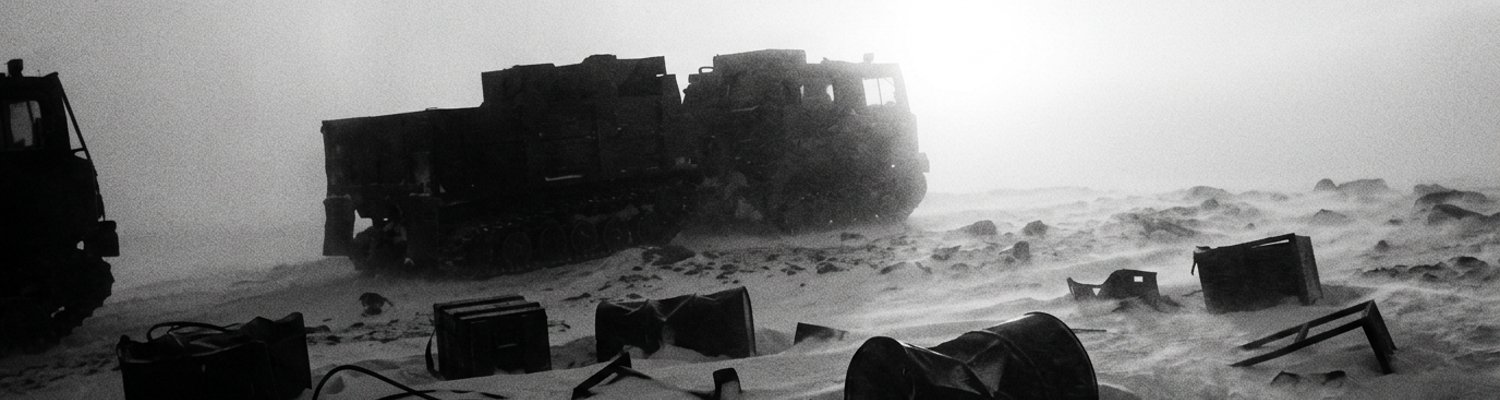

Clandestine Subarctic Depot Operations
Primary M1950 steel retaining bands snapped under sub-zero thermal contraction. Sharp cracks echoed across the ice. Private First Class Miller was blinded by atomized hydraulic fluid. The main winch of his M29C Weasel cargo carrier sheared off its mounting bracket at 58 degrees North. Archival evidence shows the ambient temperature had dropped to negative forty-two degrees Fahrenheit. Synthetic rubber seals on the primary cache containers fractured into brittle shards. Enlisted men from the detached 537th Quartermaster Company scrambled across blue-ice permafrost. They tried to manually secure three thousand pounds of exposed Class V ammunition. Whiteout conditions threatened to bury the drop zone.
The covert supply chain disintegrated in the dark.
A close review of operational logs indicates this disaster originated months earlier inside the tightly compartmented planning rooms of the Central Intelligence Agency. In mid-1954, CIA quartermaster elements operating under the newly reorganized Directorate of Plans drafted a classified directive. They wanted to establish a network of clandestine stay-behind supply depots across isolated subarctic corridors in eastern Canada. The operational blueprint required fifty-two separate subterranean stockpiles spaced at fifty-mile intervals along the Ungava Peninsula and the Labrador coast. Planners in Washington mandated that each buried depot contain enough specialized equipment to sustain a twelve-man guerrilla resistance cell for six months. Manifests included crates of .30-06 M2 armor-piercing ammunition. Unmarked M1 Garand rifles packed in heavy cosmoline filled the steel drums. Manual hand-crank radio transmitters and volatile blocks of Composition C-3 explosives rounded out the inventory. Intelligence analysts anticipated Soviet long-range aviation units utilizing the polar route for a sudden airborne invasion. Planners expected paratroopers to drop directly into the Canadian shield. The CIA required these caches to be completely undetectable from the air and entirely self-contained within hermetically sealed steel drums.
Washington drafted the doctrine without allocating the specialized engineering equipment necessary to excavate the frozen terrain.
US Army supply personnel were assigned ground-level execution roles. Command elements detached specialized platoons from the Army Transportation Corps. They stripped the enlisted men of their standard unit insignia. The soldiers deployed under civilian cover through Royal Canadian Air Force Station Goose Bay. Ground crews received prototype cold-weather entrenching gear. Officers ordered them to manually excavate permafrost trenches six feet deep. Operational reports show the physical toll on the units was immediate. Standard issue steel shovels snapped at the handle base after striking the frozen Canadian bedrock. The men resorted to using localized thermite charges to soften the ground. This expedient method frequently resulted in severe flash burns and toxic smoke inhalation in the confined trench spaces. Soldiers worked twelve-hour shifts in total darkness during the winter months. They hauled two-hundred-pound steel drums off the backs of struggling tracked vehicles.
Frostbite claimed the extremities of fourteen men during the first three weeks of the operation.
Mechanical failures compounded the physical injuries as the deployment dragged into late November. The M29 Weasels assigned to transport the caches across the roadless tundra repeatedly threw their tracks. Suspension bogeys froze solid. Army mechanics had to thaw the steel track pins using blowtorches while lying on their backs in the snow. The disconnect between the CIA quartermaster specifications and the ground-level conditions becomes glaringly apparent in the historical record. Original cache blueprints called for standard rubber gaskets to seal the lids of the subterranean drums. These specific gaskets lost all elasticity at negative twenty degrees. Sub-surface moisture penetrated the containers. The internal contents froze into a solid block of ice and metal.
Commanders at Goose Bay logged the receipt of a direct field wire instructing the ground crews to proceed with the interment of the compromised drums at coordinate sector 4A.
Diplomatic Friction and Bureaucratic Delays
A close review of declassified State Department cables (NARA Record Group 59) from October 1954 reveals a severe administrative deadlock. The dispute occurred between the CIA Directorate of Plans and the US Ambassador to Canada. Intelligence officials had unilaterally scheduled thirty-four low-altitude supply drops using Fairchild C-119 Flying Boxcars. These flights were intended to resupply the forward ground excavation teams. Diplomats in Ottawa intercepted the uncoordinated flight manifests on October 12. The State Department immediately revoked all cross-border flight clearances. Bureaucratic friction between diplomats and intelligence officials delayed air-drop clearances for weeks. Civilian attaches demanded that Royal Canadian Air Force observers be stationed aboard every American cargo plane. They wanted to verify the exact contents of the heavy equipment airdrops. CIA station chiefs operating under Allen Dulles categorically refused this demand. They needed to protect the highly compartmentalized nature of the subterranean caches. This inter-agency standoff paralyzed the entire airborne supply chain just as the early winter storms began rolling across the Ungava Peninsula. The Directorate of Plans refused to compromise on the manifest secrecy. State Department personnel threatened to involve the President if unauthorized flights crossed the 49th parallel.
Seven C-119 aircraft sat grounded on the concrete aprons at Loring Air Force Base for twenty-one consecutive days.
Aviation mechanics at Loring struggled to maintain the idle aircraft as temperatures plummeted. The prolonged delay forced ground crews to continuously cycle the Wright R-3350 Duplex-Cyclone radial engines. They needed to prevent the internal lubricating oil from congealing into a heavy sludge. The oil froze anyway. Base supply officers rapidly exhausted their monthly allocation of isopropyl de-icing fluid. Flight logs indicate that by November 2 heavy rime ice had formed on the leading edges of the C-119 wings. Three of the primary transport planes became completely unflyable. Intelligence officers in Washington refused to adjust their drop coordinates. They denied substitute ground transport.
The diplomatic hold starved the forward operating bases of heating fuel and replacement parts.
Shifting command directives left supply teams stranded in remote staging areas without clear operational timetables. Archival evidence shows that as the Washington bureaucrats argued over flight clearances, the CIA operations desk issued eleven contradictory route modifications. The ground units received these orders between October 15 and November 8. Detached platoons of the 537th Quartermaster Company had already advanced two hundred miles north of Goose Bay. They established Staging Area Delta at coordinates 57 degrees 48 minutes North by 69 degrees 14 minutes West. This position sat directly on the exposed permafrost near the frozen banks of the Koksoak River. The initial planning document required them to hold this position for exactly forty-eight hours. They were supposed to receive the C-119 parachute airdrops before pushing into the Torngat interior. The command element suddenly ordered the teams to halt all movement. They were told to maintain strict radio silence pending new drop zone coordinates. Three days later a highly encrypted transmission directed the unit to displace forty miles east into a dense spruce bog. That exact order was countermanded within twelve hours. Ground commanders had no idea if they were waiting for an immediate supply drop or a full mission abort.
They simply waited.
Enlisted men huddled inside uninsulated canvas squad tents while awaiting a final decision. The absence of a fixed schedule forced the stranded supply teams to consume their emergency tactical reserves. Quartermasters had only packed enough M-1950 squad stove fuel for a rapid five-day transit mission. Constant directives to hold position meant the mechanics had to keep the M29C Weasel engines idling continuously. This prevented the coolant lines from bursting in the negative thirty-degree air. Motor pool sergeants logged the daily consumption of eighty gallons of high-octane gasoline just to keep the tracked vehicles operational at the static encampment. Daily situation reports transmitted from Staging Area Delta detail a rapid degradation of unit capabilities. Soldiers resorted to burning empty wooden ammunition crates and spare wooden track-skids for warmth.
Supply sergeants officially recorded their last remaining ration of white gas on the morning of November 11.
Improvised Night Air-Drops in Sea Fog
The diplomatic hold ended on November 14. The CIA operations desk issued an immediate launch order to meet the winter freeze deadline outlined in Directive 44-Alpha. Archival evidence (File Designation 44-B) shows the 61st Troop Carrier Squadron received direct instructions to bypass standard safety protocols. They initiated immediate resupply flights over the Ungava Peninsula. Daylight lasted barely five hours at that extreme northern latitude. Navigators aboard the Fairchild C-119 Flying Boxcars had to rely entirely on dead reckoning over completely featureless tundra. A dense advection fog formed over the Labrador Sea just as the first wave of aircraft crossed the 60th parallel. This specific meteorological event created a blinding gray mass of suspended ice crystals from sea level up to four thousand feet. Pilots suddenly found their cockpit windshields coated in heavy freezing drizzle. The ice overwhelmed the electrical de-icing boots. Operational logs indicate the squadron commander ordered the flight crews to descend to dangerously low altitudes. Heavy transports dropped down to eight hundred feet above ground level to visually acquire the ground teams and their magnesium signaling flares. Cargo planes were flying completely blind through the dense cloud cover. Radar altimeters continuously registered false returns off the thick layers of ice fog. This provided the flight decks with wildly inaccurate terrain clearance readings.
Aircrews manually shoved the three-thousand-pound steel containers out the open rear clamshell doors into total darkness.
Reduced visibility destroyed any chance of accurately calculating the wind drift for the heavy cargo loads. A close review of post-mission debriefings reveals intense arctic air currents accelerating through the Torngat mountain passes. Sustained speeds reached sixty knots. The sixty-four-foot G-1 cargo parachutes deployed exactly as designed when the static lines snapped tight against the overhead anchor cables. High-velocity downdrafts immediately caught the nylon canopies. Instead of dropping vertically into the designated soft snow-filled ravines, the prevailing winds dragged the massive supply drums laterally across the sky for over two miles. Ground troops from the 537th Quartermaster Company stood helpless in the drop zone at coordinate sector 7G. They listened to the sound of the Wright R-3350 radial engines overhead without seeing a single parachute break through the fog layer. The entire payload drifted completely off target.
The subterranean cache components slammed directly into the exposed Precambrian granite ridges of the Canadian Shield.
Impact forces shattered the hermetically sealed containers upon contact with the metamorphic rock. Quartermasters eventually located the debris field scattered across three miles of jagged gneiss formations near coordinates 59 degrees 22 minutes North by 63 degrees 53 minutes West. Heavy A-22 canvas cargo bags ripped completely open upon striking the sharp stone outcroppings at thirty feet per second. Medical supplies lay scattered across the frozen rock face alongside cosmoline-packed M1 Garand rifles and high-frequency radio transmitters. Ground teams found the specialized rubber gaskets designed to protect the cache internals completely shredded by the violent impacts. Sub-zero temperatures immediately flash-froze the exposed medical saline. The cold shattered the fragile glass vacuum tubes required for the communication gear.
Supply personnel recorded a ninety-two percent total loss rate for the November 15 airdrop.
Flight engineers on the remaining C-119s attempted to adjust their release points on subsequent passes by factoring in the severe crosswinds. This improvised solution failed completely when the sea fog thickened and obscured the terrain entirely. Pilots lost all visual reference to the horizon. They could not distinguish the white sea ice of the Ungava Bay from the snow-covered shoreline below them. Navigators frantically calculated new release coordinates using only a stopwatch and a pitot-static airspeed indicator while the aircraft shook violently in the mechanical turbulence. Altimeter needles fluctuated wildly between five hundred and nine hundred feet. Heavy cargomasters struggled to maintain their footing on the icy aluminum deck plates as they rigged the next batch of steel drums for deployment. Loadmasters secured themselves to the fuselage bulkheads with nylon webbing to avoid being pulled out the open rear doors.
One sudden downdraft threw a loose two-hundred-pound crate of Composition C-3 explosives directly across the sloping cargo bay.
Ground Retrieval in Subzero Terrain
Archival evidence shows the shattered debris of the November 15 airdrop triggered an immediate retrieval mandate from the CIA operations desk. Ground commanders at coordinate sector 7G received encrypted orders to recover the dispersed payload before an incoming blizzard buried the drop zone. Enlisted personnel from the 537th Quartermaster Company deployed directly into pitch-black subarctic conditions. Platoon leaders organized sweep lines across three miles of jagged Precambrian granite. Visibility dropped to zero as thick advection fog froze solid against the cold-weather face masks. Soldiers navigated the treacherous terrain using only standard-issue MX-991/U angle-head flashlights. Chemical charges inside the heavy D-cell batteries depleted within fifteen minutes of exposure to the negative forty-two-degree ambient air. Men stumbled blindly over sharp gneiss outcroppings while searching for the smashed supply crates. Heavy snow drifts obscured deep fissures in the metamorphic rock. Several soldiers fell through the crust into hidden crevices. They sustained severe blunt force trauma against the granite walls.
Recovery teams resorted to crawling on their hands and knees across the blue-ice permafrost to locate the debris field by touch.
A close review of operational logs indicates a total systemic breakdown of the issued winter gear during this blind search. Standard-issue M-1944 shoepacs worn by the quartermasters featured rubber bottoms that crystallized and split open under the extreme thermal stress. Freezing meltwater from the deep snow immediately penetrated the cracked boots. Soldiers suffered severe frostbite within thirty minutes of the integrity breach. Medical officers recorded rapid tissue necrosis spreading through the lower extremities of twenty-two enlisted men during the first four hours of the retrieval effort. Gangrene threats escalated as blood flow ceased entirely in the affected toes. Ground troops lacked any functional heating equipment to treat the injuries. White gas fuel inside the M-1950 squad stoves thickened into a combustible slush. Ignition became impossible. Mechanics attempting to support the search grid experienced identical cold-weather equipment failure with their transport vehicles. Exposed starter solenoids on the M29C Weasels locked solid. This mechanical fault forced the injured men to drag the recovered cache components manually across the frozen tundra using heavy canvas sleds.
Command elements in Washington denied requests for a tactical pause. They ordered the search to continue until all high-explosives were accounted for.
The specific condition of the located supplies rendered the physical sacrifice entirely useless. Quartermasters found the steel cache drums violently deformed by the high-velocity impact against the Canadian Shield. Specialized internal rubber gaskets meant to seal the subterranean depots were completely shredded. Soldiers reached into the torn steel containers and pulled out blocks of Composition C-3 explosives that had fractured into sharp brittle fragments. Cosmoline-packed M1 Garand rifles lay twisted among sharp rock fragments with their wooden stocks splintered beyond repair. Medical personnel cataloged the destruction of the emergency field surgical kits. Glass ampoules of morphine syrettes pulverized upon impact. The narcotics mixed with flash-frozen saline solution and shredded A-22 canvas cargo bags. Enlisted men had to gather these frozen shards with their bare hands after their standard-issue leather work gloves froze solid and prevented finger articulation. Sweat inside the leather linings had turned into rigid ice crystals. Skin instantly bonded to the supercooled steel debris upon contact. Medics had to tear the flesh away from the metal to free their hands.
Unit rosters show thirty-one soldiers required immediate amputations of their digits by daybreak on November 16.
Detached platoons spent fourteen consecutive hours exposed to the severe arctic winds while cataloging the destroyed payload. Operations officers at Staging Area Delta demanded an itemized manifest of every ruined component via high-frequency radio. Copper antenna wiring on the AN/GRC-9 radio sets became entirely brittle and snapped during deployment. Radiomen tried to splice the frozen cables together using bare copper wire. Ambient wind chill factors dropped the effective temperature to negative sixty-five degrees Fahrenheit while the technicians worked. A sudden gust of wind blew a jagged piece of a shattered cache lid into the primary communications tent. Flying steel debris sliced directly through the uninsulated canvas wall. It severed the main power conduit connecting the hand-crank generator to the transmitter.
Conflicting Directives and Cache Ruptures
High-pitched static screamed through the surviving AN/GRC-9 receiver. Private First Class Miller desperately clamped the frozen Bakelite headphones against his frostbitten ears. A violent gust of negative forty-degree wind tore through the shredded canvas of the primary communications tent at Staging Area Delta. Enlisted men from the 537th Quartermaster Company were bleeding from their bare hands outside in the whiteout conditions. They were trying to manually pry open deformed steel M1950 supply drums scattered across the jagged Precambrian granite of coordinate sector 7G.
The chain of command completely dissolved in the freezing darkness.
Archival evidence shows a total breakdown in communication protocols between the civilian intelligence handlers in Washington and the military supply commanders stationed at Royal Canadian Air Force Station Goose Bay. The CIA operations desk demanded immediate priority on recovering the highly classified cryptographic cipher pads and the fragile vacuum tubes required for the covert stay-behind transmitters. Army officers simultaneously transmitted overlapping orders on the exact same high-frequency channel. They directed the quartermasters to abandon the broken electronics. The military command required the men to secure the scattered blocks of Composition C-3 explosives before the impending blizzard buried the valley floor. Radiomen had to rapidly switch between the CIA one-time pad decryption matrices and the standard Army field ciphers while their fingers stuck to the supercooled metal dials of the transceiver. Miller logged fourteen conflicting directives within a forty-five-minute window. Washington threatened immediate court-martial if the classified documents were left exposed on the ice. Goose Bay ordered a mandatory tactical withdrawal to the secondary tree line to prevent mass frostbite casualties among the search teams. Officers on the ground lacked the clear jurisdictional authority to override the civilian intelligence handlers.
Platoon leaders simply stopped answering the radio.
A close review of operational logs indicates the catastrophic physical state of the drop zone rendered the conflicting orders entirely moot. The fifty-five-gallon hermetically sealed steel drums had struck the metamorphic rock outcroppings at terminal velocity after drifting two miles off target. Their primary retaining bands snapped instantly upon impact with the Canadian Shield. Sub-zero thermal contraction had already degraded the synthetic rubber gaskets designed to waterproof the lids. The seals shattered into useless fragments. Exposed to the atmospheric conditions, the highly classified contents spilled directly into deep snowdrifts. Heavy canvas A-22 cargo bags ripped open against the sharp gneiss formations near 59 degrees 22 minutes North by 63 degrees 53 minutes West. Inside those bags, the unmarked M1 Garand rifles packed in thick cosmoline were hopelessly compromised by the extreme cold. The protective grease flash-froze into a solid block. This permanently jammed the rifle actions open and bound the internal operating springs. Soldiers struck the charging handles with steel mallets. They fractured the brittle operating rods directly in half.
Medical supplies fared much worse against the extreme subarctic temperatures.
Glass vials containing emergency morphine syrettes shattered inside their aluminum transport cases upon striking the exposed granite ridges. The liquid narcotics instantly turned into rigid yellow ice crystals embedded in the snow. Quartermasters cataloged the total destruction of the primary power units required to run the stay-behind radio networks. Hand-crank generators had their internal copper coils severed by flying shrapnel from the ruptured outer steel casings. The loss of the specialized cold-weather survival gear proved catastrophic for the forward operating bases. Insulated sleeping bags and prototype chemical heating packets were blown across three miles of open tundra by sustained sixty-knot downdrafts. Detached platoons spent six hours crawling across the blue-ice permafrost to recover the scattered materials. They found only twenty percent of the original payload intact. The remaining eighty percent consisted of twisted metal, pulverized glass, and frozen rations completely unfit for human consumption.
Supply sergeants logged the recovery of three intact field compasses out of an initial manifest of forty.
Ground commanders stared at the useless debris while the AN/GRC-9 radio continued to emit a continuous stream of contradictory Morse code. The CIA operations desk transmitted a final unencrypted demand for the recovery teams to proceed north with the salvaged equipment to establish the first subterranean depot. Army officers at Goose Bay simultaneously broadcast a mandatory recall order for all surviving personnel to retreat south toward the tree line. The enlisted men lacked the basic functional equipment to execute either directive. Their M29C Weasel cargo carriers sat immobilized on the frozen tundra with shattered suspension bogeys.