
Hagushi Beachhead Civilian Starvation
Archival evidence shows that XXIV Corps Civil Affairs detachments operating directly behind the 7th, 96th, and 77th Infantry Divisions encountered a severe demographic collapse on the Hagushi amphibious staging beaches during the first week of May 1945. Over 150,000 Okinawan non-combatants moved southward from the northern districts. Retreating Japanese Thirty-Second Army elements evicted these civilians from subterranean defensive positions. The refugees streamed into a narrow beachhead footprint measuring less than six square miles. Army Medical Corps field reports (File Reference 44-A-12) recorded high malnutrition rates across the sector. Acute outbreaks of bacillary dysentery and epidemic typhus spread among displaced family units crowding bivouac zones near Kadena airfield. The primary military government detachments, designated as B-1 and C-1 teams, possessed organic medical rations for exactly 10,000 individuals over a ten-day period.
The supply calculations failed immediately.
Field hospital staff lacked sufficient parenteral fluids. They ran out of sulfadiazine tablets and DDT powder spray units required to establish containment perimeters. Ground commanders reallocated combat rations from frontline infantry companies. They diverted K-ration packets and 10-in-1 group rations to prevent total demographic collapse in the rear sectors.
Torrential monsoon downpours began on May 11.
A close review of operational logs indicates that these storms systematically wrecked the primary shoreward quartermaster dumps along Hagushi beaches Red 1 through Blue 2. Soil composition along this six-mile stretch consisted of dense clay and coral sand. The ground liquefied under continuous rainfall. Mud sloughs formed up to four feet deep. Amphibian trucks, designated DUKW-353 units, sank to their axles along the high-water line. Standard GMC CCKW two-and-a-half-ton supply trucks suffered cracked drive shafts. Drivers burned out clutches trying to navigate the access routes to Beach Dump Number Four. Sump pits overflowed. Thousands of wooden crates containing flour, dried beans, and canned meats washed directly into the surf zone. Toxic mud slides buried the remaining pallets.
Standard United States Army Quartermaster Corps supply doctrine required rigid inventory sorting at static shore dumps prior to inland motor transport.
That doctrine collapsed under the weight of waterlogged cardboard containers. Quartermaster officers could not process formal requisition slips. They failed to maintain stock control ledgers when bulk grain bags burst and rotted within forty-eight hours of offloading from landing craft. The mud stopped every wheel on the western coast. Operational reports sent directly to Tenth Army headquarters at Fort Buckner alarmed state officials in Washington. United States Department of State advisors attached to the Pacific Theater recognized a developing diplomatic crisis. A widespread humanitarian failure on Japanese sovereign territory threatened upcoming post-war occupational policy.
Cable traffic between Admiral Chester Nimitz, General Douglas MacArthur, and the Joint Chiefs of Staff reflected growing anxiety. High civilian casualty rates from starvation promised international condemnation. Staff planners realized that the military government apparatus had to abandon standardized Quartermaster field manuals. Civil affairs officers began commandeering native wooden craft. They modified artillery spotter planes for air-drops. They pressed captured Japanese military supply caches into service.
None of it was enough.
Unsanctioned Requisition of Navy Assets
Bureaucratic channels failed while civilian body counts climbed.
Archival evidence shows that on May 16, 1945, frustrated Civil Affairs officers attached to the XXIV Corps G-4 section made direct contact with Navy Service Squadron 6. They bypassed standard Army Form 400 requisitions entirely. Standard Army Quartermaster Corps protocols mandated a seventy-two-hour clearance window for emergency ration releases through static rear depots. Major-level staff officers recognized that bureaucratic delays would trigger mass casualties among the 150,000 displaced Okinawans along the Hagushi coast. They bypassed Brigadier General David H. Blakelock and his Tenth Army supply officers.
They established direct radio links with Rear Admiral Donald B. Beary.
Beary commanded from his flagship, the auxiliary repair vessel USS Vulcan (AR-5), anchored off Kerama Retto. He directed Navy Service Squadron 6. This elite mobile logistics unit was organized specifically to rearm, refuel, and resupply Task Force 58 warships at sea. They operated without returning to land bases. XXIV Corps representatives negotiated an unsanctioned ship-to-shore supply pipeline. They requested immediate offloading of Navy canned meats, rice, and medical stores directly onto Navy landing craft.
An unofficial radio transmission overrode formal joint-service doctrine.
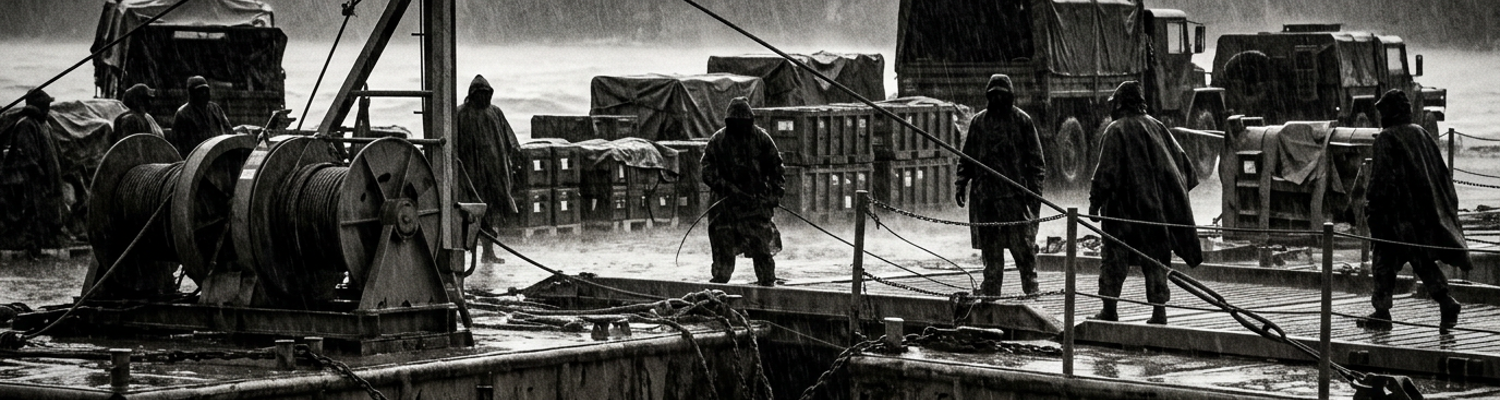
Executing this improvised transfer required Navy crews to repurpose heavy-duty underway replenishment machinery. This gear was designed exclusively for high-seas fleet operations. Service Squadron 6 auxiliaries included store issue ships like USS Pollux (AKS-4) and ammunition ships like USS Wrangel (AE-12). These vessels carried specialized heavy tackle engineered for ship-to-ship transfers during twenty-knot oceanic maneuvers. Navy riggers unbolted tension-compensated winches. They removed steel span-wire rigs, transfer whips, and pelican hook assemblies from their deck mountings. They transferred this heavy equipment to shallow-draft Landing Ship, Tank (LST) hulls.
Sailors set up improvised cableway systems.
Instead of rigging high-lines between fleet oilers and fast aircraft carriers, they stretched cables from LSTs anchored offshore. The lines crossed two thousand yards of shallow coral reef directly to the muddy shorelines of Chimu Wan and Hagushi. Operating under night illumination to evade kamikaze attacks, winch operators used high-seas transfer whips. They moved seventy-five-ton batches of civilian relief supplies over the mud flats. This was the same mud that had paralyzed standard Army GMC CCKW two-and-a-half-ton trucks. Navy personnel transferred over three hundred tons of emergency rations, sulfur powder, and parenteral fluids across the reef line in forty-eight hours. They fed forty thousand non-combatants in the southern sector.
This unauthorized inter-service maneuver produced immediate diplomatic panic in Washington.
Reports of Army officers commandeering Fifth Fleet operational assets reached Fleet Admiral Ernest King within days. Army Chief of Staff George C. Marshall received the same intelligence briefs. State Department officials attached to the Far Eastern Commission feared that the backchannel requisitioning exposed a systemic failure in American military government planning. International Red Cross representatives from neutral Switzerland were monitoring humanitarian compliance on the island. The Joint Chiefs of Staff recognized that failure to stabilize the Okinawan civilian population would signal administrative weakness to Allied coalition partners. Nimitz ordered an expedited administrative audit of Service Squadron 6 asset allocations. He quietly permitted the unsanctioned supply operations to continue off the Hagushi beachheads.
Replenishment Rig Modifications Under Fire
Steel cables snapped under the strain of high-speed ocean currents.
A close review of operational logs indicates that Japanese Kikusui Number Seven kamikaze raids struck the anchorage on May 24 and 25, 1945. Naval riggers stationed on fleet auxiliaries anchored off latitude 26 degrees 17 minutes North, longitude 127 degrees 53 minutes East modified standard underway replenishment machinery under direct anti-aircraft fire. Standard United States Navy high-line rigs were built to transfer fuel oil and heavy ammunition between moving warships. They used 7-inch Manila rope and steel tensioning cables. Low-flying Mitsubishi A6M Zero and Aichi D3A dive-bombers pressed attacks against the anchorage. Deck crews from the 72nd Naval Construction Battalion and Navy Service Squadron 6 used torch cutters and heavy wrenches. They stripped steam-driven winches directly off the decks of damaged fleet oilers like USS Kaskaskia (AO-27).
Mechanics re-engineered the winch friction clutches.
They welded custom extension frames onto cargo booms mounted aboard shallow-draft Landing Ships, Medium. Steel span-wire assemblies broke repeatedly. Ocean swells slammed craft against the sharp coral shelves along the eastern shores of Nakagusuku Wan. Shipboard machinists fabricated reinforced snatch blocks out of scrap hull plate to prevent tension wire binding. This allowed continuous rig operation even as Japanese suicide planes splashed within five hundred yards of the offloading stations. Flame and burning aviation fuel covered the water.
The winches kept turning.
Archival evidence shows that Navy deck crews and XXIV Corps Civil Affairs personnel routed these modified cables directly onto grounded pontoon causeways at Chimu Wan. They had to bypass submerged reefs. Seabees had built two-hundred-foot lines of Navy Lighterage steel pontoons. They anchored them to the sea floor where low tide exposed jagged coral heads. Winch operators dropped cargo nets packed with 100-pound bags of imported rice and sulfur powder chests. They transferred sulfadiazine tablets and portable Badger brand thermo-compression water filtration units directly onto the wooden deck planking of the causeways.
The Badger purification units weighed over eighteen hundred pounds each.
They required four-point bridle slings to prevent internal evaporator coils from cracking during rapid transit across the swell. High-line travelers moved continuous six-ton hourly loads from ship to causeway under smoke screens deployed by coastal patrol craft. Shore parties from the 96th Infantry Division Quartermaster section immediately loaded the rice and water equipment onto tracked M29 Weasel cargo carriers. They supplied Civil Affairs field stations treating thousands of malnourished Okinawan refugees. News of these tactical improvisations reached diplomatic observers in Tokyo and Allied capitals through neutral radio intercepts. Japanese cabinet ministers in the Supreme Council for the Direction of the War had calculated that civilian distress in occupied territories would force American forces to divert substantial naval transport assets away from combat operations.
They expected this to delay the impending assault on the Japanese home islands.
The rapid engineering adaptations performed off the Okinawan coast proved that American amphibious forces could sustain a civilian population without stripping front-line combat units of logistics support. United States Department of State analysts documented that the stabilization of the Okinawan civilian population dismantled a major Japanese propaganda narrative. This operational flexibility altered diplomatic estimates in Washington concerning the civilian relief costs required for Operation Downfall. Naval logistics units could improvise humanitarian lifelines under extreme combat conditions. By June 1, Navy riggers had delivered forty-two Badger filtration units and two hundred tons of polished rice directly across the causeways to XXIV Corps handlers.
Interagency Jurisdictional Disputes
The unauthorized diversion of specialized front-line fleet replenishment assets sparked aggressive resistance from naval command.
A close review of operational logs indicates that Admiral Raymond Spruance and his Fifth Fleet staff operated under Fleet Operational Order 4-45. This directive strictly prioritized heavy ammunition, high-octane aviation fuel, and diesel transfers for Task Force 58 fast carrier groups above all secondary shore missions. Diverting tension-compensated winches, steel span-wire rigs, and heavy cargo booms from auxiliary store ships like USS Pollux directly reduced the fleet high-seas sustainment capacity. Vice Admiral Charles M. Cooke Jr. served as Deputy Chief of Naval Operations for Operations. He dispatched a flash telegram to Tenth Army headquarters at Fort Buckner. He demanded the immediate return of all naval rigging gear.
Fleet Admiral Ernest King instructed his staff in Washington to file formal charges against XXIV Corps officers.
The charge was violating Joint Chiefs of Staff distribution directives. Naval logisticians insisted that stripping fleet oilers and repair ships of specialized transfer whip assemblies threatened carrier strike readiness. This occurred during ongoing Japanese kamikaze attacks against American staging anchorages at Kerama Retto. Inter-service friction quickly escalated into an administrative showdown in Washington. Archival evidence shows that this supply dispute exploded into fierce jurisdictional debates between the Navy, War, and State Departments. The core issue was authority over post-war Pacific civil administration.
The State-War-Navy Coordinating Committee was established under Directive SWNCC 150.
Within this committee, executive officials clashed over which department possessed legal jurisdiction to govern civilian populations across conquered Japanese island chains. Major General John H. Hilldring directed the War Department Civil Affairs Division. He insisted that ground occupation operations fell under Army control. He cited General Douglas MacArthur and his mandate for post-war military government in the Far East. Fleet Admiral King countered that the Navy Department held primary administrative authority over island territories within Pacific Ocean Areas. King proposed a permanent naval governorship for the Ryukyu Islands under Admiral Chester Nimitz.
State Department advisors entered the fray.
Assistant Secretary James F. Byrnes expressed deep concern that unauthorized military improvisations breached legal obligations under the 1929 Geneva Convention regarding non-combatant care. Diplomatic cables warned that administrative collapse on Okinawa would damage American diplomatic standing. Allied coalition talks regarding the post-war administration of East Asia were approaching. Policy disputes in executive corridors altered supply allocations on the ground. This inter-departmental gridlock forced the Joint Chiefs of Staff to issue emergency compromise guidelines on June 5, 1945.
Joint Chiefs Memorandum 1378 established temporary shared jurisdiction over Okinawan civil affairs.
The memorandum assigned tactical supply fulfillment to XXIV Corps G-4. It kept overall military government policy under Navy theater oversight. Army Quartermaster Corps units received authorization to requisition naval landing craft for emergency civilian feeding. These requisitions had to pass through regional clearinghouses in Pearl Harbor. State Department observers stationed on Okinawa were authorized to submit bi-weekly humanitarian assessment reports directly to the Secretary of State. This created an independent diplomatic reporting channel that bypassed field commanders. Navy riggers on board the repair vessel USS Vulcan continued operating improvised cableways into Chimu Wan. They operated under modified orders that reclassified civilian relief supplies as essential theater security materials. Field units maintained food distribution pipelines to over 150,000 Okinawan non-combatants without interrupting fleet replenishment schedules. Army G-4 ledgers recorded twelve thousand tons of grain processed under these emergency joint procedures by June 10, 1945.
Post War Pacific Civil Administration Protocols
Informal beachhead compromises shattered established Joint Chiefs of Staff administrative boundaries across the Pacific.
A close review of operational logs indicates that the unauthorized transfer of Service Squadron 6 deck machinery to XXIV Corps Civil Affairs teams fundamentally disrupted long-standing interservice administrative frameworks. These frameworks governed occupied territories. Standard War Department doctrine was formalized under Joint Army-Navy Basic Publication 1. This doctrine strictly separated maritime fleet sustainment from army military government logistics. XXIV Corps officers bypassed Tenth Army G-4 clearance channels on May 16, 1945. They drew two hundred tons of rice and sulfadiazine directly from USS Pollux and USS Wrangel off latitude 26 degrees 15 minutes North, longitude 127 degrees 45 minutes East.
They broke the structural barrier between fleet operations and land administration.
Navy logisticians discovered that winches, 7-inch Manila high-lines, and pelican hooks stripped from repair ships like USS Vulcan directly reduced Task Force 58 carrier replenishment schedules. This reduction happened during peak Kikusui air attacks. Fleet Admiral Ernest King immediately notified War Department planners that Army officers had usurped naval authority in Pacific Ocean Areas. The unauthorized ship-to-shore supply pipeline proved that existing administrative regulations could not prevent field commanders from raiding naval war reserves. Confronting civilian mass starvation behind the lines forced their hand.
Administrative procedures in Washington failed under combat conditions.
Archival evidence shows that the resulting cabinet-level confrontation between Secretary of War Henry Stimson, Secretary of the Navy James Forrestal, and State Department leadership forced a total restructuring of interagency governance. This restructuring targeted the post-WWII Pacific theater. Cabinet meetings held throughout June and July 1945 exposed deep institutional anxieties. Unregulated military improvisations threatened to violate international law under the Geneva Convention. They also threatened to trigger civil collapse during the upcoming invasion of mainland Japan.
State-War-Navy Coordinating Committee document SWNCC 150/4 directly addressed the Okinawan jurisdictional breakdown.
It established formalized protocols for joint military and civilian administration. Under these revised protocols, the Joint Chiefs of Staff created unified civil affairs logistics pools. These pools bound Army distribution networks to Navy maritime transport assets under a single operational command structure. State Department representatives received permanent observer seats on theater governance boards. This ensured humanitarian food distribution protocols met international treaties without stripping combat fleets of operational gear. These standardized protocols governed American military occupation forces across Japan, South Korea, and the Trust Territory of the Pacific Islands throughout the late 1940s.
Administrative chaos on a single island reshaped American Pacific occupation policy.
Operational planners incorporated these joint supply protocols directly into Operation Downfall staging orders issued in August 1945. Logistics officers designated standardized joint civil affairs berths at Yokohama and Sasebo. They allocated dedicated shallow-draft landing craft and pre-packaged civilian relief rations prior to troop landings. SWNCC directives had cataloged over forty thousand tons of emergency grain, DDT powder spray units, and water purification units under joint service control by August 15, 1945.