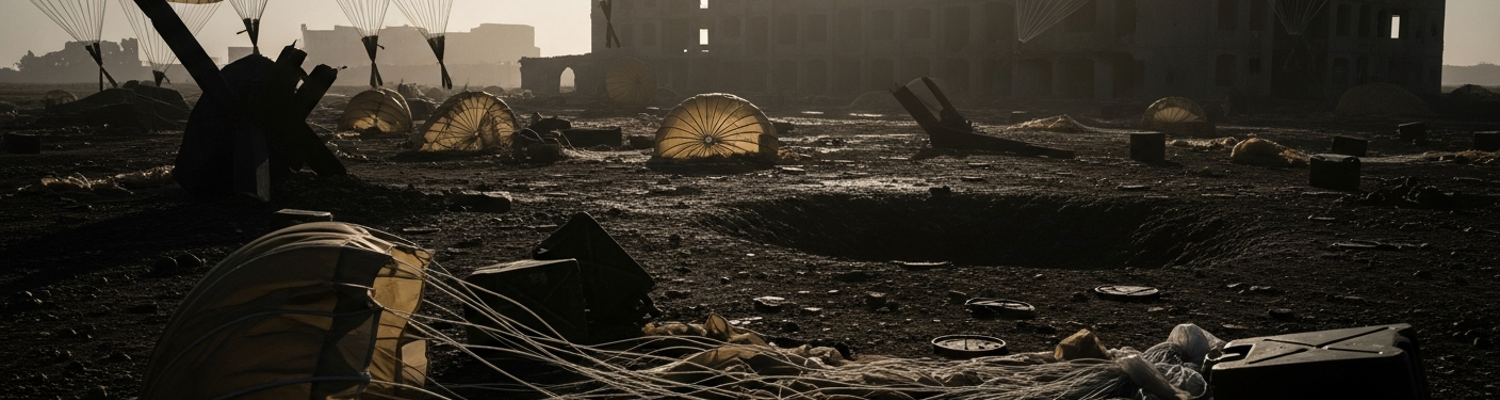

Airborne doctrine dictated drops onto wide, open fields where units could land, consolidate, and maneuver. The assault on Corregidor presented the men of the 503rd Parachute Regimental Combat Team with the direct opposite. Planners, confronting an island fortress whose cliffs and artillery emplacements negated any conventional amphibious landing, were forced into a radical vertical envelopment. The targets were the only two remotely flat surfaces available: Drop Zone "A" on the old post parade ground and Drop Zone "B" on a pre-war nine-hole golf course. Both were located on the island’s western plateau, known as "Topside." The choice was born from a complete absence of viable alternatives.
A close review of operational logs (NARA Record Group 338) reveals the extreme physical constraints. The Parade Ground measured a mere 325 by 250 yards, hemmed in by the skeletal remains of barracks and headquarters buildings. The golf course was even more restrictive at roughly 350 by 185 yards. Both zones were littered with the debris of a massive pre-invasion aerial and naval bombardment. The ground was a moonscape of craters, shattered trees, and twisted steel rebar. Compounding the danger were 16 to 18-knot winds that swept across the island on the morning of February 16, 1945, threatening to blow jumpers off the plateau and onto the 500-foot cliffs bordering the drop zones. C-47 transport planes had to fly low and make multiple passes, with jumpmasters sending only a few paratroopers out the door at a time to have any chance of hitting the constricted fields.
The collision of men with this unforgiving terrain produced an immediate and high casualty rate before the battle with the Japanese defenders had truly begun. Archival evidence shows that of the 2,050 men who jumped, 210 suffered landing injuries. This figure, a loss of over ten percent of the initial force, does not include those killed or wounded by enemy fire during descent or immediately upon landing. Troopers slammed into the ruins of concrete buildings, with two men dying on impact. Others landed in bomb craters, among shattered tree trunks, or on the hard-packed earth, resulting in a high incidence of broken bones, severe sprains, and concussions. The pre-invasion bombardment, intended to soften defenses, had inadvertently turned the drop zones into a landscape of hazards that maimed a significant number of the attackers. The loss of nine medics and thirteen artillerymen to jump injuries on the first drop alone immediately strained the unit’s ability to care for its wounded and provide fire support.
This operational friction extended directly to equipment and unit cohesion. The combination of high winds and minuscule targets guaranteed a portion of the force would be scattered. Men and essential supplies were dragged across the hazardous terrain or blown completely off the plateau. Entire sticks of paratroopers landed far from their designated companies, fragmenting the force at the moment of insertion. Instead of assembling and moving on objectives, leaders spent precious time trying to locate and rally their dispersed soldiers. Supply canisters containing mortars, machine guns, and ammunition plunged into the South China Sea or became entangled in the jungle-choked ravines surrounding Topside. They were lost to the men who desperately needed them. The 462nd Parachute Field Artillery Battalion lost equipment, impacting its ability to bring its 75mm pack howitzers into action. This initial fragmentation and loss of heavy equipment meant the 503rd began its fight for Corregidor not as a cohesive regiment, but as a collection of small, isolated groups forced to engage a determined enemy with only the weapons they had carried down.
Operational logs from the 317th Troop Carrier Group reveal the mechanical reality of resupply missions over Corregidor. The sky itself was a weaponized space. Japanese forces, though cut off and defending fixed positions, maintained a significant and effective anti-aircraft capability. This was not a token defense. It was a dense, overlapping field of fire designed to sever the airborne lifeline to the 503rd PRCT. The primary threats were the Type 96 25mm twin-mount cannons and older, but still functional, 120mm dual-purpose guns. Japanese troops had spent years fortifying the island, and these weapons were emplaced in concealed positions across Topside and the island’s flanks, creating interlocking kill zones. The C-47 Skytrain transport aircraft, lumbering and slow, had to fly at perilously low altitudes, sometimes below 500 feet, to have any chance of hitting the small drop zones. This made them predictable targets. More than half of the 51 C-47s involved in the initial lifts sustained battle damage from concentrated anti-aircraft and small arms fire. For the pilots, each pass was a gauntlet of tracer rounds and flak bursts that tore through wings and fuselages, wounding crew and the paratroopers waiting to jump.
The constant winds blowing off the South China Sea were a known and unavoidable factor. These winds created a dual problem. First, they directly affected the flight stability of the C-47s on their low, slow drop runs, forcing pilots to make constant corrections that threw off the timing for the jumpmasters and supply kickers. Second, the wind caught the large canopies of the supply parachutes and dragged them far from their intended targets. A perfectly executed drop from the aircraft could still result in a complete mission failure if a sudden gust carried the supplies over the cliffs or into impassable jungle ravines. The result was a high percentage of supplies being scattered, damaged, or lost entirely. Archival evidence shows that subsequent supply drops after the initial assault were plagued by these same issues. Entire loads of desperately needed water, ammunition, and medical equipment drifted into Japanese-held territory or plunged into the sea.
Recovery was a separate, perilous battle.
Even when a supply bundle landed on the island, its retrieval was not guaranteed. Corregidor’s terrain, already difficult, had been transformed by months of bombardment into a landscape of hazards. The so-called drop zones were cratered moonscapes littered with shattered trees, twisted rebar, and unexploded ordnance. A supply canister that missed the designated zone by even a hundred yards could become effectively irretrievable. It might be lodged high in the canopy of the remaining jungle, wedged in a deep shell crater, or have come to rest in an area still actively covered by Japanese sniper and machine-gun fire from hidden caves and tunnels. Recovery teams from the 503rd had to be dispatched on what amounted to tactical operations simply to retrieve a few boxes of K-rations or a canister of mortar rounds. This diverted combat manpower from the front lines and exposed them to additional casualties. The loss of heavy equipment like the 462nd Parachute Field Artillery Battalion’s 75mm pack howitzers and their ammunition during the drop phase directly impacted the regiment’s ability to support its advance. An estimated 95 percent drop effectiveness was recorded by the aircrews, but this metric only measured getting the bundles out of the plane over the target; it did not account for the high percentage lost on the ground due to the unforgiving combination of wind and terrain.
After-action reports for the 503rd Parachute Regimental Combat Team reveal a crippling deficit that began the moment they landed: a severe lack of water. Paratroopers, laden with weapons and basic ammunition, jumped with only their personal canteens. In the intense heat and humidity of a Philippine February, this was a grossly inadequate supply for the extreme physical exertion of combat. The pre-invasion bombardment had systematically obliterated the island’s pre-war water pipes and wells. The initial aerial resupply attempted to rectify this, with C-47s dropping 1,250 gallons of water in five-gallon cans. However, high winds and intense Japanese anti-aircraft fire turned these drops into a lottery. Many canisters were dragged by their parachutes over the cliffs and into the sea. Others fell into Japanese-held ravines, inaccessible to the American troops. The physiological effects on the paratroopers were immediate. Dehydration led to heat exhaustion, reduced physical stamina, and impaired cognitive function under fire. The hunt for water became a tactical operation in itself, diverting manpower from clearing enemy positions as small patrols searched for any viable source, often finding them contaminated or booby-trapped. The situation became so severe that amphibious troops of the 34th Infantry Regiment had to undertake perilous supply runs up contested roads to bring water tanks to the paratroopers on Topside.
This same logistical breakdown constrained the 503rd’s ability to sustain firefights. The nature of the battle for Corregidor, characterized by close-quarters assaults on deeply entrenched Japanese defenders in a labyrinth of tunnels and concrete pillboxes, was exceptionally demanding on ammunition. Units like the 503rd and the attached 462nd Parachute Field Artillery Battalion began the fight already at a deficit, with a significant percentage of their crew-served weapons, mortars, and ammunition lost during the scattered initial drop. This forced an immediate over-reliance on individual riflemen and their limited basic load of M1 Garand clips and bandoliers. Reports indicate that fire discipline became paramount not as a tactical choice, but out of sheer necessity. Commanders were forced to withhold suppressive fire from Browning Automatic Rifles and M1919 machine guns to conserve what little ammunition they had. This allowed Japanese defenders to reposition and return fire with less opposition. The problem was magnified during the numerous Japanese counterattacks and night "banzai" charges, which demanded high volumes of fire to repulse. A successful defense could leave a unit with dangerously low ammunition for the next engagement. On multiple occasions, platoons and companies were forced to disengage or halt an advance not because of enemy pressure, but because their ammunition supply was exhausted.
The fight against infection and trauma was lost before it even began for many. The airborne assault inflicted a high number of landing injuries, and a significant number of medics were among these initial casualties, immediately straining the regiment’s capacity for care. Captain Emmet R. Spicer, a doctor with the 462nd Parachute Field Artillery Battalion, was killed while repeatedly moving under heavy fire to treat the wounded, highlighting the shortage of medical officers. Subsequent supply drops that should have delivered plasma, sulfa powder, morphine, and sterile bandages were just as unreliable as those for water and ammunition. Aid stations were established in shell craters and the ruins of Topside’s barracks, exposed to enemy mortar fire and the elements. The tropical environment and the debris-strewn battlefield created ideal conditions for bacteria. With a lack of bandages and antiseptics, even moderate wounds became highly susceptible to infection. The absence of sufficient blood plasma was particularly devastating, as it was the primary tool for treating shock from blood loss. Many troopers died from wounds that would have been survivable with basic field medical supplies.
The battle for Corregidor was fought not only against the Japanese but against the absolute limits of human endurance. A direct correlation emerged between the failure of the supply chain and the rapid physical decay of the men of the 503rd PRCT. Troopers who had jumped laden with over 90 pounds of gear into the Philippine heat immediately faced a water deficit that would never be corrected. The body’s demand for water, unmet, began to consume the fighting strength of the regiment as surely as any Japanese mortar. This physiological breakdown was compounded by a severe calorie deficit. K-rations were not only in short supply but were often lost during the drop, forcing men to sustain themselves on scavenged food or go without. The physical cost was measured in men who lacked the stamina to carry ammunition boxes, evacuate wounded comrades, or sustain the final charge into a fortified enemy position.
This constant, grinding deprivation had a wearing effect on the morale of the paratroopers. These were veteran soldiers, but the sustained pressure of fighting a hidden, suicidal enemy from a labyrinth of tunnels, combined with the acute shortages, began to fray their psychological resilience. The initial success of the daring airborne assault gave way to a grim, exhausting fight. Sleep was a luxury, constantly interrupted by Japanese infiltration attempts and the unnerving sounds of unseen enemies moving in the darkness. The Japanese defenders, adhering to a code that forbade surrender, launched nightly "banzai" charges from their cave positions. These were not tactical maneuvers but fanatical, human-wave assaults. For the troopers of the 503rd, low on ammunition, every night was a desperate struggle to repulse screaming attackers in close-quarters combat, often ending in hand-to-hand fighting. The psychological strain of this nocturnal warfare was immense. The sight of comrades falling to wounds that could have been treated with basic medical supplies, or suffering from the advanced stages of heatstroke, created a pervasive sense of helplessness that no amount of training could fully prepare them for.
Of the 2,050 men who jumped, the 503rd suffered a total of 844 casualties, a category that included not just killed and wounded, but hundreds listed as injured or sick. The battle was exceptionally vicious, with Japanese defenders preferring suicide, often in massive, tunnel-detonating explosions that also killed dozens of Americans. In this environment, even a moderate shrapnel wound carried a high probability of death. Aid stations, set up in exposed shell craters, lacked plasma to treat shock and sulfa to prevent infection. The loss of medics and their equipment on the initial jump created a ripple effect of suffering through the entire campaign. A trooper with a broken leg from the hazardous landing might be left immobile in an exposed position, a static target for Japanese snipers. A soldier with a gunshot wound to the arm faced the high probability of gangrene in the tropical heat with no antibiotics to treat it. The number of men evacuated due to sickness and exhaustion, 64 in total, speaks to a force being broken down by attrition just as much as by enemy action.
The permanent, visual record of Corregidor’s logistical collapse was captured by the soldier-photographers of the U.S. Army Signal Corps. To keep military command and the public informed, the Signal Corps deployed its Army Pictorial Service film crews globally. These were not journalists; they were soldiers armed with bulky Speed Graphic cameras, operating under the same conditions as the infantry. A review of archival photographs credited to the Signal Corps (specifically the 161st Signal Photographic Company) reveals a focus that went beyond simple combat action. Their lenses documented the physical manifestations of supply failure: images of paratroopers struggling to manually haul heavy ammunition canisters across cratered drop zones, photographs of 75mm pack howitzers lying uselessly where they fell, and shots of aid stations operating in the open ruins of the Topside barracks. Each photograph was a data point illustrating a breakdown. The technical process itself was a challenge, requiring photographers to expose themselves to fire while composing a shot, then attempting to safeguard the delicate film in an environment of dust, extreme humidity, and constant enemy action. These images provided unsparing proof of the operational friction, creating a historical record more visceral and immediate than any after-action report.
The human cost of these systemic failures was chronicled by a small, embedded press corps. Correspondents like William "Bill" Dunn of CBS and Frank Hewlett of United Press International filed dispatches that gave voice to the paratroopers' physical ordeal. Dunn, who covered the Pacific War from its beginning, specialized in translating the raw experience of the frontline soldier for a radio audience back home. His reports, and those of his colleagues, moved past logistical statistics and described the visible exhaustion, the cracked lips and sunken eyes of dehydrated men, and the grim silence of units forced to conserve their last few rounds of ammunition. Hewlett, who had reported on the fall of the Philippines in 1942, was uniquely positioned to understand the desperation. Their narratives recounted the secondary battles raging within the 503rd: the fight against heatstroke, the gnawing hunger as K-rations ran out, and the psychological drain of facing nightly banzai charges while short on supplies.
Getting these stories out was its own perilous operation. A correspondent’s dispatch from Corregidor’s Topside began a hazardous journey before it ever reached a transmitter. Lacking dedicated infrastructure, journalists relied on a patchwork system of runners to carry their written reports to the shore, hoping to catch a boat returning to a larger command ship or a rear base on Luzon. Every step of this process was fraught with the risk of sniper fire or mortar attacks. William Dunn himself was wounded during the Philippines campaign, a testament to the dangers faced by non-combatants. Once a story reached a rear area, it was funneled through the military’s field press censorship system, where officers would review every word to scrub any detail deemed a security risk. This introduced significant delays and the potential for alteration. The primary means of transmission were radio and teletype, but access was controlled by the military and prioritized for operational traffic, forcing correspondents to wait for a window to send their reports. This entire communications chain, from the reporter’s typewriter to an editor’s desk in the United States, was a fragile, contested logistical path mirroring the very supply breakdowns being reported.