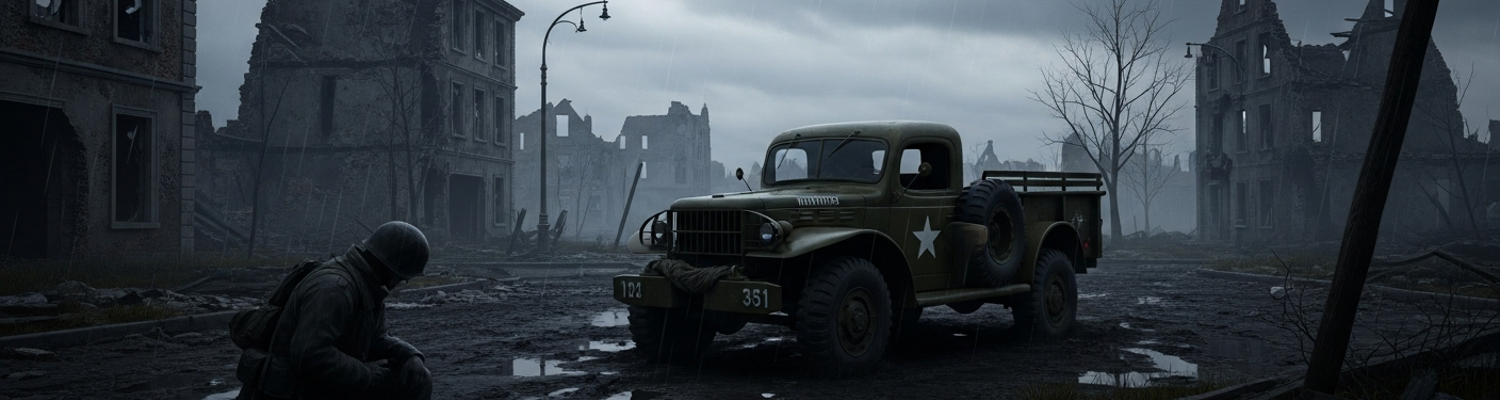

German Last-Ditch Explosive Defenses
The silence of a newly captured position was the most dangerous sound on the Western Front in 1945. It was a quiet earned through the din of combat, but one that held the tense threat of what retreating German forces had left behind. For the Allied soldier, engagement did not end when the shooting stopped. It morphed into a personal and psychological battle against the terrain itself. Every door, every abandoned vehicle, every discarded piece of equipment, and every stretch of road became a potential trigger.
Operational logs from the final months of the conflict show a marked shift in German defensive doctrine, born of desperation and propagated by the total war decree. Responsibility for this new phase of explosive warfare fell not to trained combat engineers, but to the last levy of the Reich: the Volkssturm and the Hitler Youth. These units, composed of boys as young as 14 and men up to 60, lacked the training and equipment of the Wehrmacht. They were issued simplified, often crude, tools of destruction. Their primary anti-tank weapon, the Panzerfaust, was a single-shot recoilless system effective only at very close ranges, a near-suicidal device for an untrained user. These very weapons were adapted for use as improvised explosive devices. Lacking sophisticated timing mechanisms, Hitler Youth and Volkssturm units would rig Panzerfaust warheads to simple pressure plates made of wood and scrap metal, burying them in roadways as crude anti-vehicle mines. The fanaticism of these groups, instilled by local Nazi Party officials, was seen as a substitute for proper military training. This led to high casualties among their own ranks from mishandling the unstable devices. Their efforts, while often failing to halt Allied advances, introduced a chaotic and unpredictable element to the battlefield, turning civilian structures and common infrastructure into death traps.
Distinct from this amateur effort was the highly systematic and psychologically potent use of booby traps by retreating Wehrmacht and SS pioneer units. German engineers had perfected turning the mundane into the lethal. They relied on a series of standardized, mass-produced fuzes like the Z.Z. 42. This was a simple pull or pressure-release igniter that could be attached to almost any form of explosive charge, from a standard stick grenade to a large artillery shell. These devices were weapons of psychological attrition. They were designed to slow the Allied advance to a crawl by instilling a deep-seated fear and hesitation in every soldier. A discarded helmet, a Luger pistol left on a table, a crooked painting on a wall, all became objects of intense suspicion. One common tactic involved placing a pressure-release device under a large, heavy object in a cleared building, such as a cabinet or a stove. The trap would not be sprung by the initial troops clearing the room. Instead, it would detonate when subsequent soldiers, attempting to use the structure for shelter or a command post, might try to move the object. Another favored device was the Schü-mine 42, a small anti-personnel mine encased in a simple wooden box, making it nearly impossible to locate with standard Allied mine detectors of the era. The only metal components were in the fuze mechanism itself. This forced EOD teams to resort to manual probing or even specially trained dogs to locate them. These traps were not intended to win the war. They were meant to make the cost of every foot of captured German soil intolerably high in both time and blood.
Ingenious German Improvised Ordnance
Operational logs from 1945 reveal the widespread German adoption of specific, mass-produced mines designed for maximum psychological effect and difficulty of clearance. Two devices stand out: the Schü-mine 42 and the Riegelmine 43. The Schü-mine, or shoe mine, was an anti-personnel device of deceptive simplicity. It consisted of a small wooden or pressed cardboard box containing a 200-gram block of TNT. Its lethality came from its fuze, the Z.Z. 42, and the near-total absence of metal in its construction. This made it exceptionally difficult for Allied mine detectors of the period to locate. The only metallic signature came from the small firing pin and spring mechanism in the fuze. These were often scattered in large numbers. This forced EOD teams and combat engineers to abandon electronic detection for the slow, nerve-wracking process of manually probing the ground. The Riegelmine 43, or bar mine, was an anti-tank weapon that presented a different challenge. At roughly 80 centimeters long, its shape ensured that almost any vehicle driving over it would detonate the four-kilogram TNT charge. Its design often incorporated two Z.Z. 42 fuzes, one at each end, and up to three additional fuze wells for anti-handling devices. Over time, the internal wires of these fuzes would corrode, making the entire device unstable and liable to detonate from the slightest disturbance. Standard procedure for EOD units facing a Riegelmine was often to destroy it in place rather than attempt to disarm it.
German pioneer and SS units systematically weaponized the very infrastructure the Allies sought to liberate and use. They relied on a small family of standardized, mass-produced igniters, chiefly the Z.Z. 42 pull fuze and the D.Z. 35 pressure fuze. These could be attached to anything from a single stick grenade to a stack of artillery shells. Archival evidence shows these were most often employed inside buildings. A pull igniter could be wired to a door, so that the simple act of opening it would pull the pin on a charge. A more devious application involved pressure-release fuzes placed under heavy objects like cabinets, stoves, or even the bodies of fallen soldiers. A photograph from Jungersdorf, Germany, dated December 12, 1944 (NARA Record Group 111-SC), shows a deceased German soldier in a basement. An explosive charge is clearly visible next to the body, left for the Allied troops who would try to recover the remains. This tactic preyed on the discipline and humanity of Allied soldiers, forcing them to treat their own and enemy dead as potential threats. Another common tactic was to booby-trap items that would appeal to a soldier’s desire for a souvenir, such as a Luger pistol on a table or a crooked painting on a wall. The belief was that an enlisted man might ignore a crooked picture, but an officer setting up a command post would be tempted to straighten it, triggering a concealed device.
By booby-trapping civilian homes, town halls, and even hospitals, German forces attacked the very concept of a safe rear area. Every cleared town offered no respite. Each building had to be painstakingly searched by engineers before it could be occupied for shelter or command functions. This deliberate targeting of non-military structures was designed to instill a pervasive sense of fear and paranoia, forcing Allied soldiers to become suspicious of every object in their surroundings. This created a constant, grinding stress that eroded morale and slowed operational tempo far more than the actual casualties from the devices themselves. For a retreating army, it was a highly effective force multiplier. A few men could spend a few hours booby-trapping a village, forcing an entire division to halt for days to clear it. This form of warfare transformed every soldier into a part-time bomb disposal technician, where a single moment of inattention could be fatal.
US Army EOD Frontline Challenges
Of the more than 2,000 men who served in U.S. Army bomb disposal units during the Second World War, the European Theater of Operations alone inflicted a casualty rate of ten percent. This was a high rate of attrition for a specialized, non-combat branch. The losses were a direct consequence of German fuze design and booby-trapping doctrine, which specifically targeted the men sent to clear the explosives. Anti-handling devices, often a second fuze set to trigger on movement, were a common feature. A technician could successfully complete the primary render-safe procedure on a large aerial bomb or artillery shell, only to be killed when the ordnance was shifted for removal. The psychological pressure was constant. Every task was a zero-fault-tolerance problem. A single error in judgment, a moment of fatigue-induced clumsiness, or a missed tell-tale sign resulted in immediate death for the technician and often his team. The units themselves were small, typically organized into seven-man squads separate from larger companies to provide wider, more mobile coverage.
Standard Allied equipment, effective against conventional ordnance, was frequently nullified by German improvisational genius. The primary tool for locating buried metallic mines was the SCR-625 mine detector. Its utility vanished when faced with devices like the Schü-mine 42. Constructed almost entirely of wood or pressed cardboard with only a tiny amount of metal in its Z.Z. 42 fuze, it was effectively invisible to electronic detection. This forced a reversion to a slow, agonizingly manual process of clearing roads and fields. Technicians, often lying prone, would use bayonets or thin M3 probing rods to gently feel for buried objects inch by inch. The work was mentally and physically exhausting. A lapse in concentration could easily lead to applying too much pressure and detonating a device. Compounding the problem was the inherent instability of the fuzes themselves. The mass-produced Z.Z. 42 pull/pressure fuze and the D.Z. 35 pressure fuze would degrade over time. Internal wires corroded and striker springs became weak, making them hyper-sensitive to the slightest vibration. Render-safe procedures became a gamble against material decay. For larger, more complex devices like the Riegelmine 43 anti-tank mine, which often incorporated multiple fuzes and anti-lift devices, the accepted procedure was frequently to destroy the mine in place.
Analysis of the 1945 campaigns reveals a profound disconnect between the speed of advancing combat formations and the methodical pace required for safe ordnance disposal. As armored columns of Patton’s Third Army raced across France, they rapidly outpaced their logistical support, including the thinly stretched bomb disposal squads. A single seven-man squad might be the only EOD asset available to an entire infantry or armored division, responsible for hundreds of square miles of newly captured territory. An advance of 30 miles in a single day could uncover multiple mined bridges, booby-trapped crossroads, and ordnance-filled buildings. Each required hours or days of painstaking work from that one squad. This created an impossible backlog and forced commanders into a grim calculus. Halt the advance and sacrifice battlefield momentum, or bypass the known threats. Bypassing often meant that combat engineers or even regular infantrymen, lacking the specialized training and equipment of EOD, were ordered to clear paths through minefields or neutralize booby traps. The result was a dangerous dilution of specialized talent across a rapidly expanding front, where the demand for EOD expertise far outstripped the available supply.
Allied Bombardment Hindrance to EOD
The chaos of the collapsing front in early 1945 created an environment where the greatest threat to a U.S. Army bomb disposal technician was not always a German fuze, but the uncoordinated weight of Allied air and artillery power. Small, seven-man EOD squads operated in the fluid and dangerous space between rapidly advancing combat units and the territory just relinquished by the enemy. They were uniquely vulnerable. They were ghosts on the battlefield map, their positions often unknown to the pilots and gunners tasked with obliterating any hint of German resistance. This disconnect between the fast-moving front and the slow work of ordnance disposal led directly to instances of EOD teams being misidentified and engaged by their own forces.
One such event occurred in late February 1945 near Jülich, after its capture by the 29th Infantry Division. A squad from the 55th Ordnance Bomb Disposal Battalion was tasked with clearing a series of Riegelmine 43 anti-tank mines from a key crossroads needed for the division’s armored columns. The team was working in the open, their Dodge WC-51 truck parked nearby. From the air, the silhouette of the truck and the dispersed figures of the team were misinterpreted by a flight of P-47 Thunderbolts on an armed reconnaissance mission. The pilots, conditioned to strike any military-style vehicle and personnel concentrations in what was, only hours before, enemy territory, initiated a strafing run. The EOD squad’s radio operated on a frequency intended for ground-unit command, not the air-to-ground channel used by the fighter-bombers. This made any last-second attempt to call off the attack impossible. The lead P-47’s eight .50-caliber machine guns tore across the position, killing one technician instantly and severely wounding two others before the pilots recognized the American uniforms and broke off the attack.
In other cases, the blow came not from the air, but from the ground. As American forces penetrated the Siegfried Line, EOD teams were dispatched to neutralize the explosive charges placed within its thousands of concrete bunkers. After an infantry unit cleared a bunker of enemy soldiers, they would move on, leaving the structure for the EOD squad to render safe. This created a perilous time lag. A forward observer for a 155mm artillery battalion, positioned on a ridge overlooking the newly taken ground, might see movement around a bunker that his map still marked as a German position. Standard procedure dictated that any such activity be engaged immediately to prevent a German counter-attack. In the vicinity of Bitche, France, in March 1945, this exact scenario unfolded. A squad from the 75th Bomb Disposal unit was working inside a captured pillbox, attempting to disable several hundred pounds of abandoned German explosives wired to an anti-handling device. An American artillery forward observer, his position having been shelled intermittently for hours, saw movement at the bunker’s entrance and called in a fire mission. The first ranging shell from the supporting artillery battalion landed fifty yards away. The subsequent fire for effect order brought a devastating concentration of high-explosive rounds directly onto the bunker. The barrage detonated the German explosives inside, vaporizing the entire EOD squad and leaving a crater where the pillbox had stood.
Casualty records from the European Theater show a disproportionate number of EOD personnel killed in action under circumstances listed as cause unknown or in unwitnessed single-detonation events. A portion of these are now understood to be the result of friendly fire. The nature of EOD work, small teams, isolated for long periods, deep within a chaotic battle space, made them susceptible to such tragedies. Communication failures were rampant. The rapid advance of armored columns routinely outpaced the ability of command posts to update tactical maps, leaving air and artillery units with dangerously outdated targeting information. These incidents were not born of malice but of the speed and friction of the war’s final phase, where the imperative to destroy the enemy swiftly often overrode the systems designed to protect friendly troops.
Bureaucratic Intelligence Dissemination Gaps
Archival evidence from early 1945 (Record Group 338, ETOUSA) shows that the greatest impediment to neutralizing German ordnance was not always the complexity of the device, but the fractured journey of intelligence through Allied bureaucracy. The system was broken. When combat troops overran a German engineering depot or fuze factory, the captured schematics, manufacturing diagrams, and test notes were treated as high-level strategic intelligence. These documents were not sent to the nearest Bomb Disposal headquarters. Instead, they were funneled up the chain to specialized rear-echelon units like the Combined Intelligence Objectives Subcommittee (CIOS) or T-Forces. Their primary mission was assessing the enemy’s overall war-making potential. A detailed drawing of a new long-delay chemical fuze, the L.Z.Z. (Langzeitzünder), would land on an analyst's desk in Paris or London. Meanwhile, the EOD technicians encountering it for the first time near the Rhine had no information on its function. The analysis was a slow, deliberate process. It involved translation, painstaking study of mechanical actions, and the chemical breakdown of internal components. This was all geared toward producing a comprehensive report for strategic planners, not a quick field guide for a sergeant facing the device in a muddy crater. The time lag between the capture of these plans and the distribution of actionable intelligence to frontline EOD squads could be weeks, a fatal delay on a battlefield that moved miles every day.
A captured factory technician or Wehrmacht Pionier officer held the unwritten operational knowledge that schematics could never show. These were the details that meant life or death for an EOD team. Details like the fact that a batch of Z.Z. 42 fuzes produced in a specific factory had faulty striker springs, making them hypersensitive to vibration. Or the preferred, non-standard way a particular SS pioneer company wired anti-handling devices into their Riegelmine 43s. This information was tactical gold. Yet, interrogations of such high-value prisoners were typically conducted at specialized centers like Fort Hunt in the U.S. or Latimer House in the U.K., far from the front. The focus of these interrogations was overwhelmingly strategic. Interrogators sought to uncover new weapons programs, identify scientists for recruitment in programs like Operation Paperclip, or map German industrial capacity. An interrogator’s report containing a detail about a fuze’s instability would be filed under Army Weapons and passed to a strategic analysis section. There was no efficient, systematized process for redacting this tactically critical information and transmitting it urgently to the ordnance disposal squads in the field who needed it most. The intelligence pipeline was designed to flow up to the highest levels of command, not back down to the lowest.
The consequences of this fragmented intelligence structure were paid for by ordnance disposal teams. A review of operational logs from the 61st and 75th Bomb Disposal Battalions reveals a pattern of casualties linked directly to unknown fuze mechanisms. Lacking specific intelligence on a new device, a team leader had two choices. He could attempt to destroy it in place, a time-consuming action that expended resources and was often impossible if the ordnance was inside a structure like a bridge abutment or power station. Or, he could make a calculated guess, treating the unknown device as analogous to a known one. This was a lethal gamble. Near Jülich in March 1945, a squad from the 75th encountered a 500kg bomb fitted with a fuze that had no markings familiar to them. It was the Type 17B, whose markings were intentionally designed to be rubbed off on impact. Believing it to be a standard electrical impact fuze, the technician began a procedure to shear the internal wiring. It was, however, a clockwork long-delay fuze with an integrated anti-movement device. The torque from the fuze wrench was enough to trigger the secondary mechanism, detonating the main charge and killing the entire three-man render-safe party. The information that could have prevented this existed, but it was locked away in a CIOS file in Versailles, part of a larger analysis of German aircraft bomb production (CIOS Report 45-B-11). This disconnect between the collectors of intelligence and its most desperate users turned render-safe procedures into a grim game of chance.
Inter-Service EOD Coordination Problems
After-action reports from late 1944 and early 1945 reveal that the Allied command structure, built for strategic harmony, often produced tactical discord on the ground. The effort to open the port of Antwerp, captured by the British 11th Armoured Division on September 4, 1944, became a case study in this friction. The port was the single most important logistical objective in Northwest Europe, essential for supplying the final push into Germany. Yet its approaches remained in German hands for two more months. Once the waterways were cleared for shipping, the task of making the port itself safe began, and with it, the bureaucratic paralysis. A single captured dockyard presented a nightmarish overlap of responsibilities. A German LMB (Luftmine B) aerial-dropped naval mine sitting on a pier was technically the jurisdiction of the Royal Navy’s specialist Rendering Mines Safe (RMS) teams. If that same mine had been moved inside a warehouse and wired with a tripwire, it became a booby trap, falling under the purview of the British Royal Engineers or a US Army Bomb Disposal Squad. A scuttled German E-boat blocking a channel was a salvage job for Royal Navy Port Clearance Parties, designated as P Parties, but if it was laden with explosives, it was an EOD problem. These distinct service and national lines of authority created standoffs. An American Army EOD squad, desperate to clear a quay for US Army engineers to begin repairs, would find itself legally unable to touch a British-designated naval mine, forced to wait for a specific Royal Navy team that might be miles away.
This friction was not merely bureaucratic. It was deeply personal, born of a clash between hard-won experience and by-the-book doctrine. The first US Army bomb disposal officers had been sent to England to learn directly from the British Royal Engineers, who had been disarming German ordnance since 1939. This created a dynamic of master and apprentice that bred resentment when the now-independent American units developed their own procedures. In one documented instance near Antwerp, a US Army EOD squad and a Royal Engineer Bomb Disposal section arrived at the same demolished railway bridge. A 250kg bomb with a ZUS 40 anti-withdrawal fuze lay half-submerged in the mud. The British lieutenant, a veteran of London and Coventry, insisted on a manual approach honed over four years, involving a delicate, hands-on neutralization of the fuze mechanism. The American captain, however, was under strict orders from his own command to use a newly issued remote pulling device, a procedure his unit had drilled extensively but had not been tested by the British. Neither officer had the authority to command the other. Neither would cede responsibility for the ordnance. The delay lasted six hours until a SHAEF liaison officer could be reached by radio to arbitrate, granting jurisdiction to the Americans based on the sector boundary, not on the merits of the procedure.
These jurisdictional squabbles had a direct impact on resource allocation and the tempo of the advance. The specialized tools of the EOD trade were not standardized across the Allied forces. Royal Navy P-Parties possessed the most advanced underwater cutting and salvage equipment, essential for clearing harbors of scuttled, booby-trapped vessels. US Army EOD, however, had superior vehicle-mounted heavy lifting gear and portable X-ray machines for inspecting ordnance on land. A common problem in the captured French and Belgian ports was the refusal of one service to loan its specialized equipment to another without a mountain of paperwork processed through the SHAEF chain of command. This meant a US Army team might identify a complex naval mine blocking a critical drydock but have to wait days for a Royal Navy diving team to become available, even if the American team had divers who could have done the job with the right tools. This inefficiency created bottlenecks that rippled all the way to the front. Divisions ran low on fuel and ammunition because the supplies were sitting on ships off the coast, unable to unload at a port that was still being cleared by competing, uncoordinated EOD units.
Post-War EOD Doctrine Evolution
The lessons of 1945 became the direct blueprint for a complete overhaul of U.S. Explosive Ordnance Disposal. The curriculum at the Army’s primary Bomb Disposal School at Aberdeen Proving Ground, which had focused heavily on large, conventional aerial bombs, was radically rewritten. Wartime experience demonstrated that aircraft bombs constituted only about a quarter of the EOD workload. The majority involved booby traps, improvised devices, and ground ordnance. The new training doctrine shifted emphasis accordingly. It introduced complex scenarios based directly on German tactics encountered in the final push to the Rhine. Trainees were no longer just taught to render safe a known fuze on a known bomb. They were now drilled relentlessly on identifying and defeating anti-handling devices, recognizing the signs of a pressure-release fuze under a floorboard, and navigating the psychological traps set in abandoned buildings. The lethality of devices like the Schü-mine and the multi-fuze complexity of the Riegelmine 43 forced a permanent change in mindset from ordnance disposal to a more holistic threat analysis.
The experience of 1945 also exposed a technology gap, triggering a dedicated push for new equipment. The standard-issue SCR-625 mine detector was useless against the wooden Schü-mine, forcing a reversion to manual probing that was both slow and dangerous. Post-war research and development prioritized the creation of detectors for non-metallic or low-metal-content mines. This led to early explorations of technologies like ground-penetrating radar and high-frequency electromagnetic induction sensors, direct predecessors to modern systems. The constant threat of hyper-sensitive, corroded fuzes and integrated anti-handling devices spurred the development of standoff and remote render-safe procedures. Rudimentary tape-and-line techniques used to pull fuzes from a distance were refined. Investment grew in tools like projectile disruptors, which used a focused water charge to destroy a device’s circuitry from a safe distance, a concept that remains a pillar of modern EOD.
The bureaucratic and inter-service chaos that plagued EOD operations in Europe prompted the most significant structural change in the post-war era. The jurisdictional standoffs in Antwerp and the siloed intelligence that cost lives near Jülich were identified as catastrophic failures. In response, the Department of Defense moved to break down service-specific walls. In 1946, the Navy’s separate Mine and Bomb Disposal schools were combined, and the course was officially designated Explosive Ordnance Disposal, giving birth to the modern term EOD. By 1947, the Navy was assigned responsibility for EOD training for all services. Army officers and senior enlisted personnel began attending the Naval EOD School at Indian Head, Maryland. This created a common training pipeline and a shared doctrine for the first time. To solve the intelligence problem, dedicated technical intelligence sections were integrated directly into the EOD command structure. This created a formal channel to collect, analyze, and disseminate information on new enemy ordnance directly to the field, ensuring a fuze diagram captured in the field would reach the technicians who needed it instead of languishing in a strategic analyst’s file in a rear-echelon headquarters.