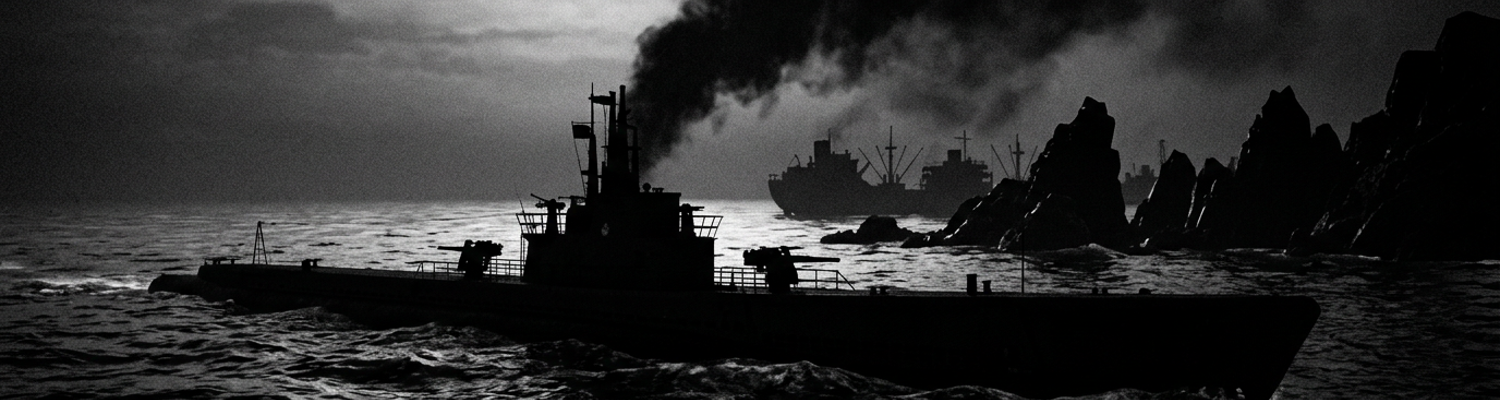

ComSubPac Tactical Directives and Shallow Water Restrictions
A diesel exhaust trail dissipated into the swell off the Fujian coast at 0300 hours on January 23, 1945. Inside the conning tower of USS Barb (SS-220), twenty-two men stood in absolute quiet. Their breathing synchronized with the dull whine of the auxiliary gyrocompass. Red battle lamps washed over the chart table. Commander Eugene B. Fluckey traced the five-fathom curve with a brass pencil point. The ocean swell lifted the steel deck plates. Every watchstander braced against the pressure of the unexploded minefields suspected beneath them. Forward torpedo room crews sat motionless beside six pressurized Mark 18 tubes. They waited for an order to loose thirty thousand pounds of high explosives into a crowded roadstead.
The boat was operating entirely outside American operational doctrine.
Archival evidence shows that Commander Submarine Force, Pacific Fleet, headed by Vice Admiral Charles A. Lockwood, maintained inflexible standing orders. These directives strictly forbade bringing fleet submarines inside unswept, shallow littoral anchorages without dedicated surface escorts. Fleet headquarters in Pearl Harbor established these operational boundaries because a 1,525-ton Gato-class vessel drew over fifteen feet of water. Shoal-water navigation presented an immediate structural hazard. Submerged groundings in uncharted coastal pockets repeatedly broke sound projector domes. They jammed forward hydroplanes. They ruptured the riveted seams of outer fuel-ballast tanks. If a boat struck an uncharted granite ledge in shallow water, emergency ballast blowing would pitch the hull violently upward. This exposed the conning tower and pressure hull to enemy shore-based artillery. Lockwood's staff explicitly classified enclosed bays and reef-choked roadsteads along the China coast as prohibited terrain for unescorted fleet boats. The risk of physical entrapment was unacceptably high.
A surfaced submarine trapped on a sandbar was an immobile target.
Standard operating procedures issued to Pacific Fleet submarines mandated blue-water operations. These guidelines guaranteed an operating floor of at least thirty to forty fathoms. Submarine designers in Groton and Portsmouth built Gato-class boats with a 311-foot length and a structural test depth of three hundred feet. Engineers specifically designed these hulls to utilize three-dimensional water volume to survive counter-attacks. A standard crash dive required thirty to thirty-eight seconds to submerge the conning tower. This forced a boat to plunge through thirty vertical feet before leveling out. Effective evasion against Japanese escort vessels required diving below local bathythermograph gradient layers to scatter active Type 93 sonar pulses. In less than forty feet of water, evasive maneuvers vanished completely. Japanese naval aircraft easily spotted the dark silhouette of a submarine resting on a sandy bottom. Mitsubishi Ki-51 dive bombers and coastal patrol floatplanes carrying Type 99 depth charges could shatter a pressure hull with shallow-fuzed ordnance before the submarine could flood its negative tank.
A close review of operational logs indicates that Fluckey possessed navigation charts of Namkwan Harbor based on outdated British surveys from 1908. Soundings across the western entrance showed depths dropping to barely twenty-four feet at mean low tide. This left less than eight feet of clearance beneath the keel of USS Barb. Entering such an enclosed littoral zone meant intentionally discarding forty fathoms of defensive water column. It was a mathematical certainty that prevented any form of evasive diving if Japanese coastal batteries on Pinghai opened fire. The patrol log recorded seawater temperatures of fifty-four degrees Fahrenheit. A north-northeasterly tide moved at two knots across the entrance channel.
Tracking Japanese Merchant Shipping Along the Fujian Coast
Archival evidence shows that by late January 1945, American carrier strikes and submarine patrols had cleared the open expanses of the Formosa Strait. This forced Japanese maritime traffic to cling to the continental shelf. Commander Eugene B. Fluckey positioned USS Barb along the Fujian littoral. He operated the boat in the shallow waters between Foochow and Wenzhou. On January 21, the bridge watch spotted coal smoke rising across the western horizon. The smoke pointed toward a southbound convoy designated MOTA-32 working through the inner islands. USS Barb tracked the escorted Japanese merchant convoy seeking sanctuary in the coastal indentations of the China coast. Fluckey matched speed on his Fairbanks-Morse diesels. He tracked the contacts by correlating visual periscope bearings with fleeting returns on the SJ surface search radar. The Japanese merchantmen moved only during daylight hours. They ducked into coastal bays whenever Allied patrol aircraft appeared overhead. The enemy ships threaded through shallow passages between the mainland and offshore shoals. They utilized granitic reefs as physical barriers against torpedo fire.
The convoy refused to enter open water.
When examining the historical record, radio intercepts produced by Fleet Radio Unit Pacific converged with Fourteenth Air Force intelligence reports. These documents exposed the destination of the gathering enemy force. Consolidated PB4Y-1 Liberator search planes flying coastal patrol tracks north of the Matsu Islands confirmed the Japanese coastal traffic was consolidating inside the lower roadstead of Namkwan Harbor near coordinate 27 degrees 15 minutes north, 120 degrees 30 minutes east. Aerial and intelligence reconnaissance identified an anchorage containing approximately thirty enemy vessels. This sheltered group combined elements of MOTA-32 with the northbound TAMO-38 convoy. Fleet analysts listed sixteen freighters and tankers packed into three distinct anchor lines. Eleven armed escorts and subchasers anchored across the entrance to protect them. Natural headlands blocked surface radar detection from outside the entrance. The surrounding shallows were strewn with rock pinnacles and fields of moored Type 93 naval contact mines.
Thirty targets were penned inside a single blind anchorage.
A close review of operational logs indicates that Fluckey spent the afternoon and evening of January 22 tracking the final stragglers as they slipped past the outer screen into the bay. Barb closed the five-fathom line to establish positive radar identification of the harbor mouth. The boat operated on two engines to conserve battery capacity and minimize diesel exhaust plumes. Watch officers recorded continuous soundings on the fathometer. The muddy continental shelf rose from forty fathoms down to twenty-six feet of water within five nautical miles of the entrance channel. By nightfall, the Japanese convoy had completely ceased movement. They shut down main boilers to eliminate soot trails. They doused all running lights under strict blackout conditions. Fluckey gathered his navigation team in the conning tower to plot the harbor approaches. They compared Japanese hydrographic data recovered from captured charts with the returns on the boat's SJ radar screen. Calculations drawn across the plotting sheet placed thirty merchant vessels and escorts stationary across an anchorage area barely four miles wide. The ships banked against the western mudflats behind Pinghai point.
Every ship was locked in place by its own anchors.
Soundings along the harbor approaches showed eight feet of clearance beneath the keel. The tide ran at two knots across the entrance channel. Fluckey evaluated the geometry of an attack from the surface. He assessed that the clustered enemy hulls presented an overlapping target presentation where misses would strike secondary vessels in the rear rows. Torpedo crews adjusted the running depth of the Mark 18 electric torpedoes down to eight feet. This prevented the ordnance from burying itself in the harbor floor during the run. Operating the submarine at such shallow depths made an immediate crash dive after firing impossible. Barb would be exposed to fire from the eleven escort vessels anchored across the inner bay. Withdrawal calculations required the boat to run at twenty-one knots on all four Fairbanks-Morse diesels along a five-fathom escape track. This relied on twenty-three feet of charted water beneath the screws.
Navigational Dead Reckoning Through Uncharted Minefields
Archival evidence shows that on January 23, 1945, Commander Eugene Fluckey navigated USS Barb through thirty miles of unmapped reefs and minefields into Namkwan Harbor. Japanese defensive doctrines relied on these coastal barriers to deter Allied submarines. They scattered moored Type 93 chemical-horn contact mines across the outer channels along the Fujian coast. Approaching from the open waters of the Formosa Strait, the bridge watch tracked jagged granite shoals rising abruptly from twenty fathoms up into black water. Chinese junks and local fishing stakes littered the approach. These created false radar reflections on the SJ display that forced bridge lookouts to scan the darkness through heavy sea spray. The submarine bypassed outer patrol lines by creeping directly across the coastal shallows that Japanese naval officers considered impassable for fleet boats. Submerged rock outcroppings forced constant bearing corrections during the transit. These hazards were completely missing from official charts.
A single scraping contact with a mine mooring cable would detonate the boat instantly.
A close review of operational logs indicates that Barb operated in barely thirty feet of water with a twenty-one-foot draft. This left a margin of nine feet between the keel and the harbor floor. This clearance eliminated any room for standard submerged maneuvers. The 311-foot hull risked striking the seabed if the bow planes tilted even two degrees downward. Engineers maintained exact neutral buoyancy by manually cycling the auxiliary trim tanks. This prevented the hull suction effects that occur when a displacement submarine moves across shallow shelves. Mud pulled into the circulating cooling water threatened to foul the main diesel engine heat exchangers. That event would disable the four Fairbanks-Morse diesels in hostile territory. Sonar technicians watched their dials register the sea bottom creeping upward toward the delicate sound projector dome bolted beneath the keel. If the steel underbelly struck a mud flat, the submarine would slide to a dead stop in plain view of enemy shore batteries.
There was no water column left to dive.
When examining the historical record, Fluckey calculated hull grounding margins and navigational waypoints entirely on improvised dead reckoning and fathometer readings. Standard optical sightings against unlit shorelines were distorted by coastal haze. The bridge team tracked progress by synchronizing gyrocompass headings with raw acoustic depth soundings emitted by the Submarine Signal Company fathometer. An enlisted quartermaster called out depth sounding intervals every thirty seconds. He tracked the foot-by-foot gradient of the seabed across a captured Japanese commercial map. Fluckey compensated for a two-knot crosscurrent by estimating drift angles against pitometer log speed readings. He plotted new tracks across the chart table. Fathometer soundings bounced off underwater rock shelves. The navigation team had to adjust rudder orders instantly whenever the water column compressed toward the keel. Relying on raw timing runs and compass drift calculations replaced the verified coastal checkpoints that standard fleet operating procedures demanded.
The plotting room relied entirely on pencil lines and stopwatches.
Entering the inner roadstead, Barb squeezed through the final mile of the northern passage. Underwater soundings dropped beneath thirty-two feet. Helmsmen adjusted the rudder in two-degree increments to prevent the stern from swinging into flanking reefs. They held the boat along a narrow channel flanked by shallow mud barriers. Lookouts on the bridge shears reported dark silhouettes of anchored freighters less than three thousand yards away across the anchorage. Engine room watchstanders stood by the reverse throttle controls. They were ready to back all engines full if the fathometer reported an immediate bottom shoaling.
Torpedo Launch Geometries Within Confined Littoral Basins
A close review of operational logs indicates that Commander Eugene Fluckey confronted severe geometric restrictions when lining up Barb inside the inner roadstead at approximately 0400 hours on January 23, 1945. Fleet doctrine for the Mark 18 Mod 1 electric torpedo prescribed a minimum run of four hundred to five hundred yards. This distance allowed the mechanical impeller on the Mark 4 warhead detonator to complete its required arming revolutions. Operating in less than thirty feet of water within three thousand yards of the primary target cluster, the Torpedo Data Computer in the conning tower received hand-entered estimations. Standard stadimeter masthead ranges produced errant inputs against overlapping, dark silhouettes. Granite shoals flanked both sides of the submarine. This compressed the attack corridor into an eighty-degree arc that eliminated the broad ocean approaches standard firing charts required. Fire control officers had to set the weapon gyros with severe lateral offsets. They calculated launch tracks that would arm the firing pins mere seconds before impact while preventing the twenty-foot-long electric weapons from sinking into the shallow mud. Fluckey bypassed orthodox single-target tracking setups. He aimed his salvos against the center mass of thirty merchant hulls and defensive escorts crammed into three tight anchor lines behind Pinghai point.
Calculated firing solutions offered zero margin for weapon failure.
Archival evidence shows that Barb fired a spread of eight torpedoes from both bow and stern tubes into the concentration of anchored transports and escorts. Forward torpedo crews loosed four Mark 18 torpedoes from the bow tubes in rapid succession. High-pressure impulse air shuddered through the hull as five tons of steel and Torpex exited into the cold roadstead. To bring the remaining ordnance to bear without wasting minutes on a wide turning circle, the helmsman threw the rudder hard over to swing the stern into alignment with the southern anchor lines. Four stern tubes discharged their electric weapons across the dark water within minutes of the initial salvo. This blanketed the crowded anchorage with a divergent spread designed to strike freighters, coastal defense ships, and tankers simultaneously. Lookouts on the bridge shears tracked the faint phosphorescent wakes of the weapons as they sped toward the anchored rows. Sound operators recorded sequential explosions beginning barely three minutes after the first salvo cleared the tubes. They confirmed eight direct strikes against six primary targets. An ammunition ship erupted in continuous secondary pyrotechnic bursts.
Reversing the boat inside the narrow basin was impossible.
When examining the historical record, standard fleet doctrine dictated that a surfaced submarine break contact through a wide tactical withdrawal. This incorporated alternating zig-zags and rapid depth changes to break acoustic contact. Namkwan Harbor allowed none of these defensive maneuvers. The Fujian mainland rose to the west. Submerged minefields blocked the southern reaches. Barb had only one navigable channel measuring barely twenty-four feet deep at low tide. Executing a standard evasive turn would drag the boat's bronze screws through harbor mud or swing the 311-foot hull broadside into unmapped granite reefs. Japanese coastal defense ships and armed escorts recovered from the concussions of the torpedo explosions. They swept the water with searchlights and opened fire with deck guns. Fluckey could not submerge because the harbor floor sat less than ten feet below the keel. A crash dive was a certain grounding event. Engine room crews shoved all four Fairbanks-Morse diesels to twenty-one knots along a predetermined five-fathom dead-reckoning track. They steered strictly by fathometer soundings and gyro headings while artillery shells splashed within yards of the deck.
At 0519 hours, Barb crossed the twenty-fathom curve into deep water.
High-Speed Surface Withdrawal Across Shallow Shoals
Archival evidence shows that at 0406 hours, Commander Eugene Fluckey wrenched the engine order telegraph handles straight down to flank speed ahead. Down in the forward and after engine rooms, motor machinists threw the heavy fuel control racks wide open on all four Fairbanks-Morse 38D8-1/8 nine-cylinder opposed-piston diesel engines. Superchargers operated at peak capacity as exhaust gas temperatures spiked past eight hundred degrees Fahrenheit. This forced raw diesel fuel into the combustion cylinders at maximum volume. Thick black smoke blasted from the stern exhaust mufflers. The twin bronze propellers churned the shallow water, dragging thirty-eight hundred horsepower directly against the sea floor. Speed indicators mounted on the conning tower bulkhead climbed from twelve knots to sixteen. They surged past twenty-one knots across the charted mudflats of the northern channel. Water depth readings dropped down to twenty-four feet against a twenty-one-foot hull draft. This pulled dense harbor silt into the main engine raw-water circulating pumps. Fluckey held the 1,525-ton hull pinned to the surface. Diving into three feet of clearance would destroy the boat against the harbor floor.
Mud boiled into the cooling lines.
When examining the historical record, Japanese defensive positions surrounding the anchorage reacted to the exploding transports within four minutes of the first torpedo detonation. Dual-purpose coastal artillery batteries mounted on the rocky cliffs of Pinghai swung their barrels east. They began firing high-explosive shells across the open roadstead. Three surviving Japanese escort vessels and an auxiliary subchaser slipped their moorings. They turned toward the outer shoals and engaged the fleeing submarine with their main three-inch deck guns and 25mm Type 96 automatic cannons. Projectiles struck the water five hundred yards off the port beam. They tossed white geysers into the night sky before the gunners walked their salvos inward toward the conning tower. Lookouts stationed in the bridge shears ducked behind three-quarter-inch splinter armor. They tracked orange muzzle flashes erupting in steady sequences along the shoreline. Shell splinters ricocheted off the steel casing of the forward deck gun. Japanese spotters adjusted their firing coordinates to bracket the diesel wake.
Tracers crossed twenty feet above the bridge deck.
A close review of operational logs indicates that the bridge team tracked the five-fathom curve without reducing engine throttle settings or altering the escape bearing. Quartermasters called out fathometer readings every fifteen seconds. They tracked bottom clearances fluctuating between three and six feet beneath the keel plates. Hull suction generated by traveling at twenty-two knots over mud shelves dragged the stern downward. This hydrodynamic squat effect nearly grounded the rudder in the silty bottom. Helmsmen compensated by keeping the steering gear locked inside three degrees of center. They held Barb along a direct northeast exit track through the shoals toward deep water. Japanese searchlights swept across the northern flats. They illuminated the submarine in white beams while coastal gun crews corrected their deflections. Heavy shell fragments cut through the unpressurized limber holes of the main ballast tanks. The diesel machinery continued running without internal pressure losses.
The diesels held together.
At 0445 hours, the distance between Barb and the pursuing Japanese escorts expanded beyond six thousand yards. This degraded the accuracy of the shore artillery batteries as the mainland headlands fell behind the horizon. Fathometer pings recorded the sea floor sloping downward from seven fathoms to fifteen fathoms. This marked the outer edge of the coastal mudflats and the approach to the open waters of the Formosa Strait.
Wardroom Emergency Triage Under Sustained Depth Charging
A close review of operational logs indicates that as USS Barb cleared the outer shoals of Namkwan Harbor, Japanese escort vessels and coastal patrol craft closed the distance. They dropped patterns of Type 95 depth charges while pursuing escorts continued surface gun action. Hydrostatic shockwaves slammed into the 311-foot pressure hull. The blasts jarred instruments loose from their shock mounts and hurled watchstanders against structural bulkheads. Submerging below the surface to break contact after clearing the shallows, the boat absorbed explosive overpressures. These forces shattered gauge glass, knocked loose cork insulation, and compromised hull fittings. Bridge personnel who had manned exposed positions during the twenty-one-knot surface withdrawal down the five-fathom curve collapsed onto the control room ladder. They suffered trauma caused by incoming shell bursts and blast waves.
Heavy concussions threw tools across the deck plates.
Archival evidence shows that Barb's pharmacist mates performed emergency triage on the wardroom table during and immediately following the escape. Chief Pharmacist's Mate William Donnelly and assistant corpsmen stripped the green baize table cover. They swept away navigation charts and clamped portable, battery-powered surgical lamps directly to the overhead framing above the mahogany mess surface. Medical instruments stored in specialized steel bulkhead lockers were laid out in metal trays. These included scalpels, surgical scissors, arterial hemostats, rolls of sterile compressed gauze, and glass bottles of normal saline. The submarine lurched under aggressive, evasive rudder angles. Corpsmen hoisted wounded sailors through the watertight door and positioned them across the bolted table under dim red battle lamps. They physically anchored the casualties against sudden depth-charge lifts that threatened to hurl them to the linoleum deck. With no commissioned physician assigned to fleet submarines, the enlisted pharmacist mates established a strict triage sequence. They prioritized airway clearance and hemorrhage control over secondary burns and contusions as enemy escorts maintained pursuit.
Blood soaked into the canvas triage stretchers.
When examining the historical record, medical personnel treated severe blast concussions, ruptured eardrums, and jagged shrapnel lacerations sustained under heavy enemy depth charging and shellfire. Pressure differentials generated by close-range Japanese naval artillery shells detonating near the bridge shears had slammed violently against exposed lookouts. This burst delicate tympanic membranes and inflicted acute acoustic trauma. Topside watchstanders were left disoriented, nauseated, and bleeding from their external ear canals. Jagged steel fragments from Japanese three-inch high-explosive shells and 25mm automatic cannon fire had penetrated the unarmored bridge fairwater. The shrapnel inflicted deep lacerations across exposed limbs, necks, and torsos. Donnelly systematically debrided torn tissue with antiseptic solutions. He probed muscle cavities with surgical forceps to extract embedded iron casing shards. He dusted open wounds with crystalline sulfa powder to suppress bacterial infection before closing flaps with silk sutures. Men suffering from intracranial trauma and severe concussions received subcutaneous injections of morphine tartrate from half-grain Syrettes. Corpsmen administered aromatic spirits of ammonia to revive sailors knocked unconscious against interior machinery by depth-charge shockwaves.
Auxiliary emergency flashlights provided the only illumination when electrical breakers tripped.
A close review of operational logs indicates that the pharmacist mates monitored nine casualties through the remainder of the morning watch. The submarine steamed southeast into open patrol lanes. Corpsmen replaced saturated pressure dressings and checked pupillary light reflexes to monitor intracranial swelling. They managed tourniquets applied to sailors struck at forward gun stations during the withdrawal. Depth charge counter-attacks dropped in intensity past 0600 hours as Barb crossed the thirty-fathom shelf into deep water. This allowed the medical watch to transfer stabilized patients from the wardroom table into bunks in the forward battery compartment.
Naval Public Relations and the Medal of Honor Review
Archival evidence shows that encrypted patrol cables had barely cleared Fleet Radio Unit Pacific before the Navy Department's Office of Public Relations coordinated directly with the Treasury Department's War Finance Division. Washington public relations officers recognized that Fluckey's surface penetration into Namkwan Harbor offered an unmatched propaganda narrative. This story would anchor the upcoming Seventh War Loan Drive. Staffers within the War Finance Speakers Bureau began assembling detailed tour itineraries for selected officers and enlisted men from USS Barb. They drafted nationwide rail routes spanning industrial centers from Chicago to Boston. Typewritten press releases and radio broadcast scripts were assembled in Washington desks while the submarine was still steaming eastward across the central Pacific toward the Submarine Base Pearl Harbor. Naval censors stripped out hydrographic coordinates, fathometer clearances, and specific radar frequencies. They replaced operational calculations with broad descriptions of coastal gun battles. The civilian bond office scheduled mandatory appearances at shipyards, steel foundries, and munitions assembly lines. They mapped out speaking engagements where crew members would pitch industrial war bond subscriptions directly to civilian factory workers.
The Navy needed domestic heroes to drive civilian war bond sales.
When examining the historical record, public affairs officers packaged operational records into pre-approved morale dispatches for national syndication across major wire services. The War Finance Speakers Bureau scheduled Fluckey, along with key bridge watchstanders and motor machinists, for multi-city speaking circuits. They arranged appearances alongside film stars and industrial executives. Publicists scheduled sixty-second radio spots across CBS and NBC affiliates. They scheduled press luncheons in cities producing submarine hardware, including Cleveland, Philadelphia, and New London. Scriptwriters prepared draft speeches emphasizing close-quarters surface actions against Japanese escorts. They structured the talking points around themes of aggressive seamanship and industrial superiority. Internal bureau routing sheets arranged for the sailors to receive fresh dress uniforms, tailored ribbons, and specialized transport priority tickets aboard military transport aircraft. This guaranteed arrival dates for scheduled stadium rallies. Civilian war bond quotas hung over regional Treasury branches. This turned the crew into frontline domestic recruiters before the ship's hull even cleared drydock inspection.
Every patrol log entry was scrubbed for domestic consumption.
A close review of operational logs indicates that Commander Submarine Force, Pacific Fleet forwarded Fluckey's patrol report directly to the Board of Awards and Decorations. Admiral Chester W. Nimitz provided an immediate endorsement. Senior flag officers evaluated the mathematical survival probability of the surface withdrawal. They dissected Fluckey's choice to discard twenty fathoms of operating depth inside a mined anchorage. The board assessed that the operational gamble fell within the strict statutory criteria for the nation's highest military decoration. They cited Fluckey's conspicuous gallantry and intrepidity involving risk of life above and beyond the call of duty during Barb's eleventh war patrol. President Harry S. Truman formally approved the decoration. He presented the Medal of Honor to Fluckey in a White House ceremony attended by senior naval leadership. The official citation specifically outlined the thirty-mile navigation through unmapped shoals, the calculated surface torpedo attack against clustered transports, and the high-speed extraction across mud flats under continuous shore bombardment.
Naval authorities simultaneously designated USS Barb as an entire combat unit for collective recognition. They awarded the vessel the Presidential Unit Citation for actions spanning its aggressive offensive patrols along the Japanese home islands and China coast. Administrative review boards cited the Namkwan Harbor assault as an exceptional demonstration of submarine warfare. They recognized the technical competence of the engine room crew during the surface withdrawal and the precision of the torpedo data calculations. The citation formally credited the submarine with sinking multiple freighters, disrupting coastal supply chains, and executing an egress across waters where standard fleet doctrine prohibited fleet boat deployment. Fleet administrators stamped the award into the service records of every crew member assigned to the boat during the eleventh patrol. They entered the decoration into the permanent vessel ledger alongside twenty-three battle stars earned across Pacific operations. Naval printing presses produced commemorative certificates bearing Truman's signature. They distributed copies to surviving personnel while Barb prepped for ordnance modifications at the Mare Island Navy Yard (Bureau of Ships File 44-A).