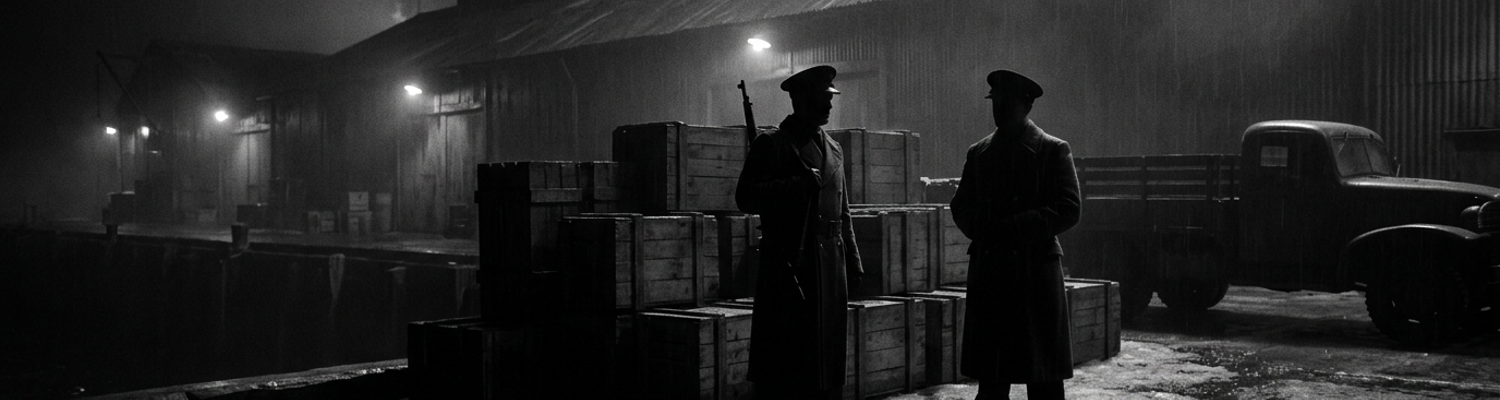

December 1941 Puget Sound Maritime Seizures
Twelve-inch coast defense mortars firing 700-pound high-explosive deck-piercing shells gave the Pacific Northwest an overwhelming defensive firepower on paper. Ten-inch disappearing rifles at Fort Worden and water-cooled Browning .30-caliber machine guns mounted on harbor patrol craft added to this documented readiness. Archival evidence shows the shooting war in western Washington actually began as an aggressive sweep of commercial civilian shipping. At 10:45 AM Pacific Standard Time on December 7, 1941, the Thirteenth Naval District ordered the immediate impoundment of every foreign-flagged commercial merchant vessel docked along the Seattle, Tacoma, and Bellingham waterfronts. Coast Guard boarding detachments carrying Springfield M1903 rifles and Thompson submachine guns stormed civilian freighters. They forcibly shut down boiler rooms. Boarding parties secured engine telegraphs to prevent intentional scuttling. Armed personnel took civilian Italian, German, and Japanese merchant seamen into custody directly from mess decks and engine spaces. They stripped foreign mariners of personal effects and herded them down gangways at gunpoint without formal detention warrants.
Administrative processing failed entirely within four hours.
The rapid exhaustion of Thirteenth Naval District holding capacity across Puget Sound harbor installations exposed an absence of pre-war internment planning. Harbor defense doctrines had prioritized physical fortification while allocating negligible square footage for non-combatant detainees. The naval brig at the Puget Sound Navy Yard in Bremerton possessed only twenty-four secure confinement cells. These were intended exclusively for disorderly enlisted personnel and routine military infractions. By mid-afternoon on December 7, local port authorities and military police had crammed more than eighty merchant mariners into the Bremerton brig corridors and administrative offices. Space ran out across the water along the Seattle waterfront. Navy personnel commandeered the King County Jail and municipal lockups in Tacoma to stage overflow populations. Local civilian wardens refused to accept responsibility for uncharged foreign nationals. Naval intelligence officers scrambled between harbor piers in commandeered sedans. They attempted to conduct individual screenings while armed sentries stood watch over shivering crews detained on unheated commercial docks in freezing rain.
Command staff solved the regional housing deficit by converting an operational aircraft base into a holding pen.
A close review of operational logs indicates that Rear Admiral Charles S. Freeman redirected the detainee overflow directly onto the western shore of Lake Washington at Naval Air Station Sand Point. Base personnel cleared aircraft maintenance tools from Hangar 1. They threw together perimeter concertina wire across storage bays to process civilian merchant mariners alongside active-duty military prisoners. The naval air station lacked basic detainee infrastructure. Guards secured merchant marine deckhands, foreign steamship officers, and Navy personnel serving sentences for disciplinary violations inside identical open bays. Armed Marine Corps sentries enforced a strict blackout regimen across the hangars. They ordered detainees to sleep on concrete slabs with two wool blankets apiece. Oil stoves failed from inadequate ventilation. Geneva Convention classifications broke down entirely inside the improvised compound. Base administrators failed to segregate civilian non-combatant crews from uniformed personnel. This generated administrative paralysis as Department of Justice agents and naval intelligence officers argued over which federal agency maintained lawful legal jurisdiction over merchant mariners impounded on sovereign American soil. Sand Point Marine detachments were still rationing cold field rations to four hundred mixed detainees in unheated hangars as temperatures dropped below freezing on December 8.
Overcrowded Improvised Naval District Brig Facilities
By midnight on December 8, naval authorities had funneled over three hundred foreign merchant seamen directly into the uninsulated freight transit sheds of Pier 41 at Smith Cove. Built purely for dry cargo handling rather than human habitation, the timber-frame sheds measured roughly one hundred feet wide. They featured drafty tongue-and-groove siding. This allowed freezing sea fog off Elliott Bay to penetrate the interior spaces continuously. Naval quartermaster personnel hauled in stacks of damp dunnage and untreated cedar pallets to keep civilian mariners off wet, creosote-soaked planking. Heating was non-existent. A single four-inch municipal freshwater riser served the entire north dock apron. It froze solid before dawn. This cut off all potable water. Men from Japanese freighters, Italian tramps, and impounded German freighters were packed shoulder-to-shoulder into open bays alongside crated airplane engine parts and raw sulfur sacks. Open five-gallon paint buckets set along the bulkhead served as crude waste receptacles for the entire civilian population. Detainees wrapped themselves in burlap coffee sacking to survive thirty-degree drafts blowing through floor gaps directly above the tide water.
The docks possessed no physical barriers to stop a mass breakout.
When examining the historical record, the physical perimeter of Pier 41 lacked every structural component required for an active detention camp. No double-apron barbed wire had been strung along the timber approaches. Chain-link fencing was absent. This left the landward entrance open to the commercial railroad spurs of the Great Northern Railway. Commercial stevedores, fuel truck drivers, and civilian longshoremen moved freely across the apron within physical reach of unsearched foreign crewmen throughout December 8 and 9. Shed cargo doors hung on overhead rollers. They were secured only by rusted hasps and lengths of frayed three-strand manila line tied to bollards. Out on the seaward end of the pier, zero watchtowers or elevated sentry boxes had been constructed to survey the open wharf. No fixed searchlights illuminated the waterline beneath the pilings. This created dead zones where small skiffs could easily tie up unobserved beneath the decking. The Thirteenth Naval District possessed neither the concertina wire nor the wooden timber posts needed to partition the broad pier floor into manageable security pens.
Security depended on an exhausted handful of teenage recruits.
The Marine Barracks at the Puget Sound Navy Yard could spare almost no combat-trained personnel for Seattle harbor watch details. Regional defense priorities assigned the primary rifle companies to secure the naval ammunition depot at Indian Island, the torpedo testing ranges at Keyport, and the strategic radio towers on Bainbridge Island. That left Captain E. L. Russell with fewer than forty-five enlisted Marines to enforce continuous armed custody over three hundred detainees spread across two massive waterfront sheds. Squad leaders instituted grueling eighteen-hour standing watches along the drafty aprons. Young privates carried bolt-action M1903 Springfield rifles loaded with five-round clips. Few had fired more than ten live rounds in qualifying courses before deployment to Seattle. Falling asleep on post became routine as rain turned to sleet. District officers attempted to plug gaps by arming untrained naval aviation mechanics from Sand Point. They drafted civilian yard watchmen with vintage break-top revolvers. This created confusion over engagement orders and basic challenge procedures.
Guard rosters from December 9 record thirty-six consecutive hours without a single meal relief for the Marine post at the pier gates.
COMNOWESTSEAFRON Supply and Bedding Failures
Commander, Northwest Sea Frontier war diary entries for December 9 through December 12, 1941, recorded an absolute breakdown in basic quartermaster reserves across the Puget Sound defense perimeter. Supply depots at Naval Station Seattle and Keyport held fewer than one hundred and twenty standard-issue wool blankets in their auxiliary stores. They faced a sudden detainee population that swelled past four hundred individuals within forty-eight hours. Folding canvas cots did not exist in district storage. Priority allocations sent every available frame to Army coast artillery batteries establishing hasty revetments along the Strait of Juan de Fuca. Most merchant seamen had been dragged from boiler rooms and mess decks wearing only thin denim dungarees, light cotton singlets, and canvas work shoes unsuited for winter weather. Requisitions marked urgent and routed by naval telegraph to Mare Island Navy Yard for fifteen hundred wool blankets produced no immediate relief. They stalled behind priority westbound trainloads of five-inch naval artillery ammunition and crated aircraft engines.
Inventory sheets listed exactly zero cold-weather jackets for civilian prisoners.
Standard naval commissary distribution channels failed immediately under the demand of non-military mass feeding. The Naval Supply Depot at Seattle operated under strict peacetime accounting statutes. These explicitly prohibited issuing rations to undocumented foreign nationals without signed billing vouchers from the Bureau of Supplies and Accounts in Washington, D.C. District paymasters could not secure approvals over teletype lines. Those lines were overwhelmed by continuous naval intelligence alerts regarding unconfirmed submarine contacts off Cape Flattery. Local supply officers bypassed military supply channels entirely to prevent open starvation along the pier aprons. Supply personnel loaded commandeered flatbed trucks with emergency disbursements taken from discretionary petty cash reserves. They drove directly into the downtown commercial district. Officers purchased thousand-pound sacks of dry pinto beans, rolled oats, and surplus day-old sourdough loaves from wholesale civilian merchants along Western Avenue and the Pike Place market stalls. Naval working parties dragged these commercial sacks across the damp wooden docks. They boiled crude porridges in galvanized twenty-gallon washbasins heated by gasoline welding torches. The district owned no portable field kitchens or mess trays for detainee holding facilities.
The naval base possessed neither the accounting mechanisms nor the mess gear required to feed the men under armed guard.
Holding unequipped men in unheated waterfront structures triggered an immediate cascade of severe hypothermia and respiratory collapse. Ambient temperatures inside the Pier 41 sheds sank to twenty-seven degrees Fahrenheit during the early morning hours of December 10. A heavy salt fog swept straight off Elliott Bay through wall gaps and unsealed cargo doors. Moisture collected on the untreated fir decking. It froze into an unbroken glaze beneath the stacked cedar pallets where men huddled for warmth. Navy medical staff from the Seattle naval dispensary noted that over forty percent of the interned mariners exhibited symptoms of advanced exposure within seventy-two hours. These included uncontrollable physical tremors, blue extremities, and altered mental states. Moisture-laden timber surfaces combined with diesel exhaust fumes from harbor tugs running continuously outside the sheds to irritate lung tissue. This sparked widespread outbreaks of acute bronchitis and lobar pneumonia. Medical corpsmen had only paper satchels filled with sodium salicylate tablets and bandages. Requests for sulfonamide antibiotics and oxygen tanks were denied by regional medical officers. They reserved all pharmaceutical stockpiles for battle casualties at Naval Hospital Bremerton.
By midnight on December 11, corpsmen had evacuated fourteen unconscious Italian mariners from Shed 2 directly to civilian county wards.
Naval and Immigration Service Custody Disputes
By the morning of December 10, an administrative conflict erupted between the Thirteenth Naval District headquarters at the Exchange Building on Second Avenue and the Immigration and Naturalization Service field office located at 815 Airport Way. Rear Admiral Charles S. Freeman classified every foreign crewman pulled from commercial freighters as an enemy detainee subject to summary naval containment under general maritime emergency directives. INS District Director Raphael P. Bonham pushed back immediately. He asserted absolute Department of Justice jurisdiction over civilian foreign nationals under the Immigration Act of 1924 and the Alien Registration Act of 1940. Bonham barred his civilian immigration inspectors from accepting custody of foreign seamen until naval intelligence officers produced individual exclusion warrants, sworn manifests, and documented proof of entry violations. Naval officers had none. Coast Guard escorts hauling sixty-two Italian deckhands up the concrete stairs of the federal immigration station found the intake doors locked from the inside by federal border patrolmen. INS field agents threatened to charge Navy intelligence officers with unlawful kidnapping under Washington State statutes if unvetted mariners were deposited in civilian holding corridors without certified civilian warrants.
Civilian immigration inspectors refused to sign a single intake receipt.
The Thirteenth Naval District motor pool held fewer than six functional two-ton flatbed trucks to service the entire Seattle waterfront. Half those vehicles were committed to shifting naval artillery shells between the naval station and Bremerton ferry slips. District quartermasters could not requisition military ambulances or troop haulers from Fort Lawton. Army commanders there hoarded every chassis for battery emplacements along Discovery Park. Navy officers commandeered civilian gasoline-powered Twin Coach buses directly from the Seattle Transit System to resolve the transport deficit. Civilian drivers on Route 15 were pulled from their scheduled runs along Elliott Avenue. They were ordered at gunpoint to strip advertising placards and sent to load hostile foreign mariners directly off the Pier 41 docks. Mechanical failures mounted instantly. Aging Spicer transmissions overheated under double passenger loads. They stripped low-gear teeth along the steep nine-percent grade of Yesler Way. Armed naval personnel were spread so thin that municipal transit drivers hauled loads of thirty unhandcuffed German and Japanese mariners across downtown Seattle traffic with only a single eighteen-year-old sailor riding the front step. This left civilian operators exposed to passenger revolts as vehicles stalled at unmonitored intersections along First Avenue South.
Civilian transit operators drove through blacked-out municipal corridors without armed escorts or functional vehicle radios.
Legal custody classifications collapsed entirely under the simultaneous execution of Presidential Proclamations 2525, 2526, and 2527. Justice Department attorneys attempted to apply standard maritime alien shore leave exemptions. They pushed to release Scandinavian, Dutch, and non-belligerent foreign seamen on temporary thirty-day conditional landing permits to clear space in overflowing county jails. Thirteenth Naval District intelligence officers blocked every application. Naval counter-espionage officers ruled that any foreign national possessing maritime engine schematics or hydrographic knowledge of Puget Sound constituted an active sabotage risk. This stripped parole eligibility from friendly, neutral, and Axis seamen alike without formal military commission proceedings. This blanket designation produced complete legal gridlock. King County prosecutors refused to hold mariners who had committed no statutory infraction. Private shipping line agents for impounded freighters like the Italian motor vessel Leme refused to pay per diem detention fees assessed by the INS for sailors locked up against their will. Conflicting telegraph orders between the Chief of Naval Operations and the Attorney General left two hundred and fifteen neutral mariners stranded in legal limbo. They were ineligible for criminal bail, denied military prisoner-of-war protections, and barred from stepping foot outside cold transit sheds on Elliott Bay.
High-Frequency Direction Finding Phantom Intercepts
Between December 9 and December 14, 1941, radio intelligence watchstanders at the naval intercept post at Fort Ward on Bainbridge Island flooded the Thirteenth Naval District command room with unverified high-frequency direction finding bearings. Operating Model DT cross-loop antenna arrays and direction-finding receivers, radiomen monitored high-frequency bands between four and eighteen megacycles. They hunted signals from Imperial Japanese Navy fleet units. Ionospheric refraction and night-effect distortions bent high-angle skywave signals against the steep volcanic terrain of the Olympic Mountains. This generated split bearings that registered as groundwave spikes originating directly inside Puget Sound. Watch officers misread these atmospheric bounce anomalies as encrypted high-speed transmissions broadcasting from surfaced enemy submarines hidden in the waterways between Whidbey Island and Hood Canal. Cryptanalysts had no technical means of isolating atmospheric interference from genuine hostile naval code groups under wartime radio silence conditions. Plotting boards at district headquarters quickly filled with red grease-pencil lines. These erroneously converged on Bainbridge Island, Port Madison, and the shallow entrance to Possession Sound.
Radio compasses registered anomalous bearings across empty water.
These anomalous radio bearings triggered immediate base-wide security lockouts across every naval installation along the western Washington coastline. District command issued unconditional readiness alerts to the Puget Sound Navy Yard at Bremerton, the Indian Island Naval Ammunition Depot, and the Naval Torpedo Station at Keyport. Marine sentries dropped steel barricade gates. They severed outbound commercial telephone switchboards and leveled Model 1917 rifles into the freezing darkness. At Bremerton, yard officers halted repair work on capital ships. They forced three thousand civilian machinists, welders, and pipefitters to lie face down on wet gravel aprons while security patrols swept the drydock basins for phantom saboteurs. Rolling power cuts plunged industrial workshops and ordnance storage bays into blackouts for six hours at a stretch. Boiler fires in central steam plants were damped down to prevent stack embers from guiding enemy bombers. This froze municipal intake pipes and cracked cast-iron radiators across barracks complexes. Sentries at the Keyport torpedo testing ranges expended four hundred rounds of .30-06 ammunition firing into sea mist at floating driftwood logs mistaken for hostile landing parties.
Unverified threat reports dictated base operations for four straight nights.
Command staff responded to the phantom signals by scrambling maritime patrol aircraft and commandeered civilian vessels into violent winter storms. Naval Air Station Sand Point dispatched twin-engine Consolidated PBY-5 Catalinas from Patrol Squadron 43 into sixty-knot gale winds over the Strait of Juan de Fuca. They searched for clandestine shore transmitters and Japanese submarine tenders. Thick sleet fouled carburetion intakes. This forced flying boats to hedgehop at two hundred feet above dark water without ground-controlled radar vectors. Simultaneously, the Thirteenth Naval District dispatched four wooden-hulled 83-foot Coast Guard cutters alongside twelve requisitioned commercial purse seiners armed with water-cooled Browning machine guns. These armed harbor pickets churned through the rocky shallows of the San Juan Archipelago and Admiralty Inlet. They boarded every drifting log raft and civilian tugboat at gunpoint in search of hidden espionage batteries. Swelling fifteen-foot sea breaks swamped the open timber decks of the fishing boats. This tore depth-charge lashings loose and ruined unshielded receiver sets.
Patrol planes returned to Sand Point at daylight with iced empennages and empty fuel tanks. They reported zero hostile craft across five hundred square miles of open water.
Coastal Roundups and Civil Internment Transfers
Between December 8 and December 12, 1941, hastily assembled shore detachments launched uncoordinated civilian sweeps across coastal fishing settlements from Grays Harbor down to Coos Bay. In Aberdeen and Hoquiam, small teams drawn from Coast Guard Section Base Westport teamed with county deputy sheriffs carrying personal shotguns. They swept docks along the Chehalis River. Orders originated as garbled phone calls from the Thirteenth Naval District operations desk in Seattle rather than formal written warrants. Armed parties kicked in the doors of commercial oyster processing shacks at Willapa Bay and fish packing plants along the Columbia River near Astoria. They dragged out Japanese gillnetters, German boatwrights, and naturalized Italian cannery workers. Seizures took place without field vetting. Coast Guardsmen loaded prisoners into canvas-topped Dodge flatbed trucks, commandeered school buses, and gravel haulers. They drove sixty miles through driving rain over the coastal range to county lockups in Centralia and Longview. Local police blotters show twenty-six Dutch and Norwegian fishermen were thrown into basement cells simply because boarding parties could not decipher foreign-language maritime registration papers.
Deputies cleared the cannery bunkhouses at loaded shotgun point.
Maritime port detention facilities overflowed so rapidly that regional authorities orchestrated emergency bulk rail transfers inland to clear the coastline. Between December 10 and December 14, naval intelligence liaisons and the Immigration and Naturalization Service commandeered heavy equipment from the Northern Pacific Railway and Union Pacific. They evacuated unsorted civilian detainees directly to the Fort Missoula internment camp in western Montana. Trains assembled on freight spurs near King Street Station in Seattle and the Albina rail yards in Portland. Railway personnel coupled aging Class P-2 steam locomotives to battered wooden-sided tourist cars and unheated express baggage coaches. Over six hundred civilian detainees, including commercial fishermen wearing damp oilskins and foreign mariners without winter coats, were shoved aboard under fixed bayonets held by the 148th Field Artillery Regiment. Steam heating lines severed during transit over the 3,900-foot summit of the Bitterroot Range. Inside car temperatures plunged below ten degrees. Guards refused to unlock coach vestibules at division stops in Spokane and Missoula. They tossed raw field bread and canned lard through half-open baggage doors directly onto the coach floors while civilian men urinated into open milk cans.
The locomotive pulled sixteen cars through mountain snowdrifts with the exterior doors chained shut from the outside.
Staff officers systematically doctored naval war diaries during the third week of December to hide the resulting administrative breakdown. Flag lieutenants at the Thirteenth Naval District headquarters in Seattle discovered that sorting detachments had filed zero formal custody transfer receipts before detaining hundreds of civilian non-combatants. Between December 16 and December 20, yeomen retyped the official daily war diaries for the Commander, Northwest Sea Frontier. They deliberately backdated administrative approvals to create the illusion of an orderly inter-agency transfer coordinated in advance with the Department of Justice. Duty officers destroyed original radio logs containing panicked sweep directives. Naval intelligence files were scrubbed of incident reports detailing the unlawful arrest of sixteen American-born citizens detained alongside foreign crews in Grays Harbor. Red ink notations crossed out references to transport derailments, lost detainee manifests, and the unauthorized deployment of armed naval personnel beyond sovereign maritime shore boundaries.
The revised district war diary for December 11 substituted a single typed line. It stated all alien maritime personnel had been transferred to civil authorities according to peacetime protocol.