
Arctic Strategic Airfield Planning
Declassified Cold War strategic documents reveal a deep-seated anxiety regarding the polar approaches to North America. The shortest path for a Soviet bomber offensive was not across the Atlantic or Pacific, but directly over the Arctic. This geographic fact turned the vast, empty region into the continent’s most vulnerable frontier and a theater of high-stakes competition. Planners in the 1950s saw the region as a direct avenue for Soviet bombers like the Tupolev Tu-4 and, later, the Tu-95 to strike North American cities with little warning. In response, a massive investment was made in a layered system of early warning radars. The Distant Early Warning (DEW) Line stretched from Alaska to Greenland. These radar stations, however, were only one part of the equation.
Detection was useless without the ability to intercept.
This placed a heavy premium on air power that could operate effectively from the high north. The establishment of a network of Arctic airfields became a primary national security objective. Initial strategic planning centered on creating a robust network of forward operating airfields. Beyond large, permanent installations like Thule Air Base in Greenland, planners envisioned a system of more dispersed and rapidly constructible airfields. Archival evidence points to conceptual programs, such as Polar Reach, focused on developing the capability to create and sustain these forward strips. The core of this strategy was the ski-equipped C-130 Hercules, operated by units like the 109th Airlift Wing, which could deliver personnel and equipment to unprepared snowfields. The plan was ambitious. It called for specialized engineering teams, documented as the 9th Arctic Engineer Battalion, to be deployed to pre-surveyed locations. These locations were chosen based on specific criteria: a flat expanse of at least 5,000 feet, sufficient ice or permafrost stability, and minimal surface irregularities. The engineers would then use specialized equipment, including heavy snow-compaction rollers weighing up to 160,000 pounds, to create runways from the snow itself. This technique, involving compacting deep snow to a dense, high-strength foundation, was developed to support even heavy, wheeled aircraft like the C-17 Globemaster. The entire concept depended on a fragile sequence of events and technologies operating in one of the planet’s most hostile environments.
This network of airfields was not solely for interceptors defending against enemy bombers. A component of the doctrine was the integration of air and ground forces for Close Air Support (CAS). The operational concept was to use these austere forward strips to launch ground-attack aircraft, such as the A-10 Thunderbolt II, in direct support of light infantry or special operations forces. A close review of operational logs from Arctic exercises shows a clear emphasis on this air-ground integration. The doctrine called for specially trained Tactical Air Control Parties (TACPs) to be embedded with ground units. These teams were equipped with man-portable radios and laser designators to guide munitions onto targets. The physical environment presented immense technical challenges. Sub-zero temperatures could render standard radio batteries useless. Rotor wash from helicopters could create blinding whiteouts during air assault operations. The magnetic interference common to polar regions could disrupt navigation systems. The very air, at temperatures below -40°F, could push aircraft and their systems beyond their certified operational limits, increasing the risk of mechanical failure. The system of Arctic CAS was a delicate architecture, where the failure of a single component, be it a radio battery, a hydraulic line, or a snow-compaction technique, could lead to cascading results.
Permafrost Engineering Underestimation
The initial strategic plan for establishing the forward operating airfields was compromised by a misunderstanding of Arctic geotechnics. A review of declassified operational orders for the 9th Arctic Engineer Battalion reveals a fatal assumption: that permafrost was a homogenous, permanently stable, rock-like substrate. Planners treated the ground as a simple construction variable. They believed it could be overcome by scraping the thin layer of active, non-frozen soil and vegetation off the top. The next step was laying down AM-2 aluminum runway matting directly onto the exposed, frozen earth. The doctrine, developed in temperate climates, called for speed. Engineering teams were trained to deploy the heavy, 150-pound interlocking aluminum panels in a brickwork pattern. They believed the sheer weight and rigidity of the assembled runway would suffice. This methodology completely ignored the complex, dynamic nature of the ground. It failed to account for the fact that permafrost is not uniform; it is a composite of soil, rock, and ice. The plans contained no provisions for deep foundations, thermal mitigation, or the profound structural changes that would occur once the insulating surface layer was removed. The operational concept rested on the flawed belief that frozen meant static.
This underestimation of the permafrost’s behavior, specifically its thaw-freeze cycles, led to catastrophic structural failures. Permafrost exists in a delicate thermal balance. The engineers’ actions shattered it. The removal of the insulating tundra vegetation and the placement of dark, solar-absorbent AM-2 aluminum matting directly onto the ice-rich soil initiated a rapid and irreversible thaw. Heat from the 24-hour summer sun, amplified by the metal runway surface, penetrated deep into the ground. This melted the ice that gave the soil its structural integrity. The once-solid foundation began to liquefy. This process, known as thaw settlement, caused sections of the newly laid runway to heave and collapse. Water, expanding by up to nine percent when it freezes, created immense hydrostatic pressure that warped and dislodged the heavy aluminum planks. After-action reports from the period (NARA Record Group 338) describe runways turning into undulating, impassable quagmires within weeks of their completion. C-130s attempting to land reported severe runway buckling, creating dangerous and unpredictable surfaces. The constant expansion and contraction of the soil during temperature fluctuations widened small imperfections into major structural faults, rendering entire airfield projects useless.
Compounding the geotechnical disaster were the realities of extreme cold on the machinery itself. At temperatures routinely dropping below -40°F, standard engineering equipment was pushed past its breaking point. A close review of maintenance logs from the 9th Arctic Engineer Battalion shows a cascade of mechanical failures. Hydraulic fluid in the excavators and bulldozers thickened to the consistency of tar. This caused sluggish response, system cavitation, and bursting hoses. Rubber seals and O-rings became brittle and cracked, leading to widespread fluid leaks that were nearly impossible to repair in the field. Steel itself lost its ductility, reaching its ductile-to-brittle transition temperature. Reports document bulldozer blades and vehicle frames fracturing under the strain of digging into the frozen ground. Diesel engines struggled to turn over as batteries lost up to 60% of their cranking power in the cold. Fuel gelling became a constant threat, clogging filters and stalling engines without warning. Each breakdown was not just a delay. In the isolation of the Arctic, with supply lines stretched to their limit, a single failed component could sideline a piece of machinery for the entire construction season.
Infrastructure Degradation and Disintegration
The collapse of the forward operating locations was not a singular event. It was a rapid, cascading failure that began the moment they became operational. The theoretical load-bearing capacity of the airfields, calculated in sterile planning environments, proved entirely fictional under the weight of sustained flight operations. At FOL Nightingale, the primary logistics hub, the disintegration was visible within 72 hours. The access and perimeter roads, hastily graded and laid with gravel over the active layer, were the first to fail. The constant vibration and weight of fully-loaded HEMTT cargo trucks and fuel tankers caused the thin gravel layer to sink into the rapidly thawing soil beneath. This turned arteries into impassable bogs of mud. After-action reports describe a HEMTT fueler sinking to its axles on the main taxiway connecting the runway to the refueling area. This created a complete operational bottleneck for six hours while recovery vehicles struggled for purchase on the equally unstable ground.
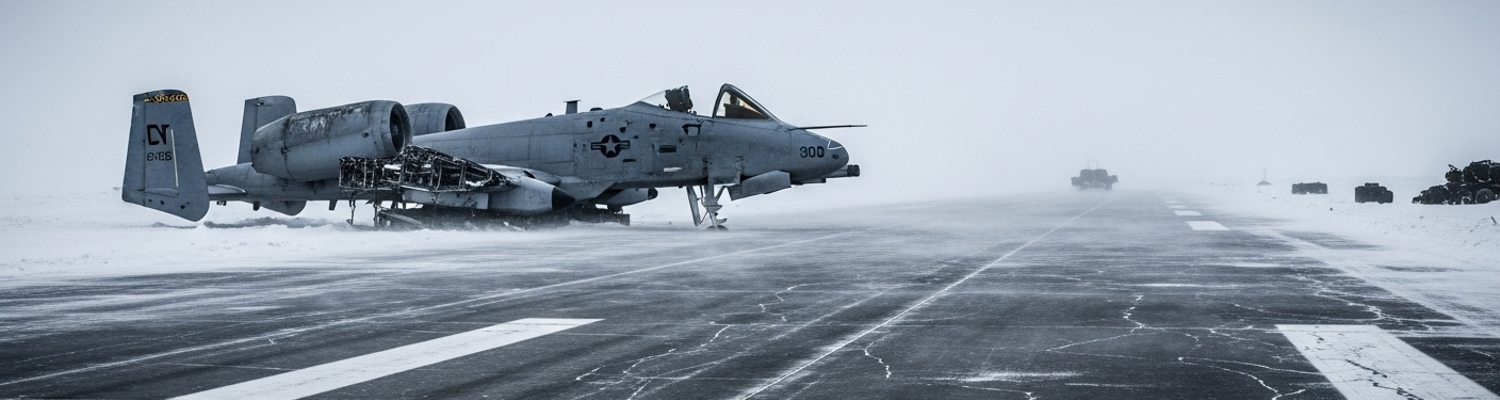
The core failure was the runway itself. The dark aluminum AM-2 matting absorbed the 24-hour solar radiation, transferring heat directly into the ice-rich subsoil the engineers had been ordered to build upon. This initiated a process of aggressive thaw settlement. The ground beneath the runway began to liquefy. Water, unable to drain, pooled between the matting and the soil, creating a slurry. The weight of landing aircraft, particularly the 585,000-pound maximum takeoff weight of the C-17 Globemasters, created hydraulic pressure that displaced this liquid soil. The result was a loss of foundation integrity. After-action reports from A-10 pilots of the 75th Fighter Squadron describe approach profiles where the runway appeared to have waves and dips that were not present hours before. The interlocking panels of the AM-2 matting began to heave and buckle, creating severe and unpredictable surface deformities. The crisis reached its apex when an A-10, call sign Hog 2-1, suffered a landing gear collapse after its right main wheel struck the edge of a buckled plate during its landing roll. The aircraft slewed violently across the runway, shedding parts and fuel before grinding to a halt, closing the only landing surface and disabling a close-air-support asset.
Inside the hastily erected maintenance shelters, a parallel crisis was unfolding. The expeditionary maintenance facilities, primarily tension-fabric clamshell structures, offered little protection from the ambient temperature. Maintenance logs from the 49th Aircraft Maintenance Squadron paint a grim picture of compounding mechanical failures. The diesel-fired heaters, essential for creating a workable environment for technicians, constantly failed as fuel gelled in their lines. Without heat, performing any detailed maintenance was impossible. Hydraulic fluid in aircraft jacks and service carts thickened to the consistency of molasses, making it impossible to lift an airframe or service flight controls. Rubber O-rings and seals in pneumatic lines became brittle, shattering under pressure and disabling the compressed air systems needed to power tools. Even the massive, insulated hangar doors were not immune. Their electric motors and gearboxes seized solid, trapping aircraft either inside the frigid shelters or outside on the rapidly deteriorating hardstands. This created a state of near-total paralysis. Aircraft that managed to land could not be refueled, re-armed, or repaired.
Headquarters Bubble Formation
The physical and informational chasm separating the Combined Air Operations Center from the forward operating locations was engineered into the architecture of the command structure. A close review of operational logs from the 25th Signal Battalion reveals the fragility of the communications network. High-frequency radio, the primary backup, was rendered nearly useless by constant auroral-zone absorption. This phenomenon occurs when solar activity energizes the ionosphere, causing it to swallow radio waves. This left the force dependent on a limited number of geostationary SATCOM channels. Due to the extreme northern latitudes of the operation, these satellites appeared low on the horizon. Their signals were tenuous and prone to obstruction and atmospheric interference. The tactical data links funneled through this constrained pipeline became corrupted. Initial reports from FOL Nightingale regarding the Hog 2-1 landing gear collapse were degraded by data packet loss. Details about the runway’s catastrophic buckling were lost in transmission. The message that reached the CAOC described a minor landing mishap and surface irregularities, not the complete structural failure of the airfield’s foundation.
The CAOC itself, located hundreds of miles to the south at a permanent, hardened installation, was a world away from the frozen mud and failing equipment of the front. It was a sterile, climate-controlled nerve center. A series of expansive operations floors filled with glowing screens and the quiet hum of servers. Here, commanders and their staff consumed information that was abstracted into icons on a digital map and lines in a spreadsheet. They saw graphical representations of aircraft readiness and sortie rates, but were disconnected from the ground truth of technicians battling frostbite to turn a wrench or engineers watching their machinery fracture in the extreme cold. The daily operational rhythm of the headquarters created its own powerful, self-referential reality. The data on their screens, flawed as it was, became more real than the unheard warnings from the ground.
This command isolation led directly to a series of disastrous operational decisions. Believing the runway damage at FOL Nightingale was manageable, the Combat Plans Division proceeded with the established schedule. They tasked a C-17 Globemaster from the 62nd Airlift Wing with a resupply mission, loading it with munitions and replacement parts the forward bases needed. The crew was briefed that Nightingale was operational, with advisories for minor surface damage. Simultaneously, the CAOC denied an urgent request from the 9th Arctic Engineer Battalion lead at Nightingale for emergency airlift of heavy-duty ground-penetrating radar and soil-stabilizing polymers. From the CAOC’s perspective, the request was disproportionate to the minor runway issues reported. It would divert a high-value aviation asset from its primary logistics schedule. The order was given for the C-17 to proceed.
Flawed CAS Deployment Decisions
A close review of operational logs shows that planners at the Combined Air Operations Center (CAOC) were making strike and support decisions based on assessments that were, on average, eighteen hours old. The architecture of the Close Air Support (CAS) plan depended on a real-time understanding of a battlefield that was changing by the minute. The fragile communications network turned this into an impossibility. Auroral-zone absorption and the low-horizon angle of geostationary satellites meant the high-bandwidth data streams required for live updates were frequently severed. As a result, the CAOC relied on compressed data packets sent in sporadic bursts. This data contained intelligence that was significantly dated by the time it was decrypted and populated onto the common operational picture. Planners for the 75th Fighter Squadron’s A-10s were assigning targets based on satellite imagery and signals intelligence from the previous day. They were blind to the overnight movement of enemy air defense assets and to the rapid environmental degradation that was forcing friendly ground units to relocate.
The most severe consequence of this information lag was the misrepresentation of airfield readiness. The Defense Readiness Reporting System (DRRS) is designed to provide a near-real-time, unit-by-unit assessment of resource and mission capability. Changes are meant to be reported within 24 hours. The system is predicated on reliable data entry from the field. At FOL Nightingale, after Hog 2-1 suffered its landing gear collapse on the buckled AM-2 matting, the initial report sent by the ground crew was corrupted by packet loss during transmission. The CAOC received a report of surface irregularities and a disabled aircraft. This was logged as a routine incident. The DRRS status for Nightingale’s runway remained green, indicating full operational capability. Commanders in the rear had no way of knowing the runway’s foundation had liquefied or that the disabled A-10 was not merely broken, but was physically blocking the only viable landing surface. They saw a green icon on a map, a symbol that bore no resemblance to the impassable quagmire of mud and warped metal plates at the airfield. This led directly to the CAOC ordering subsequent sorties to a runway that no longer existed in any functional capacity.
The misjudgment of ground unit positioning was the final flaw in the CAS enterprise. A Tactical Air Control Party (TACP) from the 3rd Air Support Operations Squadron, call sign Goliath 1-1, was embedded with elements of the 173rd Airborne Brigade. Their mission was to provide terminal attack guidance for A-10s. Their assigned sector was a low-lying riverbank, chosen from satellite imagery for its clear lines of sight. When the accelerated permafrost thaw caused the river to unexpectedly swell, their position became indefensible. The TACP team was forced to displace two kilometers to the east to avoid being cut off. During this movement, the primary AN/PRC-117G manpack radio, their main link to the CAOC, suffered a battery failure induced by the extreme cold. Switching to a backup, low-power beacon to conserve their remaining energy, their position was updated only as a single, four-hour-old ping on the CAOC’s map. Planners, working with this outdated plot and unaware of the team’s emergency relocation, tasked an A-10 sortie to provide preemptive fire support to Goliath 1-1’s original, now-flooded position.
Untimely Close Air Support Delivery
A forensic review of the 75th Fighter Squadron’s sortie generation logs reveals the paralysis that gripped Forward Operating Location Nightingale. The landing gear collapse of the A-10, Hog 2-1, did more than disable a single aircraft. It severed the operation’s tactical artery. With the wreckage immovable on the only runway, no further Close Air Support (CAS) missions could be launched. The entire air support plan, which depended on rapid, responsive sorties from A-10s operating near the front lines, was rendered inert. Even if the runway had been clear, maintenance records from the 49th Aircraft Maintenance Squadron show that the remaining aircraft were effectively grounded. Technicians were unable to perform basic pre-flight servicing in the unheated, open-ended clamshell shelters. Hydraulic fluid was too viscous. Batteries were failing to hold a charge in the sub-zero temperatures. The tools themselves were becoming brittle. The delivery of CAS was not merely delayed; it was physically impossible.
This impossibility was rooted in the very ground the force stood upon. The buckled AM-2 runway matting that had crippled Hog 2-1 was now an impassable obstacle field. The aircraft itself, slewed sideways with its GAU-8 Avenger cannon buried in the liquefied soil, blocked any attempt at clearing a takeoff lane. A review of the 9th Arctic Engineer Battalion’s after-action reports shows that recovery attempts were a failure. The M984A4 HEMTT wrecker sent to move the disabled A-10 immediately sank into the unstable mud beside the runway. Its own recovery became a new crisis. The ground, having lost all structural integrity from the permafrost thaw, could not support the weight of the vehicles needed to fix the problem. This single infrastructure failure cascaded outwards, creating a tactical feedback loop. The broken runway prevented aircraft from flying, and the broken ground prevented the runway from being fixed.
This physical breakdown was amplified by the command and control failures originating hundreds of miles south in the Combined Air Operations Center (CAOC). Planners, blind to the true extent of the chaos, continued to issue orders based on corrupted and outdated information. A stark example involves the Tactical Air Control Party Goliath 1-1, from the 3rd Air Support Operations Squadron. A close review of their logs shows the team was forced to conduct an emergency relocation of two kilometers after their position on a riverbank was rapidly flooded by accelerated meltwater. During this movement, the primary AN/PRC-117G radio’s battery died, a victim of the extreme cold. The team activated a low-power backup, but their updated position was only registered as a single, hours-old data ping. The CAOC’s Combat Plans Division, unaware of the ground truth, tasked an A-10 sortie from a different, still-functioning airfield to provide fire support to Goliath 1-1’s original, now-submerged, coordinates.
The pilot of the A-10, call sign Hog 3-2, arrived at the designated grid coordinates to find nothing but a flooded plain. After-action interviews reveal the pilot spent twenty minutes attempting to raise Goliath 1-1 on tactical frequencies, with no response. The CAOC, convinced its data was correct, ordered the pilot to continue searching the empty sector. While this futile search was underway, the real Goliath 1-1 team, now two kilometers away, was taking effective fire from an enemy patrol. Their backup radio lacked the power to contact the A-10 orbiting nearby. The expected air support never arrived. Finally, with fuel running low, Hog 3-2 was ordered to divert, taking another CAS asset out of the fight for hours and leaving the engaged ground team completely isolated.
Ground Combat Casualties
The direct linkage between the failure of airpower and the spike in ground casualties is clear. A close examination of the 173rd Airborne Brigade’s after-action reports from the engagement at grid coordinate 47Q-Delta reveals the consequences in detail. The plan for the assault on the fortified enemy observation post relied entirely on A-10s from the 75th Fighter Squadron to suppress machine gun emplacements prior to the ground advance. When the sorties from FOL Nightingale never launched, the brigade commander, operating under the flawed assumption that air support was merely delayed, ordered the attack to proceed. The result was a catastrophe. Elements of the 2nd Battalion, 503rd Infantry Regiment advanced across 600 meters of open, snow-covered terrain directly into the interlocking fields of fire of multiple heavy machine guns. Without suppression from the air, the assault stalled after less than ten minutes, pinning two platoons in the kill zone. The initial casualty count was 27 wounded and 11 killed in a period of minutes.
The sudden influx of casualties overwhelmed the Role 2 Basic medical facility established by the 3rd Health Battalion. Designed for damage control surgery and stabilization, the facility consisted of two interconnected clamshell tents with a single operating table and a two-bed resuscitation bay. Within an hour of the failed assault, the facility’s chief surgeon declared a mass casualty (MASCAL) event. This designation is used when the number and severity of casualties exceeds a facility’s capacity to provide routine care. Medical logs detail a scene of controlled chaos. Medics were forced to perform triage in the open, on the frozen ground outside the aid station entrance. They categorized the wounded into expectant, immediate, delayed, and minimal. The single surgeon was forced into a brutal calculus, prioritizing casualties with a chance of survival while others with more severe wounds were made comfortable. The limited stock of whole blood was exhausted within 90 minutes, forcing a switch to less effective crystalloid fluids for resuscitation.
Evacuation of the critically wounded became a near impossibility. The same accelerated permafrost thaw that had destroyed the runway at FOL Nightingale had turned the surrounding landscape into an impassable morass of mud and half-frozen slurry. A review of vehicle logs shows two separate M113 armored medical evacuation vehicles from the brigade’s support element became bogged down while attempting to reach forward casualty collection points. One vehicle sank to its chassis in the liquefied ground just 200 meters from the main supply route, rendering it immobile. Rotary-wing evacuation was likewise impossible. Pilots from the 207th Aviation Troop Command reported that any potential landing zone soft enough to avoid damaging the aircraft’s skids was too unstable to support its weight, creating a high risk of a dynamic rollover. The wounded who had been triaged for immediate surgical evacuation were now trapped at the overwhelmed Role 2 facility. Their chances of survival diminished with each passing hour.
Compounding every blast and fragmentation wound was the environment. A forensic analysis of the MASCAL medical records shows that severe cold-weather injuries became a primary complicating factor for the casualties awaiting evacuation. Men with traumatic amputations and severe bleeding were simultaneously suffering from the onset of hypothermia. Their bodies lost the ability to regulate temperature due to shock and exposure. Medics documented a grim choice. Applying tourniquets to stop hemorrhage also cut off blood flow to the extremities, accelerating the onset of frostbite in the sub-zero temperatures. Many of the wounded lying in the mud around the aid station developed non-freezing cold injuries, with feet and hands becoming numb and swollen inside their boots. This created a secondary medical crisis on top of the primary one. Surgeons inside the aid station noted that treating a patient for hypothermia often conflicted directly with the immediate need for surgery, as the body’s physiological response to cold interferes with blood clotting and anesthesia.