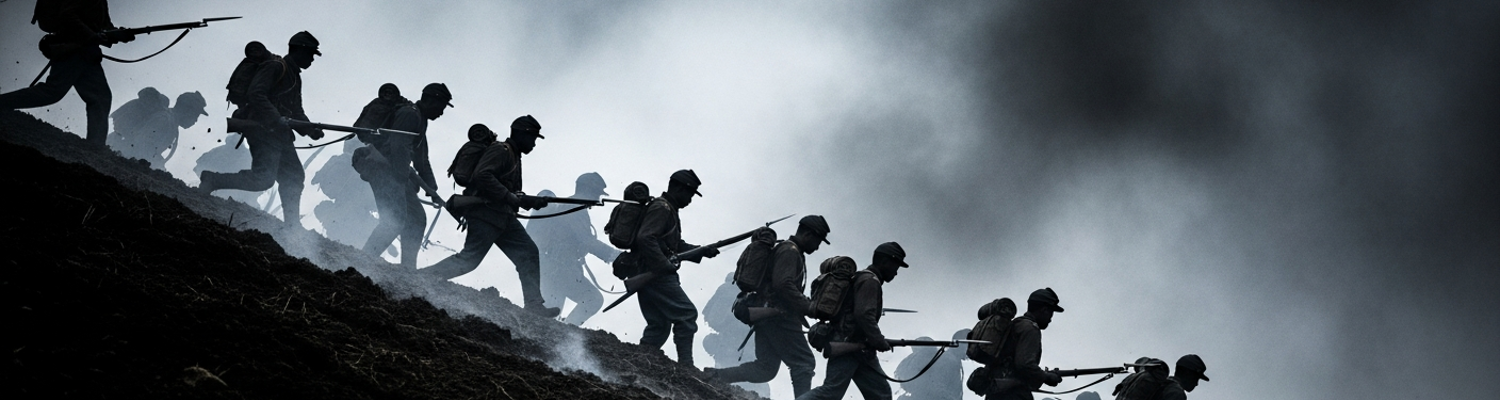

An Unequal Call to Arms
The Emancipation Proclamation of January 1, 1863, irrevocably altered the strategic calculus of the American Civil War. It formally sanctioned the mass enlistment of African Americans, a manpower resource the Union desperately needed. The War Department moved to standardize this new force, issuing General Order 143 on May 22, 1863. This directive established the Bureau of Colored Troops, an administrative body headquartered in Washington D.C. under Major Charles W. Foster. The Bureau created the machinery to organize, train, and equip what would become the United States Colored Troops (USCT), a force that eventually numbered over 178,000 men in approximately 175 regiments.
This organizational success, however, masked a deep-rooted strategic failure in equity. The Bureau of Colored Troops codified racial discrimination from its inception. The most significant impediment was the legislated pay disparity. The Militia Act of July 1862 stipulated that soldiers of African descent would receive ten dollars per month, from which three dollars were deducted for clothing. White privates received thirteen dollars per month with no such deduction. This policy, based on the assumption that Black soldiers would primarily serve as laborers, ignited widespread protest. The men of the 54th and 55th Massachusetts Infantry regiments famously refused any pay for eighteen months, insisting on parity. In a more extreme case, Sergeant William Walker of the Third South Carolina Colored Infantry was court-martialed and executed for leading his company to stack arms and protest the unequal pay. The protest was a direct challenge to the Union’s systemic bias. It took an act of Congress in June 1864 to finally equalize pay, and even then, full retroactive pay for all soldiers, including former slaves, was not granted until March 1865.
Command parity was another significant failure. The Bureau of Colored Troops insisted on assigning only white men to commissioned officer ranks. While a few Black men, like Martin R. Delany, eventually received commissions late in the war, they were exceptions. The officer corps of the USCT remained overwhelmingly white. This created a command structure where Black soldiers, fighting for their own freedom, were led by men who often shared the racial prejudices of the day. USCT regiments frequently received inferior equipment. They were often issued obsolete or second-rate weapons, like the .69 caliber Springfield Model 1842 smoothbore musket, while white troops received the more accurate .58 caliber Springfield Model 1861 rifle-musket. Medical care was another area of catastrophic failure. USCT soldiers were often stationed in unhealthy environments and suffered from a severe shortage of qualified physicians, resulting in a mortality rate from illness that was substantially higher than that for white soldiers.
Port Hudson's Bloody Proving Ground
Initial Union command strategy relegated USCT units to garrison and labor duties, reflecting a deep-seated doubt in their combat capabilities. This perception was shattered by fire and blood on the fields of Louisiana. On May 27, 1863, during the Siege of Port Hudson, two USCT regiments, the 1st and 3rd Louisiana Native Guards, were ordered to make a frontal assault against heavily fortified Confederate positions. Port Hudson was one of two remaining Confederate strongholds on the Mississippi River, and its capture was vital to Union control of the waterway.
The attacking force consisted of just over 1,000 men. The 1st Louisiana Native Guard was composed largely of free men of color from New Orleans, some of whom, like Captain André Cailloux, were wealthy and educated. The 3rd Louisiana Native Guard was made up mostly of former slaves. Union Major General Nathaniel P. Banks ordered the assault across a landscape of rugged ravines and abatis against entrenched Confederate infantry and artillery. The attack was a tactical failure. The regiments charged into a maelstrom of canister and rifle fire, suffering heavy casualties. Captain Cailloux fell while leading his men, his body left on the field for days. The assault was repulsed with a loss of 37 killed, 155 wounded, and 116 captured out of about 1,080 men.
Strategically, the assault was a success. The sheer determination shown by the Black soldiers under withering fire answered the question of their fighting ability. General Banks himself reported, "It gives me pleasure to report that they answered every expectation. In many respects their conduct was heroic. No troops could be more determined or more daring." News of their performance spread, providing a powerful counter-narrative to the prevailing prejudice. The valor displayed at Port Hudson proved that USCT soldiers were not just laborers in uniform but a capable fighting force, paving the way for their deployment in major combat operations.
The Crater's Cauldron
The Battle of the Crater on July 30, 1864, provided a tragic illustration of how command prejudice could sabotage the tactical effectiveness of USCT units. The plan, part of the Siege of Petersburg, was to detonate a massive mine under a Confederate salient and send a specially trained division of Black soldiers from Brigadier General Edward Ferrero's Fourth Division to lead the assault. These troops were drilled to bypass the crater itself and fan out to seize the heights beyond. At the last minute, Major General George Meade, with General Ulysses S. Grant's reluctant approval, ordered that an untrained white division lead the charge instead. The commanders feared political backlash in the North if the attack failed and Black troops suffered heavy casualties.
The result was a disaster. The mine exploded, creating a massive chasm, but the lead white division, unprepared for the task, charged directly into the crater instead of around it. They became trapped in a chaotic pit, a perfect killing ground for Confederate artillery and mortars. Ferrero's USCT division was then ordered in, but by then, the element of surprise was lost. They too were forced into the crater, adding to the confusion and carnage. Confederate troops, enraged at the sight of armed Black soldiers, engaged in a brutal massacre, shooting many USCT soldiers who tried to surrender. The attack failed completely, with the Union suffering over 3,700 casualties, a large portion from Ferrero's division. The battle was a strategic failure born from command indecision and racial bias, squandering the bravery of the USCT soldiers involved.
Decisive Action at Nashville
By late 1864, USCT regiments were an integral part of Union armies. This was decisively demonstrated at the Battle of Nashville on December 15-16, 1864. Major General George H. Thomas, commanding the Union forces, deployed approximately 13,000 USCT soldiers from eight different regiments, the largest concentration of Black troops in any single battle of the war. These units, including the 12th, 13th, 14th, and 100th USCT, formed two brigades under Colonel Thomas J. Morgan. On the first day, these brigades made a diversionary attack against the heavily fortified right flank of the Confederate line. The 1st Colored Brigade suffered heavy casualties in its assault on Granbury's Lunette, but their pressure fixed Confederate reserves in place.
On the second day, December 16, USCT units participated in the main assault on Overton Hill. Colonel Charles R. Thompson’s brigade, which included the 12th, 13th, and 100th USCT, charged the Confederate earthworks. They advanced under a devastating fire across open ground entangled with abatis. The 13th USCT pressed its attack with particular ferocity, continuing up the hill even after other units fell back. The regiment suffered immense casualties, losing 221 men, but their relentless pressure contributed to the eventual collapse of the Confederate line. The Army of Tennessee was shattered. General Thomas, who had harbored doubts about Black soldiers, declared, "Gentlemen, the question is settled, negro soldiers will fight." The Battle of Nashville represented a strategic success in the integration and deployment of USCT forces in a decisive offensive, proving their effectiveness beyond any doubt.
The Policy of No Quarter
The service of USCT soldiers was conducted under a unique and terrible threat. The Confederate government refused to recognize them as legitimate soldiers. In May 1863, the Confederacy passed a law declaring that captured Black soldiers would be turned over to state authorities to be treated as slave insurrectionists, a capital offense. Their white officers faced execution. This policy created an environment where atrocities were common. The most infamous example occurred at the Fort Pillow Massacre on April 12, 1864. A Confederate force under Major General Nathan Bedford Forrest overran the Union garrison, which consisted of both white Tennessee Unionists and Black soldiers from the 6th U.S. Colored Heavy Artillery. After the fort’s defenses were breached, Union soldiers attempted to surrender. Instead, they were shot down. The killing disproportionately targeted the Black soldiers. The Confederate policy of no quarter was a significant external impediment, but it also became a powerful motivator. "Remember Fort Pillow!" became a battle cry for USCT regiments, steeling their resolve and transforming their fight for freedom into one of vengeance.
The Political Fallout of Service
The battlefield contributions of the USCT had a direct and profound socio-political impact. Their courage systematically dismantled the arguments of those who claimed African Americans would not fight. The blood spilled at Port Hudson, Nashville, and dozens of other engagements served as a powerful political tool. It armed abolitionists and radical Republicans with irrefutable evidence of Black patriotism and manhood, strengthening the case for emancipation and citizenship. After an assault at Dalton, Georgia, in August 1864, Colonel Thomas J. Morgan noted that as his 14th USCT marched into town, a white regiment that had witnessed their charge gave them "three rousing cheers," a sign of shifting perceptions within the army itself.
This shift translated into concrete policy changes. The most immediate was the victory in the fight for equal pay, legislated in June 1864. This was a direct result of both the soldiers’ protests and their proven value on the battlefield. The war’s end saw USCT regiments comprising a significant portion of the Union’s occupation forces in the South, particularly in places like Texas, where they enforced General Gordon Granger's General Order No. 3, announcing emancipation. In this role, they protected freedmen and served as a visible symbol of the Confederacy’s defeat.
In the long term, the service of nearly 180,000 Black men in the Union Army laid the essential groundwork for the fight for civil rights. Their service became a central argument for the passage of the 14th and 15th Amendments. Frederick Douglass’s famous wartime declaration proved prophetic: "Once let the black man get upon his person the brass letter, U.S., let him get an eagle on his button, and a musket on his shoulder and bullets in his pocket, there is no power on earth that can deny that he has earned the right to citizenship." Many USCT veterans, such as Joseph H. Rainey and James T. Rapier, became political leaders and community organizers during Reconstruction, leveraging their wartime prestige to advocate for their rights. Their fight did not end at Appomattox. It continued in the halls of Congress and the state legislatures of the post-war South, a direct legacy of the valor they demonstrated in the uniform of the United States Army.