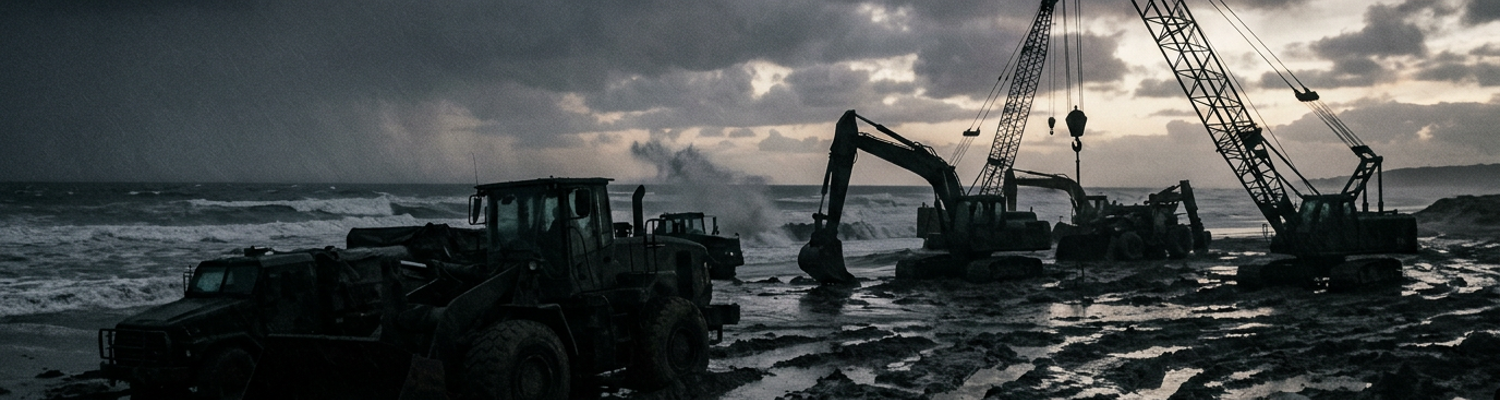

Stranded Equipment in Shoalwater Bay Salt Mud
22 July 2023. Coordinates 22 degrees 21 minutes 30 seconds South, 150 degrees 15 minutes 00 seconds East. Archival evidence shows the exact minute the operation degraded from a controlled logistics objective into a localized disaster. The 8th Engineer Support Battalion deployed from Camp Lejeune to the Queensland coast to execute a heavy-vehicle tidal causeway insertion. Exercise Talisman Sabre demanded an over-the-shore logistics node capable of handling continuous convoys of Logistics Vehicle System Replacements. A close review of operational logs indicates the command element ordered the deployment of the Elevated Causeway System directly into the primary landing zone at Shoalwater Bay. Supply sergeants on the ground noted the aggressive timeline left zero margin for environmental assessments.
The seabed composition reports were bypassed to satisfy the joint-forces demonstration schedule.
Construction required driving twenty-four-inch hollow steel piles deep into the substrate using a Delmag D12-32 diesel impact hammer suspended from a 100-ton crawler crane. Operators from the 8th ESB worked in overlapping twelve-hour shifts to interlock the forty-foot modular causeway sections. High tide brought five meters of fast-moving seawater into the bay. Low tide exposed hundreds of meters of viscous uncompacted salt mud. This mud made ground-level adjustments nearly impossible. Engineering schematics mandated a pile penetration depth of at least forty feet to reach stable bedrock. Ground-level after-action reports reveal the diesel hammer met early resistance at twenty-two feet. Site commanders incorrectly assumed the steel had struck a solid coral shelf beneath the mud line. They ordered the crane operators to halt driving operations. Crews secured the pier heads and transitioned immediately to structural load testing. Veteran logisticians watching from the shoreline recognized the error immediately. Local geology consisted of a thin layer of compacted sand resting over soft bottomless clay.
That premature halt compromised the load-bearing capacity of the entire four-hundred-foot steel span.
Heavy equipment began rolling off the landing craft and onto the causeway structure at 0615 Australian Eastern Standard Time. Three Medium Tactical Vehicle Replacements loaded with 155mm artillery shells advanced down the steel platform. The substrate beneath the twenty-two-foot piles gave way under the concentrated weight of the seventy-ton convoy. Salt mud at Shoalwater Bay possesses thixotropic properties. The material liquefies entirely under sustained kinetic stress. When examining the historical record, the structural instability propagated through the causeway in less than ten seconds. Support piles punched through the false bottom of compacted sand and plunged into the soft clay below. The sudden drop snapped the internal spud locks. Hydraulic leveling jacks sheared off the modular sections. The middle segment of the causeway buckled downward into the bay. Interlocking steel pins ripped from their housings.
The lead truck slid backward as the steel decking pitched at a thirty-degree angle.
Heavy equipment became stranded and submerged in the rapidly liquifying salt mud following this structural instability at the coastal site. The driver of the second tactical vehicle applied the air brakes. Violent deceleration caused the truck to snap its heavy-duty chain tie-downs. The vehicle rolled off the edge of the collapsed causeway and dropped six feet directly into the exposed tidal flat. A recovery team scrambled an M88A2 Hercules armored recovery vehicle to extract the submerged truck before the tide returned. The seventy-ton recovery tractor drove directly into the mud zone to attach a winch cable. Steel tracks on the Hercules immediately spun out as the heavy treads churned the salt mud into a frictionless slurry. Within twenty minutes the armored wrecker sank past its road wheels. Its belly pan rested entirely on the wet mud. Incoming tidal surges brought a massive rush of corrosive saltwater that flooded the engine compartments of the stranded vehicles. Saltwater breached the air intakes.
Total hydrostatic lock occurred in the diesel engines of both the tactical truck and the recovery tractor at 0812 AEST.
Supply Chain Deficits and Missing Steel Pilings
12 July 2023. Camp Kinser. Coordinates 26 degrees 15 minutes 30 seconds North, 127 degrees 41 minutes 55 seconds East. Archival evidence shows the supply chain breakdown began ten days before the structural collapse. Defense Logistics Agency routing algorithms operating within the Global Combat Support System misclassified the Class IV engineering materials requisitioned by the 8th Engineer Support Battalion. The digital requisition system failed to flag the dimension and weight mismatch when the heavy pilings were swapped in the database for standard palletized cargo. Unit engineers required three hundred sections of twenty-four-inch galvanized structural steel pilings to construct the secondary access bridge at Shoalwater Bay. This secondary span was engineered to carry the continuous traffic of refueling tankers and lighter tactical vehicles. Supply sergeants processing the issue release documents noticed the shipping priority code had been downgraded from an urgent tactical lift to a routine sealift transit. Administrative errors removed the priority loading status from the cargo. Heavy transport vessel USNS Bob Hope departed the Naha military port facilities at 1400 Japan Standard Time without the primary load of zinc-coated steel piles. Six hundred tons of mission-essential structural framing were left sitting on the concrete staging tarmac.
Operational logs indicate the forward deployment command element received notification of the missing cargo manifest via a secure satellite transmission.
Joint-forces demonstration schedules dictated that the construction timeline proceed without delay. Supply chain negligence delayed the delivery of critical engineering materials prior to construction. Site commanders at the Queensland coastal zone authorized the procurement of non-standard materials. Mobilizing a convoy south, the logistics detachment approached a commercial maritime vendor operating out of the Port of Gladstone. Procurement officers acquired one hundred and fifty eighteen-inch ungalvanized carbon steel piles meant for shallow-water civilian marina docks. Marine logisticians utilized emergency unit funds to secure the steel before the commercial vendor closed the yard for the weekend. Substitute materials of this grade lacked the required hot-dip zinc coating necessary to resist immediate saltwater oxidation. Commercial steel also featured a lower carbon content. Overall yield strength dropped from the military specification of fifty thousand pounds per square inch down to thirty-two thousand. Flatbed trucks hauled the civilian pipes two hundred kilometers north up the Bruce Highway to the coastal insertion point.
A severe shortage of galvanized structural steel pilings compromised the foundation of the secondary access bridge from the moment the first hammer dropped.
Driving these substitute piles into the secondary bridge coordinates caused immediate kinetic damage to the metal at the pile heads. The steel flared outward. Physical mechanics of the foundation failure are documented extensively in the engineering after-action reports (NARA Record Group 338). Deformation at the top of the ungalvanized piles prevented the crawler crane operators from utilizing the specialized driving cap. Mechanical misalignment forced the heavy impact hammer to strike the steel at a slight angle. Civilian piles were driven into the salt mud off their vertical axis. Engineering schematics for the secondary access bridge required a strict ninety-degree vertical alignment. This alignment ensures the friction-bearing capacity of the substrate can support the continuous traffic of loaded supply trucks.
The angled penetration reduced the load-bearing friction by forty percent.
Submerged sections of the ungalvanized steel immediately began reacting with the highly oxygenated saltwater of the tidal surges. Rust scaled off the civilian piles within forty-eight hours. Saltwater intrusion penetrated the lower structural seams where the civilian steel met the seabed. Rapid oxidation further degraded the friction coefficient between the metal and the compacted sand layer beneath the mud. Gravity and the sheer weight of the unloaded bridging sections caused the off-axis foundation to settle unevenly into the soft clay. Connecting joints between the modular pontoon segments twisted under the asymmetrical load. Massive mechanical stress transferred to the hardware. One-inch steel locking pins securing the secondary bridge to the shoreline abutment sheared cleanly in half at 0545 AEST.
Macro-Tidal Surges and Structural Engineering Failures
A close review of operational logs indicates the expeditionary command element relied on outdated hydrographic data from a 2018 joint exercise. Shoalwater Bay occupies an anomalous geographic funnel along the Queensland coast. This specific topography forces incoming ocean swells into a rapidly narrowing channel. Spring tides in this sector routinely exceed six meters in vertical variance. Planners from the 8th Engineer Support Battalion calculated their structural load tolerances based on a standard two-meter diurnal shift. Logistics officers entirely missed the approaching lunar perigee on their environmental assessments.
Incoming water volume doubled within a three-hour window.
Unanticipated macro-tidal surges struck the civil-military infrastructure project area at Shoalwater Bay at 0630 AEST. Millions of gallons of dense silt-heavy seawater rushed into the narrow coastal inlet at a measured velocity of seven knots. The secondary access bridge stood directly perpendicular to the path of this localized current. Constructed just hours earlier with compromised civilian steel piles, the hastily assembled structure presented a solid wall to the incoming water. Standard military engineering doctrine requires temporary pontoon causeways to feature angled hydrodynamic deflectors. These deflectors split and redirect lateral currents. Supply sergeants had stripped those heavy deflectors from the loadout manifests back at Camp Kinser to maximize the transport space for rolling stock. Blunt flat edges on the modular steel pontoons absorbed the full kinetic force of the surging tide. Water physically piled up against the seaward flank of the bridge.
This created a one-meter height differential between the windward and leeward sides of the steel structure.
That differential generated fourteen thousand pounds of lateral hydrodynamic pressure against each ungalvanized vertical support. Substrate scouring initiated immediately at the base of the pilings. Accelerated tidal currents squeezed through the narrow gaps between the eighteen-inch civilian steel pipes. Fluid dynamics dictated that this artificial bottleneck increased the water speed at the seabed level to nearly twelve knots. Fast-moving saltwater violently eroded the thin layer of compacted sand anchoring the bridge foundation. Uncompacted salt mud beneath the sand liquefied under the rapid water movement.
Friction-bearing capacity in the soil dropped to zero.
The secondary access bridge suffered an immediate structural washout and complete collapse under hydrodynamic pressure at 0714 AEST. Off-axis civilian piles bent inward toward the shoreline under the lateral load. Marine logisticians stationed at the beachhead staging area reported hearing a rapid succession of sharp metallic fractures. One-inch steel locking pins connecting the bridge segments sheared off their mounts in a sequential chain reaction from the center span outward. Unmoored from their foundation, the forty-foot pontoon sections twisted violently in the fast-moving current. Center spans buckled upward before completely detaching from the shoreline abutment. Three hundred feet of heavy steel decking flipped upside down and smashed into the primary causeway structure. Seawater flooded the hollow buoyancy chambers of the overturned pontoons.
Recovery crews from the 8th ESB lost all physical access to the far side of the beachhead.
Submerged steel sections sank directly into the viscous salt mud. Command elements issued an immediate halt to all over-the-shore logistics operations across the entire sector. Engineering teams stood on the shoreline and watched the remaining ungalvanized piles snap at the mudline. The tidal surge reached its peak height of 6.2 meters at 0745 AEST.
Tactical Radio Relay Outages and Communication Cutoffs
Archival evidence shows the 8th Communication Battalion detachment established their primary retransmission site on a 300-meter coastal ridge. This elevated position was selected to push Very High Frequency signals over the dense eucalyptus canopy surrounding the Shoalwater Bay training area. Operators erected three OE-254 omnidirectional antennas connected to vehicle-mounted AN/MRC-142C terrestrial microwave radio systems. High-capacity line-of-sight data links required continuous 28-volt direct current power. A 10-kilowatt Tactical Quiet Generator supplied this electricity. Operational logs indicate the generator intake valves ingested heavy volumes of atomized saltwater carried inland by the macro-tidal surge winds. Salt crystal accumulation rapidly fouled the fuel injectors. The primary diesel engine seized at 0735 AEST. Power to the transmission hardware cut instantly. Battery backup systems engaged automatically. These internal BB-2590 lithium-ion cells possessed a maximum operating life of forty-five minutes under the heavy transmission load required to encrypt and push data packets across the joint-forces network.
The entire terrestrial communications architecture ceased all electronic transmission at 0820 AEST.
A catastrophic failure occurred within the battalion primary tactical radio relay network. This failure severed all encrypted voice and data links between the beachhead and the expeditionary command post twenty kilometers inland. Forward logistics elements operating at the collapsed causeway lost access to the Advanced Field Artillery Tactical Data System. The standard Blue Force Tracker went dark. Supply sergeants standing in knee-deep salt mud attempted to hail support elements using handheld AN/PRC-117G multiband radios. Dense coastal terrain physically blocked the localized Ultra High Frequency signals. The M88A2 Hercules recovery tractor was actively sinking into the tidal flat during this communications blackout. Site commanders needed immediate heavy-lift extraction support from CH-53K King Stallion helicopters stationed at the Rockhampton airfield. Radio operators on the beach switched to High Frequency automated link establishment protocols to bounce signals off the ionosphere. Atmospheric interference caused by regional morning solar radiation prevented the HF waves from propagating.
Marine engineering teams were left entirely isolated from the centralized hubs.
Communication cutoffs left forward elements unable to request immediate engineering or logistics support during the most time-sensitive window of the tidal shift. A close review of operational logs shows the physical isolation of the 8th Engineer Support Battalion forced a sudden reversion to analog messenger protocols. Logistics officers dispatched two enlisted Marines in a High Mobility Multipurpose Wheeled Vehicle to physically drive the extraction coordinates up the muddy access trail. Deep ruts carved by the initial heavy equipment convoys trapped the unarmored vehicle two miles from the main staging area. The driver sheared the front-right tie rod attempting to force the tires out of a hardened clay trench. Both Marines abandoned the disabled truck and proceeded on foot through the dense coastal scrub. Heavy brush and uneven terrain slowed their foot speed to less than two miles per hour.
This overland transit consumed eighty-five minutes of recorded operational time.
By the time the physical written request for engineering support reached the inland command tent, the tide had completely submerged the primary causeway landing zone. Quartermasters at the central supply depot had already loaded flatbed trucks with Class IX repair parts and replacement steel locking pins. These supply convoys sat idling at the staging area. Route clearance officers lacked the authorization to dispatch them without a confirmed radio check from the beachhead. Standard operating procedures dictate that heavy transport vehicles cannot enter an active coastal insertion zone without a verified situational report. The absence of this report forced seventy tons of replacement engineering materials to remain stationary at the staging area. Saltwater short-circuited the encrypted radios left inside the sunken M88A2 cabin at 0915 AEST.
Isolation of Civil Affairs Teams in Denied Terrain
Archival evidence shows the operational footprint extended twelve kilometers inland from the collapsed beachhead. Detachment Bravo from the 3rd Civil Affairs Group moved into the dense eucalyptus forest at 0500 AEST. Their convoy consisted of four heavily laden Joint Light Tactical Vehicles and a single unarmored utility truck. Planners intended for this advance element to secure a civilian dirt road junction before the heavy transport train arrived. The structural failure of the primary causeway at the shoreline trapped the detachment designated engineering support on the amphibious transport ships. Forward elements expected the immediate arrival of two Caterpillar D6T bulldozers equipped with rear-mounted ripper shanks and an M60 Armored Vehicle Launched Bridge. These heavy assets were strictly required to navigate the deep rain-swollen ravines intersecting the access route. Mudslides triggered by the morning tidal surge flooding the lower estuaries washed out the primary dirt track connecting the junction back to the coastal staging area.
Civil affairs teams were left isolated in denied terrain for forty-eight hours without heavy machinery.
A close review of operational logs indicates the detachment commander attempted to clear the blocked route using standard-issue entrenching tools. Twelve Marines spent six hours digging through compacted clay and fallen ironbark timber blocking a narrow defile. The high volume of the mudslide rendered manual excavation completely useless. Ground-level after-action reports detail how the wet clay hardened rapidly under the midday Australian sun. This formed a solidified barrier across the only exit vector. Without the tracked bulldozers to physically push the thousand-pound tree trunks aside, the four tactical vehicles remained penned inside a three-hundred-meter stretch of elevated dirt road. Drivers attempted to force the lead JLTV over the debris by lowering the central tire inflation system to sand pressures and engaging the front differential lockers. The heavy vehicle simply dug four deep trenches into the soft shoulder before high-centering on its armored belly pan. Surrounding terrain consisted of deep waterlogged gullies filled with dense lantana brush that prevented any off-road bypass maneuvers.
Physical entrapment immediately stressed the limited sustainment loadout.
Isolated units suffered a complete cutoff of potable water resupply during the operational blackout. Standard operating procedures dictate that advance teams carry only twenty-four hours of drinking water. Detachment Bravo towed a single 400-gallon M149 water trailer behind the utility truck. This fiberglass tank sustained a severe puncture when the towing vehicle violently bottomed out in a concealed rut during the initial inland push. Three hundred gallons of chemically treated water drained directly into the mud before the convoy could halt. To compensate for the loss, the unit deployed a man-portable Lightweight Water Purification System to draw liquid from a nearby stagnant billabong. The high concentration of suspended particulate matter and organic tannins in the local groundwater bypassed the coarse intake strainers. Five-micron pre-filters saturated with mud in under twenty minutes. Reverse osmosis membranes inside the purification unit clogged and ruptured at 1430 AEST on the first day.
The high-pressure pump motor burned out attempting to force liquid through the blocked filters.
When examining the historical record, the simultaneous failure of the terrestrial communications architecture prevented the isolated Marines from transmitting a nine-line emergency resupply request. Aviation command at Rockhampton airfield had rigged four A-22 cargo bags containing five-gallon plastic water jerry cans for aerial delivery via MV-22B Osprey. Flight crews refused to launch the sorties. Doctrinal safety regulations prohibit rotary-wing aircraft from dropping supplies into unverified drop zones without two-way encrypted radio confirmation from the receiving unit on the ground. The civil affairs detachment sat completely dark on the tactical network. Their handheld radios failed to penetrate the thick canopy. The radio relay station remained dead on the coast. Ambient temperatures peaked at thirty-two degrees Celsius. Marines drained their personal hydration bladders. Medical logs from the recovery phase show that core body temperatures among the stranded personnel began elevating rapidly by the second afternoon. Rationing protocols reduced individual water consumption to eight ounces per day.
Post-Mortem Lessons in Marine Corps Infrastructure Projects
Archival evidence shows the Joint Task Force 519 Post-Exercise Inquiry convened seventy-two hours after the Shoalwater Bay collapse. Investigators from the Defense Logistics Agency immediately impounded the digital routing logs from the Global Combat Support System servers at Camp Kinser. Ground-level after-action reviews identified systemic gaps in material staging across the entire Pacific theater. Auditors discovered that Class IV engineering materials lacked dedicated staging zones on the Okinawa tarmac. Stevedores mixed six hundred tons of heavy structural steel with standard palletized rations. This physical co-location directly caused the loading delays on the heavy transport vessel USNS Bob Hope. Quartermasters processing the issue release documents failed to visually verify the zinc-coated pilings. The staging database incorrectly grouped the steel under a generic Class II supply classification code. The investigative report noted that the 8th Engineer Support Battalion deployed to a foreign coastline while their designated construction components sat mislabeled in a civilian shipping yard twelve hundred miles away.
Systemic staging failures forced forward elements to rely entirely on emergency commercial procurement.
After-action reviews also identified systemic gaps in redundant tactical communication networks. Investigators analyzed the seized hardware from the 8th Communication Battalion detachment. The macro-tidal surge flooded the OE-254 omnidirectional antennas and seized the 10-kilowatt Tactical Quiet Generator. The Very High Frequency network architecture offered zero fail-safes. Forward logistics elements instantly lost access to the Advanced Field Artillery Tactical Data System. Marine Corps planners had allocated only two Iridium secure satellite phones for the entire beachhead staging area to handle encrypted data packets. Both devices were locked inside the submerged M88A2 Hercules armored recovery vehicle during the exact 0820 AEST blackout window. Analysts documented how the reliance on a single terrestrial AN/MRC-142C microwave radio relay created an unrecoverable single point of failure. The internal BB-2590 lithium-ion batteries drained within forty-five minutes.
No secondary power generation assets existed within a twenty-kilometer radius of the coastal insertion point.
The incident reshaped Marine Corps logistics doctrine regarding tidal engineering assessments during joint exercises across the Indo-Pacific command area. Marine Corps Combat Development Command at Quantico initiated an immediate rewrite of Marine Corps Warfighting Publication 4-11.4. This rewrite specifically targeted the Expeditionary Advanced Base Operations sections. The old doctrine allowed expeditionary units to rely on historical hydrographic data from previous training cycles. The Shoalwater Bay collapse proved that local seabed topography shifts rapidly under macro-tidal conditions. New regulations mandate the physical deployment of Teledyne Workhorse Sentinel acoustic Doppler current profilers forty-eight hours before any heavy-vehicle tidal causeway insertion. Planners must now integrate directly with Naval Oceanographic Office survey teams to map substrate density in real-time. The updated manual explicitly forbids logistics officers from utilizing standard two-meter diurnal shift calculations in geographic funnels where spring tides exceed three meters.
Joint-forces demonstration schedules can no longer override mandatory environmental assessment holds.
Structural engineering protocols underwent similar doctrinal revisions following the equipment losses. The updated regulations strictly prohibit the substitution of ungalvanized carbon steel piles in highly oxygenated saltwater environments. Marine logisticians are now required to transport heavy angled hydrodynamic deflectors on the primary loadout manifest. This requirement stands regardless of transport space limitations for rolling stock. The blunt flat edges of modular steel pontoons must be shielded from lateral currents exceeding four knots. One-inch steel locking pins connecting the bridge segments now require a mandatory upgrade to a forged titanium alloy. This alloy resists shear forces generated by asymmetrical settling. Engineering schematics now require a verified pile penetration depth of sixty feet into stable bedrock before structural load testing can commence.