
A Command Forged in Chaos
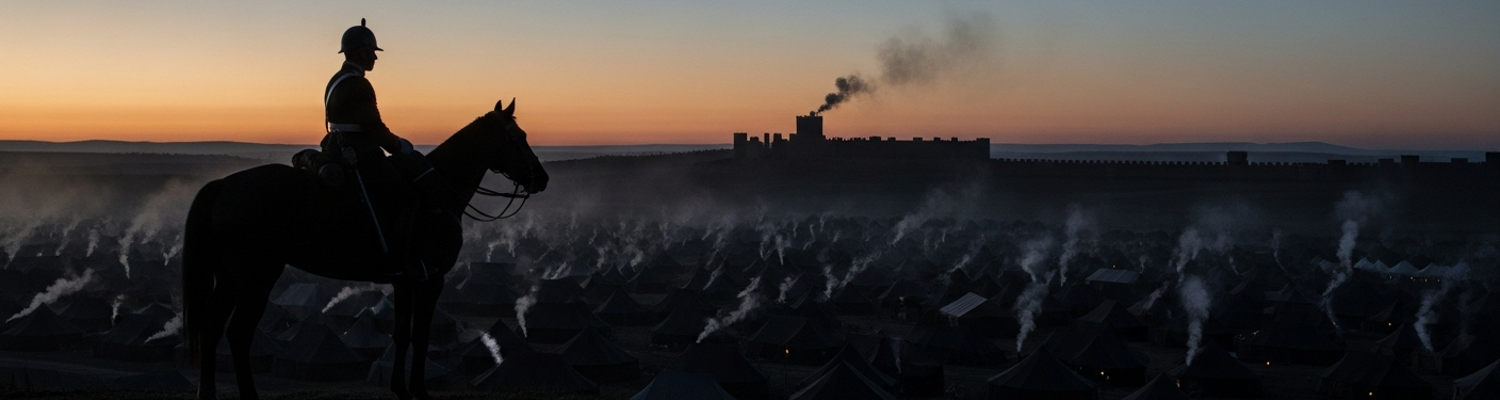
When General George Washington rode into Cambridge, Massachusetts, on July 3, 1775, he did not find an army. He found what he described as "a mixed multitude of people under very little discipline, order or government." This force, which had spontaneously materialized around Boston after the clashes at Lexington and Concord, was a patchwork of provincial militia units from Massachusetts, Connecticut, New Hampshire, and Rhode Island. They were bound by a common anger but separated by local loyalties, varied enlistment terms, and a near,total lack of military standardization. The Second Continental Congress had appointed Washington commander,in,chief on June 15, 1775, creating the Continental Army on paper and charging him with transforming this armed protest into a credible military instrument. The camps he surveyed, stretching in an arc from Roxbury to the Mystic River, were sprawling, unsanitary collections of tents and makeshift shelters. The air hung thick with the smell of woodsmoke, unwashed bodies, and poorly managed latrines. Washington, a Virginia planter who prized order and whose own military experience in the French and Indian War had been a harsh lesson in the professionalism of the British Army, was appalled. He saw an armed mob, not a military force. The men were spirited but insubordinate, treating military service like a temporary civic duty rather than a professional obligation. Washington faced the monumental task of imposing a military structure on a revolutionary movement. The eleven,month Siege of Boston would become his crucible, a period of intense trial where he would grapple with the fundamental challenges of building a national army, battling not just the British but also provincialism, logistical destitution, and the very nature of his own troops.
Forging Unity from Colonial Fiefdoms
Washington’s first task was to impose a unified command structure on a force that was, in reality, several distinct colonial armies encamped together. The Massachusetts Provincial Congress had appointed Artemas Ward as the commander of the forces besieging Boston. Ward, a veteran of the French and Indian War, had directed the American forces during the Battle of Bunker Hill from his headquarters, though his command was hampered by illness and a consultative leadership style that favored consensus over direct orders. The troops were organized into companies by town and regiments by county, with officers often elected or appointed based on local standing rather than military acumen. A popular man with local influence could become a captain, regardless of his tactical understanding. This system fostered intense loyalty to the local unit but worked against the cohesion needed for a national army. Washington found the officer corps riddled with incompetence, a situation he sought to rectify by asserting his congressional authority to approve all officer commissions. This move was met with immediate political friction. Soldiers from one colony felt little obligation to obey officers from another. Enlistment terms were dangerously short, with many set to expire at the end of the year, threatening to dissolve the army just as winter set in. Washington immediately set about dismantling this parochial structure. He organized the approximately 15,000 soldiers into three grand divisions, commanded by Major Generals Artemas Ward, Charles Lee, and Israel Putnam. This was a political necessity. Ward was the established Massachusetts commander. Lee was an eccentric and ambitious former British officer whose experience was deemed invaluable. Putnam was a Connecticut folk hero known for his personal bravery. Washington issued a stream of general orders that established standardized camp duties, mandated sanitary practices, and created a system of courts,martial to enforce discipline. He recognized that to build an army, he first had to create a shared identity. Men who saw themselves as New Hampshire volunteers or Massachusetts militiamen had to begin thinking of themselves as soldiers in a unified American cause. This process was slow and met with resistance from men accustomed to the more casual and democratic norms of militia service.
The Specter of Bunker Hill
The Battle of Bunker Hill, fought on June 17, 1775, occurred just before Washington's arrival but profoundly shaped his strategic outlook. The battle, which actually took place primarily on Breed's Hill, saw colonial militia under commanders like Colonel William Prescott and Israel Putnam inflict staggering casualties on seasoned British regulars. The Americans had hastily constructed a redoubt on the hill overnight, presenting General Thomas Gage's forces with a direct challenge. General William Howe led the British assaults, sending waves of redcoats marching up the hill in disciplined lines. The American commanders famously ordered their men, "Do not fire until you see the whites of their eyes," a command born of necessity due to the scarcity of ammunition. The first two British assaults were repulsed with devastating losses. The British took the ground on the third attempt but at a cost of over 1,000 killed and wounded, a casualty rate that shocked both sides and led to Gage's eventual replacement by Howe. For Washington, the battle offered two powerful, competing lessons. First, it proved that American militiamen, when positioned behind fortifications, could fight with a ferocity that matched the best professional soldiers in the world. This raw fighting spirit was the essential material from which he had to build his army. Second, the battle's ultimate outcome exposed the fatal weaknesses of the militia system. The American position was lost not due to a failure of will, but a failure of supply and command. The defenders ran out of gunpowder, reducing them to throwing rocks and using their muskets as clubs before the final British assault with bayonets overwhelmed them. The sight of the organized bayonet charge breaking his countrymen left a deep impression on Washington, who would later prioritize bayonet training for his own regulars. Reinforcements were disorganized, and many units failed to advance to the front lines, demonstrating a critical breakdown in command and control. Washington understood that bravery alone could not win the war. It needed to be harnessed by professional discipline, supported by a reliable logistical chain, and directed by a clear, unquestioned command structure. The loss at Bunker Hill convinced Washington of the urgent need for professionalization and drove his relentless focus on training and securing the material of war.
A War Fought with Empty Powder Horns
Washington’s most immediate and terrifying crisis was the severe shortage of gunpowder. Shortly after taking command, a formal inventory revealed that the army had only enough powder for about nine rounds per man. This discovery, Washington later admitted, shocked him so profoundly he did not speak for half an hour. The information was kept a closely guarded secret to prevent panic and to hide the army’s vulnerability from the British. The shortage was so acute that Washington issued strict orders against wasting powder on celebratory firings or hunting. The problem was systemic. Before the war, most gunpowder was imported from Britain, a supply now cut off. There was only one significant powder mill operating in the colonies at the start of the conflict. The Continental Congress and various colonial committees of safety launched frantic efforts to procure powder. They funded new mills, published pamphlets on how to manufacture saltpeter (a key ingredient), and dispatched agents to acquire supplies through smuggling, primarily from French and Dutch colonies in the West Indies. This logistical poverty extended to every class of supply. The army lacked standardized firearms. Soldiers carried a miscellany of personal hunting pieces, fowling guns, and old muskets of varying calibers. This made ammunition resupply a logistical nightmare. Clothing was another persistent problem, with many soldiers in rags as the harsh New England winter approached. The procurement system was fragmented, relying on individual colonies to supply their own troops, a method that proved inefficient and unreliable. Congress had created the positions of Quartermaster General and Commissary General, but these departments lacked the funds, authority, and infrastructure to function effectively. Food spoiled for want of transport, while men in other camps went hungry. Washington’s correspondence from this period is filled with desperate appeals to Congress and the colonial governors for arms, clothing, food, and money. A critical logistical success came from the mind of a 25,year,old bookseller,turned,artilleryman, Henry Knox. Recognizing the need for heavy artillery to break the stalemate at Boston, Washington dispatched Knox in November 1775 on an audacious mission. Knox traveled 300 miles to the recently captured Fort Ticonderoga in New York. Over three brutal winter months, he and his men moved 60 tons of captured British cannon, mortars, and howitzers by boat, ox,drawn sledges, and sheer manpower across the frozen Hudson River, through the snow,choked forests of the Green Mountains, and over the Berkshire Mountains. This feat, known as the Noble Train of Artillery, was a logistical masterpiece executed under the most primitive conditions. The train arrived outside Boston in late January 1776, providing Washington with the firepower he desperately needed. In early March 1776, using prefabricated fortifications and hay bales to muffle the sound, Washington’s men secretly fortified Dorchester Heights in a single night. Under the command of General John Thomas, they placed the Ticonderoga cannons in a position that threatened the British fleet in Boston Harbor. Faced with this untenable position, British General William Howe chose to evacuate the city. On March 17, 1776, the British fleet sailed for Halifax, ending the eleven,month siege. The army Washington now commanded was far from a finished product, but the crucible of Boston had begun the transformation. He had taken a "mixed multitude" and forged the foundation of the Continental Army.