
### I Corps Tactical Zone: The Operational Environment
Training manuals issued to Marines bound for Southeast Asia depicted a clear, linear process for handling captured enemy personnel. The directives promised a structured chain of evacuation from point of capture to rear-area interrogation centers. The I Corps Tactical Zone in 1967 had other plans. It was a region where doctrine collided with a complex and unforgiving battlespace, making textbook procedures an administrative fiction for the infantrymen on the ground.
A close review of operational logs reveals the scale of the III Marine Amphibious Force (III MAF) area of responsibility. III MAF, comprising the 1st and 3rd Marine Divisions and the 1st Marine Aircraft Wing, prosecuted the war in South Vietnam's five northernmost provinces: Quang Tri, Thua Thien, Quang Nam, Quang Tin, and Quang Ngai. This battlespace extended from the heavily infiltrated Demilitarized Zone (DMZ) down to the Viet Cong-dominated coastal plains. The 3rd Marine Division was largely fixed in the north, engaged in a conventional fight against North Vietnamese Army (NVA) regulars. Their headquarters at Dong Ha and outposts like Con Thien and Khe Sanh became focal points of large-unit combat. To the south, the 1st Marine Division, with its headquarters at Chu Lai and later Da Nang, fought a different kind of war. Its Tactical Area of Responsibility encompassed populous, rice-rich provinces where the enemy was a mix of local Viet Cong guerrillas and NVA main force units.
The year 1967 was one of continuous, large-scale combat. Operational records document a relentless tempo of multi-battalion operations. The 3rd Marine Division contended with the NVA along the DMZ in a series of engagements known as the hill fights and in major named operations like Prairie IV, Hickory, and Kingfisher. These were not small skirmishes but conventional battles involving thousands of troops, massed artillery, and constant air support. During Operation Buffalo in July, a single company from the 9th Marines made contact near Con Thien and rapidly found itself engaged with five NVA battalions. Further south, the 1st Marine Division conducted its own large-unit sweeps, including Operations Union, Union II, and Swift in the Quế Sơn Valley. Over the first half of the year alone, the 1st Marine Division conducted 43 operations of battalion size or larger, alongside tens of thousands of smaller patrols. The fighting was constant; in July 1967, III MAF forces killed nearly 3,000 enemy combatants and captured over 200, at a cost of 413 Marines killed and over 3,200 wounded.
This operational intensity was set against an environment that actively worked against military procedure. The triple-canopy jungle, mountainous highlands, and waterlogged rice paddies presented severe physical obstacles. Visibility was often reduced to meters. The climate was an enemy in itself. Extreme heat and humidity caused widespread equipment failure. The delicate electronics of portable radios like the PRC-25 were susceptible to moisture, leading to communication breakdowns during contact. The very paper used for administrative tasks, such as filling out capture tags for detainees, would disintegrate into pulp in the monsoon rains or from sweat. For a rifle squad that had just survived a firefight, the doctrinal requirement to safeguard and transport a prisoner through kilometers of dense, hostile jungle was a monumental physical and tactical challenge. Stopping to administer aid or process a detainee created a static, vulnerable target for a follow-on attack, a risk that ground commanders had to weigh against procedural mandates.
### Point of Capture: Doctrine Versus Reality
Official procedure dictated a clear sequence, known by the mnemonic Search, Silence, Segregate, Safeguard, and Speed to the rear. This was the theoretical foundation for handling a captured enemy combatant. The moment of capture, however, was rarely a sterile tactical environment conducive to administrative work. After-action reports from III MAF operations in 1967 show that contact was most often a sudden, violent collision in dense terrain. For a Marine rifle squad that had just suppressed a burst of AK-47 fire and taken a prisoner, the fight was not over. The immediate priority was tactical: establish a perimeter, redistribute ammunition, attend to friendly wounded, and brace for a counter-attack from the prisoner’s retreating comrades. The Standard Operating Procedure assumed a degree of control that did not exist in the seconds after a firefight. Silence and segregation were tactical necessities to prevent the detainee from alerting other enemy forces, not just procedural checkboxes. Safeguarding a prisoner was secondary to safeguarding the unit itself.
The procedural requirements began to pile up immediately. A thorough search was paramount, not only for overt weapons but for concealed items like a hand grenade tucked in an armpit or a map hidden in a sandal. Following the search, the Marine squad leader was required to report the capture up the chain of command. This typically involved the unit’s radioman and his 25-pound AN/PRC-25 radio set. The report itself was a formal exercise, often a SALUTE report detailing the size, activity, location, unit, time, and equipment related to the captured enemy. This transmission, however, broadcast the unit’s position to any enemy force monitoring radio frequencies. Next was tagging. Each prisoner was to be affixed with a DD Form EPW-1, a three-part carbon paper tag designed to track the individual and any confiscated property. In the heat and drenching humidity of Quang Tri province, these paper tags would frequently turn to useless pulp, their ink running into an illegible smear.
The final step was to speed the prisoner to the rear. This simple phrase masked an immense physical and tactical burden. A single, able-bodied prisoner required at least two Marines as an escort, instantly reducing a depleted squad’s combat power. If the prisoner was wounded, the burden increased exponentially. He would have to be carried, often on an improvised stretcher, through kilometers of jungle or across flooded rice paddies. A Marine patrol, already laden with weapons, ammunition, water, and their own wounded, was now slowed to a crawling pace. This made them a lingering, predictable target. Helicopter evacuation was the doctrinal solution, but a helicopter was a high-value asset. A request for a single prisoner extraction, a popeye, had to compete with priority requests for medevac of wounded Marines, emergency resupply, or close air support. Command and control had to weigh the potential intelligence value of one NVA soldier against the risk of losing a UH-34 Seahorse and its crew to ground fire for a non-emergency extraction. The patrol would often have to walk him out.
### An Apparatus of Attrition: Firepower Saturation
Operational logs from I Corps in July 1967 reveal a command philosophy dedicated to attrition through firepower. The 1st Marine Aircraft Wing (1st MAW) reported dropping 15,000 tons of aerial ordnance during that single month. This torrent of destructive energy was delivered by platforms like the F-4 Phantom and A-4 Skyhawk. During the intense fighting around Con Thien in operations like Buffalo and Kingfisher, these aircraft delivered high-explosive bombs, napalm, and cluster munitions to blunt large-scale NVA attacks. When a company from the 1st Battalion, 9th Marines, was ambushed by five NVA battalions on July 2nd during Operation Buffalo, only the immediate application of air and artillery strikes prevented the unit’s complete destruction. The objective of this airpower was not to enable capture, but to inflict maximum casualties. More than 500 of the 1,290 NVA dead claimed during Operation Buffalo were attributed to air, artillery, and naval gunfire.
Ground-based fire support told a similar story. In July 1967, III MAF artillery units expended over 300,000 rounds in I Corps. Batteries of 105mm and 155mm howitzers, augmented by heavy Army 175mm guns, were positioned in fire support bases like Con Thien, Gio Linh, and Đông Hà. They executed a constant stream of fire missions, from pre-planned strikes on suspected enemy assembly areas to rapid-response support for units in contact. During the heaviest periods of fighting near the DMZ, artillery units fired thousands of rounds per day in massive concentrations designed to saturate large grid squares. Archival evidence shows that during one period of intense NVA pressure, III MAF artillery fired 12,577 rounds while the Seventh Fleet added another 6,148 rounds from naval guns. This volume of fire was for area denial, a way to make infiltration routes untenable through sheer explosive force. The result was a battlespace so pulverized that identifying individual combatants, let alone taking them alive, became a near impossibility in the aftermath of a strike.
This focus on destructive power created a fundamental disconnect in operational priorities. The resources dedicated to killing the enemy dwarfed those allocated to processing a live one. A Marine squad leader could request an artillery fire mission or an airstrike with relative speed through a Forward Air Controller or a Forward Observer. That same squad leader, upon capturing a single NVA soldier, faced an administrative and logistical ordeal with almost no dedicated support. While artillery battalions were experimenting with the new M18 Field Artillery Digital Computer (FADC) to increase the speed of fire missions, the infantryman on the ground was still using paper DD Form EPW-1 tags that dissolved in the monsoon rains. The system for delivering violence was technologically advanced and heavily resourced. The system for handling a captured human being was primitive and improvised. The official monthly summary for July 1967 records that III MAF forces killed 2,983 enemy personnel and captured 246. For every prisoner taken, twelve enemy soldiers were killed.
### The Failure of Secure Communications
A mid-1967 internal review of III MAF signal operations paints a bleak picture of tactical communications. The promise of secure voice transmission hinged on the KY-38 NESTOR, a cryptographic device designed to be paired with the infantry’s workhorse AN/PRC-25 radio. On paper, it offered encryption. In the jungles of I Corps, it was a failure. The unit was heavy and bulky; a Marine radioman carrying the PRC-25 and the attached KY-38, along with spare batteries, was burdened with a 54-pound load before adding his weapon, ammunition, or water. This weight penalty led many units to simply leave the device behind. The NESTOR was also notoriously unreliable in the tropical environment, sensitive to heat and humidity which caused frequent electronic failures and drained its separate, specialized batteries. A National Security Agency estimate from the period suggests that only about one in ten NESTOR units sent to Vietnam were actually used. The result was a near-total reliance on unencrypted FM radio traffic for platoon and company-level operations.
This reliance on insecure radio had a damaging impact on the flow of tactical intelligence. Captured North Vietnamese and Viet Cong documents and post-war analysis confirmed that enemy signals intelligence units were adept at monitoring American radio nets. These units could easily decipher the simple, locally-generated codes and slang that Marines used in an attempt to obscure their transmissions. A standard SALUTE report broadcast in the clear was an open invitation for an ambush or mortar strike. Enemy units were known to react tactically to information they overheard, including details about patrol routes, casualty reports, and unit plans. The fear of such compromise was pervasive. A squad leader who had just captured a prisoner deep in hostile territory had to assume his every transmission was being monitored. This knowledge created a chilling effect; commanders on the ground would often deliberately withhold sensitive details from their radio reports, especially the exact location of the capture or the nature of any documents found on the prisoner.
The consequence was a delay in reporting captured personnel data. The intelligence cycle, which relied on the rapid exploitation of information from new prisoners, was often broken at its first link. Instead of immediately relaying the full details of a capture to rear-echelon intelligence officers, the patrol was forced into a communications blackout. The time-sensitive information held by a captured NVA officer, the location of a headquarters element or plans for an impending attack, could not be transmitted securely. The patrol’s only option was to walk the prisoner back to the nearest command post, a journey that could take many hours or even a day. By the time the prisoner was finally available for formal interrogation, the tactical intelligence they contained was often stale. The enemy unit had moved. The planned ambush had been executed. The window of opportunity had closed.
### Centralized Assets and Tactical Blindness
A review of III MAF’s intelligence structure in 1967 reveals a shortage of trained interrogation personnel. The designated Marine Corps Military Occupational Specialty for this role was Interrogator-Translator, MOS 0251. These specialists were few, and the pipeline for training them was long. A persistent shortage of trained, Vietnamese-speaking American interrogators curtailed the effort to exploit human sources. This scarcity was magnified by the operational tempo; in July 1967 alone, III MAF captured 246 enemy personnel, a number that overwhelmed the limited number of specialists available. The problem was not just a lack of bodies, but a lack of linguists. A qualified American interrogator who could not speak Vietnamese was forced to rely on an interpreter, a process that introduced delays and potential inaccuracies. The 11th Interrogation Translation Team, a key unit, did not even arrive in Da Nang until July 17, 1967, well into a year of heavy fighting. For much of the year, the number of formally trained interrogator-translators available to the two Marine divisions was perilously low.
This scarcity of specialists was compounded by their physical location. The few available interrogation assets were largely consolidated in rear-area installations. This command decision created a fatal time lag in the intelligence cycle. Prisoners captured by a 1st Marine Division patrol in the Quế Sơn Valley or by a 3rd Marine Division unit near the DMZ had to be transported from the point of capture, often on foot, to a battalion command post, then to a regimental collection point, and eventually to a divisional or corps-level interrogation center like the Combined Interrogation Center (CIC) in Da Nang. This journey could take days.
The entire structure was designed for strategic, long-term intelligence gathering, not for the immediate tactical needs of a unit in contact. A captured NVA soldier might hold information about an impending attack planned for that night, but by the time he reached a trained interrogator in Da Nang 24 hours later, that intelligence was operationally useless. A review of the CIC's structure shows it was organized to produce detailed reports for dissemination to high-level commands, not to rapidly feed information back to the platoon that had captured the prisoner. The delay between capture and effective interrogation meant that actionable, time-sensitive tactical intelligence was consistently lost. Information about enemy unit locations, planned ambushes, or mortar firing positions became stale before it could ever be exploited. After-action reports from 1967 are filled with instances where patrols walked into ambushes that a timely interrogation might have prevented.
### The Unofficial Triage: Medical Care for Detainees
A review of III Marine Amphibious Force operational summaries from July 1967 reveals a system consumed by combat, one that recorded its own casualties with precision while affording captured enemy wounded little more than a cursory note. During that single month, III MAF documented 413 of its own men killed and 3,208 wounded. In the same period, it recorded 2,983 enemy killed and 246 captured. The medical records from field units reflect this command focus. They are exhaustive in their documentation of American casualties but show a telling absence of specific data on the condition or treatment of the 246 detainees. Geneva Convention mandates required that enemy casualties receive care, but on the ground, this was interpreted through the lens of tactical priority and resource scarcity. The system for casualty care was built for Marines, and its capacity was stretched to the breaking point by operations like Buffalo and Kingfisher.
Official Marine Corps doctrine laid out four categories for triage: Immediate, Delayed, Minimal, and Expectant. A wounded Marine would be assessed and placed into one of these categories by a Navy Corpsman. A captured, wounded enemy combatant, however, fell into an unofficial fifth category: last. A Corpsman’s first, second, and third priority was the Marines in his platoon. His medical kit, often a standard M3 Unit One bag, was a finite resource, containing items like field dressings, sutures, and a small surgical kit. These were not resources to be expended on an enemy soldier while a single Marine was still at risk. Initial stabilization for a detainee, therefore, was often rudimentary. It might consist of a single battle dressing hastily applied to a wound, often over a filthy uniform, or a tourniquet cinched down to stop arterial bleeding. There was no time or capacity for cleaning wounds, administering antibiotics, or managing the onset of shock.
This initial lack of care ensured that a detainee's existing wounds were almost certain to worsen. The journey from the point of capture to a rear area was a gantlet of infection and physical stress. The oppressive heat and humidity of the jungle created a perfect breeding ground for bacteria. A gunshot or shrapnel wound, packed with dirt and shredded uniform fabric and covered by a single, soon-to-be-saturated dressing, would begin to fester within hours. The method of transport itself became a mechanism of injury. Lacking dedicated litters, Marines would improvise stretchers from ponchos and branches. This created an unstable platform that jostled the casualty with every step, aggravating fractures and causing internal bleeding. A journey of several kilometers through dense jungle could take most of a day, during which a detainee suffering from a chest wound or internal injuries would deteriorate past the point of no return, often succumbing to shock or blood loss long before reaching a facility equipped to treat them.
### Administrative Paralysis and Logistical Strain
A review of III MAF’s administrative records from mid-1967 reveals a support system buckling under the weight of continuous combat. For every Marine fighting in the field, personnel in a rear echelon headquarters at Da Nang or Đông Hà were tasked with tracking his existence. The operational tempo of 1967 generated a cascade of paperwork that threatened to overwhelm the S-1 (personnel) and S-3 (operations) sections. In July 1967 alone, administrative clerks had to process casualty reports for over 3,600 Marines killed or wounded, an average of 116 per day. This workload was familiar. The processing of the 246 enemy detainees captured during that same period introduced a level of friction the system was ill-equipped to handle.
The entire administrative chain of custody for a prisoner began with the DD Form EPW-1 tag. When a prisoner arrived at a battalion collection point without a tag, or with a pulpy, unreadable one, the administrative process broke down. Clerks were forced to create new records from scratch based on fragmented radio reports or the verbal debrief of the escorting Marines, introducing errors and consuming time that was already scarce.
This administrative chaos was mirrored by the severe stress placed on medical personnel. The high casualty rates meant that Navy Hospital Corpsmen were in a state of perpetual triage, their efforts consumed entirely by saving wounded Marines. A corpsman’s duty was to his own men first, and any aid given to a detainee was often the bare minimum required to keep him alive for transport. The psychological toll on these corpsmen was heavy; they were often teenagers themselves, forced to make life-or-death decisions in the middle of a firefight, a burden compounded by the constant exposure to trauma.
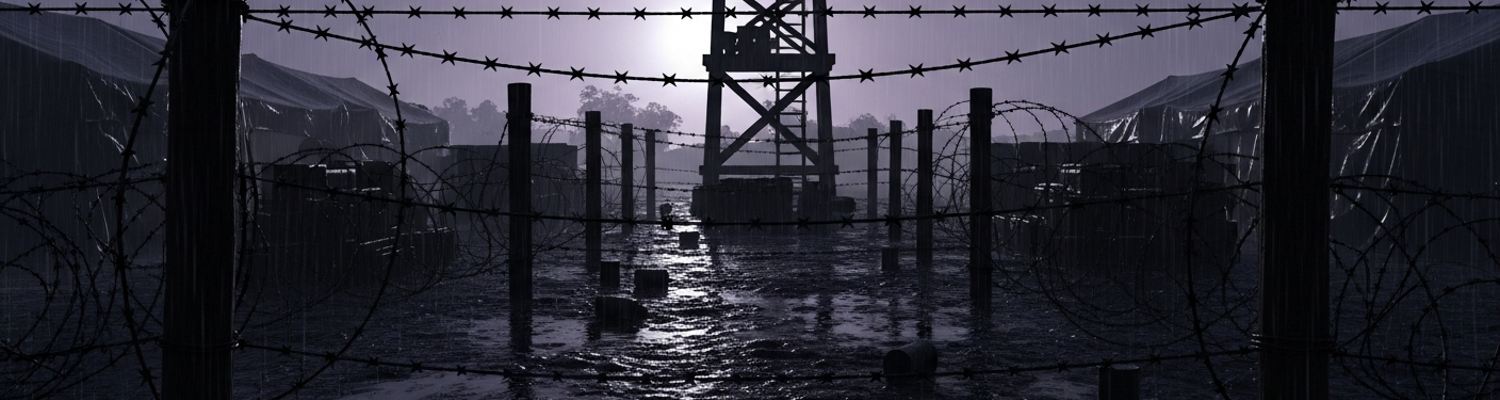
Underpinning these personnel issues was a fundamental logistical strain. The high operational tempo ensured that every key logistical asset, especially helicopters, was dedicated to the primary mission of fighting. A request from a platoon to extract a single prisoner was always last in line. This forced the infantry squad to walk the detainee out. The logistical chain for a human being was improvised and inefficient. Upon reaching a battalion command post or a fire support base, there were no dedicated facilities. Prisoners were held in makeshift enclosures of concertina wire, often exposed to the elements. These collection points were themselves strained, their personnel and resources focused on their main function, such as providing artillery fire. The guards assigned to watch detainees were infantrymen pulled from the line, reducing the combat effectiveness of their own units. Food and water were scarce, and medical care was non-existent beyond what had been rendered in the field. The entire logistical system was designed for moving supplies forward and evacuating American casualties to the rear; it had no efficient mechanism for moving a captured enemy combatant in the opposite direction.
### Command Philosophy and Doctrinal Inertia
The systemic failures in detainee handling were not accidental. They were the direct result of a command philosophy that prioritized attrition above all else. The primary metric of success in 1967, as directed by the Military Assistance Command, Vietnam (MACV), was the body count. The operational architecture of III MAF, from its fire support coordination to its logistical priorities, was engineered to produce this single statistic. Taking prisoners was a complicated, resource-intensive, and dangerous activity that ran counter to this prime directive. It was an operational distraction.
This philosophy is evident in resource allocation. The investment in systems designed to kill, such as the 1st MAW’s air assets and the divisional artillery batteries, was enormous. In contrast, the investment in systems to process live captives was negligible. There was no equivalent to the FADC for prisoner intake. There was no high-priority asset like a medevac helicopter on standby for prisoner extraction. The Interrogator-Translator MOS 0251 was chronically under-filled, a clear indicator that human intelligence exploitation was not a command priority on par with signals intelligence or aerial reconnaissance.
Doctrinal inertia played a significant role. The procedures for handling prisoners of war, like the DD Form EPW-1, were largely inherited from the conventional battlefields of World War II and Korea. They were designed for a different kind of war, one with clear front lines and secure rear areas where administrative tasks could be performed without immediate threat. They were not adapted for the realities of a counter-insurgency in the jungles and rice paddies of I Corps. The failure of the KY-38 NESTOR secure voice system was a technological problem, but the decision to not prioritize a replacement or alternative procedure was a command failure. It accepted the risk of compromised communications and the resulting loss of tactical intelligence.
The result was a self-reinforcing cycle. Because the system for capturing, evacuating, and interrogating prisoners was so inefficient, the intelligence it produced was often stale and of little tactical value. This poor return on investment reinforced the command’s preference for firepower and attrition. Why risk a squad and a helicopter for a prisoner who might yield no useful information when an artillery strike offered a guaranteed, quantifiable result? The individual Marine in the field was left to manage the consequences of this high-level calculus, caught between the demands of a dysfunctional doctrine and the lethal realities of his immediate surroundings.