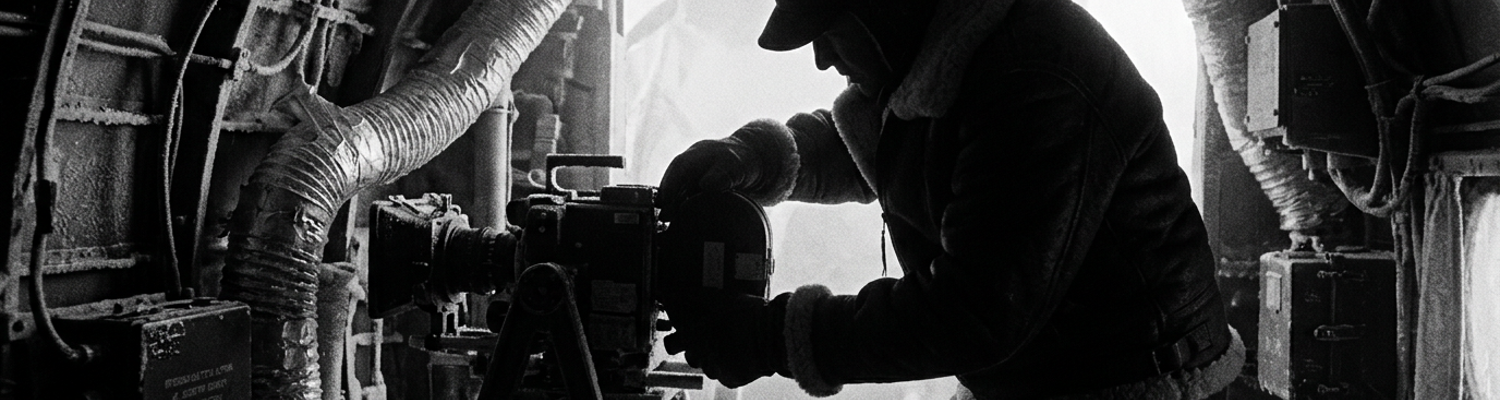

High-Altitude Optical Freezing in B-29 Reconnaissance Platforms
At 0841 over the Pacific approaches to Suruga Bay, Technical Sergeant Robert C. Vance tightened an insulated wire clamp around the lower frame of a Fairchild K-18 aerial camera. He used bare, numb fingers. He had exactly five minutes before the modified Boeing F-13A crossed the coast of Honshu at thirty-two thousand feet. Beneath his boots, the unheated aluminum flooring of the aft camera bay radiated freezing air directly through his fleece-lined shearling suit.
If the lens heater coil slipped off its mounting bracket before the reconnaissance run began, thirty-six rolls of nine-inch film would return to Saipan as blank, unusable exposures.
Metal contracted faster than the rubber seals could flex.
Archival evidence shows that environmental hazards at these operating heights exceeded anything USAAF planners had calculated during testing at Wright Field. Flights belonging to the 3rd Photographic Reconnaissance Squadron routinely encountered sub-zero temperatures dropping below minus fifty degrees Celsius at 30,000 to 35,000 feet over the Japanese mainland. Across the central plains of Honshu, atmospheric instruments documented ambient readings plummeting to minus fifty-eight degrees.
This thermal barrier altered the mechanical behavior of standard flight hardware.
Aircraft motor oils congealed into heavy pastes. Shutter mechanisms on long-focal-length Fairchild K-17 and K-22 cameras seized mid-cycle. Petroleum-based lubricants solidified instantly in the open gear teeth. The upper-troposphere jet stream clocked sustained tailwinds over one hundred and sixty knots. This forced the stripped-down bombers to run their Wright R-3350 engines at full power settings simply to maintain stable photographic tracks against the gale.
The air outside was thin, dry, and hostile to precision instruments.
A close review of operational logs indicates that altitude transitions between the tropical lower atmosphere and the stratosphere created severe frost and condensation accumulation on optical glass ports. F-13A aircraft staged out of Isley Field on Saipan took off in ambient temperatures exceeding thirty degrees Celsius. Relative humidity hovered near ninety percent. Tropical water vapor infiltrated unsealed gaps in the fuselage skin. It saturated the interior bulkheads and pooled along the inner faces of the heavy optical glass ports.
When the aircraft climbed through twenty thousand feet, this suspended moisture condensed into heavy liquid beads.
By the time the aircraft reached mission ceiling above Mount Fuji, that trapped moisture flash-froze across the viewing windows into opaque crystalline sheets. Flight crews could not wipe the glass clean from the pressurized forward cabin without depressurizing the entire aircraft. The alternative involved crawling through the narrow bomb-bay tunnel into freezing unpressurized pockets.
Two millimeters of ice grounded the entire intelligence gathering effort.
When examining the historical record, the technical bottleneck traced directly back to the inadequacy of baseline B-29 environmental systems for unpressurized and semi-pressurized camera bays. Boeing designed the standard Superfortress cabin-heating layout specifically to maintain habitable temperatures for the forward flight deck and the aft gunners. This system used exhaust manifold heat exchangers that routed warmed air through regulated distribution lines.
The F-13 field modifications disrupted this thermal balance.
Engineers carved dedicated photographic wells directly behind the rear pressure bulkhead and inside the unpressurized lower empennage. Secondary ducting installed at continental modification depots lacked sufficient static air pressure to push heated air into these rear camera compartments against outside air wash. At minus fifty degrees, the trickling warm air dissipated before reaching the glass optical flats. This produced thermal gradients that cracked five-inch-thick ground lenses. Crews found that primary heating ducts choked with internal ice pellets. This starved the ventral camera ports of thermal protection at the exact moment the planes turned toward their primary targets over downtown Tokyo.
Air Technical Service Command Contract 12-BR-1349 Procurement
Thermal failure over Honshu forced an immediate response from stateside production commands.
Archival evidence shows that engineers at Wright Field in Dayton, Ohio, recognized the structural failure of the standard heating layout within forty-eight hours of receiving after-action reports from the Mariana Islands. Test benches at the Wright Field equipment laboratory confirmed that cold-soaked motor armatures drew excessive amperage. This repeatedly tripped circuit breakers during simulated high-altitude runs.
Staff officers inside the Air Technical Service Command bypassed regular bureaucratic review cycles.
They issued emergency priority contracting authorization under contract designation 12-BR-1349. Technical personnel awarded the production order to Dynamic Air Engineering, Incorporated. This was a specialized industrial firm based in Los Angeles, California. Production managers assigned the highest factory priority rating to the fabrication of compact, lightweight axial-flow blower assemblies.
Standard commercial blowers were far too heavy for the stripped-down reconnaissance airframes. They routinely seized in sub-zero flight conditions.
Dynamic Air Engineering retooled their assembly line to cast the blower housings out of lightweight magnesium-aluminum alloys. They mated each housing to a high-speed electric motor wound to draw twenty-eight volts of direct current straight from the auxiliary power bus of the Boeing airframe.
A frozen camera bay left zero margin for standard flight equipment.
When examining the historical record, the engineering specifications written into contract 12-BR-1349 reflect the severe aerodynamic turbulence unique to long-range photographic flight profiles. Cruising at altitudes exceeding thirty thousand feet, unpressurized sections of the F-13A fuselage experienced an extreme negative pressure differential. Thin, high-velocity slipstreams roared past the camera bay aperture openings.
The external vacuum continually sucked ambient air out of the compartment.
This created localized pressure drops that completely stalled the weak thermal flow provided by factory heat exchangers. Contract parameters required Dynamic Air Engineering to construct blower mechanisms capable of delivering forced-air heating under this extreme negative pressure environment. The specifications demanded a sustained output rating of four and a half inches of static water-gauge pressure.
Heating engineers paired the axial blowers with specialized flexible ducting coated in heat-resistant neoprene and insulated with spun glass.
This system was designed to funnel continuous blasts of air heated to sixty-five degrees Celsius directly over the camera lenses and optical viewports. This forced draft had to scour frost accumulation off the glass without creating optical distortion across the focal plane.
Supply routes stretched over five thousand miles of open water.
A close review of operational logs indicates that the Air Technical Service Command established an emergency airlift priority status to move the newly fabricated blower assemblies from production facilities to the forward operational bases. They bypassed intermediate warehouse processing entirely. Crates containing the finished Dynamic Air Engineering units moved from the factory floor straight to waiting transport ramps at Fairfield-Suisun Army Air Base in northern California.
Air Transport Command C-54 Skymaster aircraft flew the shipments through Hawaii and Kwajalein on an around-the-clock schedule.
They logged continuous transpacific hops that reached the Mariana Islands within seventy-two hours of final factory inspection. Ground crews assigned to the 3rd Photographic Reconnaissance Squadron received the components directly on the dirt hardstands of Isley Field on Saipan. Mechanics cut into rear fuselage bulkheads and wired the compact blowers directly into the secondary power networks of twenty-two modified airframes.
Third Photographic Reconnaissance Squadron Field Modifications on Saipan
Archival evidence shows that ground depot personnel belonging to the 3rd Photographic Reconnaissance Squadron faced a technical crisis on the crushed-coral hardstands of Isley Field in late October 1944. Operating from the southern coast of Saipan at coordinates 15 degrees 07 minutes North, 145 degrees 42 minutes East, maintenance crews worked inside open-air canvas shelters. Salt spray and daytime heat reaching thirty-five degrees Celsius deteriorated equipment.
Early reconnaissance sorties over central Honshu produced unacceptable failure rates.
Seven out of ten aircraft returned with unexposed or ruined film due to frozen ventral optical ports. Squadron engineering officers recognized that waiting for factory-built thermal conversion kits through standard supply channels would ground long-range intelligence gathering ahead of XXI Bomber Command strikes.
Working around the clock alongside the 73rd Bombardment Wing repair echelons, depot mechanics tackled the stripped-down F-13A airframes parked along the perimeter dispersal pads.
Enlisted metalworkers and electrical specialists cannibalized structural aluminum, copper conduit, and mechanical parts straight from the airfield scrap heaps. Stripped B-29 hulks sat there after crash-landing on the rough coral runways.
Corrosive marine air pitted bare electrical terminals within hours.
A close review of operational logs indicates that mechanics solved the thermal delivery deficit by rewiring existing forward cabin heating blowers into improvised sheet-metal ductwork fabricated directly inside depot tents. Technicians removed twenty-four-volt cabin circulation blowers from redundant radio-operator stations. They spliced them into the primary direct-current auxiliary power buses running along the starboard bomb bay catwalk.
Field crews cut raw twenty-four-gauge aluminum panels from discarded engine cowlings using hand shears.
They hammered the metal over wooden cargo pallets to form square and cylindrical distribution trunks. Mechanics riveted these hand-shaped conduits together with soft aluminum fasteners. They sealed the rough seams with zinc-chromate paste and heavy friction tape to prevent pressure leakage.
Depot electricians modified circuit protection systems.
They swapped out fifteen-ampere fuses for heavy-duty thermal breakers capable of handling the continuous inductive loads generated by rerouted fan motors. This handmade ducting network bypassed standard fuselage bulkheads. It descended through floor hatches to channel pressurized air from the forward cabin heat exchangers directly into the lower photographic bay.
Tin snips blistered the hands of three shifts.
When examining the historical record, the primary mechanical challenge lay in directing targeted hot-air channels over the optical glass ports of Fairchild K-17 and K-22 cameras without warping the polished silica flats. They heavy K-17 mapping cameras sat directly over raw fuselage cutouts where incoming minus-fifty-degree slipstreams met interior cabin moisture. They were equipped with six-inch Metrogon wide-angle lenses.
Alongside them, long-focal-length K-22 reconnaissance cameras required steady thermal distribution to prevent their forty-inch telephoto barrel assemblies from contracting unevenly.
Depot mechanics flattened the exhaust ends of their improvised sheet-metal ducting into wide, knife-edge nozzles positioned precisely two inches above each optical port. These tapered nozzles swept continuous streams of forty-degree air across the glass faces. They swept away condensation before ice crystals could seed across the photographic field.
Crew chiefs calibrated the air blast velocity to wash over the lower gear housing of the K-22 shutter assemblies.
This kept the internal focal-plane blinds from sticking during high-speed exposures over central Tokyo.
Thermal shock cracked three initial test lenses down their optical centerlines.
Field adjustments to the nozzle baffles eliminated this severe glass breakage by evening out the airflow across the full twelve-inch diameter of each viewport. Squadron mechanics fitted manual damper gates inside the sheet-metal risers. This enabled flight technicians to restrict or increase hot-air flow during climb-outs when ambient moisture levels shifted abruptly. Ground depot specialists tested every duct joint under static pressure on the Saipan flight line by running engine run-up cycles at 2,400 revolutions per minute before clearing airframes for combat operations.
By mid-November 1944, eleven modified F-13A aircraft carried these operational field modifications into combat.
Ingress Over Honshu at Thirty Thousand Feet
Archival evidence shows that solo F-13 reconnaissance airframes from the 3rd Photographic Reconnaissance Squadron approached the southern coastline of Honshu without fighter escorts or accompanying diversionary strikes. Flying unescorted at thirty-two thousand feet near coordinates 34 degrees 15 minutes North, 138 degrees 40 minutes East off Cape Omae, these modified Superfortresses struck the core of the polar-front jet stream.
Flight logs recorded sustained headwinds registering 175 knots.
This atmospheric shear hammered the stripped-down airframes with violent clear-air turbulence. Drift angles exceeded twenty degrees. This yawed the bombers crabwise along their planned track toward the Musashino industrial sector. Pilots kept the four Wright R-3350-23 engines pushed past 2,400 revolutions per minute and forty-five inches of manifold pressure simply to maintain a groundspeed of ninety knots.
The airframes shuddered continuously under high dynamic pressure.
This twisted structural stringers and strained the mechanical cables connecting the flight control yokes to the empennage trim tabs.
A ninety-knot groundspeed exposed the solitary reconnaissance aircraft to land-based radar for twenty extra minutes.
When examining the historical record, this extended exposure directly triggered an environmental failure across the unheated camera bays five minutes prior to the photographic alignment run. Outside ambient temperatures fell past minus fifty-six degrees Celsius as the aircraft crossed the shoreline over Suruga Bay. High-velocity air seeped through the non-pressurized camera hatch seals.
This chilled the thick optical glass flats mounted beneath the Fairchild K-18 and K-22 camera bodies.
Moisture trapped between the dual-pane quartz viewports began to solidify. Hexagonal ice crystals expanded rapidly from the perimeter mounting rings inward toward the optical axes. This occluded the twelve-inch viewing surfaces.
At 0912, the reconnaissance officer looking down through the ventral viewfinder reported rapid clouding across forty percent of the field glass.
If these crystal sheets merged across the center of the aperture, refraction patterns would scatter incoming light rays. This would render high-resolution focal-plane mapping useless over target coordinates 35 degrees 42 minutes North, 139 degrees 31 minutes East.
Ice formed across bare quartz within ninety seconds.
A close review of operational logs indicates that flight engineers managed this freeze by enforcing aggressive circuit-management procedures across the auxiliary electrical network. Activating the newly retrofitted Dynamic Air Engineering axial blowers along with the internal K-22 heating jackets pulled continuous current exceeding one hundred and ten amperes across the primary twenty-eight-volt direct-current bus.
This sustained draw overheated the secondary distribution panels located on the forward pressure bulkhead.
Standard thermal circuit breakers repeatedly tripped open with sharp mechanical clicks. They were calibrated to pop under prolonged high-amperage heat. Flight technicians implemented an exact monitoring rotation to prevent continuous electrical collapse.
The aft scanner checked the optical bay breaker bank every thirty seconds.
He held an insulated manual reset tool against hot toggle switches. If a thermal trip occurred, crew doctrine dictated a ten-second cooling pause before re-engaging the switch. This avoided melting the copper contact studs inside the fuse box.
Technical Sergeant Vance positioned himself directly over the distribution panel three minutes before the bomb-run approach over Tokyo Bay.
Sparks arc-flashed at the auxiliary bus relay when both camera drive motors engaged at 0914. Vance held the blower circuit breaker closed with his gloved thumb. He absorbed the electrical heat through insulated canvas while the forced-air ducts blasted forty-degree air straight down onto the frosted glass flats.
The concentrated air stream halted the crystal growth two inches from the optical centerlines.
It blew liquefied frost pellets out through the fuselage vent ports. Shutter solenoids on the vertical Fairchild cameras began cycling at three-second intervals.
The Five-Minute Reconnaissance Run Across the Kanto Plain
Archival evidence shows that at 0915, Captain Ralph D. Steakley rolled F-13A serial number 42-24621 onto a steady heading of 035 degrees true over the southwestern edge of the Kanto Plain. The coordinates read 35 degrees 20 minutes North, 139 degrees 10 minutes East. Low-altitude stratocumulus clouds blanketed eighty percent of the ground below twenty-eight thousand feet.
This forced the crew to commit to an unyielding five-minute straight-and-level flight profile at thirty-two thousand feet.
This permitted the vertical split-vertical camera setup to overlap frames properly. The aircraft flew with bomb bay doors closed and defensive guns locked forward. Any evasive bank or throttle reduction would immediately skew the focal axes of the paired Fairchild K-17 mapping units.
This would ruin the overlapping stereoscopic coverage required by XXI Bomber Command mapmakers on Guam.
Imperial Japanese Army antiaircraft batteries stationed along the perimeter of Tachikawa and western Tokyo tracked the lone Superfortress by sound locators and early-warning radar arrays. They detonated heavy flak bursts four hundred yards off the starboard wingtip. Steakley kept the gyroscopic autopilot engaged.
He held airspeed steady at two hundred and thirty knots indicated while crosswinds pushed the rudder trim against the stop.
Straight-and-level flight turned thirty tons of aluminum into an unmoving target for coastal radar tracking stations.
When examining the historical record, the mechanical burden shifted directly to the improvised thermal controls running along the lower fuselage stringers during this unyielding five-minute run. Technical Sergeant Vance engaged the toggle levers on the improvised distribution panel. He threw twenty-eight volts directly into the Dynamic Air Engineering axial blower motors.
Air heated to seventy degrees Celsius surged through the hand-riveted aluminum ducting.
It rattled the friction-taped joints as it hammered toward the camera well. Vance knelt beside the open bay holding a calibrated contact pyrometer against the copper delivery elbows. He watched the needle climb from minus forty-five degrees toward the target threshold of thirty-eight degrees.
He adjusted the sheet-metal damper slide every twenty seconds with insulated pliers.
If the air hit the quartz too cold, crystallization would black out the glass within seconds. If it struck too hot, the optical flat would fracture under uneven expansion. Flight engineers monitored the ammeter dials on the central junction box. They warned Vance over the interphone whenever the current exceeded one hundred and fifteen amperes.
The copper casing of the forward blower motor radiated heat directly through grease-stained leather gloves.
A close review of operational logs indicates that moisture film began vaporizing from the glass ports ninety seconds before reaching initial photo coordinates over the Musashino industrial zone. Moisture that had gathered into milky frost during the ingress run broke apart under the high-pressure hot-air wash. It retreated toward the outer perimeter retaining rings.
Condensation streaks that clouded forty percent of the optical aperture at 0917 thinned into micro-droplets.
They evaporated completely into the slipstream exhausting through the lower fuselage drain ports. Looking down through the optical drift meter at 0919, the reconnaissance technician reported unobstructed crosshairs across the target grids at 35 degrees 42 minutes 40 seconds North, 139 degrees 31 minutes 05 seconds East.
Both three-inch quartz panes stayed transparent.
This permitted the six-inch Metrogon lens on the vertical K-17 camera to acquire unobstructed ground resolution across downtown Tokyo and the Nakajima engine works. Shutter motors engaged without hesitation as the aircraft crossed the northern perimeter of the rail yards. They exposed rolls of nine-inch nitrate film to clear atmospheric windows beneath the cloud breaks.
The primary intervalometer completed seventy-two cycles across the central factory sector without a single frame slipping out of focus.
Fairchild K-17 and K-22 Camera Shutter Performance
Archival evidence shows that maintaining shutter-timing accuracy on the forty-inch telephoto lens assemblies of the Fairchild K-22 depended entirely on countering thermal shrinkage across dissimilar internal metals. Cruising at an altitude of thirty-two thousand feet through sub-zero air over the western approaches to Tokyo, the massive cast-aluminum barrel assembly of the K-22 contracted faster than the internal steel guide rods and focal-plane shutter rollers.
This rapid metal contraction narrowed the traveling focal-plane slit mechanism.
The slit measured barely five-sixteenths of an inch across during high-speed runs. At groundspeeds pushed to two hundred and thirty knots by upper-tropospheric winds, any timing slippage greater than three milliseconds caused disastrous image blur or exposure banding across target negatives. Intelligence officers required pin-sharp resolution of individual machine shops within the Nakajima aircraft plant complex at coordinates 35 degrees 42 minutes North, 139 degrees 31 minutes East.
Technicians adjusted spring tension ratchets on the focal-plane roller heads prior to departure from Saipan.
This compensated for the physical drag created by contracted roller journals. Flight personnel used handheld optical tachometers and calibrated stroboscopic timing lights during pre-target equipment checks. They ensured the slit speed held steady at 1/350th of a second.
A timing deviation of three milliseconds turned structural blueprints into smeared gray wash.
When examining the historical record, the primary mechanical vulnerability inside the K-22 camera housing was the hardening of standard lubricants along the focal-plane tracks. Standard specification petroleum-based instrument greases congealed into rigid, waxy solids when exposed to ambient compartment temperatures plunging toward minus fifty-five degrees Celsius.
Solidified grease seized the miniature ball bearings in the shutter curtain rollers.
It jammed the drive gears that advanced the nine-inch film spool. Depot mechanics belonging to the 3rd Photographic Reconnaissance Squadron overcame this mechanical failure by routing flexible neoprene-coated conduits from the newly installed Dynamic Air Engineering axial-flow blowers directly against the shutter housing.
Continuous streams of air heated to sixty-five degrees Celsius swept across the camera drive assembly under four inches of static pressure.
This forced draft washed over the curtain drum bearings. It held lubricant viscosity at optimal working fluidity despite the freezing slipstream pouring through the ventral bay opening. Internal thermal sensors recorded twenty degrees Celsius along the shutter guide rails throughout the photographic pass over the Kanto Plain.
Grease flowed freely across the steel roller races at minus fifty degrees.
A close review of operational logs indicates that the split-vertical Fairchild K-17 mapping array required uninterrupted mechanical synchronization to build stereoscopic mosaics for XXI Bomber Command target plotters. Maintenance crews installed two K-17 cameras equipped with twelve-inch lenses at opposing oblique angles of fifteen degrees from true vertical. They overlapped their fields of view to cover an unbroken ten-mile reconnaissance corridor.
Reconnaissance technicians verified continuous cycle exposure by watching the pulsing neon tell-tale lamps on the B-3B intervalometer control box mounted near the aft pressure door.
Every three seconds, the intervalometer sent a direct-current trigger pulse. This fired the between-the-lens leaf shutters and tripped the automatic film winding motors in unison. The aft technician tracked each exposure cycle against a mechanical tally counter. He listened for the distinctive mechanical slap of the leaf shutters through his insulated flight helmet.
Technicians checked the ventral vacuum gauges every fifteen seconds.
They confirmed that negative air pressure held the nine-inch film web completely flat against the focal-plane platen at the moment of shutter release. Failure of a single vacuum line or a jammed shutter leaf instantly shattered the sixty-percent forward frame overlap needed to extract three-dimensional terrain elevation data over the urban core of Tokyo.
Both cameras fired in uninterrupted succession across thirty-six consecutive cycles over central Honshu.
Photographic Intelligence Exploitation of Bomb Damage Assessment Data
Silver nitrate settled in the developing tanks before the aircraft engines cooled.
Archival evidence shows that darkroom specialists belonging to the 3rd Photographic Reconnaissance Squadron rushed ninety-foot rolls of exposed Aero Pan film into continuous-processing tanks at Harmon Field within forty minutes of touchdown. Enlisted technicians mixed Kodak D-19 chemical developer at constant seventy-degree temperatures. This stabilized the dense negatives against tropical humidity.
These nine-by-nine-inch frames yielded an exceptional ground resolution of twelve inches per line pair from thirty-two thousand feet.
They were exposed through modified Fairchild optical assemblies over Musashino-Nakajima Target 357 at coordinates 35 degrees 42 minutes 40 seconds North, 139 degrees 31 minutes 05 seconds East. Crisp diagonal shadows thrown across concrete taxiways proved that thermal boundary modifications on the ventral camera ports had eliminated edge distortion and glass frost completely. Factory roof ridges, thermal cracking patterns on reinforced masonry, and individual rail spurs along the Chuo Main Line emerged with sharp definition across seventy-two overlapping exposures.
The chemical baths fixed clear, high-contrast imagery of the entire two-million-square-foot industrial facility before nightfall.
Shadow lengths exposed what smoke had concealed.
When examining the historical record, photo interpreters belonging to the Twentieth Air Force Photo Interpretation Unit applied stereoscopic binocular viewers directly to the contact prints. They cross-referenced crater fields against pre-strike target templates. Analysts plotted four hundred and eighty individual bomb impacts produced by the 73rd Bombardment Wing's five-hundred-pound AN-M64 general-purpose ordnance drops.
Concentric plotting rings drawn over the Musashino complex revealed a high miss rate.
Eighty-four percent of the explosive tonnage had scattered into open agricultural fields, residential districts, and dry watercourses up to five thousand yards north of the factory gates. Upper-troposphere jet stream winds clocked at one hundred and sixty knots had pushed release vectors off planned bomb-run tracks. This disrupted strike distribution.
Only twenty-four direct hits landed within the 140-acre Nakajima engine works fence line.
Sixteen craters struck empty storage yards between railway sidings. Eight penetrated structural bays inside the machine fabrication facilities.
The factory remained eighty percent operational.
A close review of operational logs indicates that these verified damage metrics directly altered XXI Bomber Command operations planning on Saipan. Intelligence officers calculated that less than three percent of the roof area covering the primary engine assembly halls had collapsed. This left the underground power plants and heavy die-stamping machinery completely intact.
General Haywood S. Hansell Jr. reviewed these precise square-footage figures at command headquarters.
He recognized that daylight high-altitude bombing doctrines had failed to disable Nakajima's primary aircraft engine supply. Operations staff used the F-13 damage plots to immediately assign fifty-eight additional B-29 sorties against Musashino for the following week. They shifted aim points three hundred yards south-southeast to correct for upper-air ballistic deflection. Planners also utilized the high-contrast negative sets to calculate concrete penetration thresholds. This prompted field ordnance officers to substitute fast-acting delay fuses for instantaneous contact strikers on subsequent missions.
Standardization of Pressurized Reconnaissance Thermal Systems
Archival evidence shows that by late December 1944, field modification reports compiled by 3rd Photographic Reconnaissance Squadron engineering officers on Saipan were delivered directly to the Air Technical Service Command at Wright Field. Personnel in Dayton evaluated the hand-hammered aluminum ducting, rerouted twenty-four-volt cabin blowers, and improvised electrical bypasses that had kept the Fairchild cameras operational over Tokyo.
ATSC staff codified these Pacific combat adaptations into standard Technical Orders.
They formally published modifications under the T.O. 01-20EJ series for all F-13A airframes deployed across the Pacific Theater. Continental modification depots at Wichita, Kansas, and Marietta, Georgia, received blueprint packages containing exact metal-gauge specifications, flame-resistant neoprene hose part numbers, and revised schematics for the aft auxiliary power buses.
Maintenance crews at intermediate staging depots no longer had to scavenge scrap airframes on crushed-coral runways.
Standardized conversion kits packed with pre-bent 0.032-inch aluminum distribution trunks and calibrated circuit breakers arrived at depot supply depots in the Marianas in factory-sealed shipping crates.
Scrap-metal improvisation was converted into uniform technical doctrine.
A close review of operational logs indicates that Boeing and Bell-Atlanta production facilities permanently integrated Dynamic Air Engineering axial-flow blowers into factory assembly lines for subsequent B-29 photographic conversions. Industrial tooling adjustments eliminated the need for field personnel to splice fan motors into the radio operator's electrical circuit. Factory technicians installed the cast magnesium-aluminum blower units directly onto reinforced structural brackets behind the aft pressure bulkhead.
They connected the blower armatures to heavy-duty thirty-ampere circuit lines engineered into the primary fuselage wiring harness.
These permanent factory installations delivered a sustained static pressure of four and a half inches of water gauge through rigid, fire-resistant distribution lines routed beneath the cabin floorboards. Air heated to sixty-five degrees Celsius was piped straight into the ventral camera bay through factory-calibrated knife-edge nozzles aimed across the optical window retaining frames. Standardized panel controls placed on the aft scanner console permitted technicians to dial in air velocity using graduated rheostats.
This maintained optical pane clearance at temperatures falling past minus fifty-five degrees Celsius without tripping aircraft circuit breakers.
Factory blueprints permanently replaced wire splices and friction tape.
When examining the historical record, this wartime thermal architecture defined the structural development of post-war strategic photo-reconnaissance aircraft. Air Materiel Command engineers applied the 3rd PRS ducting layout directly to the Boeing RB-29A and the subsequent RB-50B platforms designed for long-range surveillance during the early Cold War. Designers abandoned the unheated, open-well camera concept. They enclosed the photographic suite within pressurized fuselage sections equipped with dedicated optical compartment defrosting ducts.
These post-war variants routed high-pressure air from Pratt and Whitney R-4360 engine turbocharger bleed-air stages directly through thermostatically regulated secondary heat exchangers.
This maintained the camera glass at a stable twenty-two degrees Celsius. Specialized delivery nozzles bathed the heavy quartz flats of ninety-inch focal-length Fairchild K-38 and K-40 optical systems in continuous laminar hot-air sheets. This prevented condensation during rapid descents through tropical moisture layers.
Operational squadrons carried these standardized thermal ducting systems into combat during reconnaissance sorties over the Korean peninsula in 1950. Crews flying RB-29s assigned to the 91st Strategic Reconnaissance Wing out of Yokota Air Base operated at thirty-four thousand feet in temperatures below minus fifty degrees Celsius. They executed mapping runs over the Yalu River without experiencing window frost or focal-plane shutter lockups.